

There is a moment every founder faces during a fundraise.
The investor listens.
Nods.
Asks a few sharp questions.
Then leans back and drops the line every founder dreads:
“So, what valuation are you raising at?”
Most founders freeze.
Some guess.
Some anchor high and hope the investor buys the confidence.
But here is what almost no founder realises.
Investors are not guessing. They are running a model.
A simple return based framework that has quietly shaped venture for decades.
It is called the Venture Capital Method.
And if you do not understand it, you are negotiating blind.
This guide explains the method in the clearest possible terms and walks you through the template that lets you run the same maths investors do.
📊 A Look Inside the Template
The template is designed to give founders the same clarity investors have in their own models.
Two tabs matter most:
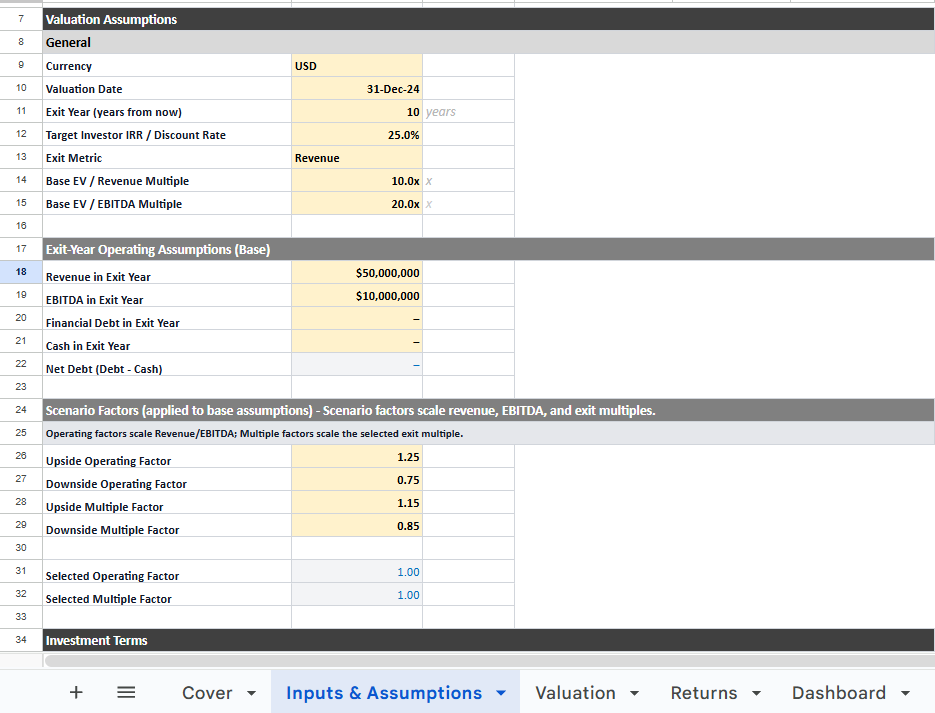
🟡 Inputs and Assumptions
You only edit the yellow cells.
Everything in blue is the engine that does the hard work for you.
The inputs are structured the way an investor thinks, not the way founders usually present their numbers. Each section captures a piece of the equation that determines whether your round is fundable:
Valuation assumptions set the baseline for how you price the company today
Exit year and multiples define the long term outcome an investor is underwriting
Revenue and EBITDA at exit map the scale you need to reach for the maths to work
Expected dilution adjusts the model to reflect the reality of future rounds
Optional preferred terms show how structure can shift returns even when valuation does not
Scenario factors let you stress test outcomes with one change rather than rebuilding a model
The result is an input page that forces clarity. If you fill in the yellow cells honestly, the model tells you exactly what an investor will see.
📈 Dashboard
This is the investor view.
The quiet calculation that decides whether you get a term sheet or a polite no.
Instead of simply listing metrics, this dashboard shows you how an investor thinks through your company:
IRR tells them if the return profile justifies the risk.
MOIC shows the total value they can extract from their cheque.
Holding period anchors the timeline and signals how long capital is committed.
Exit enterprise value and exit equity value reveal what the business must be worth for the maths to work.
Ownership today and ownership at exit highlight dilution, trajectory, and whether your cap table supports meaningful upside.
Required ownership shows the stake an investor needs to hit their return target.
Implied valuation today shows the price your current metrics justify rather than the price you hope for.
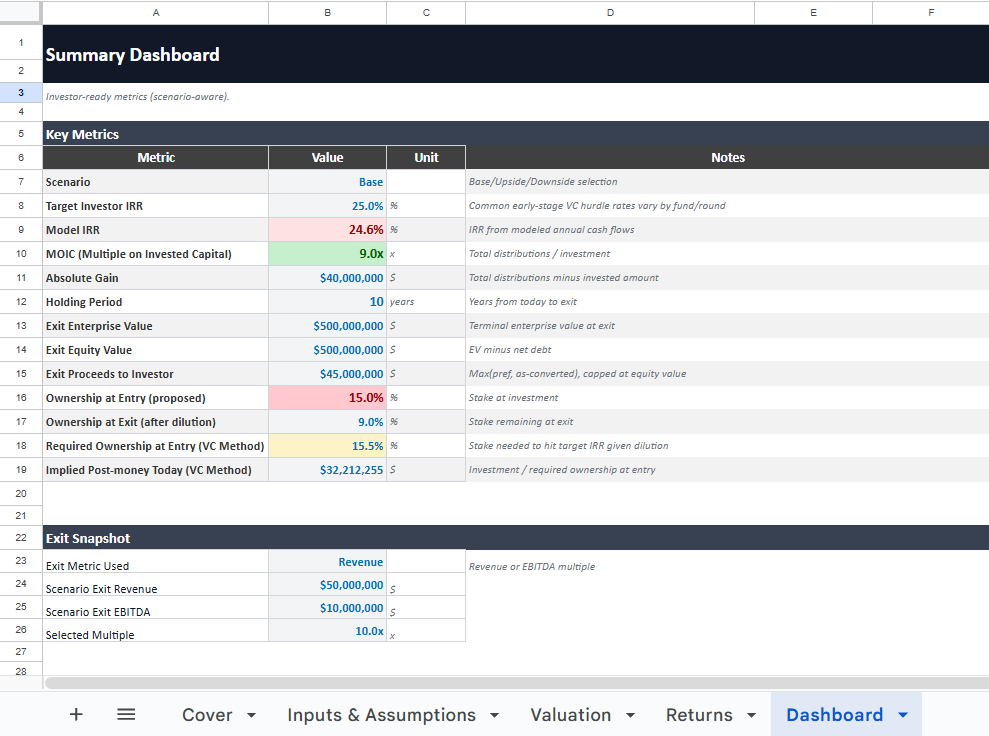
Key metrics turn green when they meet investor thresholds and red when they do not.
You end up with a snapshot that is easy to read and impossible to misinterpret.
🧠 What the Venture Capital Method Actually Is
The Venture Capital Method starts from a simple truth.
Early stage companies cannot be valued the way mature companies can.
There is no reliable EBITDA.
No cash flow.
No forecast anyone believes.
So investors flip the question.
Instead of asking:
“What is this startup worth today?”
They ask:
“What could this company be worth at exit and what return do I need to justify investing today?”
Then they reverse engineer your valuation from that future point.
The method unfolds in six clear steps.
🟦 Step 1: Estimate Your Exit Value
Investors choose a realistic exit year and apply a multiple to a metric that can scale over time.
Typically:
Revenue at exit multiplied by an exit multiple
Or EBITDA at exit multiplied by an EBITDA multiple
Example:
Exit revenue: $40M
Revenue multiple: 5
Exit Value = $40M * 5 = $200M
This becomes the anchor for everything that follows.
🟦 Step 2: Calculate the Return the Investor Needs
Every fund has a return target.
It often looks like:
25% to 40% IRR
Holding period of 7 to 10 years
That target determines how much their investment must grow.
Example with a 30% IRR over 8 years:
Required Future Value = $5M * (1.3)^8 = $43M
If they invest $5M, they must receive $43M at exit.
🟦 Step 3: Convert Required Return into Required Ownership
If the company exits for $200M and the investor needs $43M:
Required Ownership = $43M / $200M = 21.5%
This is the real number investors anchor on.
Not pre money.
Not post money.
Ownership.
🟦 Step 4: Convert Required Ownership into Today’s Valuation
If the investor needs 21.5% ownership and is investing $5M:
Post Money = $5M / 0.215 = $23.3M
Pre Money = $23.3M − $5M = $18.3M
This is the valuation that satisfies the return requirement.
If you ask for a $35M post money instead of $23.3M, the investor cannot accept it because the math no longer hits their targets.
🟦 Step 5: Adjust for Dilution Over Future Rounds
This is where founders get caught out.
Even if an investor enters at 21.5%, dilution erodes that stake over time.
Example with 40% cumulative dilution:
Exit Ownership = 21.5% * (1 - 0.4) = 12.9%
But if they need 20% at exit:
Entry Ownership = 20% / (1 - 0.4) = 33.3%
This is why investors sometimes ask for more ownership than founders expect. They are pricing future dilution in advance.
🟦 Step 6: Check IRR, MOIC, and Holding Period
Once ownership is set, investors test:
Does the IRR exceed their hurdle
Does the MOIC make sense for the stage
Does the holding period kill the return
If these line up, the valuation works.
If not, the deal breaks.
🔥 Two Concepts That Change How Founders Think
These are the pieces that founders rarely understand and investors never say out loud.
Time to Exit Drives Valuation More Than Anything Else
Change the exit year by two or three years and the valuation can double or collapse.
This single variable creates most valuation disagreements.
Investors Negotiate Ownership, Not Valuation
You can debate the story, the momentum, the traction.
But if the investor needs 20% to hit their return target, no argument will convince them to take 10%.
Understanding this changes the entire dynamic of a negotiation.
🛠️ Why This Template Matters
Most founders raise on story.
Investors commit on numbers.
This template gives you the same analytical lens investors use when they decide whether your round makes sense. It shows you the real drivers of a fundable raise:
how your ownership evolves from today to exit
what return profile your company actually produces
what valuation your metrics can justify right now
how dilution compounds over time
what an investor must believe to write the cheque
where your story matches the numbers and where it breaks
It turns fundraising from a negotiation based on hope into a conversation grounded in outcomes.
When you understand this system, you walk into investor meetings with clarity, confidence and a valuation that stands up to scrutiny.
⭐ Want the Template?
The VC Method calculator is fully editable and built for Excel.
Enter your revenue targets, round sizes, and dilution assumptions, and it shows you the valuation logic investors apply long before they react to your narrative.
The VC Method calculator is available exclusively to paid subscribers of The Founders Corner.
It sits inside a growing library designed to help founders raise with clarity, avoid preventable dilution, and understand how investors think when the spreadsheet opens. As a member, you’ll get:
✅ The Term Sheet Walkthrough
A clear breakdown of what investors look for and why certain clauses matter more than others
✅ Cap Table OS
A complete cap table modelling system covering dilution, SAFEs, ESOP, and exit outcomes
✅ The Cold Email That Changes Everything
Breakdowns of the outreach structures that get real responses today
✅ The 30 Second Pitch Test
A fast filter that shows you whether investors can grasp the essence of your business before they’ve even blinked.
✅ Funding Milestone Navigator
Stage by stage expectations so you know what investors want to see next
…plus new templates, deep dives, and practical playbooks released every week.
If you’re serious about landing the round you want, this is the clarity that gets you there.