

There’s a moment every founder secretly imagines:
You send a cold email, not to a random angel, but to someone like Mark Cuban, and instead of silence, you get:
“Let’s get it done.”

Most founders assume this never happens. Too busy. Too famous. Too many pitches.
But the truth, across 500+ founders I’ve worked with, is that cold outreach works far more often than people think.
What doesn’t work is bad cold outreach.
Today we’re going to break down exactly how elite founders craft cold messages that get replies… and then examine one of the clearest real-world examples: the cold email sequence that got Mark Cuban to lean in.
Brought to you by Deel: Hire Faster, Grow Smarter
Global teams used to be a nightmare.
Sixteen different tools.
Compliance panic.
Payroll that broke every time you hired outside your postcode.
Deel flipped that. It became the first global HR platform built to hire, manage, and pay anyone - contractors, employees, or entire remote teams - without founders drowning in admin.
And the numbers back it.
15,000+ companies trust it.
Founders move faster. Compliance gets solved. Teams onboard anywhere in the world in minutes.
Here is the real insight.
Founders are not choosing Deel because it is HR.
They choose it because it removes everything that slows down execution, something its competitors still struggle with.
👉 Book a call with the team here
Table of Contents
🧠 How Your Email Actually Lands in a VC’s Brain
🧭 The Four Ways Founders Actually Reach Investors
❌ When You Should Not Be Cold DMing Investors
🔎 A Real Case Study: The Cold Outreach That Closed Mark Cuban
⭐ The Structure of a Top One Percent Cold Email
⚡ A Proven Cold Email Format
🧩 Follow Ups That Actually Work
🎯 The Emotional Layer Investors Never Say Out Loud
🚀 How to Apply This to Your Own Fundraise
✨ Final Thought
🧠 How Your Email Actually Lands in a VC’s Brain
Let’s start in my inbox, not yours.
By the time I see your cold email:
I’ve probably already had 8–10 meetings that day.
I’m behind on portfolio fires, IC prep, and a board pack.
I’m scanning my inbox in short, slightly caffeinated bursts, looking for signal.
What I don’t have:
The patience for six paragraphs of “hope you’re well” and “we’re passionate about changing the world”.
The context that your deck has been rewritten 20 times and your numbers represent years of sweat.

A clear reminder of the cold emails investors actually answer.
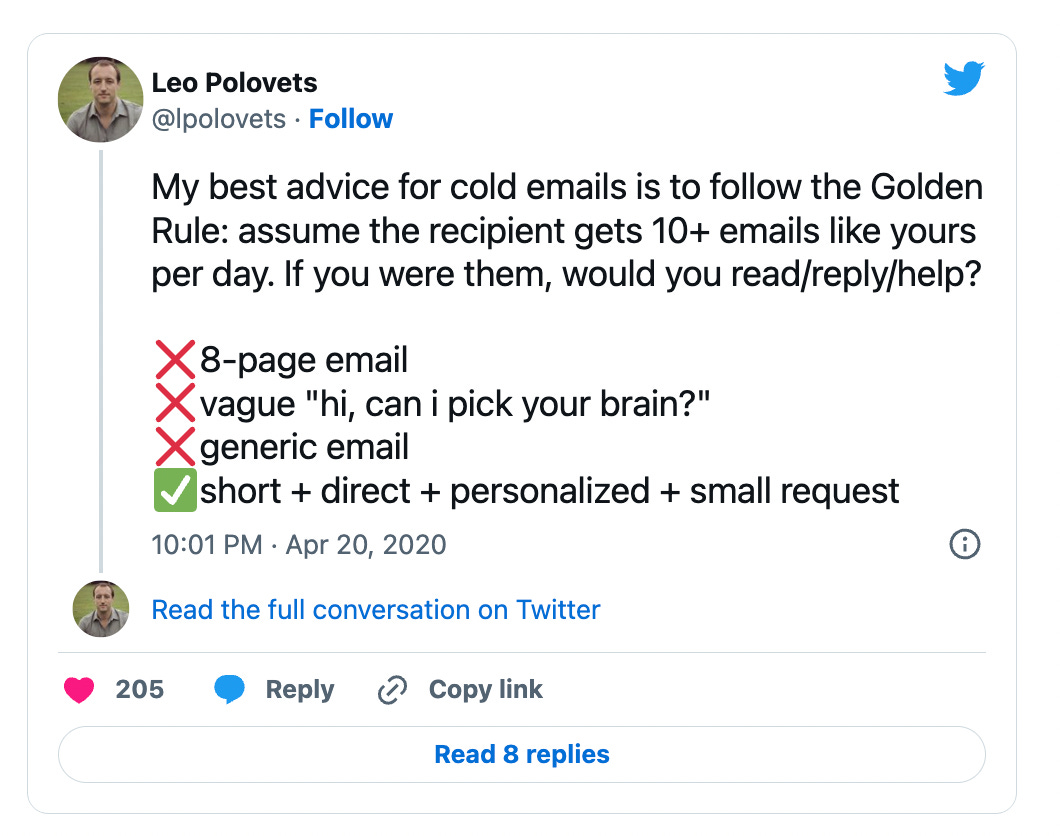
I see a subject line, a preview line, and the first two sentences. That’s it.
From there, the mental decision tree is brutally simple:
“Relevant to what I invest in?”
“Is there any evidence this is real?”
“Is the ask clear?”
If you clear those three hurdles, I’ll read the rest.
If you don’t, I’m closing the tab and moving on.

When founders say “VCs don’t reply to cold emails”, what they usually mean is:
“VCs don’t reply to unresearched, bloated, or indistinguishable emails.”
The good ones get replies. Always have. Still do.
🧭 The Four Ways Founders Actually Reach Investors
There are only four doors into a fund. Cold DMs are one of them, not a second-class citizen.
1. Warm Introductions
The classic route.
A partner at a fund hears about you from:
A founder they’ve already backed.
An operator they trust.
An angel whose judgment they respect.
Warm intros are powerful because the filtering has been outsourced. Someone has already burned social capital to say: “This one is worth your time.”
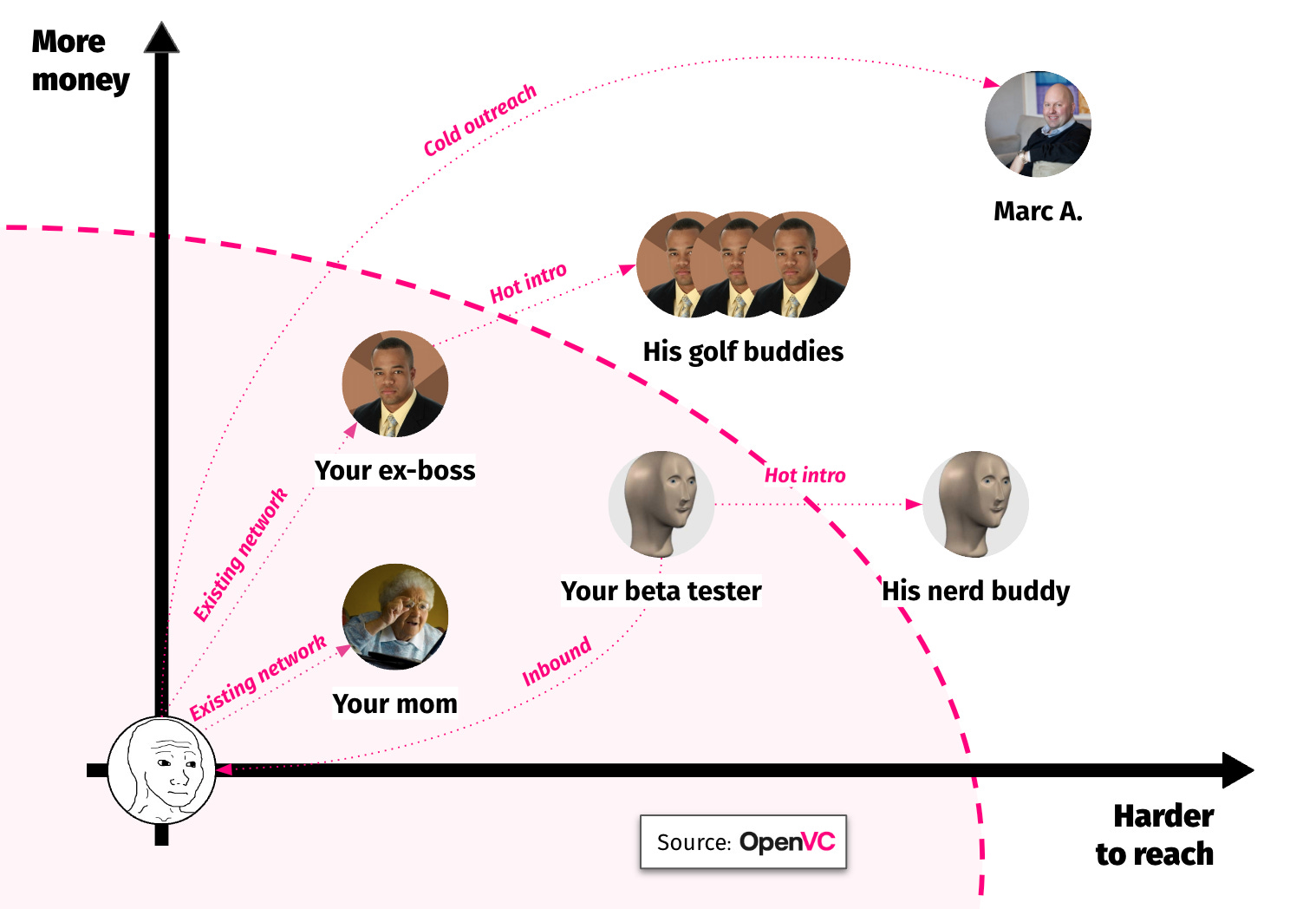
The problem: if you don’t already live inside that network, you’re stuck.
2. Backchannel Networks
Softer than a formal intro, but still warmer than a cold email.
This might be:
An LP mentioning you at a dinner.
A scout sending a WhatsApp.
A co-investor forwarding your deck with a one-liner: “Smart team, worth a look.”
It doesn’t hit the CRM as a “warm intro”, but in the partner’s mind it is.
3. Public Presence
You ship a product.
You write about a painful industry problem.
You show your work in public.
Over time, investors start recognising your name. When your email lands, it’s no longer truly “cold”. There’s already a trace of familiarity.
This is the compounding advantage of:
Posting regularly where investors lurk (LinkedIn, X, niche Slacks).
Writing founder-grade breakdowns of your market, not motivational fluff.
It turns a future cold email into a warm reminder.
4. The Cold DM
The democratiser.
A founder with no network, no famous angels, and no board slides can still land in the same inbox as a Series C unicorn CEO.

Is it harder? Of course.
But the gap between “harder” and “impossible” is where the opportunity is.
The key is this: a cold DM is not an inferior channel. It’s a different skill.
❌ When You Should Not Be Cold DMing Investors
Here’s where I’m going to be blunt.
There are situations where you’re wasting your time emailing VCs — warm or cold.
1. The Business Isn’t VC-Fundable
This doesn’t mean it’s a bad business. It just means it doesn’t match the fund’s model.
Red flags from a VC lens:
Tiny market that caps out at a few million in profit.
Heavy capex, low margin, slow scaling.
Complex, messy legal structure.
A broken cap table where founders already own too little.
If you’re building a fantastic, cash-flowing local business: brilliant. But don’t burn cycles pitching people who are structurally incapable of saying yes.
2. You Have No Proof of Execution At All
Pre-product, pre-customer, pre-anything?
You can sometimes raise at pre-seed on narrative and founder background alone — but it’s rare, and cold email is the wrong tool for that job.
At a minimum, you want one of:
A working product.
A waitlist that isn’t just your friends.
Early revenue.
Evidence of deep founder-market fit.
Otherwise you’re asking an investor to buy a story with no spine.
3. You Haven’t Done the Work on Targeting
If you’re emailing:
Consumer fintech funds with deeptech hardware.
Late-stage growth funds for a pre-product idea.
“AI-focused” funds with a Web3 marketplace.
You’re telling the investor: “I haven’t done even the most basic research.”
Targeting is half the battle.
🔎 A Real Case Study: The Cold Outreach That Closed Mark Cuban
Picture this.
You are an artificial intelligence founder building a research and monitoring tool for public relations and government affairs teams. You have bootstrapped. You have early revenue and real customers. You have raised a competitive seed. And you still want the strategic partner who meaningfully elevates your company.
Most founders hesitate at this point.
This founder did not.
Adam Joseph, founder of Clipbook, wrote directly to Mark Cuban, then followed up with clarity, speed, and expert level precision.
What unfolded is one of the cleanest examples of world class cold outreach I have seen.
It reveals:
• what a top tier investor questions first
• how a founder should respond
• how conviction builds across a thread
This part is worth studying with care.
Read the exchange below, then study the cold email template that follows it.
It is the exact version I have watched founders use to turn cold outreach into real conversations with investors who rarely reply to anyone.