

Every seed founder asks the same question eventually.
How much revenue do we need for a Series A?
They search. One blog says $1M to $2M. Another says a $3M median. An investor says $2M to $3M, sometimes $4M.
Then they read the round announcements.
$10M of revenue in ten months. A $100M run-rate in fifteen. $240M.
Then they read X.
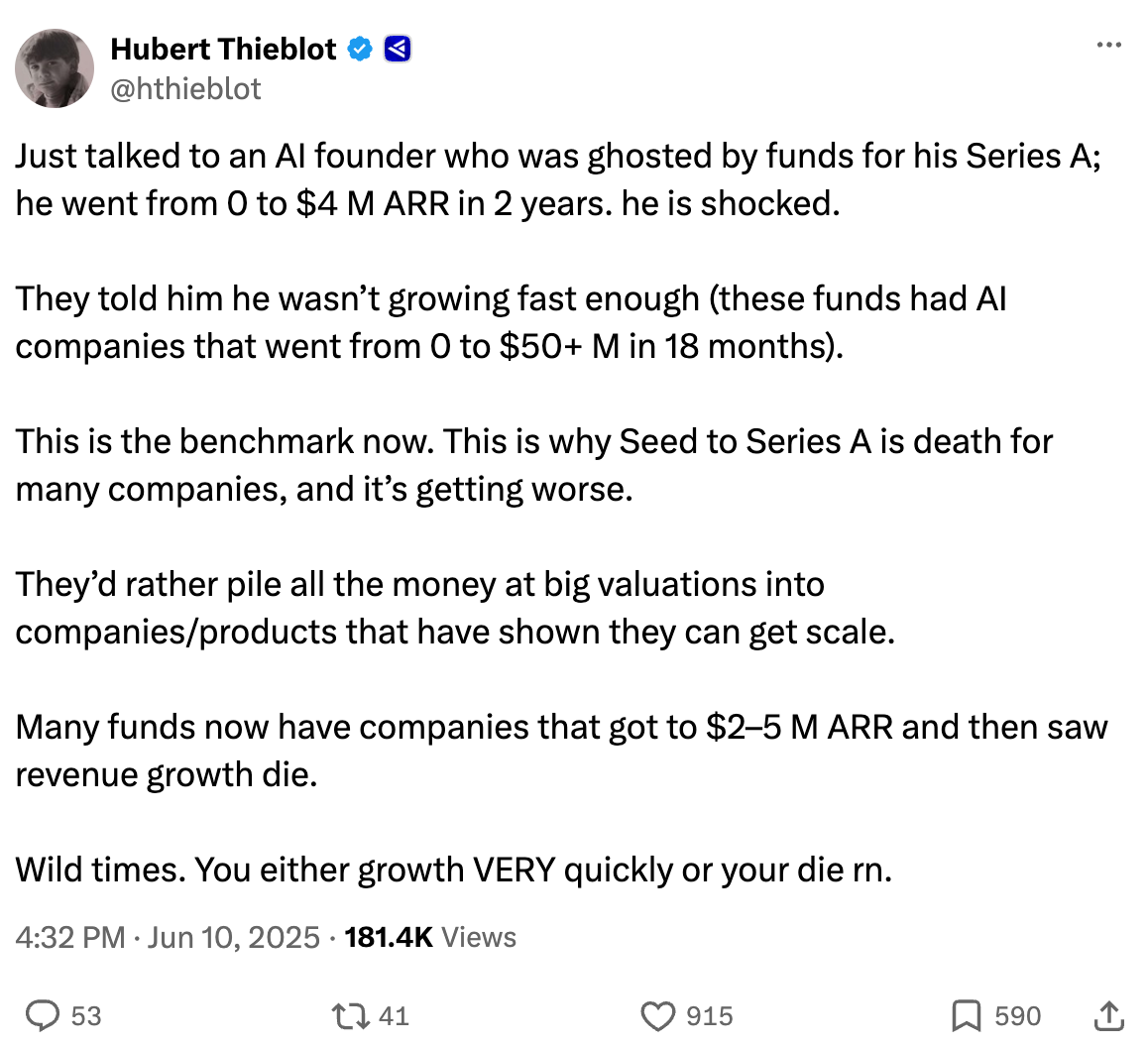
And they decide they’re nowhere near.
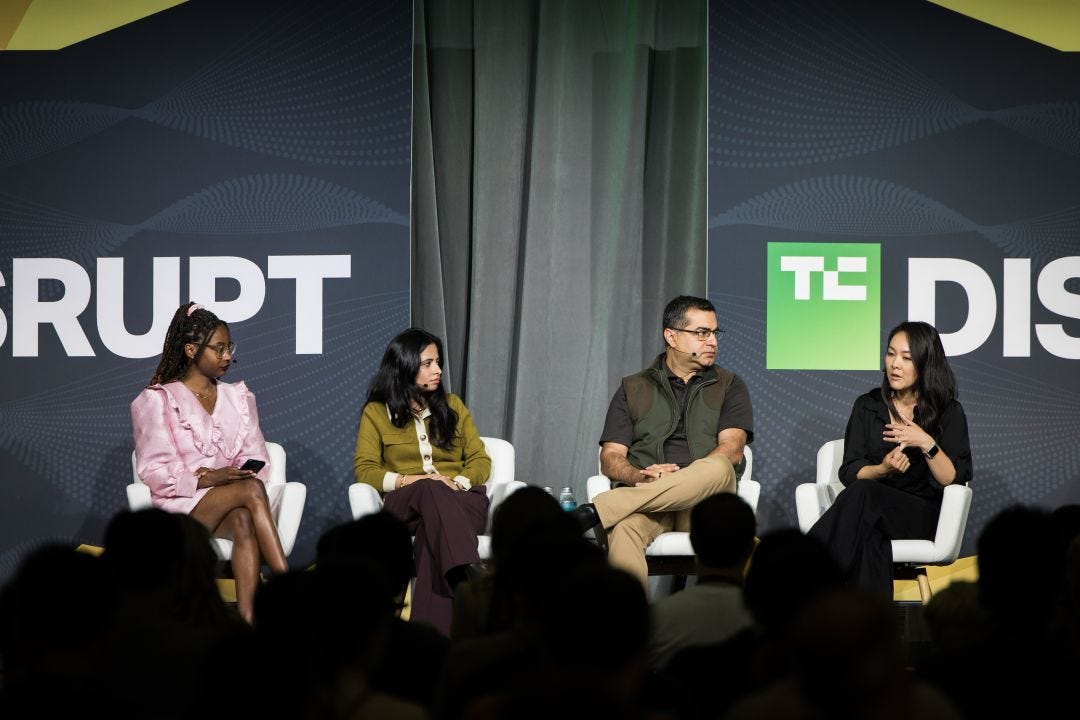
On that stage, Singh put it bluntly: “Seed and venture, I’ve never seen it as dysfunctional as it is now.”
The Series A bar is the number founders need most and the market publishes least.
So we logged 324 Series A rounds announced in 2026 across the US, Europe, India and Southeast Asia, plus every round we could find where the company published its revenue.
Brought to you by Omnisend
Black Friday is in 2 days. This could make your weekend.
Your customers want to buy. That’s never really been the problem.
They open your email, they like the offer, they add to cart. Then they hesitate. “I’ll come back later.”
And most of them don’t.
“Later” costs ecommerce brands a fortune every Black Friday, and this week you’ll hear it more than ever.
A bigger discount won’t fix it. A deadline they can actually see will.
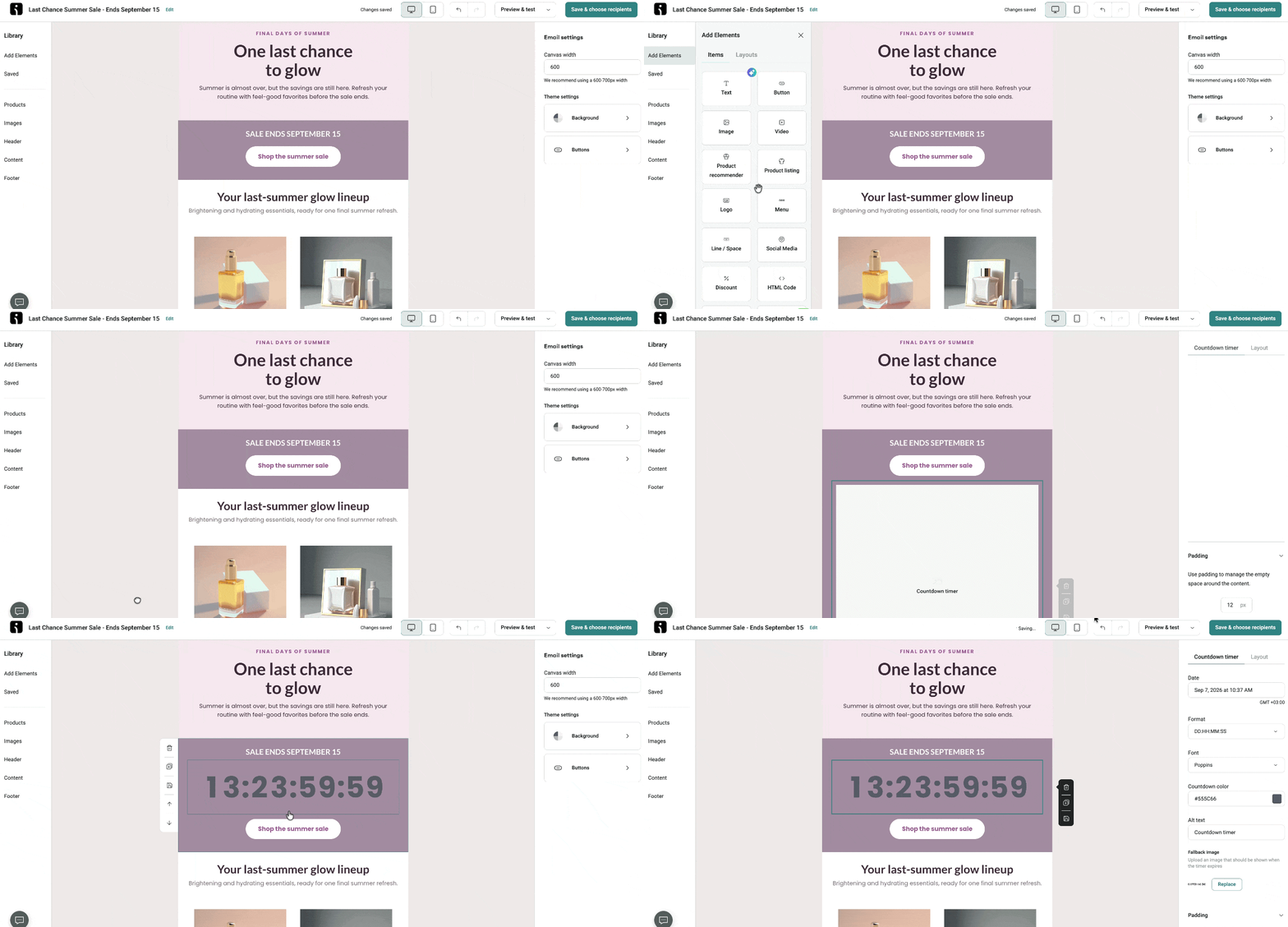
That’s what the Omnisend email countdown timer does. It’s a live clock, built right into the email builder, ticking down every second of your offer inside your customer’s inbox.
00:14:32:09... 00:14:32:08... 00:14:32:07...
Hard to say “later” to that.
Tick. Tock. Sold.
🚀 People can see the deadline. Every other brand will write “ends soon.” Yours will show exactly how soon.
🛒 More “maybe”s turn into orders. When the clock’s running down in front of them, today starts to feel like the day.
🔁 It keeps working while you sleep. Add it to your campaigns and automation workflows, and every time-sensitive email carries the deadline for you.
🎨 It looks like your brand. Your fonts, your colours, days down to seconds, or just minutes and seconds for the last push.
💸 No extra tools, no extra cost. No third-party timer app, no HTML, nothing new on the bill.
Drag it in, set the end date, send yourself a test. You’ll be live in a few minutes.
This week your competitors will keep making “HURRY!!!” bigger and redder.
You’ll add a clock.
Live now on Omnisend’s Standard and Pro plans. You’ve still got five days.
👉 Add a countdown timer to your Black Friday emails
Three in 72 Gave You a Number
Start with the US. We took every Series A in Qubit Capital’s weekly round-ups from March to June 2026: 72 rounds, de-duplicated.
31 disclosed no traction at all. 27 gave customers, users or volume. Six gave a growth multiple and nothing else.
Eight gave any revenue figure. Three gave an exact one.
Those three were Mega ($10M of revenue in ten months), AfterQuery (a $100M-plus run-rate in fifteen months) and Runpod (about $240M).
This is what one of them looks like when it lands in your feed:
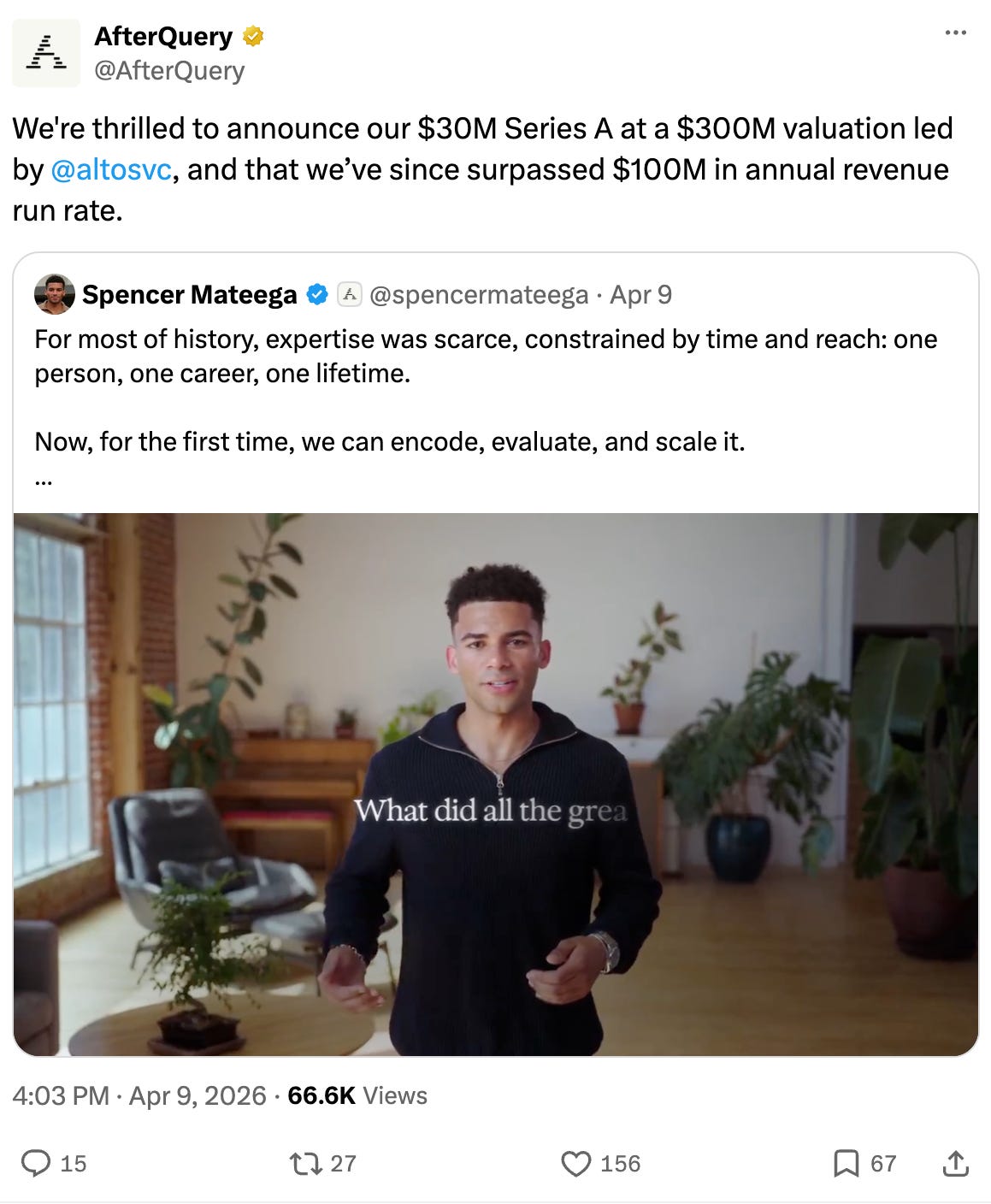
The rounds that publish revenue are the outliers. They publish because the number is extraordinary.
a16z’s Jennifer Li tells founders to be especially sceptical of spectacular ARR announced in a tweet. AfterQuery’s held up: five months later it was reportedly valued at $3.2B. It is also the exception your seed-stage company is being compared against.
Carta’s data shows how far out those rounds sit. In Q2 2026 the median Series A on Carta was valued at $84M post-money. The 95th percentile was $585M.
And an announcement is a marketing document before it is a data point. Some read like a festival poster.
The rest of our sample shows the market those rounds sit in. Median round: $27M. Nine of the 72 were $100M or more. 60% were AI-native.
Meet The Founders Corner Team
You know the email.
“Loved meeting you. Not quite right for us at this stage. Keep us posted.”
Translation: no. And no idea why.
Was it the traction? The deck? The valuation? You never find out.
This time you can ask.
Today, Wednesday 25 November at 4pm GMT, we’re hosting a live call for paid subscribers and free trialists. No camera-off webinar. You bring the problem, we dig into it with you.
Straight answers. Uncomfortable ones included.
🧭 Me. MessageLabs from tiny team to $700m exit, then co-founded Notion Capital. Operator and investor.
📣 Paul Watson. Sales won’t move? Paul works out who to sell to, what to say and how to make it repeatable.
💰 David Levine. CEO of Glenluna Ventures, Principal at Manchester Angels. Story, valuation, who to approach. Wonderfully blunt.
🛠 Your tools, actually opened. Investor readiness check, the 30-second deck test, and the filter across 2,500+ investors.
Three experts on your problem would normally take three intros and a lot of diary juggling. Here, it comes with your subscription.
Places are limited. Another call on 10 December.
👉 Start your 7-day free trial and the invite is yours. Book your place:
The Same Revenue Buys Two Different Rounds
Outside the US, more revenue figures surface, many of them through Indian regulatory filings. Across seven regions we found 27 Series A rounds from 2026 where the company’s revenue was public.
Divide the round by the revenue:
Series A size ÷ revenue at the raise
AI-native, median: 2.1x. In rounds under $100M, 3.55x.
Everyone else, median: 1.15x.
Bengaluru’s Runable raised $21M on $2M of ARR. Pluto Security raised $34M on $2M.
India’s Escape Plan raised $25M on a run-rate of about $34M. Malaysia’s Aonic raised $10M on more than $60M of annual revenue.
It’s a small, self-selected sample, and revenue bases differ: ARR, run-rate, trailing year. Read it as how the two markets price revenue. It won’t price your round.
Carta’s software rounds show the same split from a much larger base. The median AI Series A raised $15.0M at $89.2M post-money. The median non-AI Series A raised $9.8M at $53.2M.
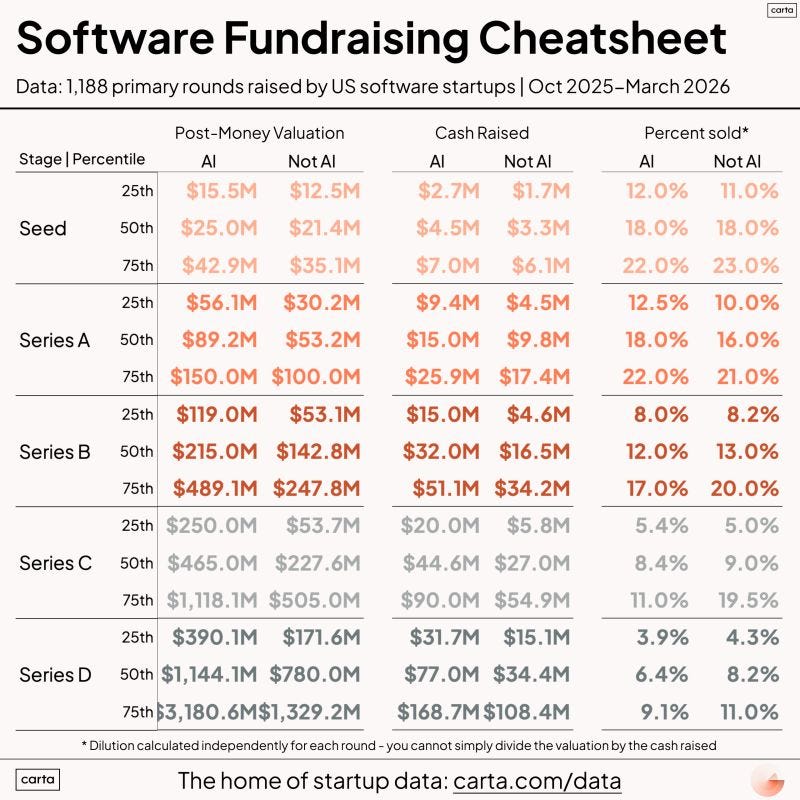
In our sample, an AI-native company raised nearly twice as much per dollar of revenue as everyone else. Under $100M, about three times as much.
Fewer Companies Are Getting Across
The data providers agree on direction, on both sides of the Atlantic.
US. Of companies that raised a $1M-plus seed in 2024, 16% have moved past seed. Through 2020 the figure was 55% or higher. US Series A deals fell to 272 in Q3, from 377 a year earlier.
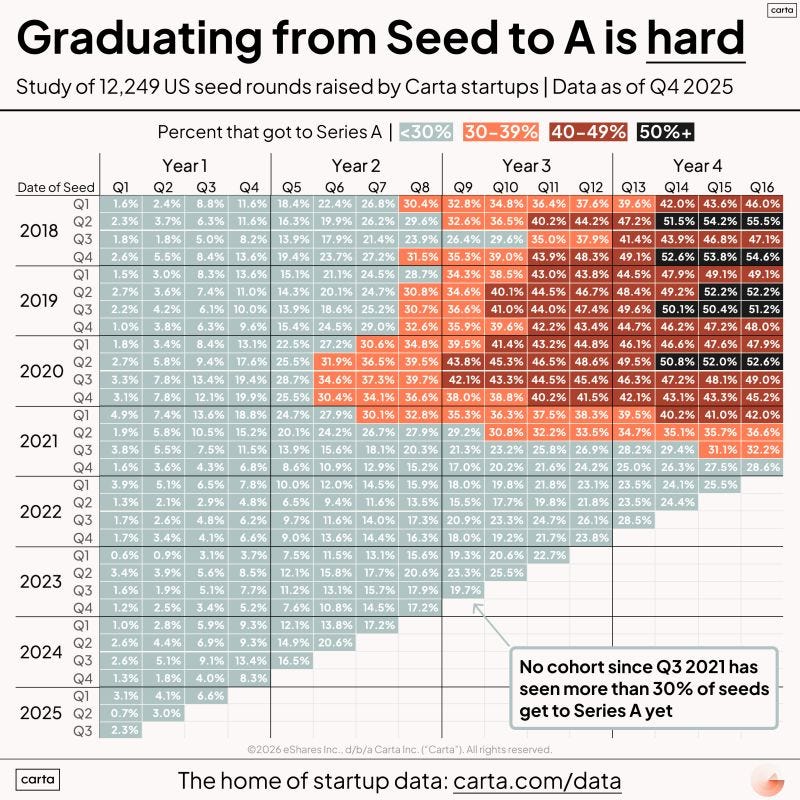
Carta’s cohort table tells the same story quarter by quarter. Across 12,249 US seed rounds, no cohort since Q3 2021 has seen more than 30% of its companies reach Series A.
Europe. Antler’s European Founder Report puts seed-to-Series A conversion at 23.3% for 2008 to 2019, 13.1% for 2022 and 9.3% for 2023. Series A deals are down 45% since 2021. The number of Series A investors is down 44.7%.
Terms. Carta’s Q3 data, says about one in three US Series A rounds in 2026 was a bridge. The median gap from seed to Series A was 664 days. Participating preferred appeared in more than 10% of Q3 rounds, a six-year high.
The bar most investors describe is lower than the headlines suggest. Uncork Capital’s Andy McLoughlin puts it at $2M to $3M of ARR, sometimes $4M.
That number comes with a growth rate attached. Thieblot’s founder had $4M and was turned away for pace, not size. Uncork’s Susan Liu, writing about her seed companies’ recent Series A raises, says she regularly sees companies go from zero to $3M to $5M of ARR in a single year, and that this is roughly what it now takes.
The bar investors describe is $2M to $4M, reached fast. The bar in the headlines is $10M and up. Plan to the first.
Our Most-Read Articles Right Now
📈 How Investors Decide If You Are Ready to Raise, in Under 5 Minutes Score how fundable you are at your target round, then fix the gaps in order.
🔥 The Number That Kills More Fundraises Than Any Bad Idea Why your market size slide costs you second meetings, and the bottom-up fix.
📈 The 300+ AI Investors Actually Worth Your Time 305 AI investors with cheque sizes, theses and how to reach them.
🔥 The Most Dangerous Document a Founder Will Ever Sign The term sheet clauses that matter more than valuation, now participating preferred is back.
The Seed Decision That Changes Your Odds 4.5x
Dealroom studied about 800 seed investors active in EMEA, using seed rounds from 2015 to 2021.
Their portfolio companies’ chance of a Series A within 36 months:
Top 5% of seed investors: 63%.
Top 25%: 58%.
Middle: 42% and 29%.
Bottom quartile: 14%.
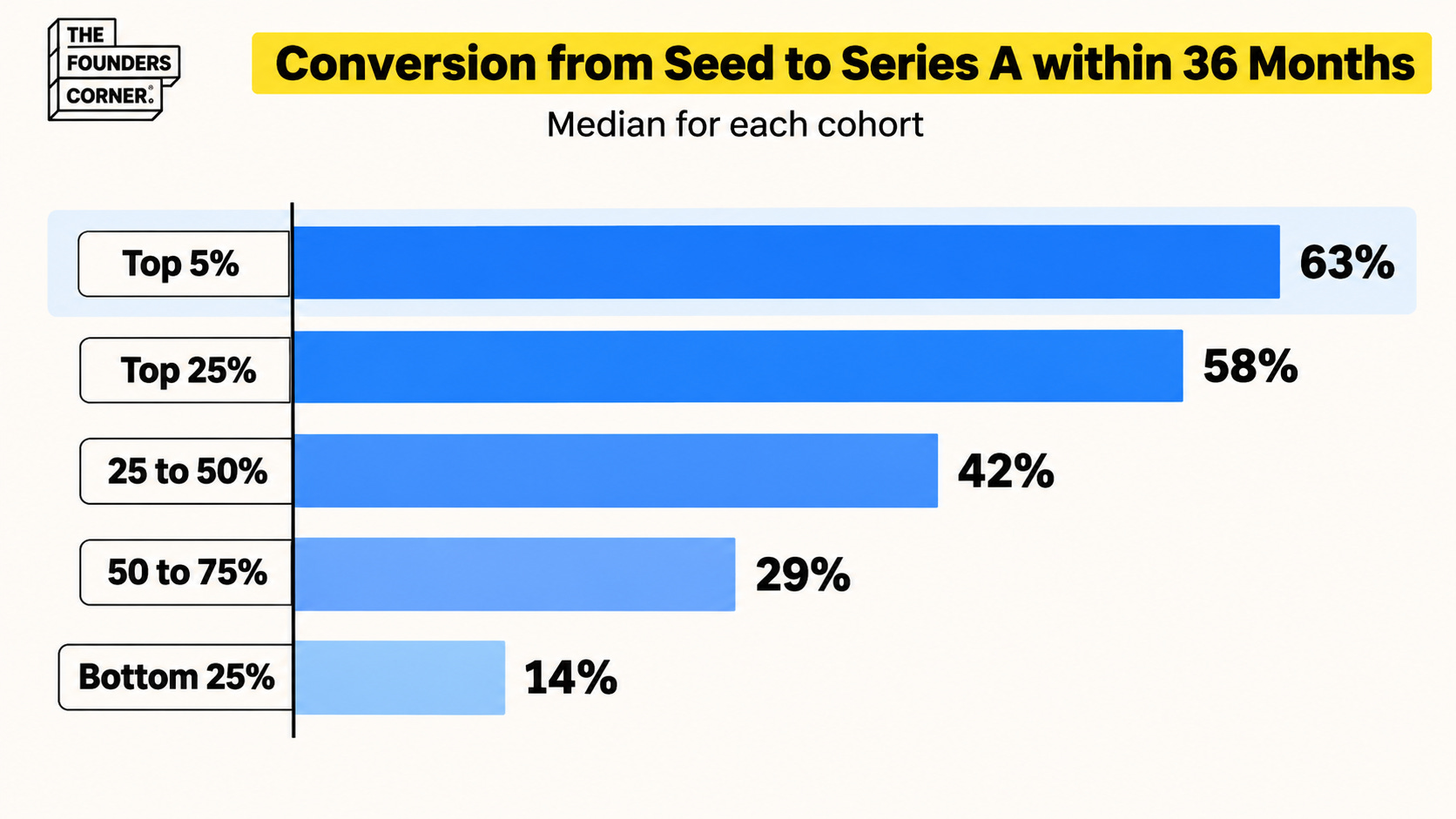
Companies backed by the top 5% got there in 17 months instead of 24, and their median Series A was $13M against $6M.
Part of this is selection: the best seed funds see the best companies. Some of it is access. For the top cohort’s companies, 91% of follow-on capital came in rounds led or co-led by a top Series A investor. For the bottom cohort, none did.
Some seed funds will tell you their number before you ask. The internet has opinions about that.
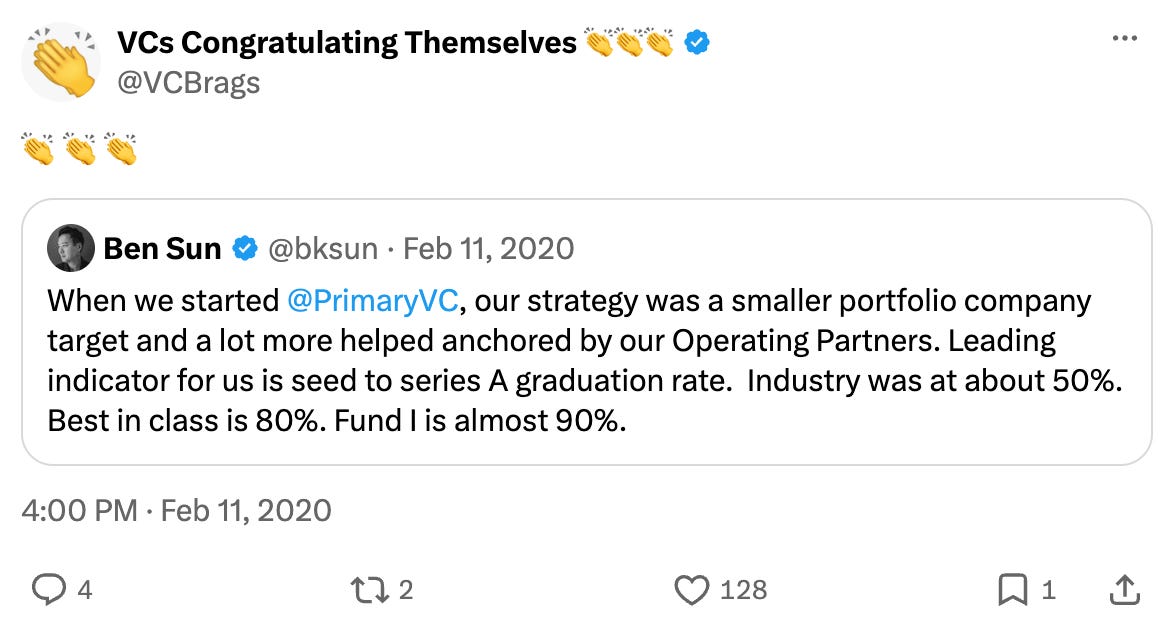
Primary’s figure may well be right. The useful question is the one underneath it: which cohort, and over what window?
The other lever is the size of the seed. Marc Schröder of MGV argues it should get you to the bar with about six months to spare, and that a smaller seed can be the better deal.
Run the timeline before you raise:
Months to the bar = ln(target ARR ÷ ARR today) ÷ ln(1 + monthly growth)
At $900K of ARR growing 8% a month, $3M takes 15.6 months. With $2.4M in the bank and $160K of monthly burn, the money lasts 15.
That company reaches the bar after the cash runs out.
Carta’s Peter Walker is blunt about the fallback: planning to raise a bridge is not a plan. His own data gives bridges a fair hearing. In the seed cohorts from the last three quarters of 2024, bridged companies reached Series A more often, which he puts down to investors pre-empting strong companies.
“Founders benchmark against the rounds that publish revenue. Those are the rounds built to impress.”
Before You Raise the Extension
Founders benchmark against headlines.
They assume the bar is $10M because that’s what got published.
They pick a seed lead on price and never ask how many of its companies reached a Series A.
They plan the bridge before they plan the growth.
The fix: plan to the $2M to $4M bar, check that months-to-bar fits inside your runway minus six, and ask your seed lead for its Series A conversion rate before you sign.
Do it before your next board meeting.
The file is waiting below.
The Series A Ledger 2026: 324 Rounds
Exactly what you’re downloading:
Runway to the Bar. Enter ARR, growth, cash and burn. Returns months to your target ARR, months of runway, months to spare, the growth you’d need and the burn you can afford.
Revenue vs Round. The 27 rounds from 2026 that published revenue, with round ÷ revenue for each and live medians for AI-native and everyone else. Enter your revenue to see the round each market would price.
US Series A, March to June. 72 rounds with amount, lead, sector, AI flag and exactly what traction each announcement disclosed.
Europe and Asia Series A. 252 rounds: 199 in Europe from January to November, 45 in India, 8 in Southeast Asia.
Lead Index. 45 investors ranked by Series A rounds led in the ledger, with live counts.
Market Benchmarks. 18 figures from Carta, Crunchbase, Antler, Dealroom and KPMG, each with its source.
Run your timeline first, then filter the round tables to your sector and region and see who leads.
Paid subscribers also get:
60+ additional tools across every stage of fundraising and company building: investor research, pitch deck screening, meeting prep, term sheet analysis, financial models, and the full investor database library.
Download Below
Start your 7-day free trial → Cancel anytime.