

Most founders raising an AI round build their investor list the same way.
They Google “top AI VCs 2026.”
They look at who funded their competitors.
They find a PDF from two years ago on someone’s Substack.
The result is a list of 80 funds, no individual names, and zero understanding of whether the people inside those funds would actually care about what they’re building.
Then they send 80 cold emails to generic inboxes.
Three responses. One polite no. One form rejection. One silence.
The problem isn’t the pitch. The problem is targeting.
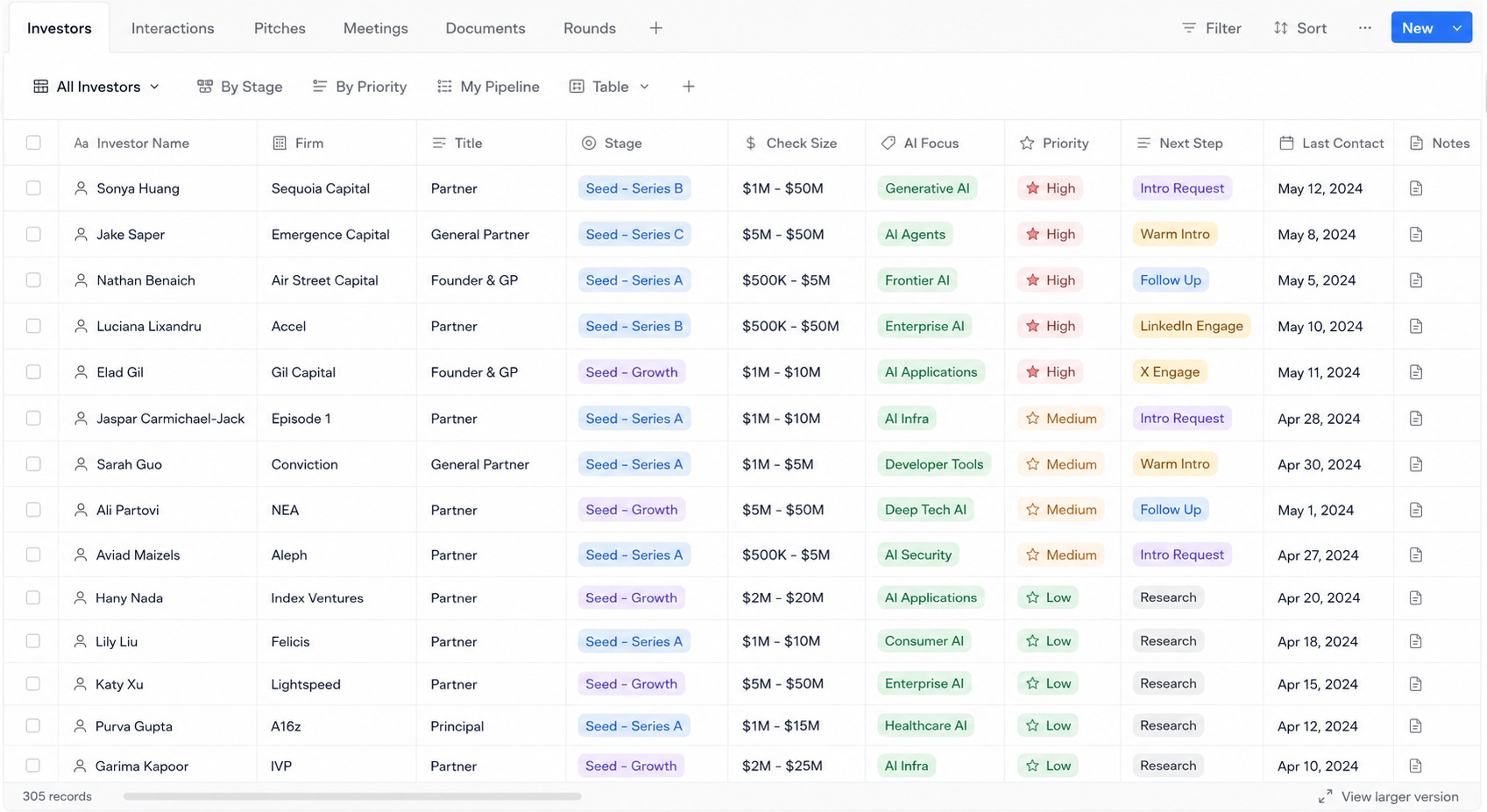
We’ve spent weeks fixing that. The result is a database of 305 individual AI investors - not funds, not firms, but the actual human beings who write the cheques and make the decisions. Names, titles, LinkedIn URLs, real investment theses, warm intro playbooks, and check sizes.
The full downloadable spreadsheet is for Premium subscribers. More on that below.
Why the Fund-Level List Doesn’t Work
Venture is not a monolith.
A16z has 17 general partners. Each one has a distinct thesis, distinct portfolio patterns, and distinct ways of getting their attention.
Marc Andreessen cares about AI as a civilisational technology. Very public about this on X. His thesis: AI as the defining technology of our era, backing companies building the AI stack from chips to applications.
Katherine Boyle has built her entire franchise around American Dynamism. She backs defence-adjacent AI, government AI, and national security AI. Completely different thesis.
Vineeta Agarwala leads a16z Bio and has an MD. Her first question will be about your clinical validation pathway.
Three people. Same building. Completely different answers to the same pitch.
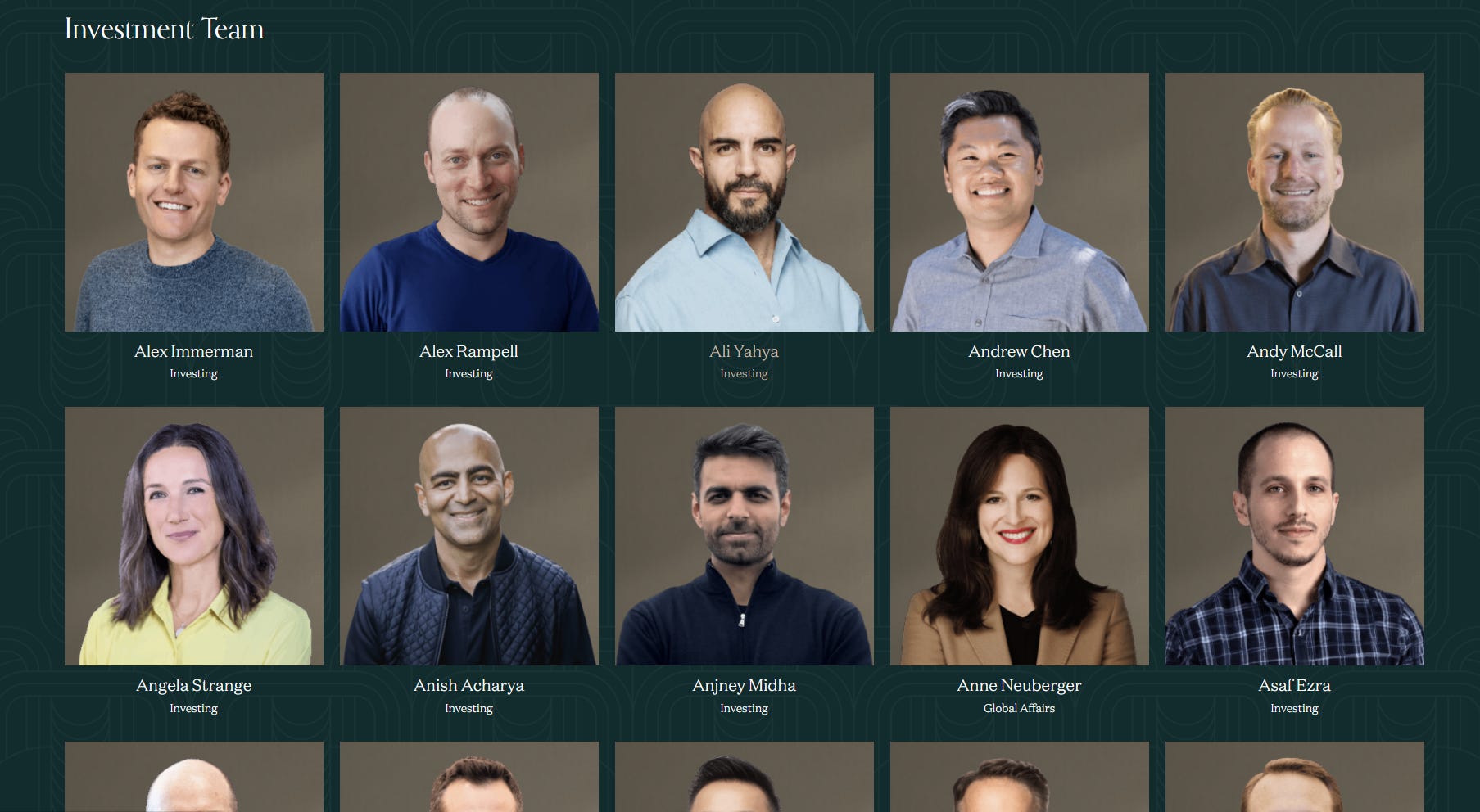
You need to know which one you’re talking to, and why they should care, before you send a single email.
How We Built This Database
Every entry is researched from primary sources.
Not scraped from Crunchbase. Not copied from a listicle. Not estimated from fund websites.
For each investor, we went to:
Their blog posts and essays
Podcast appearances (No Priors, 20VC, All-In, Invest Like the Best)
Their X/Twitter threads
Their portfolio and the pattern behind it
Their public talks and interviews
Where investors have explicitly articulated their frameworks, we built those in. Where they haven’t, we reverse-engineered them from their last ten investments.
The result is 305 profiles you can actually use.
What Each Profile Includes
Every entry gives you eight things:
1. Full Name + Title. Who they are and their seniority. GPs and MDs take first meetings. Associates pass up the chain. Always target GP-level for initial contact.
2. Stage + Check Size. Filter immediately. A growth investor at Series B won’t fund your seed round however good you are.
3. AI Focus Areas. Their sector sweet spot. Match before you pitch. If your focus isn’t in their list, find the overlap rather than ignoring it.
4. LinkedIn URL. Direct profile. Engage before you ask. Comment on their posts. Share their content with a genuine observation. Build a presence before you send the cold email.
5. Twitter / X Handle. Most active investors can be reached via a thoughtful, non-pitchy reply to a relevant post. We tell you who responds to this and who doesn’t.
6. Notable Investments. Their track record. Understand why they made each bet. Your company should rhyme with the pattern.
7. Warm Intro Tip. The most important field. Specific, actionable guidance for this particular investor. Not generic. Some respond to X engagement. Others are portfolio-intro only. Some have accelerator programmes that are the real entry point. We tell you which is which.
8. Investment Thesis. What they believe about the world. Open your outreach by referencing this belief and explaining why your company is the consequence of that belief being true.
A Taste of What’s Inside
Four profiles from across the database.
Sonya Huang, Partner at Sequoia Capital
Seed to Series B · $1M to $50M
Leads Sequoia’s generative AI thesis. Very active on X; thoughtful engagement works before a warm introduction. Thesis: AI-native products with 10x better UX than legacy software, companies where the category genuinely couldn’t have existed before.
Jake Saper, General Partner at Emergence Capital
Seed to Series C · $5M to $50M
Leads the AI Agents thesis at Emergence. Very vocal and accessible. DMs on X work well; one of the few GPs at a major fund where a direct, substantive message genuinely lands. Thesis: AI Agents replacing knowledge worker tasks is the new SaaS wave.
Nathan Benaich, Founder and GP at Air Street Capital
Seed to Series A · $500K to $5M
Publishes the annual State of AI Report; essential reading before you approach him. Cold DMs work if they’re substantive and reference his research. Thesis: AI research with commercial applications at the frontier of capability and deployment.
Luciana Lixandru, Partner at Accel
Seed to Series B · $500K to $50M · Europe
Leads European AI investing at Accel. Led Spotify’s Series F. Backs European AI companies with global category leadership potential. Engage with her content on LinkedIn; she is one of the most accessible senior partners in European VC.
Four completely different approaches to AI: generative consumer products, enterprise agents, research commercialisation, and European B2B. The database covers all of this, and the 301 other individuals operating across every stage, geography, and sub-sector.
The Geography Breakdown
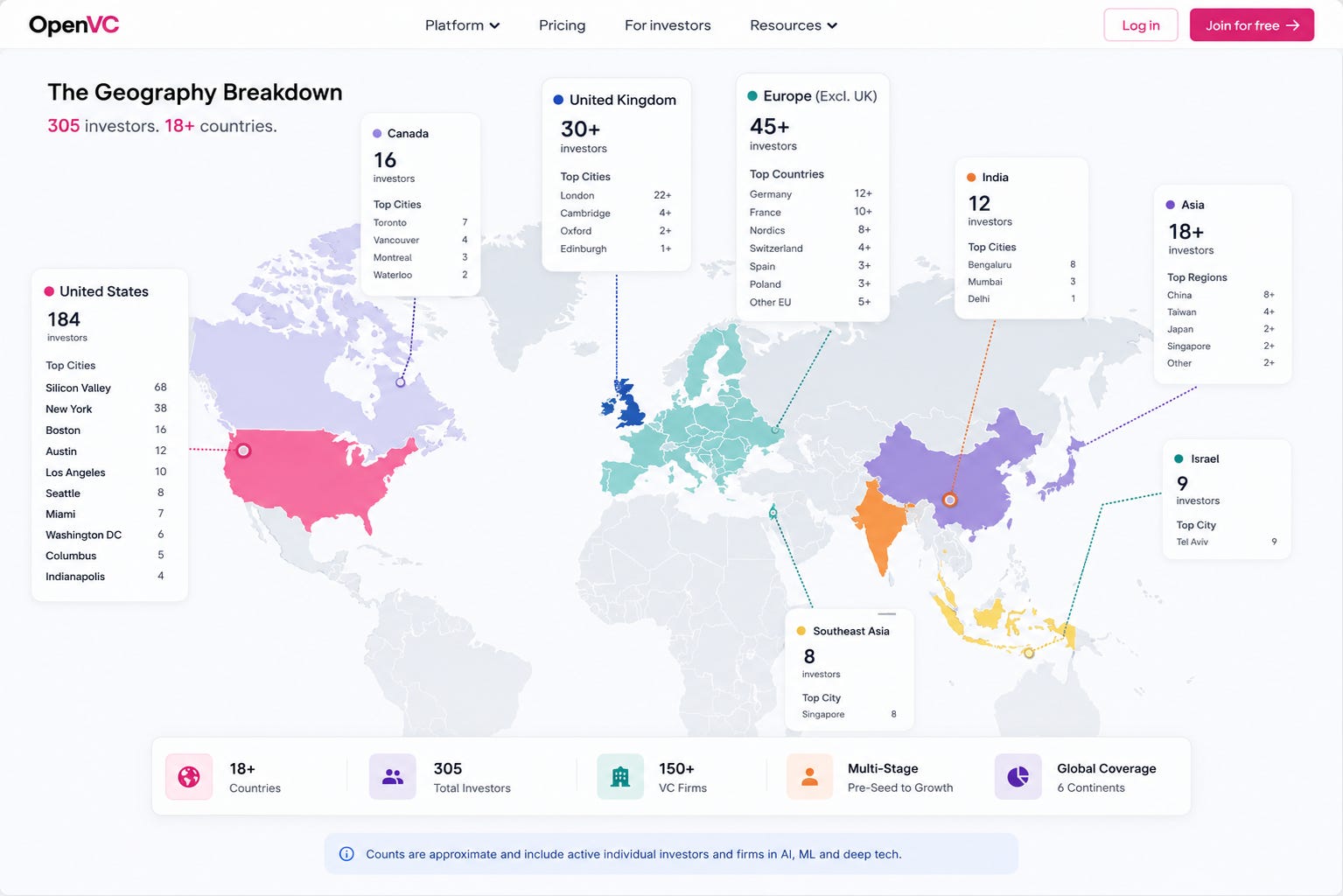
305 investors. 18+ countries.
United States. Silicon Valley, New York, Boston, Miami, Austin, LA, Columbus, Indianapolis, Washington DC, and Seattle.
United Kingdom. 30+ individual UK investors. Multi-stage European funds (Atomico, Balderton, Accel London), seed specialists (Hoxton, Passion Capital, Ada Ventures), deep tech labs (Amadeus, Entrepreneur First). The UK AI ecosystem is deeper than most US founders realise.
Europe. Germany (HV Capital, Earlybird, Project A, Fly Ventures), France (Partech, Elaia, Serena, Eurazeo), the Nordics (Northzone, Creandum, EQT Ventures, Sunstone), Switzerland (Lakestar), Spain (Nauta Capital), Poland (Inovo, TDJ Pitango).
Beyond. Canada (Radical Ventures, BDC, Inovia, Real Ventures), India (Peak XV, Accel India), Southeast Asia (Jungle Ventures), Israel (OurCrowd, Angular Ventures), and Asia (GGV, HongShan/Sequoia China, AppWorks Taiwan).
Stage-by-Stage: Who Is Right for Where You Are
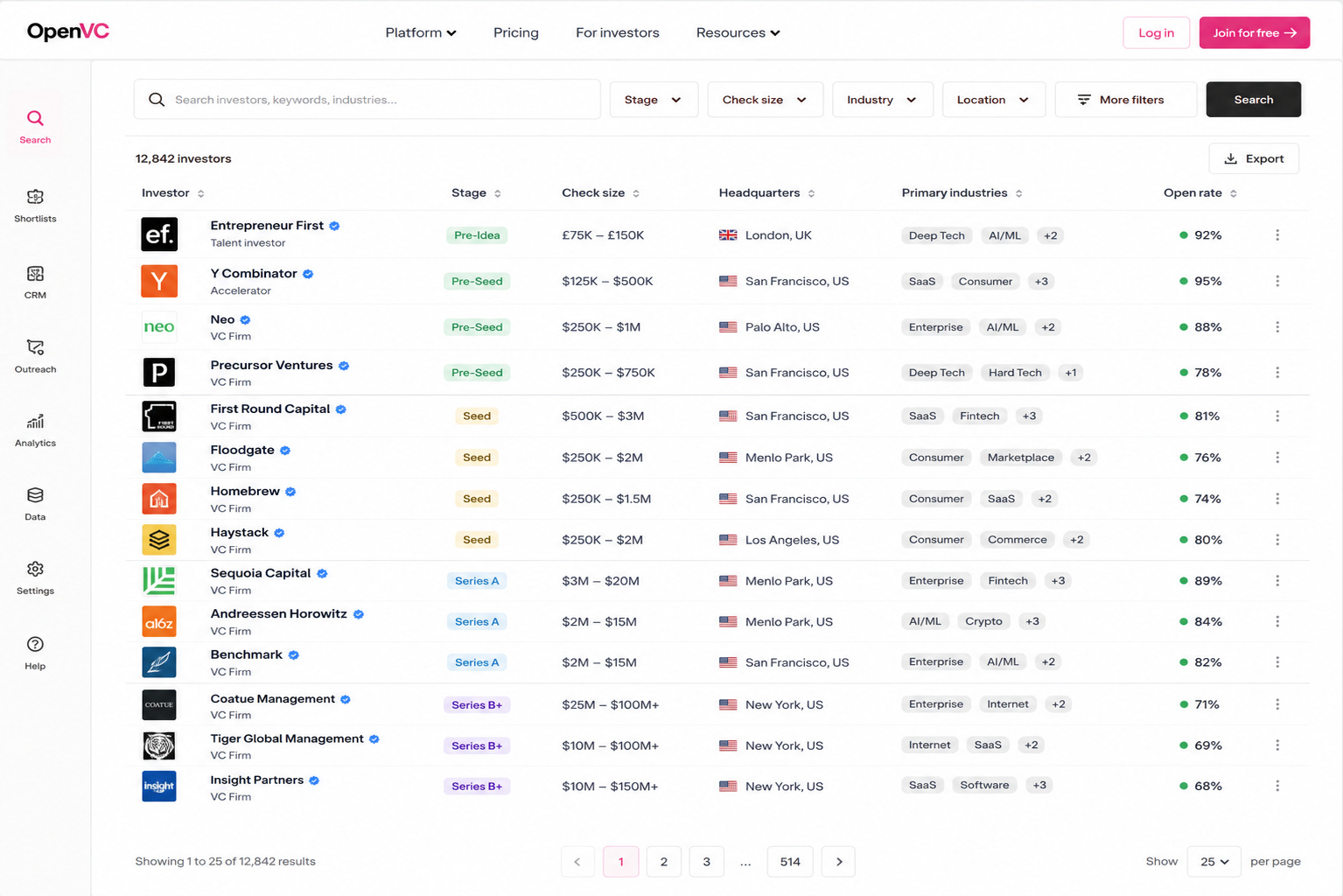
Pre-idea and pre-product
Entrepreneur First’s Matt Clifford, Y Combinator’s Garry Tan, Neo’s Ali Partovi, and Precursor’s Charles Hudson. These investors back individuals and teams before products exist. The bar is exceptional people, not exceptional traction.
Pre-seed and seed
The largest category in the database. First Round, Floodgate, Homebrew, Haystack, Hustle Fund, Pear VC, and dozens of others operate here. This is where warm introductions matter most, but where thoughtful cold outreach to active-on-X investors can still work.
Series A
Sequoia, a16z, Benchmark, Lightspeed, Greylock, Kleiner Perkins, General Catalyst, Bessemer, CRV, Redpoint, True Ventures. Every named partner at every major fund is in the database. By Series A, you need a warm introduction. Identify the portfolio company founders who could make the call and build those relationships now.
Series B and beyond
Coatue, Tiger Global, Insight Partners, Meritech, Bond Capital, Bain Capital Ventures. These investors move fast and are data-driven. They will find you if you’re growing, but knowing their specific partners and theses still shapes first-meeting quality dramatically.
The Warm Intro Playbook: Specific Beats Generic
Every entry includes a warm intro tip. These are not generic. “Get a warm intro” is not advice.
Here is what the database actually tells you for specific investors:
Elad Gil. His blog is essential reading before you approach him. An X DM that references a specific post and connects it clearly to your company gets replies. Generic messages don’t.
Benchmark partners. The firm doesn’t take cold outreach. Full stop. The path is through a Benchmark portfolio company founder. Find which founders are alumni of your sector. Build a relationship there first. The introduction takes six months but it’s worth it.
Harry Stebbings at 20VC. A podcast guest spot is the fastest path. If that’s not possible, a direct and specific X DM about something he’s posted in the last 48 hours is the next best route.
Matt Clifford at Entrepreneur First. Don’t pitch a company. Apply to the programme as an individual. EF explicitly backs people before ideas. If you have a research background in AI, this is among the highest-value applications you can make.
Sonya Huang at Sequoia. Thoughtful engagement on X over several weeks before a warm introduction. Reference her generative AI thesis writing directly in your outreach.
The database has 305 of these. Each one is specific and actionable.
One Rule Before You Approach Anyone
Before approaching any investor in this database, read or listen to at least one primary source from them.
A blog post. A podcast appearance. A long X thread.
Not a journalist’s summary of their views. The source itself.
You will discover things that make your pitch sharper. You will reference those things naturally in your outreach. Investors notice.
“The best founders don’t spray and pray. They send five emails that matter. That takes knowing exactly who you’re emailing, why they’ll care, and who can introduce you.”
📚 Our Most-Read Articles Right Now
🔥 You get one meeting. Here’s how to prepare for it in 20 minutes with Claude. Most founders spend their prep time on the pitch. The founders who close rounds spend it on the investor.
🔥 The Claude prompt that turns a cold email into one a VC actually reads. Cold emails to investors have a 3% response rate. The founders who beat that aren’t writing better emails. They’re writing completely different ones.
🔥 I asked Claude to reject my pitch until it couldn’t. Then I raised. The preparation system founders are using to walk into VC meetings already knowing every question that kills deals.
📈 How to Build Your Fundraising Narrative with Claude The step-by-step prompt playbook smart founders use to craft, sharpen, and stress-test their story before they ever walk into a room with a VC.
📈 The Number That Kills More Fundraises Than Any Bad Idea Every investor asks it. Most founders get it wrong. Why your market size slide is either your strongest asset or the quiet reason you’re not getting a second meeting.
📋 The Due Diligence Playbook: What VCs Actually Analyse Before They Invest An inside look at how venture capital firms evaluate founders, financials, structure and scalability before committing capital.
The Bottom Line
Most founders raise badly because they target badly.
They target funds instead of people.
They send one-size-fits-all pitches to investors with completely different theses.
They approach warm-intro-only investors with cold emails.
They spend hours crafting a perfect message to someone who hasn’t invested in their category in three years.
This database fixes that.
305 names. 305 LinkedIn URLs. 305 warm intro playbooks. All researched. All specific.
The file is waiting for you below.
📥 The Full 305-Investor Database
The complete spreadsheet is available below for Premium subscribers.
Here is exactly what you’re downloading:
305 named investors across 140+ firms in 18+ countries
Master Database sheet. Fully filterable by stage, type, location, and AI focus area
Browse by Firm sheet. Every investor grouped by organisation
LinkedIn Quick-Reference sheet. Clean A-Z by surname with name, LinkedIn URL, Twitter, and firm. The fastest way to work through a systematic outreach campaign
Quick Stats sheet. Summary data by geography, investor type, and stage coverage
The file is in Excel format. Add your own columns for outreach status, intro source, and meeting notes. Work through it systematically, not alphabetically: filter by stage first, then by AI focus area, then by geography.
