

You meet. You build something on weekends.
One of you says “50/50?” The other says “obviously.”
You incorporate on a Tuesday. Someone mentions vesting. Someone else says “we trust each other.”
That’s the whole conversation.
Thirteen months later, one of you wants out.
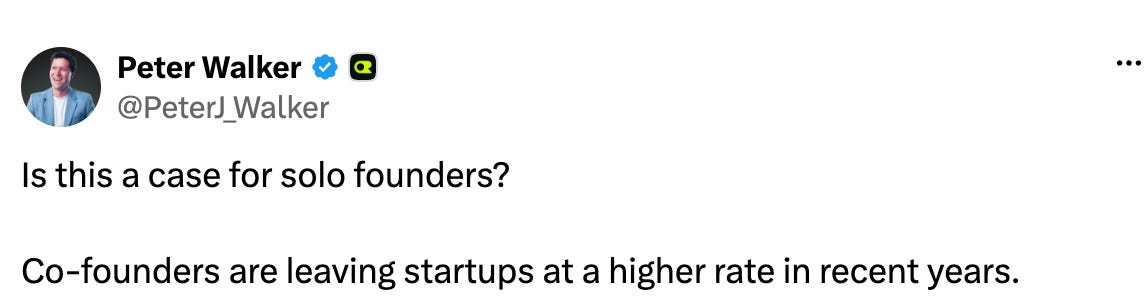
Founders spend weeks on the split and almost no time on what happens when one of them leaves.
So we took one ordinary two-founder company and walked a departure through every version of the paperwork.
Want to get in front of 250k+ founders and investors?
For sponsorship opportunities across The Founders Corner newsletter and LinkedIn (160k followers), email: founderscornermedia@gmail.com
A Quarter of Teams Break Before the Equity Vests
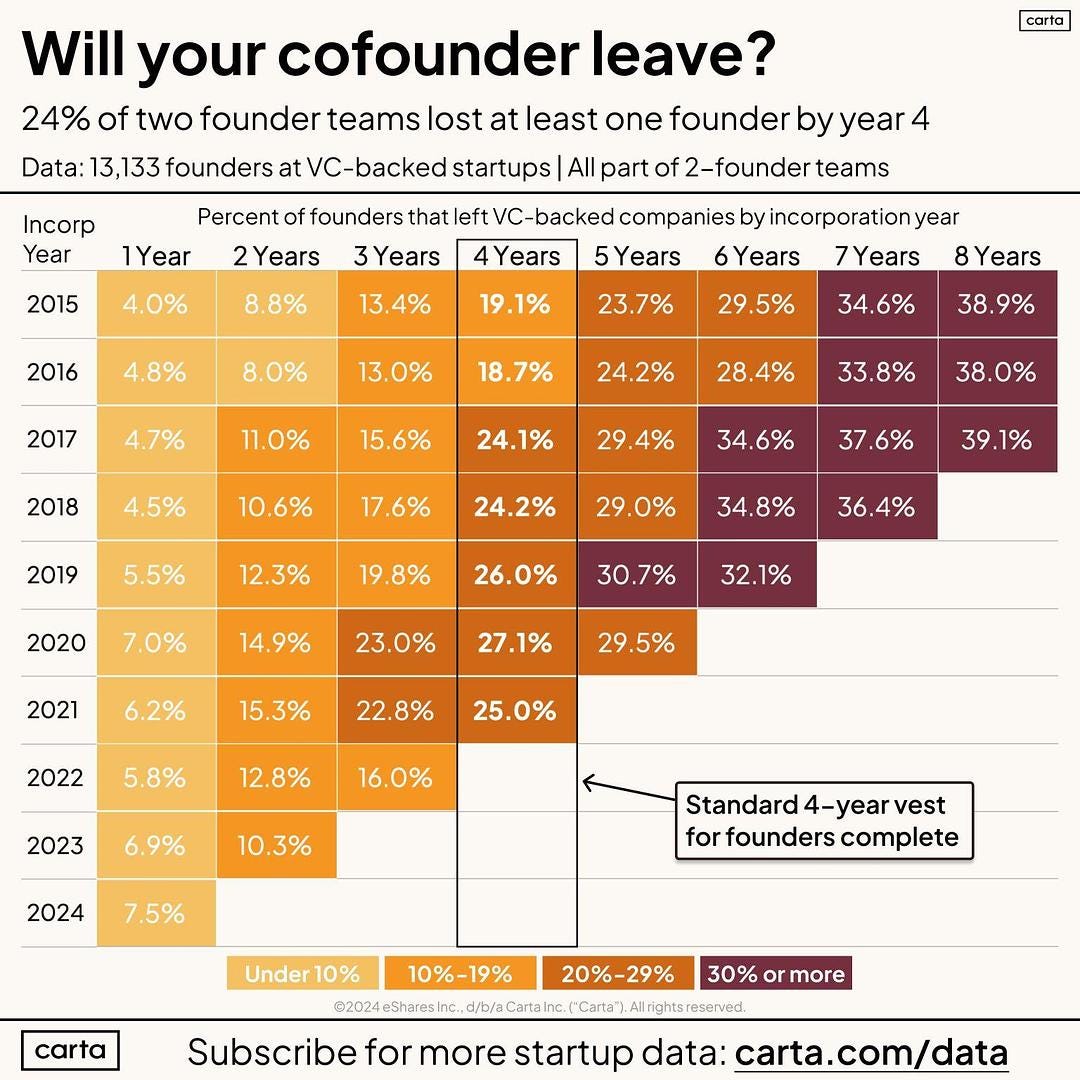
Walker tracked 13,133 founders from US two-founder teams that raised venture money, founded between 2015 and 2024.
Roughly one in four of those companies lost a co-founder within four years. For teams founded in 2017, it was 24.1%.
In a larger cut of 22,352 founders, nearly one in four from late-2021 companies were gone within three years.
Four years is exactly how long founder shares usually take to vest.
Carta excludes companies that shut down, so breakups that killed the company aren’t counted. Walker thinks the data undercounts.
Meet Maya and Tom
Invented, on ordinary terms.
Shares. 10 million. Maya. 4.5m. Tom. 4.5m. Option pool. 1m.
Vesting. Four years, monthly, with a one-year cliff.
Tom leaves in month 13.
Vested shares = founder shares × months worked ÷ 48
4.5m × 13 ÷ 48 = 1,218,750 shares.
His other 3.28m shares go back to the company. Once they’re cancelled, Tom’s 1.22m shares are 18.1% of the company.
Two Months, Eighteen Points
Month 11. Before the cliff. Tom keeps nothing.
Month 13. 18.1%.
Month 30. 33.8%.
No vesting signed. His full 45%, whenever he goes.
Michael Seibel puts the cliff plainly in Y Combinator’s video on co-founder equity: if you leave or are fired in the first year, “you get nothing.”
On the cliff date, 17 points of the company vest in one go. It’s the biggest single-day move in an ordinary vesting schedule.
Where the Breakups Happen
Carta’s chart shows departures clustering in years one to three.
It’s the stretch Paul Graham and the YC partners once drew at a dinner.
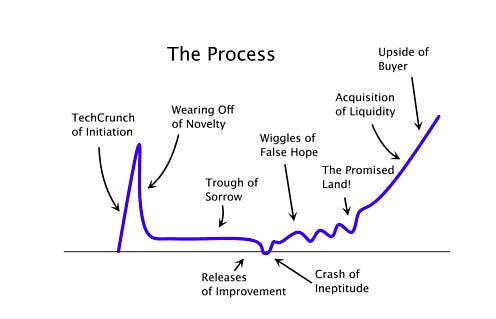
Matrix Partners’ Jake Jolis made the point in TechCrunch in 2020: co-founder departures usually happen in that trough. After the launch, before anything works.
Which is exactly when nobody has the energy to renegotiate the cap table.
The Announcement Said “Smaller Teams”
In January 2011, TechCrunch reported that Garry Tan was stepping back from Posterous, the blogging startup he’d co-founded, to an advisory role. The reason given: he wanted to work with smaller teams, at Y Combinator.
Ten years later, he told the real story.
By the end of 2010, he said, he couldn’t sleep or eat, and his heart rate “felt pegged at 120.”
From the outside, it looked like a career move.
Breakups rarely look like breakups from the outside. What’s left afterwards is the paperwork.
The $157.5 Million Handshake
Reggie Brown pitched Evan Spiegel an app for photos that disappear. Bobby Murphy joined to write the code. In the Los Angeles Times’ words, “an oral agreement cemented their triumvirate.”
In August 2011, Brown was allegedly locked out. He sued in February 2013, claiming a third. Snap settled in September 2014, and its 2017 IPO filing put the price at $157.5 million.

TechCrunch saw no evidence of a written split. Brown’s own 2012 email cited a “40-40-20” split the three had discussed.
A handshake doesn’t avoid the negotiation. It moves it to a courtroom, at a later valuation.
Our Most-Read Articles Right Now
🔥 What a Cap Table Actually Is (And Why Most Founders Misread It) What your ownership tells investors before you say a word.
🔥 The Document That Is Killing Your Series A (And You Have Already Signed It) The cap table problems to fix in the twelve months before you raise.
📋 The Most Dangerous Document a Founder Will Ever Sign The term sheet clauses that matter more than valuation.
📋 The Founder’s Guide to Understanding Investors How to vet the people on your cap table before they’re on it.
Four Years Is Shorter Than the Journey
Back to Tom. Maya raises a seed, then a Series A. Illustrative: 20% dilution at each.
After the Series A, Tom still owns 11.6%. At a $50m post-money, $5.8m on paper. He left years ago.
This is dead equity. Walker calls founder vesting “a non-negotiable, must-have, deal-breaker equity term”, because without it a departure can make a company harder for a VC to back.
And the clock is short.
By the time a four-year vest finishes, Walker notes, the median company is only a little past its Series A. IPOs take 12 to 14 years.
So he leans towards six-year founder vesting. Jolis goes further: he’d pick eight. In his example, a co-founder who leaves at 2.5 years keeps 22% of the cap table on four-year vesting, and 11% on eight.
To be fair to four years: it’s what lawyers, investors and hires expect. Walker asks openly whether he’s just echoing VC interests.
The Fair Case for 50/50
More founders split equally than any other way.
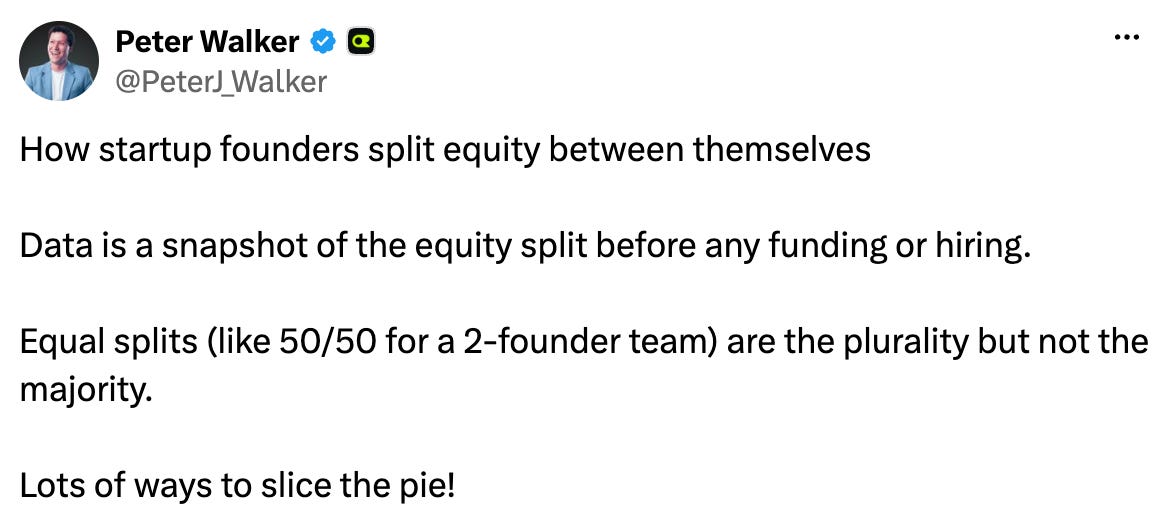
Carta’s larger dataset shows equal splits rising from 31.5% to 45.9% of two-founder teams between 2015 and 2024.
The research is less tidy. Thomas Hellmann and Noam Wasserman studied 1,476 founders in 511 ventures. Equal splits were linked to lower first-round valuations, most of all when teams agreed them quickly.
Both can be true. The split decides who owns what if you both stay. The leaver terms decide it if one of you doesn’t.
The Five Terms to Agree Before Month Ten
1. Vesting length, and when the clock starts. Four years with a one-year cliff, or longer. Write down whether time you’ve already worked counts.
2. What makes a bad leaver. In the UK, a bad leaver typically loses everything, as worthless deferred shares; a good leaver keeps what’s vested. The latest BVCA model documents no longer treat resigning as bad leaving, though some investors still push for it.
3. Vested shares. Can the company buy them back, and at what price?
4. The board seat. A “fallaway” clause treats a departing founder as resigned as a director.
5. The IP. Everything assigned to the company, including work done before you incorporated. Brown’s claim leaned on IP he said he co-owned.
“Founders argue for weeks about who owns what if they both stay. Few spend an hour on who owns what if one of them goes.”
The Conversation You Haven’t Had Yet
You split 50/50 in a minute and called it trust.
You left vesting for “when we raise”.
You never said out loud what happens if one of you walks.
You assumed the IP was the company’s because you built it together.
The fix: vesting with a cliff, signed now. Good and bad leaver defined in writing. A buyback right on vested shares. Every piece of IP assigned on day one.
Have the conversation before month ten, not after month twelve.
The file is waiting below.
The Co-Founder Leaver Kit: 7 Tabs, 342 Live Formulas
Exactly what you’re downloading:
Inputs. Up to four founders, each with their own shares, vesting length, cliff and months already credited, plus your pool, who leaves, when, and as a good or bad leaver
Leaver Result. What the leaver keeps, their share today, after your seed and after your Series A, its paper value, and the cost of buying them out
Month by Month. Every departure month from 0 to 60, with a chart showing exactly where your cliff sits
Paperwork Compare. The same departure under no agreement, vesting with no cliff, and a cliff as a good or a bad leaver
The Agreement. 26 questions across the split, vesting, leavers, roles, IP, money and disputes, each with a common starting point and a column for your answer
It opens with Maya and Tom. Swap in your team, set the vesting to four, six or eight years, and move the departure month either side of your cliff.
Paid subscribers also get:
60+ additional tools across every stage of fundraising and company building: investor research, pitch deck screening, meeting prep, term sheet analysis, financial models, and the full investor database library.
Download Below
Start your 7-day free trial → Cancel anytime.