

On Wednesday, PitchBook published its Q2 2026 US VC Valuations report.
One number in it should change how you run your raise.
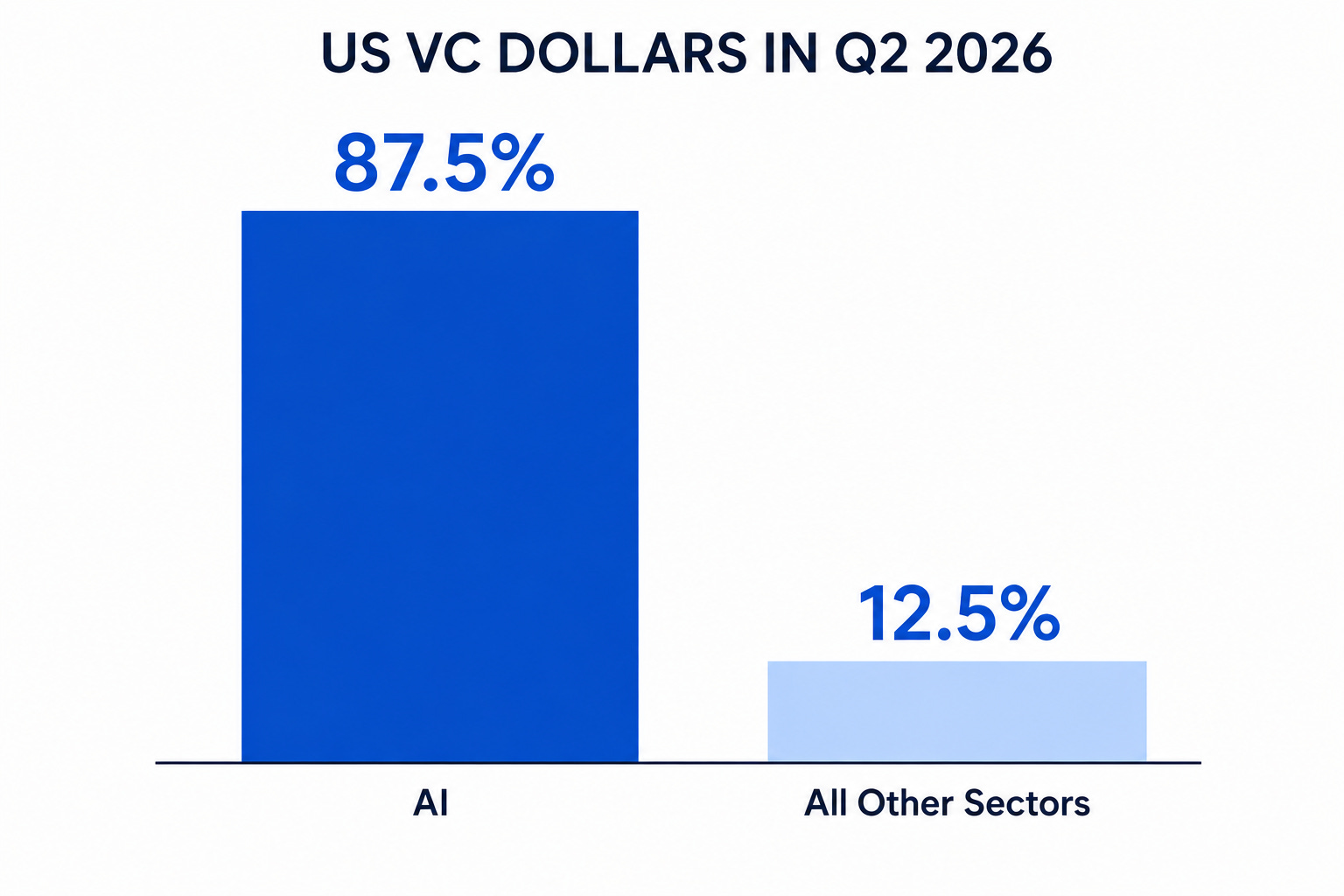
87.5% of all US venture dollars in the quarter went to AI companies. Every other sector in technology, fintech, healthtech, climate, marketplaces, consumer, devtools, logistics, split the remaining 12.5% between them.
It is the most skewed AI-versus-everything split PitchBook has ever recorded.
The single week the report covers makes it concrete. Lovable raised $400 million at a $13.3 billion valuation. River AI raised $1.1 billion across seed and Series A, two months after leaving stealth. CodeRabbit closed $143 million at $1.5 billion. Cognition opened talks on a round that could value it above $40 billion.
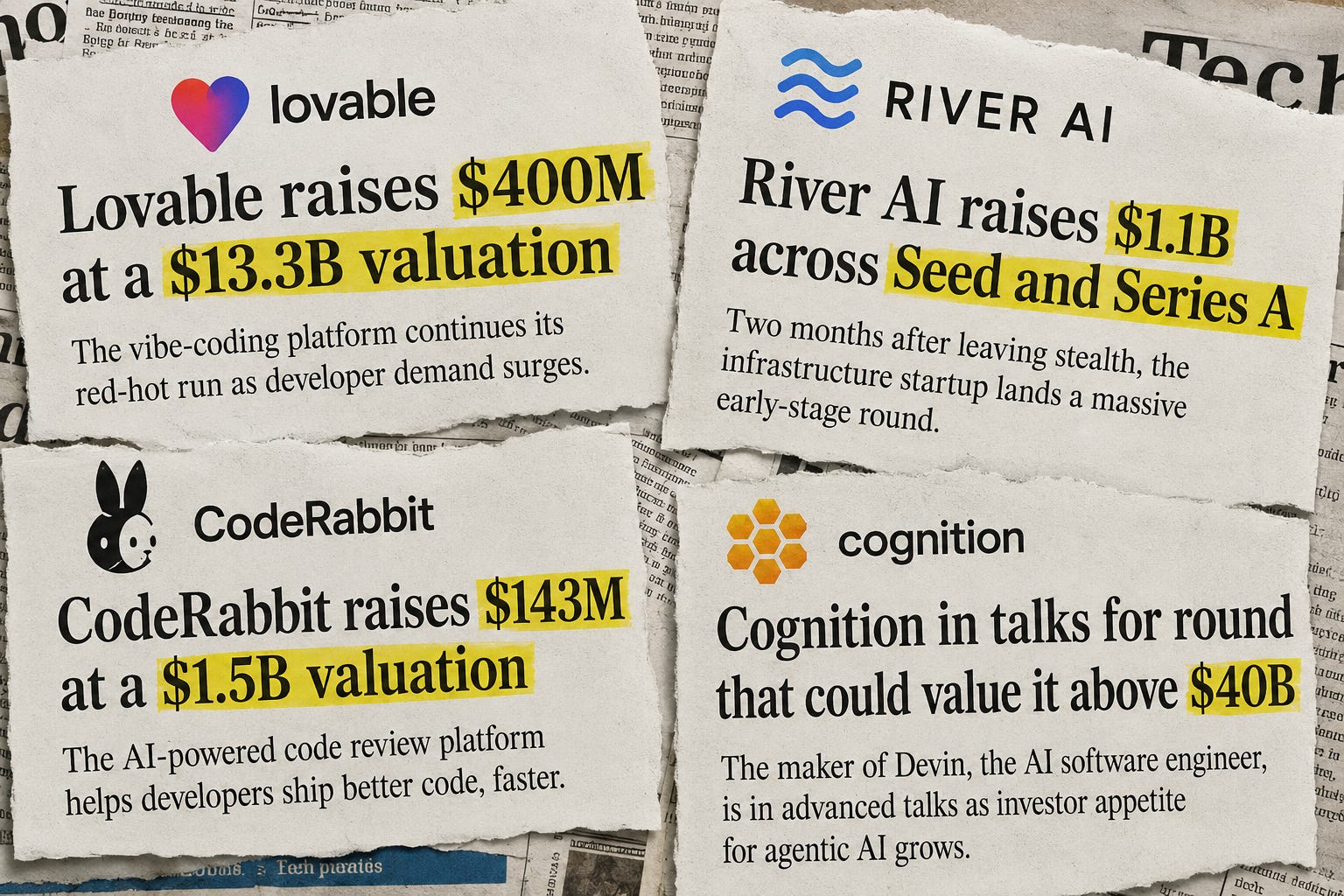
Four companies. One week. All AI.
Zoom out and it gets stranger. Global venture funding hit a record $510 billion in the first half of 2026, more than all of 2025 combined. OpenAI and Anthropic alone took more than 40% of it. In Q1, roughly 65% of every venture dollar on earth went to four companies.
If you are not building AI, you have spent the last eighteen months being told, in a hundred small ways, that the money left the room.
It didn’t. But where it went is not where you have been looking.
Want to get in front of 250k+ founders and investors?
For sponsorship opportunities across The Founders Corner newsletter and LinkedIn (160k followers), email: founderscornermedia@gmail.com
The number nobody did the math on
Percentages are designed to make you feel something. Absolute numbers are designed to tell you something.
Crunchbase puts total Q2 2026 investment into US and Canadian startups at $137.2 billion.
Run 12.5% against that and you get roughly $17 billion. Deployed into non-AI companies. In ninety days.
For scale: that is more capital than the entire US venture market deployed in some full years of the early 2010s. It is not a rounding error. It is a functioning market that happens to be standing next to a much louder one.
(The two datasets do not measure identically, so treat $17 billion as an order of magnitude rather than a decimal point. The direction is not in dispute.)
Here is what actually changed, and it is not “there is no money for you.”
The money didn’t shrink. The default search path broke.
The generalist multi-stage funds that used to be the obvious first fifty names on a non-AI target list are now under enormous LP pressure to show AI exposure. They will still take your meeting. They are far less likely to lead your round. Founders keep pitching that list, keep getting warm passes, and conclude the market is closed.
The $17 billion did not come from that list. It came from nine other places.
If you’re raising right now, you’ll need to read these:
The Number That Kills More Fundraises Than Any Bad Idea: one slide, one metric, quietly killing raises before founders even notice.
The Quiet Filter That Decides Your Entire Fundraise: every investor runs this before you open your mouth.
The Way VCs Actually Calculate Your Valuation: they have a number in their head before you walk in.
How Investors Decide If You’re Ready to Raise: it’s not timing, it’s not luck, it’s a checklist.
Which of the three buckets you are actually in
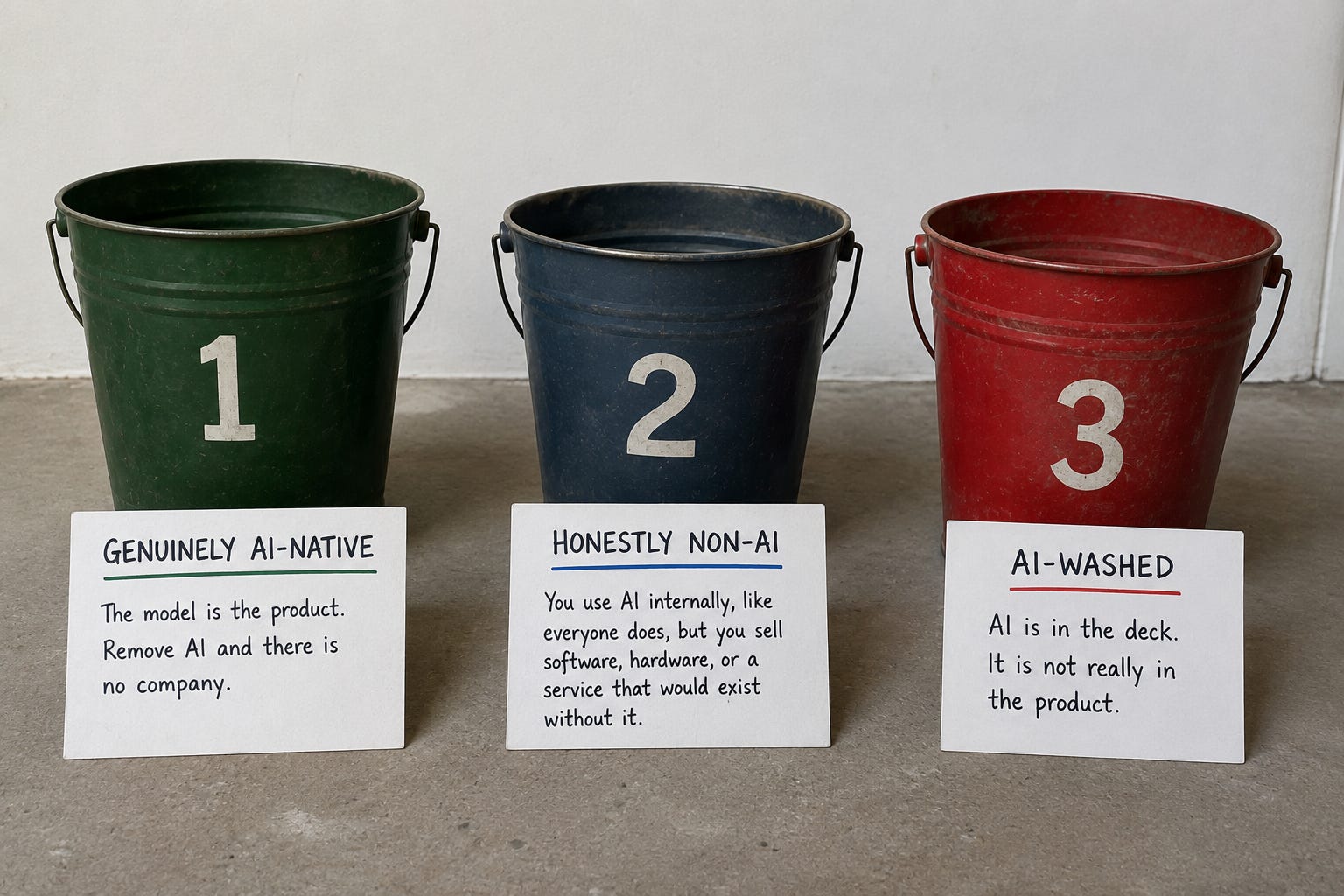
Before you touch your target list, be honest about which market you are raising in. There are three positions and only two of them are viable.
Bucket 1: genuinely AI-native. The model is the product. Remove AI and there is no company. You are competing in the 87.5% market, and the bar there is brutal but the capital is limitless.
Bucket 2: honestly non-AI. You use AI internally, like everyone does, but you sell software, hardware, or a service that would exist without it. You are competing in the 12.5% market, where there is $17 billion a quarter and considerably less noise.
Bucket 3: AI-washed. AI is in the deck. It is not really in the product.
Bucket 3 is the one that kills raises, and it is the most crowded bucket in the market right now.
The logic is simple and most founders get it backwards. By putting AI at the front of your narrative, you volunteer for the 87.5% market. Once you are in it, you get measured against companies where the model is the product. “We use GPT” raised money in 2023 and raises nothing in 2026. Investors now ask one question in the first meeting: what happens when OpenAI ships this? If your AI is a feature, you have no answer, and you lose a race you never needed to enter.
Meanwhile the 12.5% market, where you would have been a credible category leader with real margins and a defensible customer relationship, never got to see you.
Being honestly non-AI is a stronger position than being unconvincingly AI. That sentence is worth more than most fundraising advice published this year.
The 9 investor categories still writing non-AI checks
These are the nine places the $17 billion actually came from. Two of them, in full, below.
Category 1: Vertical sector specialists
Funds whose entire thesis is a non-AI sector: industrials, insurance, construction, food systems, logistics, marine, energy retail. Their LPs did not give them money to chase foundation models, and they are quietly delighted that the generalists have vacated their patch.
What they screen for: domain credibility over technology novelty. They want to know you have sold into this industry before, or that someone on your cap table has. They will forgive a slower growth curve for a customer relationship they understand.
How to reach them: they are almost never on the standard “top VCs” lists your peers are working through. They show up as sponsors at industry conferences, not tech conferences. That is the search term.
Category 2: Family offices
Single-family and multi-family offices are structurally the best-positioned buyer in this market. No LP to answer to, no fund cycle forcing deployment into whatever is hot, and often an operating business in exactly the sector you are selling into.
What they screen for: durability and downside. They ask what the business looks like if it never raises again. Answer that credibly and the conversation moves faster than any VC process you have run.
How to reach them: they do not have a submission form and they do not want one. Access runs through the operating business, the wealth manager, or a portfolio founder. Warm-intro discipline matters more here than anywhere else on this list.
Categories 3 through 9, including the two that write the largest non-AI checks in the market right now and the one most founders have never seriously considered, are below.
🔒 You now know the market exists. Here is the map to it.
Everything above tells you the $17 billion is real and which bucket you are raising in. What follows is the part you can put to work tomorrow morning. Here is exactly what is waiting below:
✅ The full 9-category investor map, as a single reference table: who they are, the check size band they actually write, what each one screens for, and the specific route in. Categories 3 to 9 include corporate venture arms, revenue-based and non-dilutive capital, regional and sovereign-backed funds, lower-mid-market growth equity, operator holdcos, Fund I and Fund II emerging managers, and strategic customer-funded development.
✅ The one line that decides which market you are raising in. There is a single sentence near the top of your deck and the top of your outreach email that sorts you into the 87.5% market or the 12.5% market. Most founders write it wrong and never find out why the meetings went cold. The corrected four-part frame, with a worked before-and-after example.
✅ Three copy-paste Claude prompts: one that audits your existing deck for accidental AI-washing, one that rebuilds your positioning line against the frame, and one that generates a ranked non-AI investor target list from your actual sector and stage.
✅ The capital sequencing rule for a 12.5% raise, which is a different order of operations to a standard venture process and the reason most non-AI raises stall at week six.
Paid subscribers also get:
✅ 60+ additional tools across every stage of fundraising and company building: investor research, pitch deck screening, meeting prep, term sheet analysis, financial models, and the full investor database library.
Start your 7-day free trial → Cancel anytime.
The one line that decides which market you are raising in
Open your deck. Find the sentence that describes what your company is. It is usually on slide one or slide three, and it is the same sentence you use in the first line of every cold email.
That sentence is doing the sorting.