

You close the seed round.
You divide the cash by the burn. Fifteen months.
“15 months of runway” goes into the first investor update.
Then you do what the number seems to tell you. Hire, so the next round comes sooner.
Nobody asks the other question.
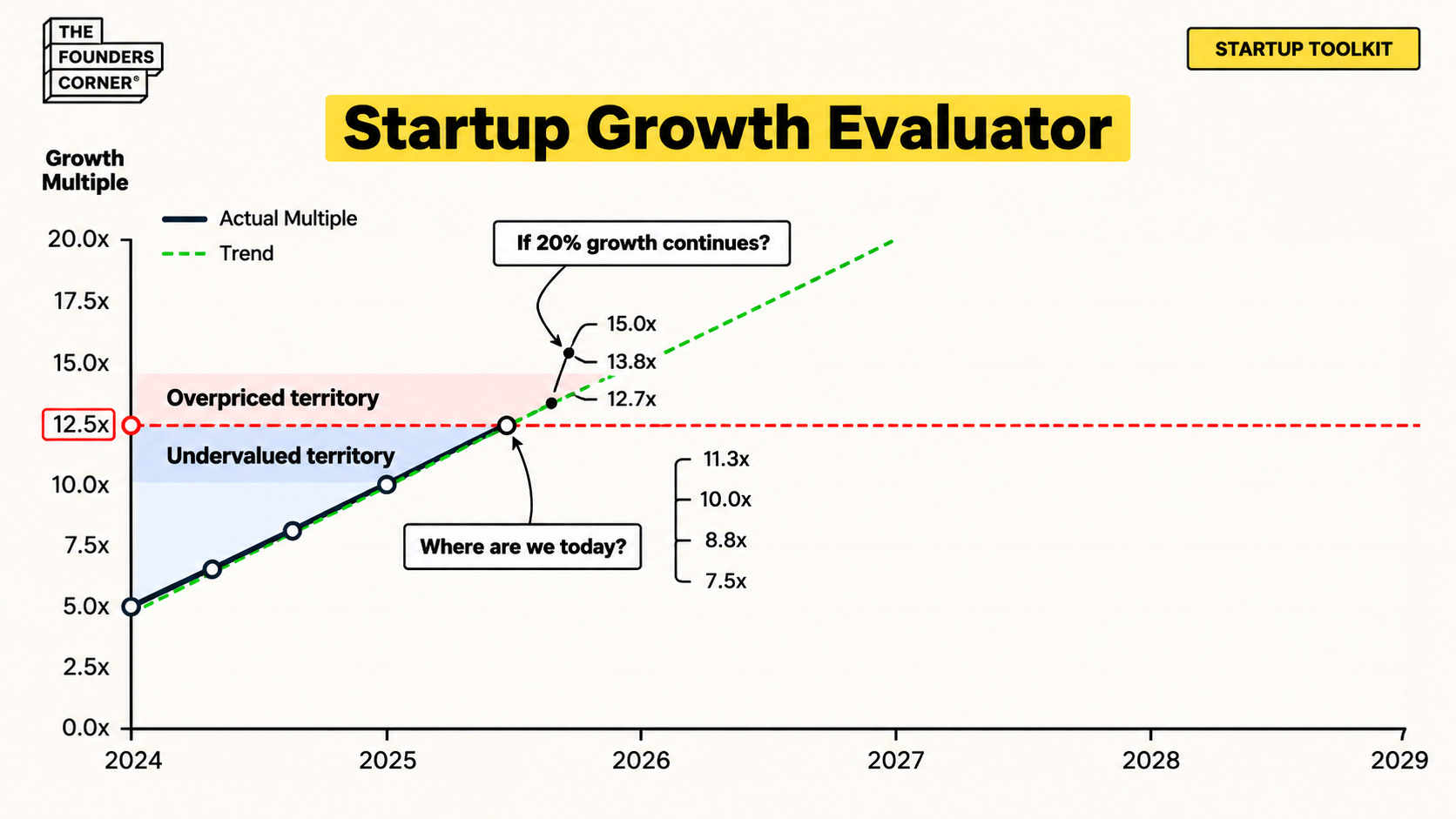
Runway tells you when the money runs out at today’s burn. It doesn’t tell you whether it has to.
So we took one typical seed-stage company, ran it through Graham’s test, and then added two hires.
Want to get in front of 250k+ founders and investors?
For sponsorship opportunities across The Founders Corner newsletter and LinkedIn (160k followers), email: founderscornermedia@gmail.com
The Question Half of Founders Can’t Answer
In October 2015, Graham wrote down the first thing he asks any startup that’s been running for more than eight or nine months.
Hold expenses where they are. Keep revenue growing at its recent rate. Do you reach profitability before the money runs out?
If yes, you’re default alive. If no, you’re default dead.
What surprised him was how many founders didn’t know: about half of the ones he talks to.
The test is one comparison:
Default alive = revenue overtakes expenses before cash hits zero
Here’s our company:
Cash. $2m.
Expenses. $170k a month.
Revenue. $40k a month, growing 7% a month.
Runway, the way most founders work it out, is $2m ÷ $130k net burn. 15.4 months.
Now run Graham’s test. Revenue overtakes expenses in month 22. Cash bottoms out at $350k.
Default alive. The “15 months” never comes, because the burn shrinks every month.
The Two Hires That Flip the Answer
Now add two people at $15k a month each, fully loaded. Expenses go to $200k.
Growth stays at 7%. Cash runs out in month 16.
Default dead.
Same company, same customers, same growth. To pay for those two people, growth has to jump from 7% to 8.1% a month, starting the month they join.
This is the one line from Graham’s essay I’d pin above every hiring plan:
“Hiring too fast is by far the biggest killer of startups that raise money.”
His reasoning: founders hire to fix slow growth, when slow growth usually means the product isn’t good enough yet. More people rarely fix that. Often they make it harder.
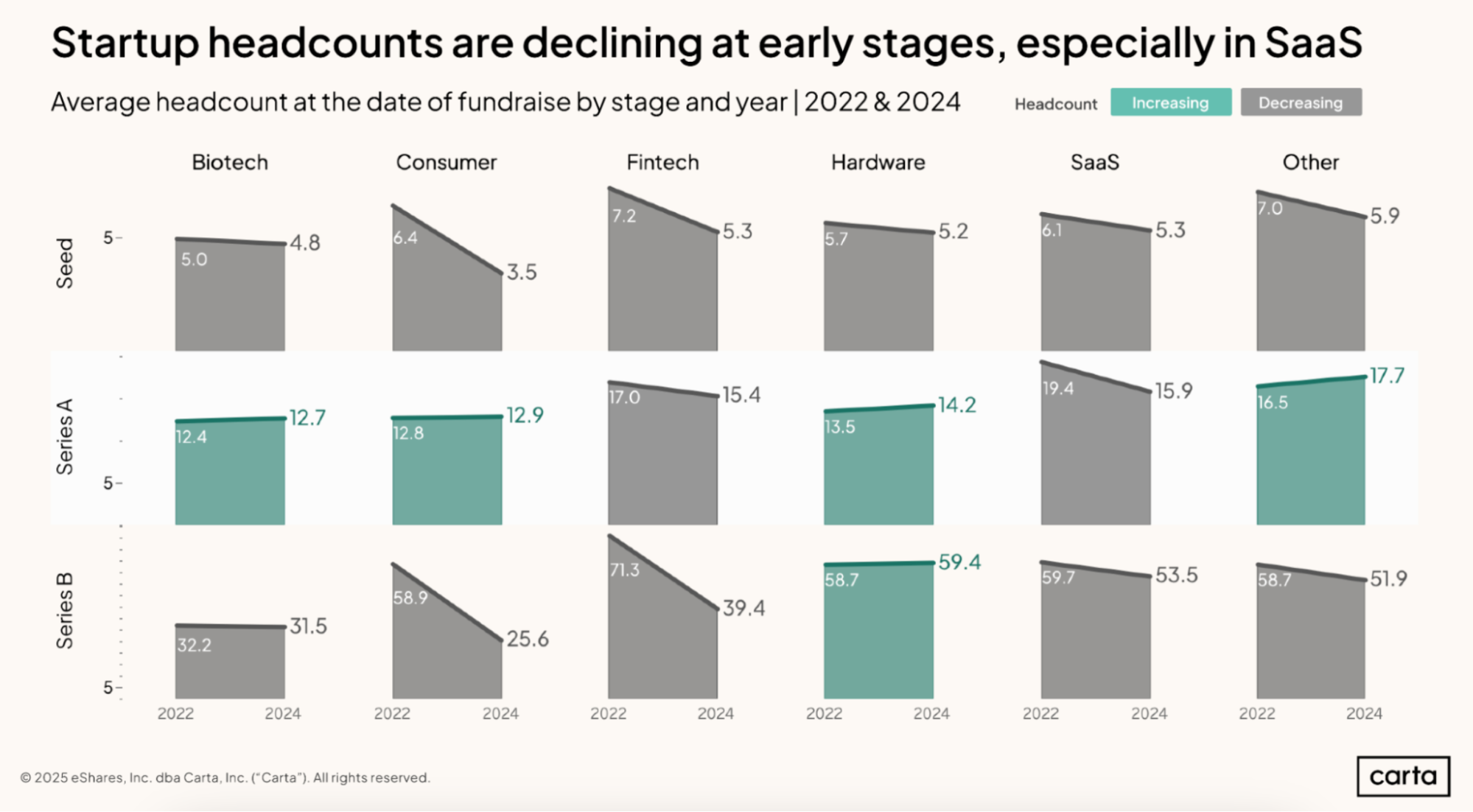
The market seems to have learned this. Carta’s data shows SaaS companies raising a Series A in 2024 with an average of 15.9 people, down from 19.4 in 2022.
To be fair to the hire: some hires do lift growth. A good seller in a market that’s already pulling you along can pay for themselves.
The test doesn’t say don’t hire. It says know what growth rate each hire has to buy, and by when.
The Round That Was Supposed to Save You
Graham names a second reason founders skip the question. They assume they’ll be able to raise more. And the more they depend on that, the less true it gets.
Carta puts the median gap between seed and Series A at 1.9 years in Q4 2025.
In Q3 2025, 39% of companies raising a Series A had taken more than three years to get there. In 2019 it was 19%.
Only 15% get from seed to Series A within 12 months.
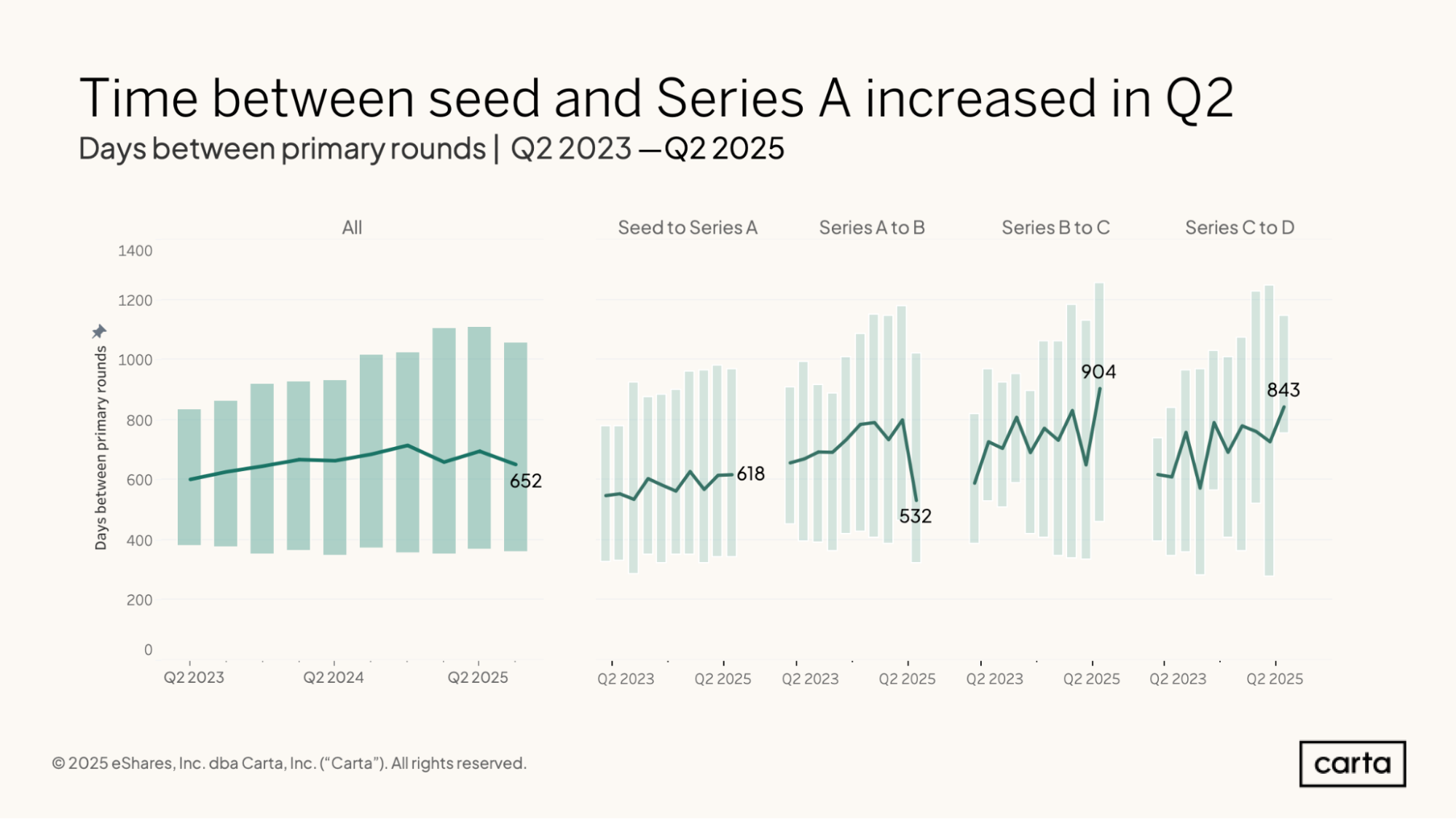
Put the two numbers side by side. Fifteen months of runway. Twenty-three months to the next round.
The plan only works if you’re in the fast minority.
What Happens When Nobody Asks
Carta tracks the companies that close down on its platform.
966 US startups on Carta shut down in 2024, up from 769 in 2023. Carta’s head of insights, Peter Walker, said the immediate cause is usually running out of cash.
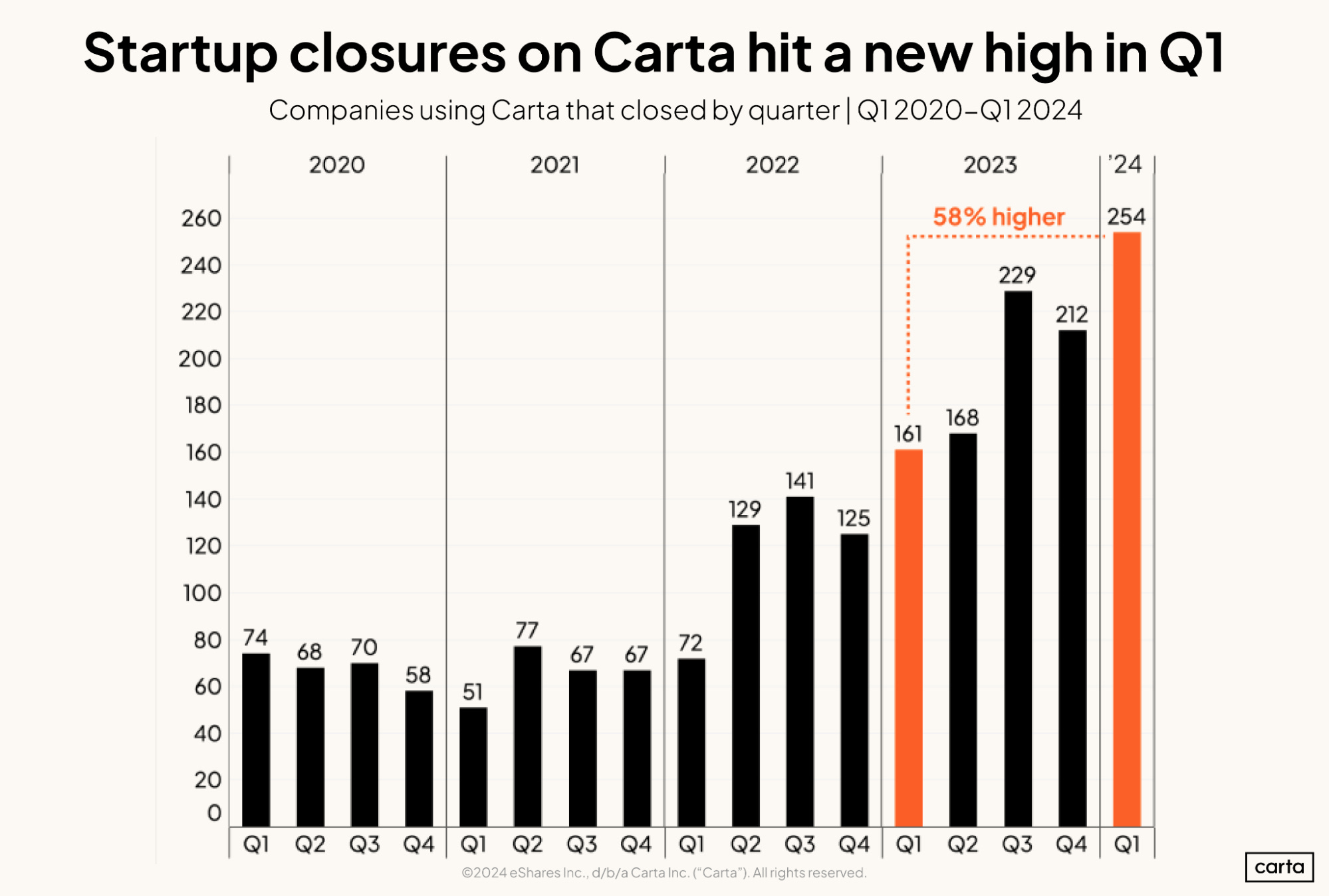
And they’re early. SimpleClosure, which handles wind-downs, found that 74% of the shutdowns it has handled since 2023 were pre-seed or seed companies.
Carta’s figures count only companies that tell Carta why they’re leaving, so the real number is higher.
Our Most-Read Articles Right Now
📈 Seeing Your Exit Before It Happens What you actually walk away with after dilution, pools and every financing decision.
📋 The 8 Checks That Can Kill a Signed Term Sheet The Claude prompts that find cap table and paperwork gaps before diligence does.
🔥 The Quiet Filter That Decides Your Entire Fundraise Rank investors by real fit, and stop emailing the ones who were never going to reply.
🔥 I asked Claude to reject my pitch until it couldn’t. Then I raised. Rehearse against a sceptical partner who asks the questions that kill deals.
The Fair Case Against Default Alive
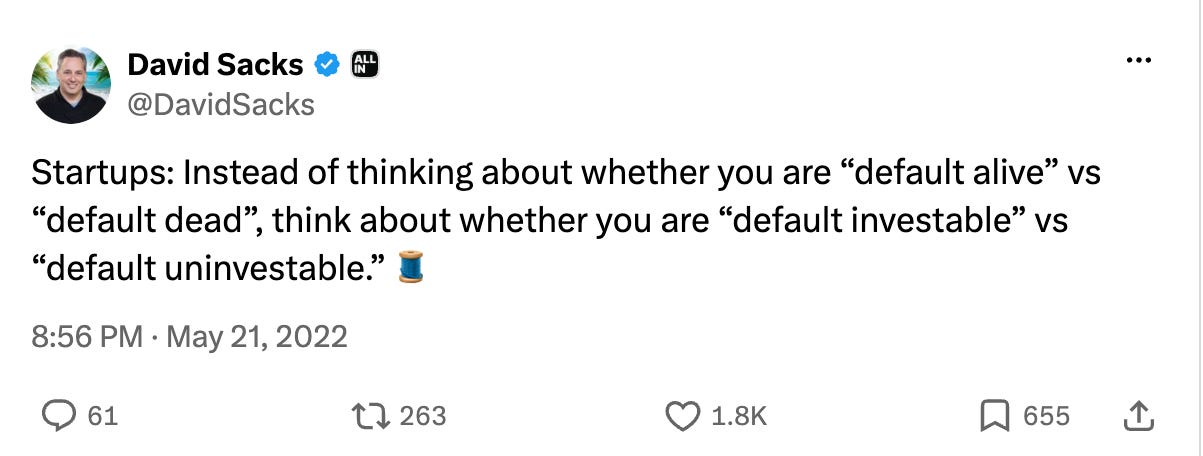
In 2022, David Sacks argued that founders should ask whether they’re “default investable” instead: are your numbers good enough to raise the next round in today’s market? Default alive, he said, is a near-impossible standard for an early-stage company.
He has a point, and Graham partly agrees. If revenue is growing more than about 5x a year, investors are likely to stay interested even if you’re losing money.
But 5x a year is 14.4% a month. Our company grows at 7%, which is 2.25x a year.
And Graham’s point still holds at any growth rate: investors change their minds. A raise is Plan A. You still need a Plan B.
The Date on Your Plan B
Graham says Plan B should be written down: exactly what you’ll do if you can’t raise, and exactly when you’ll switch.
Most founders write the what. Almost nobody writes the when.
Take our company with the two hires. Plan B is taking the two roles out. Every month they stay costs $30k off the lowest point in the bank.
Take them out after 5 months. You bottom out at $200k.
After 11 months. $20k. Alive, just.
After 12 months. Dead in month 20.
Month 11 is the deadline. It isn’t the day the cash runs out. It’s the last day the cut still works.
What Half a Million Dollars Looked Like at Justin.tv
Michael Seibel told this story in a 2022 Y Combinator video with Dalton Caldwell. It’s about Justin.tv, where he was CEO.
Revenue was about $750k a month. Expenses were about $1m. They were burning $250k a month.
With roughly $500k left, the team met in August. Seibel put three options in front of them: die in two months, get to break-even, or get to profit.
They let some people go and put pre-roll ads on everything.
They broke even in October. By December they’d made $1.2m in profit. Twitch came later, once the company was stable.
They had two months, and they used both.
“Runway tells you when the money runs out. Default alive tells you whether it has to.”
The Bottom Line
You divide cash by burn and call it runway.
You hire to buy growth without working out how much growth you need.
You assume the next round arrives in time. The median wait is 1.9 years.
You write a Plan B with no date on it.
The fix: hold expenses flat, grow revenue at your real rate, and check whether it overtakes expenses before cash hits zero. Then price every hire in growth points, and put a date on Plan B.
Run it before the next offer letter goes out, not after.
The file is waiting below.
The Default Alive Kit: 8 Tabs, 34,391 Live Formulas
Exactly what you’re downloading:
Verdict. Default alive or default dead, today and with your planned hires, side by side: break-even month, lowest cash, the month cash runs out, and Graham’s 5x-a-year check
Inputs. Cash, expenses, revenue, growth, a cash floor, and up to eight planned hires, each with its own cost and start month
Growth Needed. 251 growth rates tested, returning the lowest monthly growth that keeps you alive, with and without the hires
Plan B Date. 37 switch months tested, returning the last month you can change course and still clear your floor, as a calendar date
Plan B Worksheet. Your cuts, savings, owners and lead times, ending in one dated sentence for your board
Projection. 60 months, month by month, for both scenarios
It opens with this article’s example. Swap in your numbers, list your hires, and read the growth each one has to buy.
Paid subscribers also get:
60+ additional tools across every stage of fundraising and company building: investor research, pitch deck screening, meeting prep, term sheet analysis, financial models, and the full investor database library.
Download Below
Start your 7-day free trial → Cancel anytime.