

The call goes well.
The partner laughs at the right moments. Asks for the deck. Says it was really interesting.
Then the email.
“Really enjoyed meeting you. It’s a bit early for us, but let’s keep in touch.”
The founder reads it four times. Forwards it to their co-founder. Posts it in the founder WhatsApp group with one question.
Is this a soft yes?

I’ve sat on both sides of that email.
I joined MessageLabs in 1999 as one of its first employees and was there for the $700m sale to Symantec. For the 17 years since, I’ve been on the other side at Notion Capital: eight funds, more than 500 founders backed.
Which means I’ve written far more of the other email than the one founders want.
Most of mine were polite. Some were honest. Fewer were both.
A VC’s no is the most useful piece of data you’ll get in a raise. It just arrives in a language nobody taught you.
My First Ever AMA
You know the email.
“Loved meeting you. Not quite right for us at this stage. Keep us posted.”
Translation: no. And no idea why.
Was it the traction? The deck? The valuation? You never find out.
This time you can ask.
On Thursday 29 October at 4pm GMT, we’re hosting a live call for paid subscribers and free trialists. No camera-off webinar. You bring the problem, we dig into it with you.
Straight answers. Uncomfortable ones included.
🧭 Me. MessageLabs from tiny team to $700m exit, then co-founded Notion Capital. Operator and investor.
📣 Paul Watson. Sales won’t move? Paul works out who to sell to, what to say and how to make it repeatable.
💰 David Levine. CEO of Glenluna Ventures, Principal at Manchester Angels. Story, valuation, who to approach. Wonderfully blunt.
🛠 Your tools, actually opened. Investor readiness check, the 30-second deck test, and the filter across 2,500+ investors.
Three experts on your problem would normally take three intros and a lot of diary juggling. Here, it comes with your subscription.
Places are limited. More calls on 25 November and 10 December.
👉 Start your 7-day free trial and the invite is yours. Book your place:
The Arithmetic Behind Every Polite No
Paul Gompers, Will Gornall, Steven Kaplan and Ilya Strebulaev surveyed 885 VCs at 681 firms for the Journal of Financial Economics in 2020.
The average firm screens 200 companies a year and makes four investments.
Passes per year = companies screened − investments made
200 − 4 = 196 nos. Close to four every week, from a firm with five senior investment professionals.
Now picture writing a thoughtful rejection four times a week for companies you’ll never back.
Lightspeed partner Mercedes Bent said it in a viral LinkedIn post: a careful no takes effort, and when it won’t become a deal it slides down the list. Hustle Fund’s Eric Bahn gets about 30 inbound pitches a day.
That explains why the no is short.
It doesn’t explain why it’s vague. That part is deliberate.
Why the Real Reason Never Makes It Into the Email
Paul Graham described the mechanism in How to Raise Money back in 2013, and nothing about it has changed.
Investors want to wait, because every week tells them more about a young company. So they lead founders on. Some never say no at all. They just stop replying, which keeps a free option open in case you turn hot.
His translation of “I’d invest, but I don’t lead” is still the best in print:
“No, except yes if you turn out to be a hot deal.”
Jason Lemkin at SaaStr has the honest investor’s version. The clear nos go out fast. The yeses go out fast. It’s the almosts that sit in his inbox: a great CEO without a great CTO, or 90% growth at $1m ARR when he needed it faster. He calls it inbox drag. To the founder, it looks exactly like ghosting.
The vague no isn’t a lie. It’s an option the investor hasn’t decided to close.
Founders feel it. When Sifted asked 59 founders about their worst investor experiences, more than 75% said they’d dealt with arrogant VCs and been ghosted. One wanted investors to just say so:
“When you’re never going to be more than a frog — let us know.”
And sometimes the reason is simply that nobody was listening.
In June a thread on X turned into a confession booth. Greg Isenberg described a partner at a top firm sleeping through 30-plus minutes of a $15m Series A pitch. Liz Wessel, now at First Round, said an investor dozed off in her 2015 Series A meeting, then called to say his firm wanted in anyway. Her team passed. Travis Kalanick once finished a pitch from the passenger seat of the investor’s car.
The Fair Case for the Vague No
Before you draft the angry reply, hear the other side. A specific no invites an argument.
Investor David Paul wrote about it: founders ask for honest feedback, then use it to rebut him. Investors learn to stop giving it.
Bahn told TechCrunch his firm sometimes sent detailed reasons for a pass and got abuse back, occasionally threats. Those founders went into the firm’s database and never heard from it again.
And the honest reason can be wrong and damaging at once. “We don’t think your CTO can scale this” is one partner’s guess after one hour. Written down, it can follow a team around.
So the fix isn’t demanding honesty from investors. It’s learning to read the no you actually get.
Our Most-Read Articles Right Now
🔥 I Ran a Startup Through a VC Investment Committee. It Died in Four Minutes. The memo and the verdict, before you walk in.
🔥 The Way VCs Actually Calculate Your Valuation The return maths that sets your price before the meeting starts.
🔥 The Pitch Deck Test Investors Use in 30 Seconds — Now You Can Too How your deck really lands, before the silent no.
📈 The 169 VCs Leading Rounds Right Now Who actually led a round in the last ninety days.
The Investors Who Said No, Then Chased
A no is a decision made on the evidence available that week. It has a date on it.
Bessemer Venture Partners keeps the most honest page in venture: its anti-portfolio, the great companies it passed on.
It passed on FedEx seven times. It passed on Apple’s pre-IPO stock at a $60m valuation because the price looked steep. A partner told Eduardo Saverin to forget Facebook because Friendster had already won.
And David Cowan’s college friend rented her Menlo Park garage to two Stanford students writing a search engine. She kept trying to introduce them. Cowan’s response, as Bessemer tells it:
“How can I get out of this house without going anywhere near your garage?”
The same page tells the other half of the story.
Bessemer’s Kent Bennett passed on Toast. Twice. Then a co-founder showed him payments built into the product, and he called his mentor to admit a huge mistake. The advice: send a term sheet that day, and every day after, until they signed. Toast went public in 2021 at a $20bn valuation.
With Legora, Bessemer missed the round entirely, then stayed close. Four months later the company had more than doubled. Two partners met the founder at Penn Station after midnight, watched a demo in a bar, and led the $1.8bn Series C in 2025.
It matters more now than it did in 2021. Carta tracked 12,249 seed rounds and found that no seed cohort since Q3 2021 has reached a 30% graduation rate to Series A within two years.
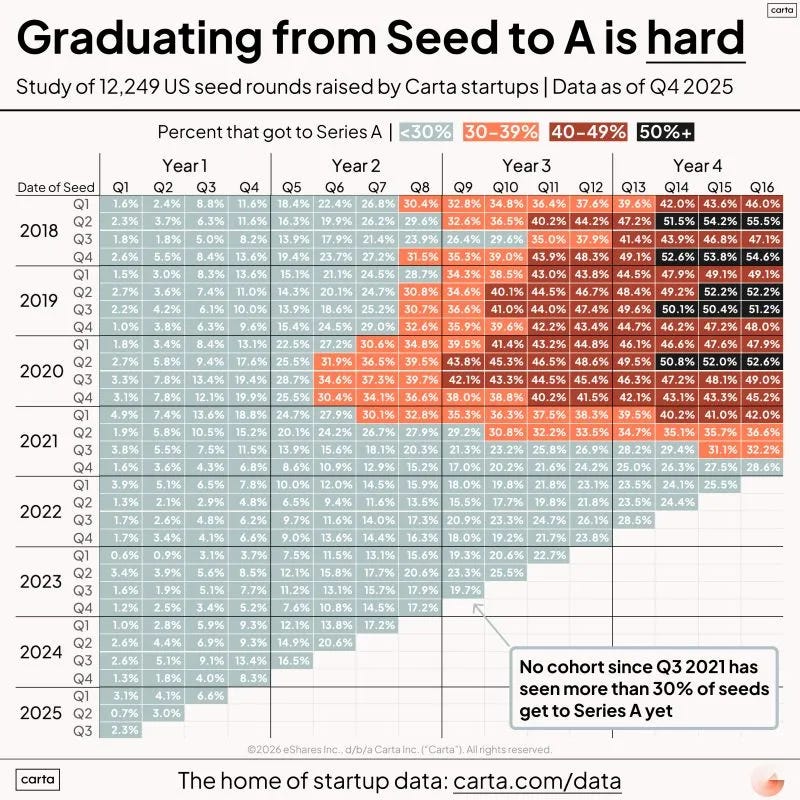
Which makes the investors who passed on your seed a large part of your Series A pipeline.
The question is which ones.
Not All Nos Are Equal
Toast and Legora both started with a no. But not every no comes back.
Over 17 years I’ve learned that the shape of a no matters far more than how warm it sounds.
So I went back through the pass lines I see most, the ones I’ve sent and the ones my founders have forwarded to me, and sorted them by what tends to happen next.
They fall into three groups.
Green. Nos that often come back, if you send the right email.
Amber. Nos that mean nothing until you act. Leave them alone and they quietly run down your runway.
Red. Nos that mean stop. Stop chasing, stop updating, and in some cases stop asking for intros.
Here’s what surprised me when I sorted them.
The line founders take hardest usually sits in the green group. It tends to mean someone inside the firm put their name on your deal and lost a vote you could win next time.
And the line founders forward with a smiley face, the one at the top of this article, is amber. Left alone, it’s where hope goes to run out the clock.
Most founders spend the next month on exactly the wrong one.
What’s Below the Line
The green no. Which line it is, why it’s usually the warmest lead in your pipeline, and the email to send within 48 hours
Why “let’s keep in touch” is the most expensive email in your inbox. What Sifted’s founders called their biggest fundraising mistake, and the one-line reply that stops it costing you a month
The red nos. Three lines that mean stop, including one founders think is a maybe
The 12-word question that makes it almost impossible to be ghosted, and the moment in the meeting to ask it
The decoder, sorted green, amber and red. 12 pass lines in the article, each with the reply to send. All 24 in the download
The No Ledger. The one column that turns every pass into a reason to write back, and the founder who came back to me with exactly what I’d asked for
Keep reading with a 7-day free trial. Cancel anytime.
