

Most founders prepare for the pitch.
The deck. The demo. The market slide, rewritten for the fourth time.
Then the meeting goes well, the partner is warm, and nothing happens for three weeks.
Here is why. The pitch is not the decision. The decision happens days later, in a room you are not in, where the partner who liked you has to stand up in front of four colleagues and defend you against people paid to find the hole.
You never see that meeting. You only ever see its output, compressed into two polite sentences.
After 25 plus years building companies, backing founders and sitting on the other side of that table, I wanted founders to see the room itself.
That is why I built the IC Simulator.
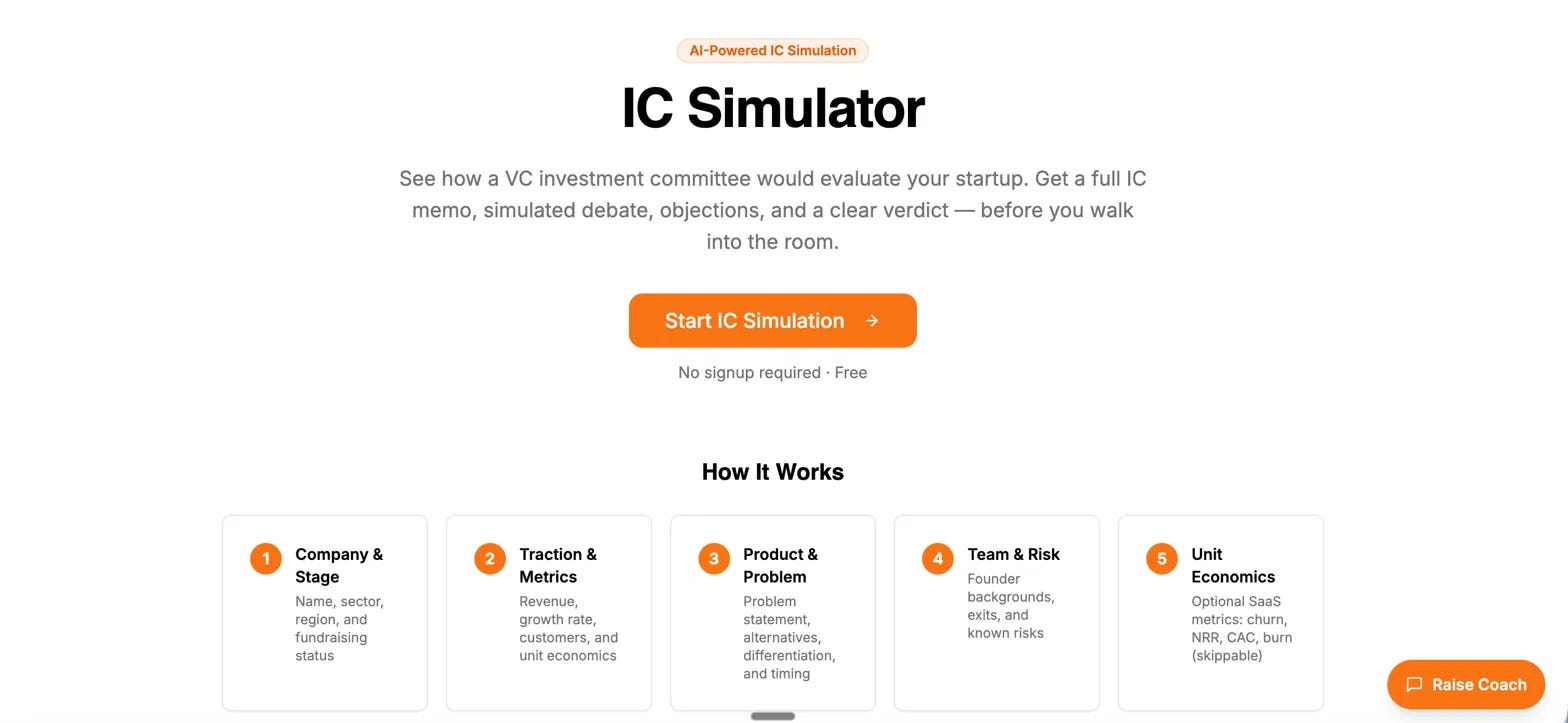
No signup. About eight minutes if your numbers are to hand.
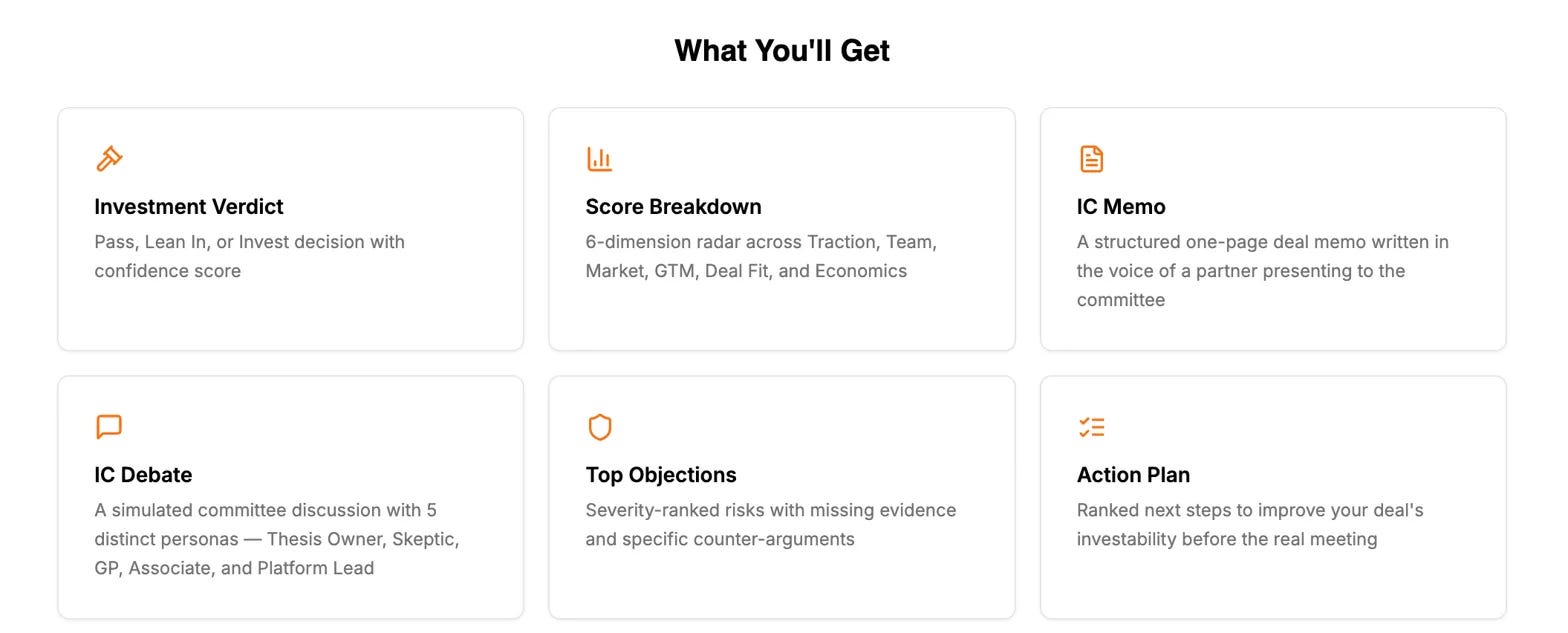
Below is the walkthrough, run against a deliberately imperfect deal so you can see what happens when the case has holes in it.
Want to get in front of 250k+ founders and investors?
For sponsorship opportunities across The Founders Corner newsletter and LinkedIn (160k followers), email: founderscornermedia@gmail.com
1️⃣ Company And Stage
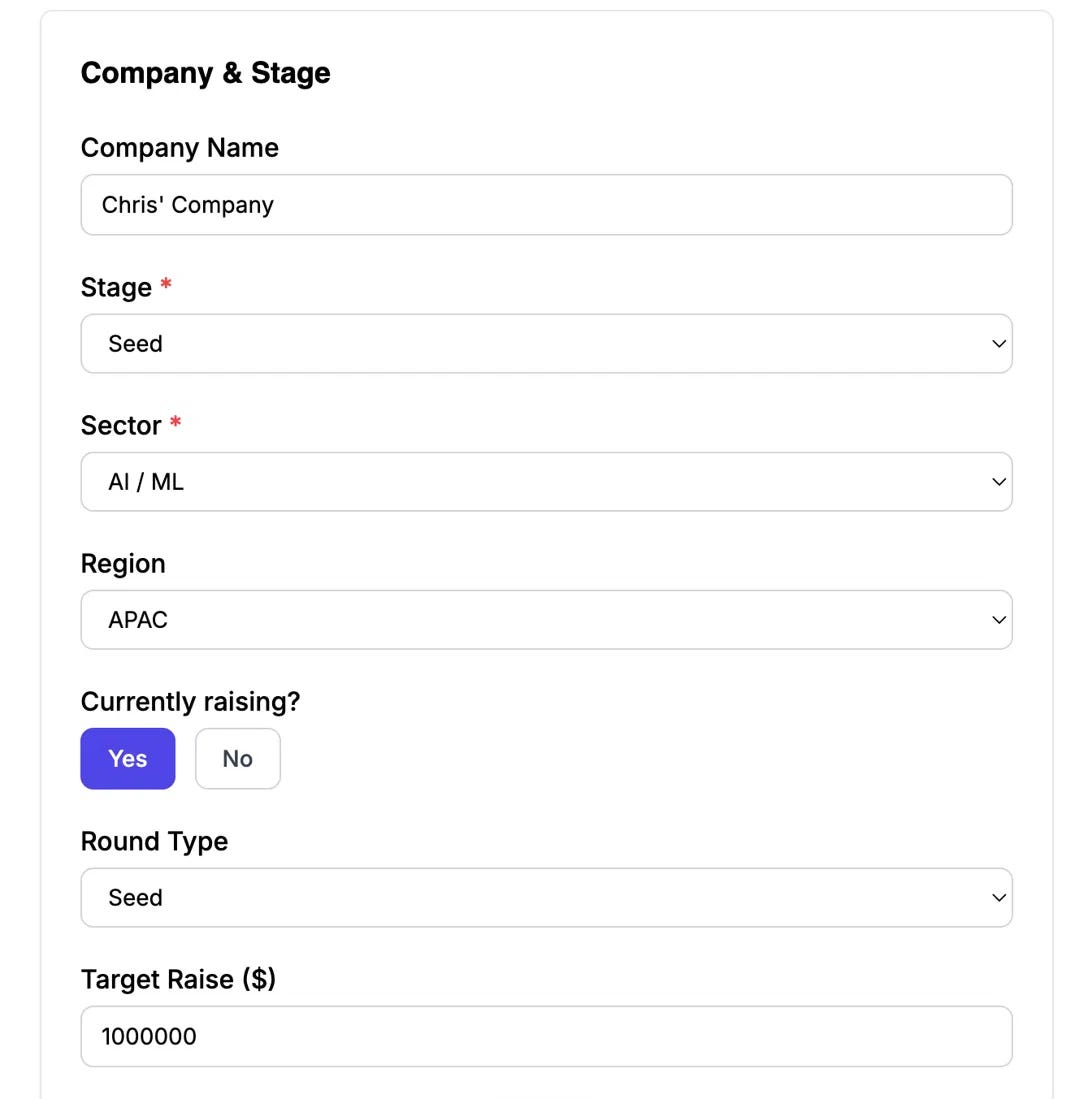
This screen looks like admin. It is the frame every other answer gets graded against.
There is no such thing as good metrics. There are only metrics that are good for a stage.
$500K of ARR is a strong Seed, a weak Series A and an extraordinary pre seed. The number did not move. The frame did.
So the first failure appears before you have typed a single metric: founders who select the round they want rather than the round their evidence supports, then receive a cold verdict for reasons that have nothing to do with the business.
Set it honestly, then run it twice. Once at the round you want, once at the round below. The gap between the two verdicts is exactly what you are asking a partner to overlook.
2️⃣ Traction And Metrics
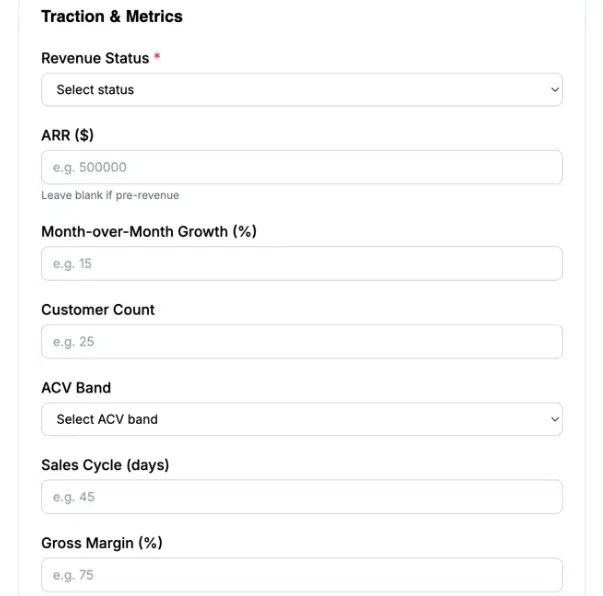
Only Revenue Status is required, and pre revenue is a recognised, fundable state at Seed. Leave ARR blank if that is the truth.
Then the most valuable thing in this article.
These fields are not independent. An associate reads them as a system, and the first thing they do is divide.
On my run I entered $500,000 of ARR, 20,000 customers, and an ACV band of $50K to $100K.
$500,000 ÷ 20,000 = $25 per customer per year.
Against a stated floor of $50,000. Out by a factor of two thousand.
The simulator caught it. So would a 24 year old associate, in four minutes, and they would not email you about it. The deal would just stop moving.
Before you fill this in, run three divisions on your own deck: ARR over customers, ARR over headcount, and cycle length against ACV. Any answer you cannot explain in one sentence is a problem you will meet later.
3️⃣ Product And Problem
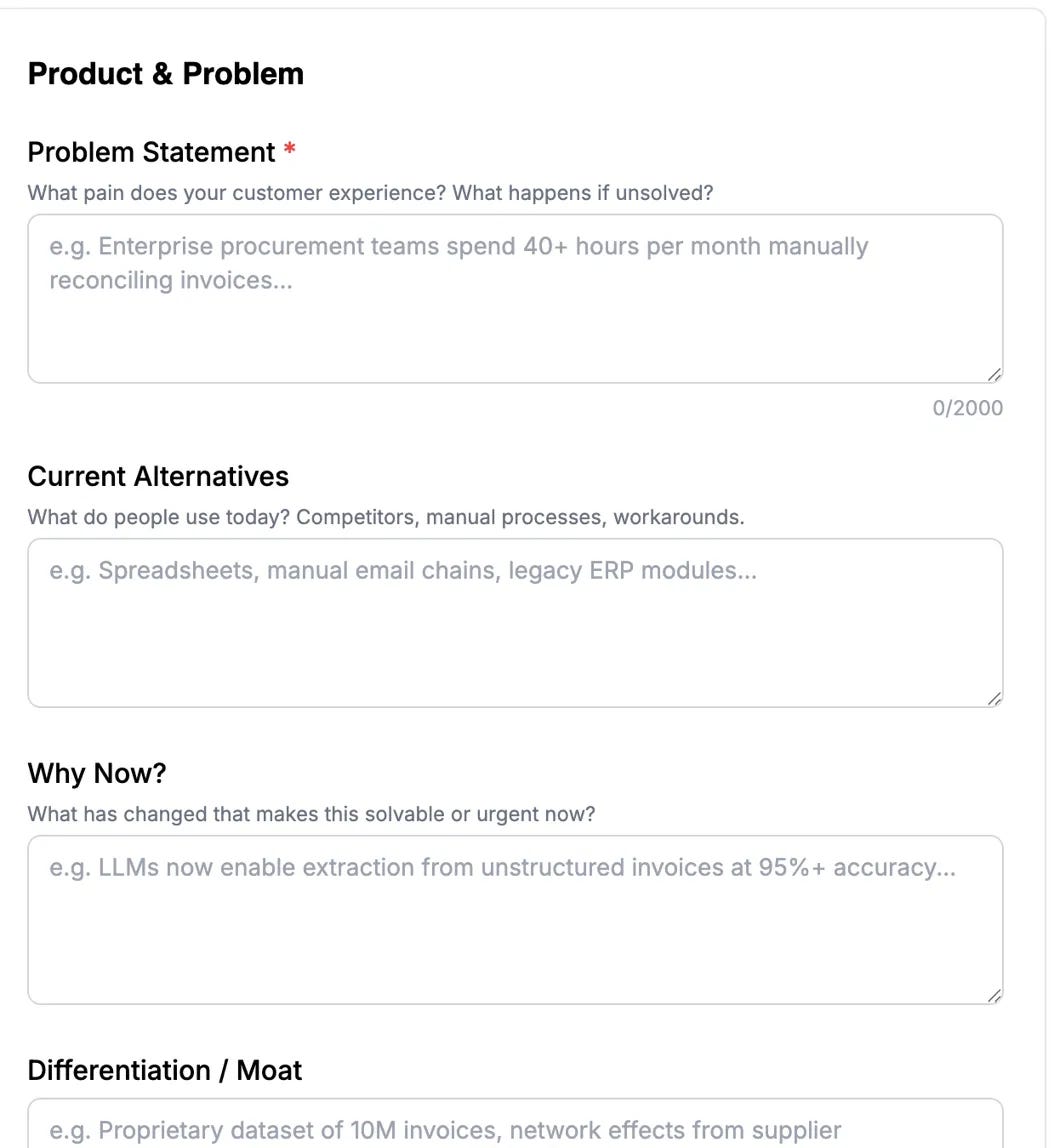
The Problem Statement gives you 2,000 characters. Most founders use a quarter of them.
The prompt asks two questions and founders skip the second: what happens if this goes unsolved? A problem with no consequence is a preference, and preferences do not get budget.
Current Alternatives is the field I would make required. Founders instinctively want it empty. “Nobody else does this.”
Read that the way a committee reads it: no category, no budget line, no procurement path.
The strong answer names the spreadsheet, the manual process, the incumbent module and the internal team doing it badly today. Every one of those proves money is already being spent on your problem.
Why Now has one job: explain why this was not buildable three years ago.
Moat has one test: does it get harder to copy as you grow. Being first and being faster are advantages. Neither is a moat.
4️⃣ Team And Risk
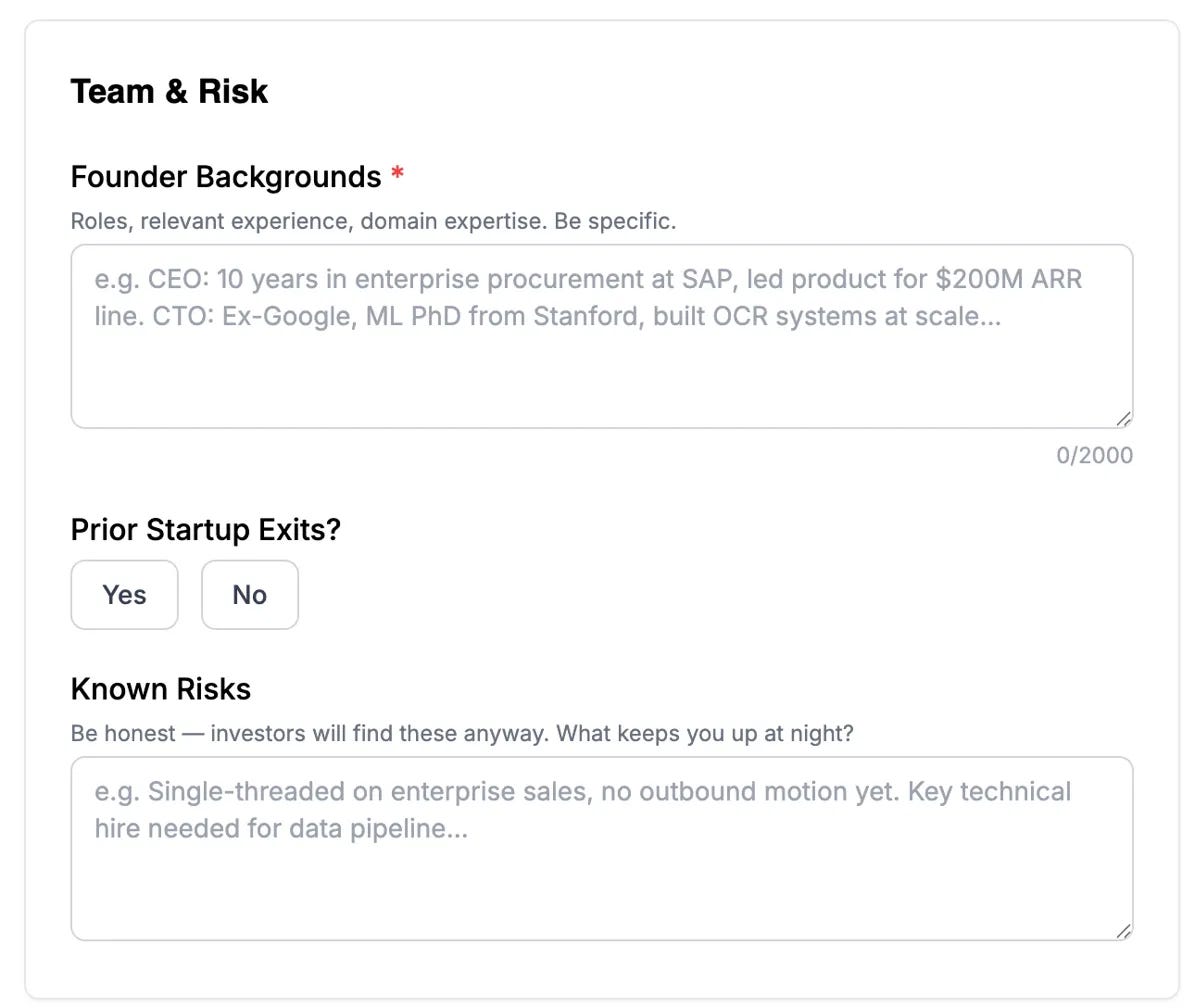
Founder Backgrounds is required, and at Seed it carries more weight than anything else in the tool.
The instruction says be specific, and the example shows what specific means: a role, a company, and a number attached to it. Not “experienced operator” but “led product for a $200M ARR line.”
The test is not how impressive you are. It is whether your history explains why you win this market.
Then Known Risks, where the helper text says the quiet part out loud: investors will find these anyway.
Every instinct says minimise it. Ignore the instinct. A volunteered risk moves out of the diligence column, where it would have surfaced in week five as something you concealed, and into the judgment column, where it reads as clear sight of your own business.
Same fact. Opposite meaning.
5️⃣ Unit Economics
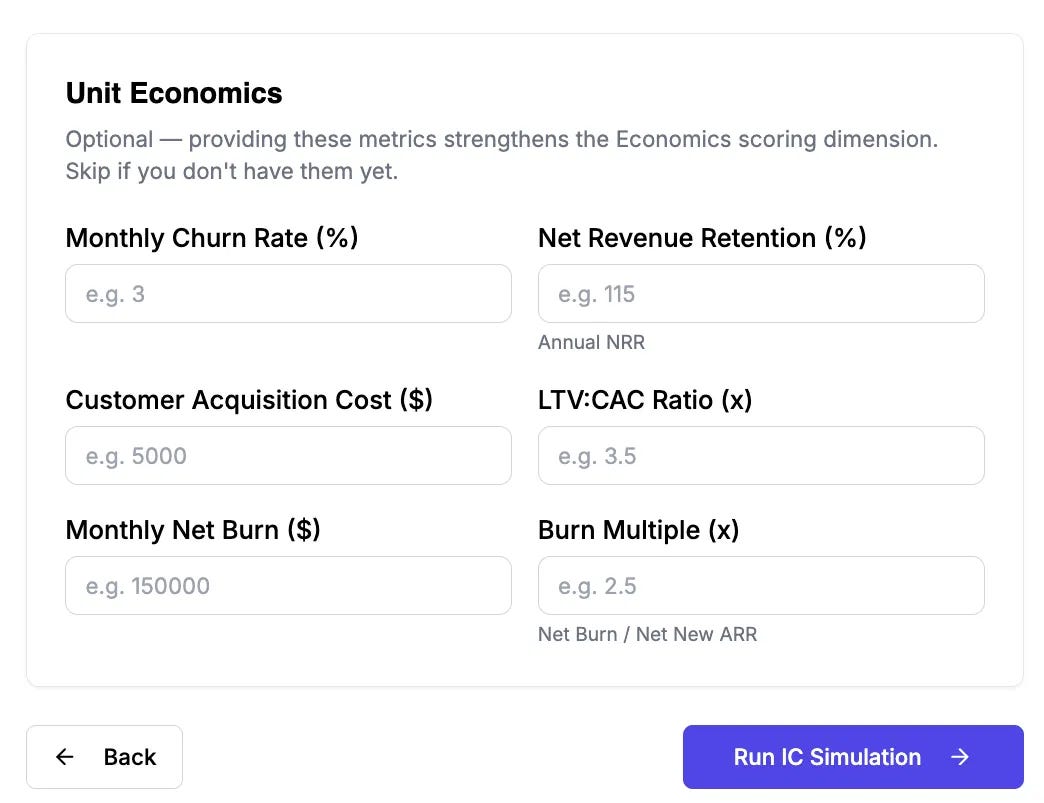
Marked optional. Blank does not remove the question, it converts a number into an assumption, and assumptions are scored conservatively.
There is a worse option than blank, and my run demonstrates it. I entered 20% monthly churn, 80% NRR, $30 CAC and a 3x LTV:CAC.
20% monthly churn means a five month average customer lifetime, and roughly 7% of a cohort surviving twelve months.
A 3x ratio on a $30 CAC implies a lifetime value of $90.
Ninety dollars, on a customer described one screen earlier as sitting in a $50K to $100K band.
Contradictory numbers cost you more than absent ones. If the economics are ugly, enter the ugly version and use Known Risks to say what you are doing about it.
Then press Run IC Simulation.
6️⃣ Your Component Scores
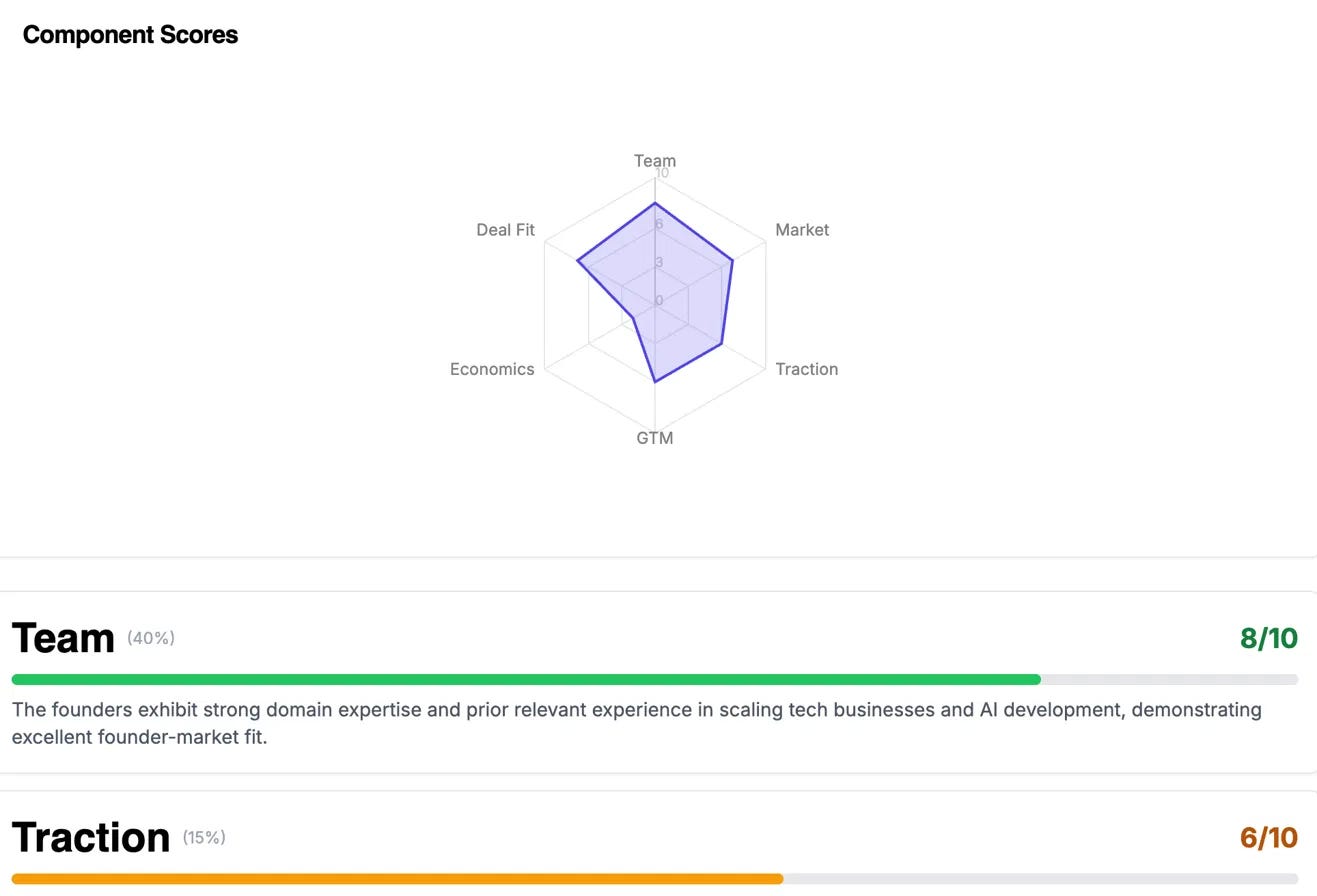
Six axes. Look past the scores to the number in brackets.
Team: 40%. Traction: 15%.
At Seed, who you are is worth nearly three times what you have built, because six months of data only tells you about six months. The founding team is the only variable with a decade of signal behind it.
Founders spend eleven weeks improving the 15% and twenty minutes on the 40%.
And do not chase a bigger shape on the radar. Committees fund spiky shapes with one fixable dent, not uniform sixes. Here Team, Deal Fit and GTM push outward and Economics collapses to the centre, which makes the whole deal turn on one question: can money fix that dent, or is it the shape of the business.
7️⃣ The Memo Written About You
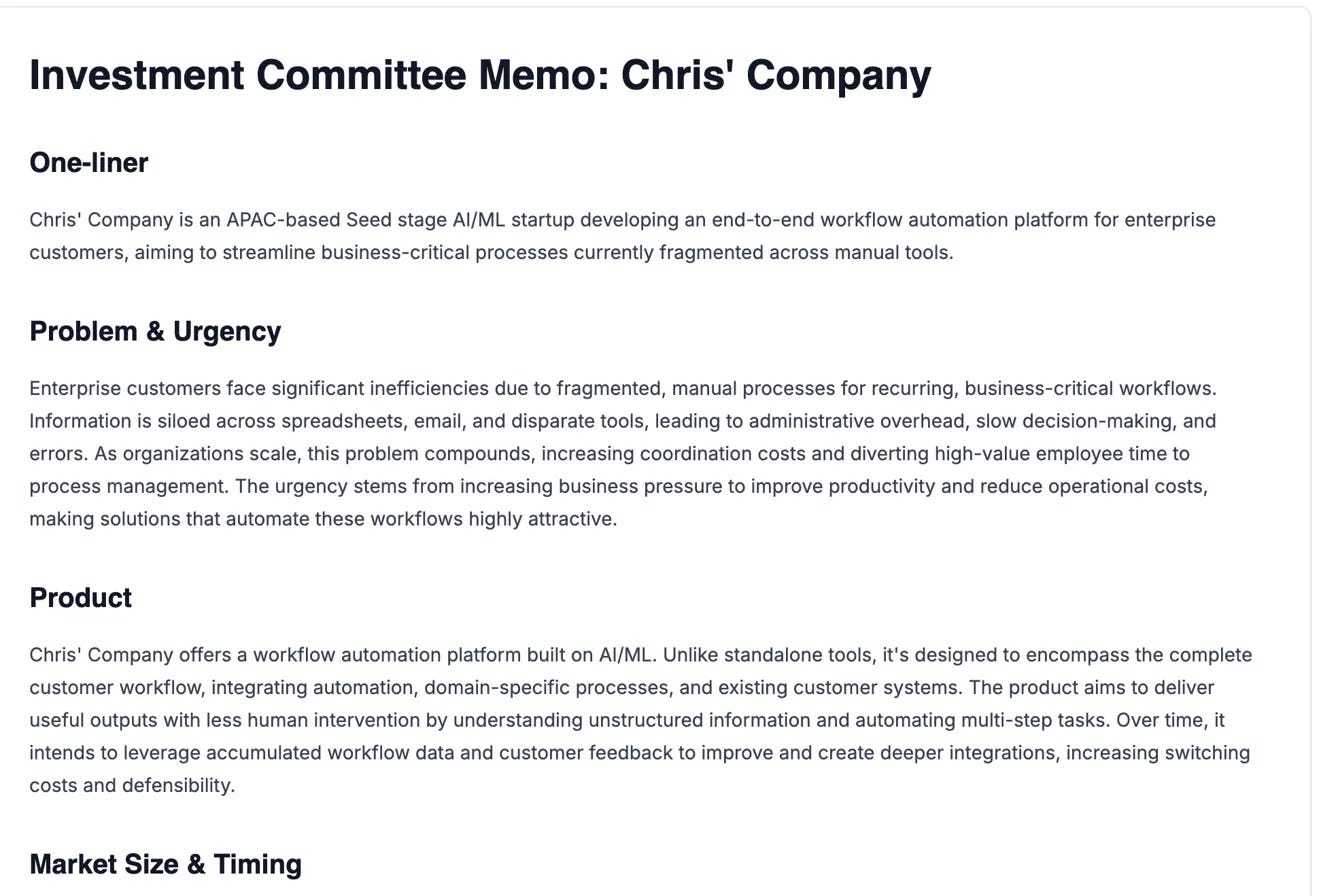
This is the artefact no founder has ever read about their own company.
It opens with a one liner, and that sentence matters more than the rest of the document. It is the version of you that travels, repeated to a partner who was on a plane and an LP at a dinner. Write your own before you run the tool. If the machine’s is clearer, your positioning is not landing.
The memo continues through seven further sections: Traction, GTM Motion, Unit Economics, Team, Deal Terms, Key Risks and Recommendation Rationale. This is where the divisions from step two reappear in writing. The traction section credited the growth, then flagged that 20,000 customers inside a $50K to $100K band needs clarification. The economics section called the 80% gross margin excellent, then noted that a 0.8x burn multiple is overshadowed by the poor retention.
Every section traces back to a field you filled in.
Our Most-Read Articles Right Now
🔥 The Pitch Deck Test Investors Use in 30 Seconds What a partner decides about you before the second slide.
📈 How Investors Decide If You Are Ready to Raise Stage by stage expectations, so you know what is wanted next.
🔥 The Investors Who Actually Write Cheques In 2026 The layer of capital that does not call itself venture.
📋 The Most Dangerous Document a Founder Will Ever Sign The clauses that matter more than valuation.
8️⃣ The Debate
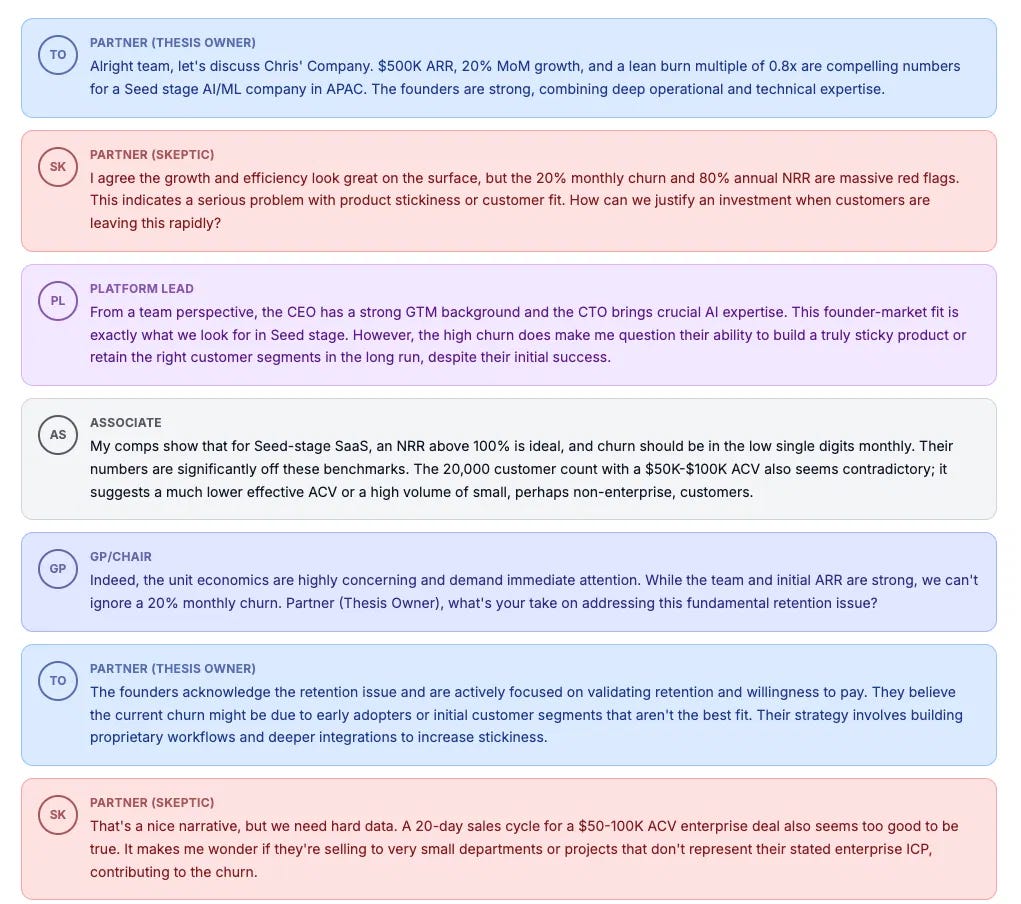
Five personas, five jobs. The Thesis Owner champions you. The Skeptic is assigned to break the case. The Associate arrives with comps and a calculator. The Platform Lead decides whether they want eight years with you. The Chair does not adjudicate, they route.
Read the transcript as a sequence and the mechanism is visible.
The Thesis Owner opens on the ARR, the growth and the lean burn. The Skeptic comes straight in on 20% churn. The Platform Lead agrees on the team and then defects on stickiness, which is worth more to the Skeptic than their own argument. The Associate produces the benchmark: Seed SaaS wants NRR above 100% and churn in low single digits.
Then the Chair routes the retention question directly to the Thesis Owner.
This is the decisive moment in every committee and it has nothing to do with you. Your champion is alone, being asked for evidence, and whatever you gave them is all they have.
On this run they answered with narrative: early adopters, wrong segments, deeper integrations coming. Not one number. The Skeptic replied that it was a nice story but they needed hard data, then merged it with the 20 day sales cycle to argue the real buyer was never enterprise.
Two weaknesses became one. That is how deals die.
9️⃣ Objections And Action Plan
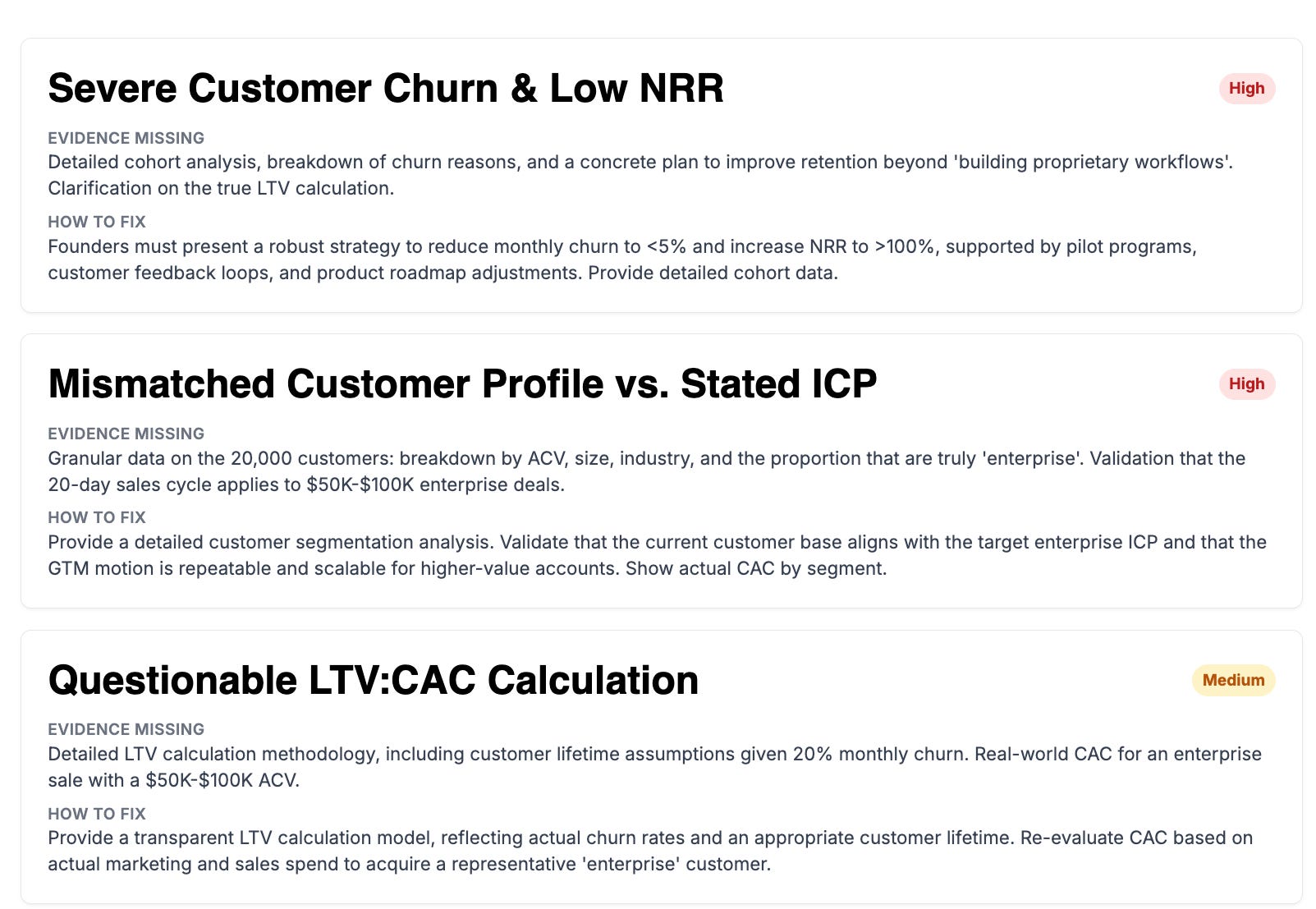
The debate is theatre. This is the operating document.
Four risks, ranked not by size but by how fast each one stops the deal: retention and willingness to pay, GTM scalability, commoditisation of the underlying AI, and the LTV:CAC discrepancy.
Crucially, the tool does not tell you the objections are unfair. It names what would answer them. A cohort curve by segment. A cycle length distribution split by deal size. The LTV working, shown.
An objection you cannot answer is a pass. An objection you can answer with a document is a follow up meeting.
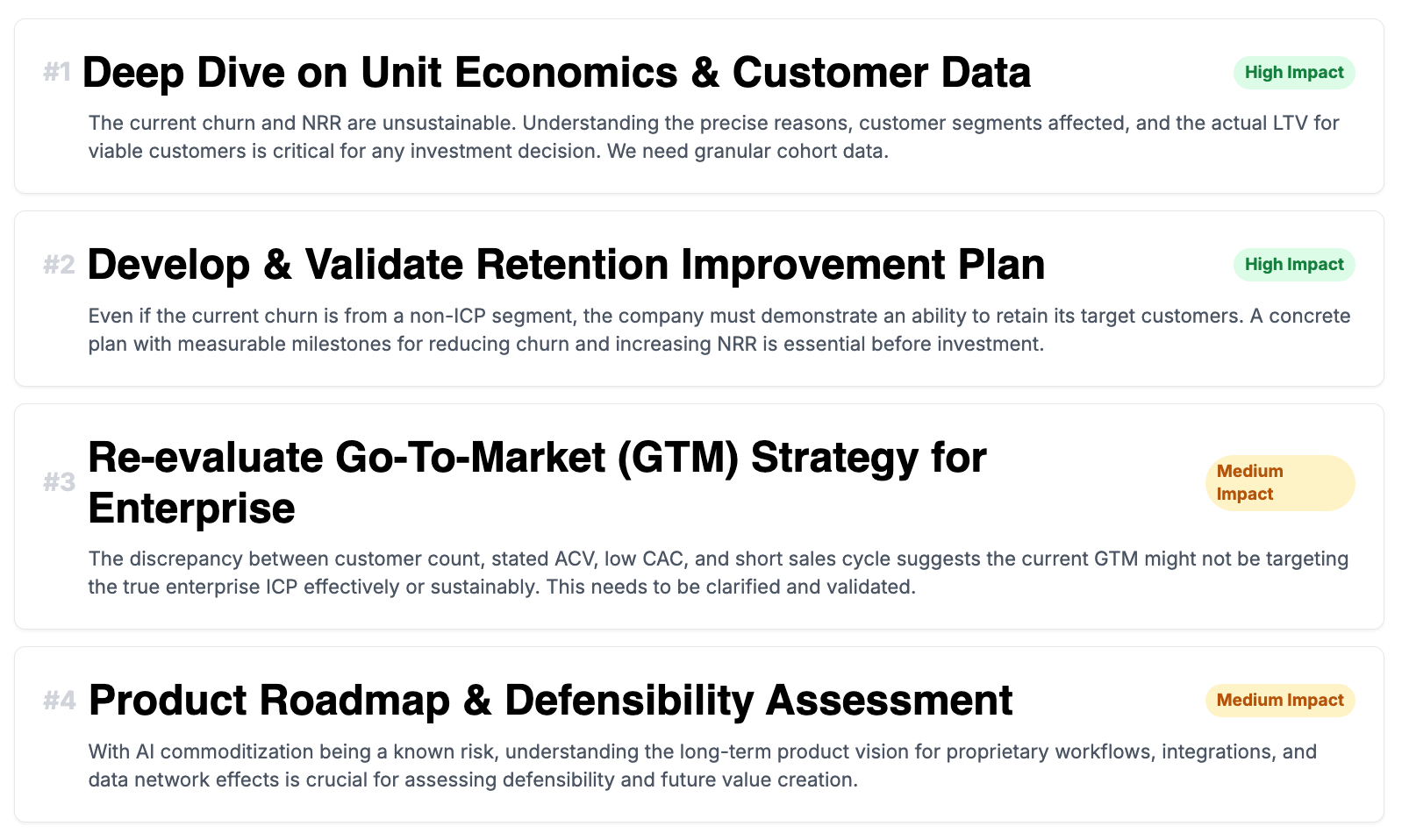
The action plan then converts those objections into sequenced work. Segment the churn. Reconcile ACV against customer count. Split the sales cycle by deal size. Reprice for the segment that actually retains.
Four pieces of work, none requiring a product rebuild, and the difference between a Pass and a Lean In.
Closing Thoughts
I built this because founders lose rounds in a conversation they are not present for, and then receive a summary too polite to act on.
The simulator will not know your market the way a partner of nine years does, and it will occasionally be confidently wrong. Use it as a rehearsal against the questions rather than a verdict, because the questions are the part it gets right.
Rank your objections before someone else does. Write down the exact artefact that closes each one. Build the top two, and hand them to your champion before the meeting rather than after the pass.
The intake is free and live now. The full simulator, with the memo, the debate, the objection register and the action plan, is below.
👀 If you are raising this year, run it before the partner meeting, not after the pass.
Download Below
The Investment Committee Simulator