

You close the round.
You download a template. Highlights, lowlights, KPIs, asks.
You fill it in on the last Sunday of the month, half asleep.
It reads like every other update in your investor’s inbox. Because it is.
Then one month is flat. The next is busy. By spring, nobody has heard from you.
And nobody asked.

I’ve read investor updates for 17 years at Notion Capital, across eight funds and more than 500 founders.
Templates make an update complete. They don’t make anyone want to read it.
So instead of another template, I went looking for founders who published their real updates, in full. Three did. Here’s what they show.
Want to get in front of 250k+ founders and investors?
For sponsorship opportunities across The Founders Corner newsletter and LinkedIn (160k followers), email: founderscornermedia@gmail.com
The Founder Who Never Missed a Month
Hoala Greevy runs Paubox, a healthcare email security company that went through 500 Startups’ Batch 18 in 2016.
He has sent a monthly investor update since December 2016. Every month, good or bad, in his words.
In 2025 he published the format on 500 Global’s site. Bullet points. No essays. Five sections, in this order:
Mahalo. Thanks first, naming the investors who helped that month and how.
Key updates. ARR, new bookings, revenue churn, logo churn, NPS, customers, headcount, cash.
Highlights.
Lowlights. One example: his outbound sales team went from seven people to four, and the latest to leave was poached by Salesforce.
Blockers.
Then, sometimes, a photo from his life. Time in the water is how he deals with stress. Hence the halibut.

The first section is a thank-you, not a number.
That’s cleverer than it looks. Every investor on the list sees, by name, who helped this month and what the help was. It shows the rest exactly what a useful reply looks like.
The Founder Who Published All 13
Reza Khadjavi, co-founder of Shoelace, a retargeting tool for Shopify stores, did something almost nobody does. In April 2017 he published every update he’d sent, March 2016 to March 2017, with the original emails.
Over those 13 emails, monthly recurring revenue went from $2,230 to $32,726.

He didn’t think the updates were special. His explanation was consistency. Near the end of one month, an investor bumped into him and said she was looking forward to the next one.
That’s the bar. An investor who knows it’s coming, and wants it.
Two of Shoelace’s sections are worth stealing tomorrow.
The first was called “Scary Things.”
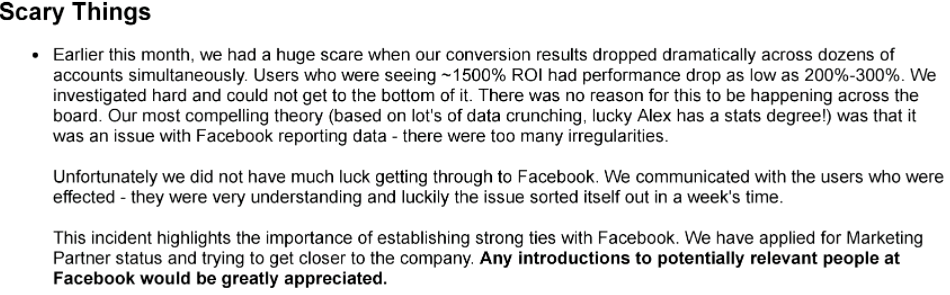
Look at how it ends. Not with an apology. With a request: introductions to people at Facebook.
A lowlight that ends in an ask stops being a confession and becomes a job. Your investors can’t fix your bad month. One of them might make one phone call.
The second sat at the bottom of every email.
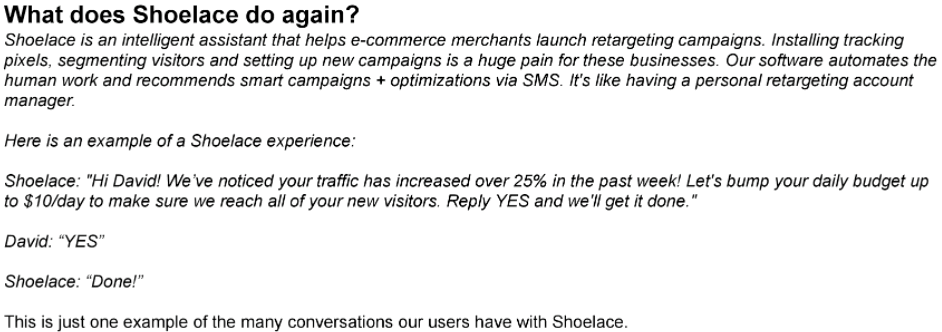
Why bother, when your investors already know what you do?
Because updates get forwarded. To a partner. To a co-investor. To the Series A fund someone’s having lunch with on Thursday. That person has never heard of you.
The last paragraph of your update is the first paragraph a stranger reads about your company.
The Founder Who Forgot to Start
Julia Enthoven co-founded Kapwing, the online video editor. After closing the seed round in June 2018, she sent no updates for two months.
Her investors didn’t ask for one.
Once she started, on the first of every month, roughly one investor in five replied with encouragement and another one in five answered an ask or sent a question. An investor at Sinai Ventures found the team its office after an ask in her first update.
Kleiner Perkins’ Mamoon Hamid told her a good early-stage update can be read in under two minutes. Village Global’s Erik Torenberg suggested five to ten asks, so every investor can help with something.
Nobody chases you for an update. That’s exactly the trap. Silence feels free, right up until the month you need something.
What Silence Says to an Investor
Paul Graham wrote about this in 2007, in an essay called How Not to Die.
When Y Combinator hadn’t heard from a startup for a couple of months, he said, that was a bad sign. When they emailed to ask how things were going and got no reply, it was worse. He called it, so far, “a 100% accurate predictor of death.”
That’s one investor’s observation about YC’s early batches, not a study. But I’ve never met an investor who reads silence differently.
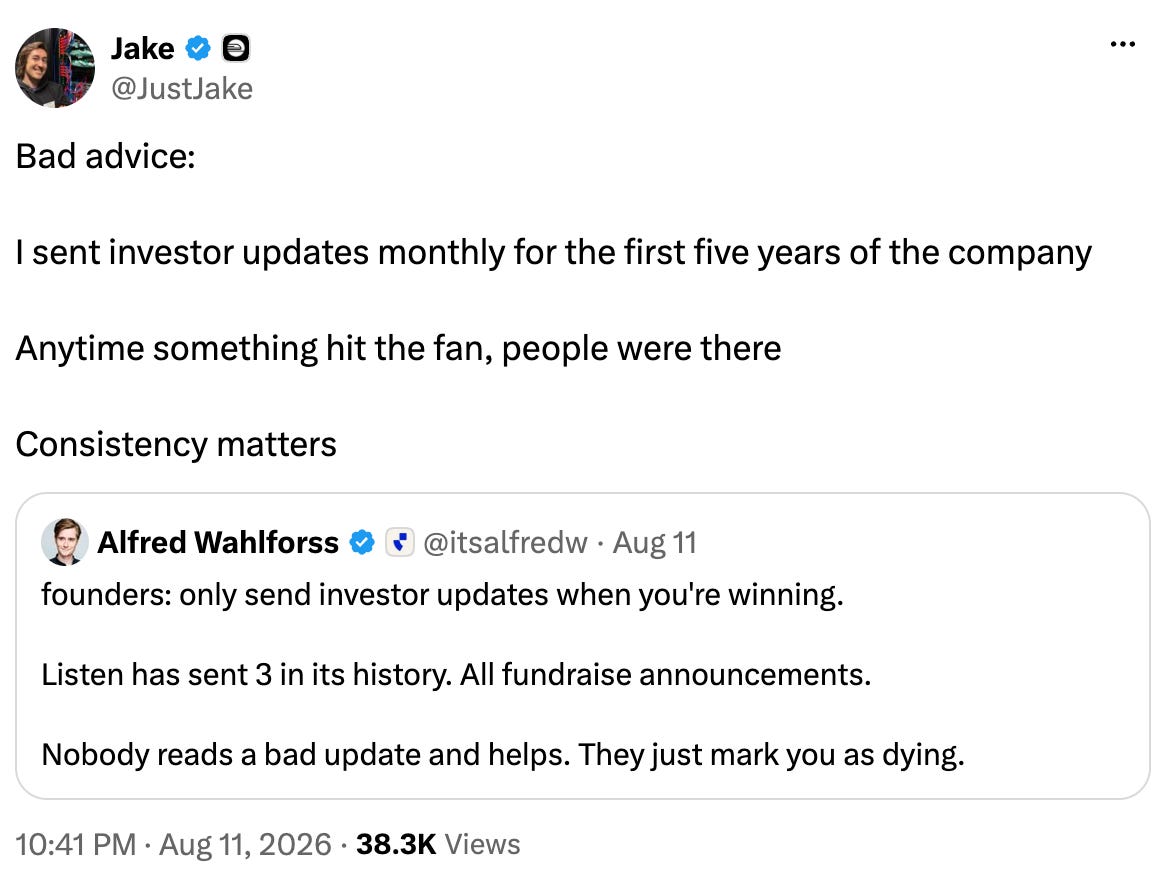
To be fair to the other side: Deel’s Alex Bouaziz told 20VC he stopped monthly updates when he felt most investors had stopped helping, and now sends them occasionally. He also warned that updates get forwarded, sometimes to competitors.
He’s right on both counts, for a company at Deel’s scale with a full board. At seed, the people on your update list are your board. And the forward is the point. Write it so nothing in it hurts you if it travels.
Our Most-Read Articles Right Now
🔥 I Ran a Startup Through a VC Investment Committee. It Died in Four Minutes. The memo and the verdict, before you walk in.
🔥 The Way VCs Actually Calculate Your Valuation The return maths that sets your price before the meeting starts.
📈 The 169 VCs Leading Rounds Right Now Who actually led a round in the last ninety days.
📋 The Founder’s Guide to Understanding Investors How to vet the people on your cap table before they’re on it.
What Real Updates Have That Templates Don’t
Put the three side by side and the same five things keep showing up.
Thanks by name, before the numbers. Paubox leads with it.
The same numbers, every month, with last month beside them. Shoelace never changed its five.
Every problem ends in an ask. “Scary Things” ends with a request for introductions.
One human line. A fish. A birthday. A first hire’s first week.
A footer for the stranger. What you do, in one paragraph, every time.
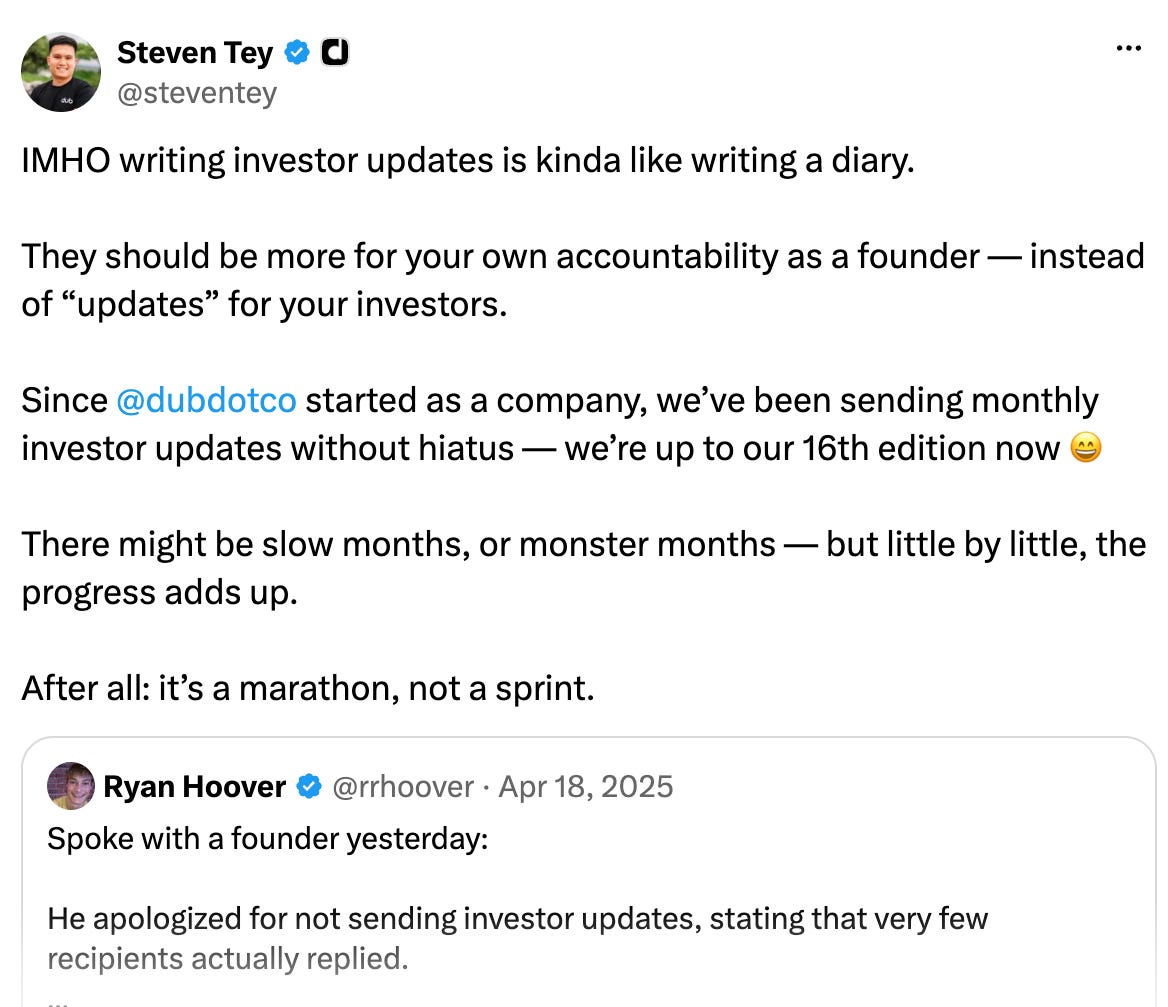
And one habit underneath all of it: the same day, every month. Kapwing sends on the first. Paubox hasn’t missed one since 2016.
The Test I’d Run Before You Hit Send
Here’s the question I ask of any update.
If I forwarded this to a partner at another fund, with one line on top, would they understand what you do, which way you’re heading and what you need?
If the answer’s no, the update did its job for the 12 people on your list and nothing for the one person who matters most: the one who isn’t on it yet.
“The last paragraph of your update is the first paragraph a stranger reads about your company.”
The Bottom Line
You write updates from a template, so they read like a template.
You lead with numbers and leave out who helped.
You confess bad months without asking for anything.
You assume every reader knows what you do.
You stop when nobody asks.
The fix: thank people by name first. Report the same numbers every month. End every problem with an ask. Add one human line. Finish with what you do. Send it on the same day, every month.
Start with the next one, not the one before you raise.
The next first-of-the-month is Tuesday, 1 December.
The file is waiting below.
The Update Investors Forward: Three Real Updates, Annotated, and the One I’d Forward
Exactly what you’re downloading:
A note from me. What makes me open an update the day it arrives, and forward it.
Three real updates, annotated. Paubox, Shoelace and Kapwing, section by section, with what to steal from each and links to the originals.
The Forward-Ready Update. One template, eight parts, with a complete worked example you can copy into an email.
Trouble to Ask. Six bad months, each rewritten in three beats so it ends with a request an investor can act on in one reply.
30 human lines. Prompts for the one sentence that makes an update sound like a person wrote it.
The Forward Test. Six questions to run before you hit send.
The 12-month habit. The calendar, the reminder, and what to send the month you have nothing good to say.
Write the footer first. It takes five minutes, and you’ll use it every month for the life of the company.
Paid subscribers also get:
60+ additional tools across every stage of fundraising and company building: investor research, pitch deck screening, meeting prep, term sheet analysis, financial models, and the full investor database library.
Download Below
Start your 7-day free trial → Cancel anytime.