

On 26 June 2008, three founders got the introduction every founder wants.
Seven prominent Silicon Valley investors. One email.
They asked for $150,000. For 10% of the company.
Five said no.
Two never replied.
Twelve years later, that company closed its first day of trading worth $86.5bn.
The Airbnb deck is the best twelve slides a founder can study, because it shows what investors saw, what they missed, and the one slide that made a $86bn company look small.
We’ve got the full deck. Here are the first four slides, and what each one did.
Want to get in front of 250k+ founders and investors?
For sponsorship opportunities across The Founders Corner newsletter and LinkedIn (160k followers), email: founderscornermedia@gmail.com
The Round Nobody Wanted
Michael Seibel made the introductions. Brian Chesky published the replies seven years later.
The ask: $150,000 at a $1.5m valuation.
The rejection reasons read like every no a founder still gets today:
Not our area of focus.
Outside our target markets. Come back at the Series A.
Too stretched right now, with worries about traction, technical hiring and the syndicate.
We’ve never been able to get excited about travel.
And the fifth. The market opportunity looked too small for our investment model.
Remember that last one. It comes back.
We can’t prove which version of the deck those seven saw. Chesky’s post shows the emails, not the slides. But the deck that survives makes exactly the argument they turned down.
Here’s what happened instead.
Y Combinator put in $20,000 in 2009. Sequoia followed with a $600,000 seed.
By 2015 the 10% the seven passed on would have been worth $2.4bn.
In December 2020 Airbnb priced its IPO at $68 a share and closed day one at $86.5bn.
$1.5m to $86.5bn. Roughly 57,000 times the price of the round nobody wanted.
That’s the company’s value, not any one investor’s return. Dilution across a decade of rounds would have cut a 10% stake many times over.
Last year it booked $12.2bn of revenue. It has more than 5 million hosts in over 220 countries and regions, according to its latest annual report.
So what was in the deck?
Slide 1: Seven Words That Name the Enemy
“Book rooms with locals rather than hotels.”
That’s the whole cover.
It names the customer: a traveller who needs a room. It names the supply: locals. And it names the incumbent the company is coming for: hotels.
Sequoia’s Writing a Business Plan tells founders to define the company in a single declarative sentence. Sequoia opens that same guide by noting that Airbnb’s founders used it to build their deck.
Most decks open on a logo and a tagline nobody remembers. This one opens on a fight.
Hold on to the word “hotels”. Slide five quietly takes it back.
Slide 2: Three Problems, Both Sides of the Market
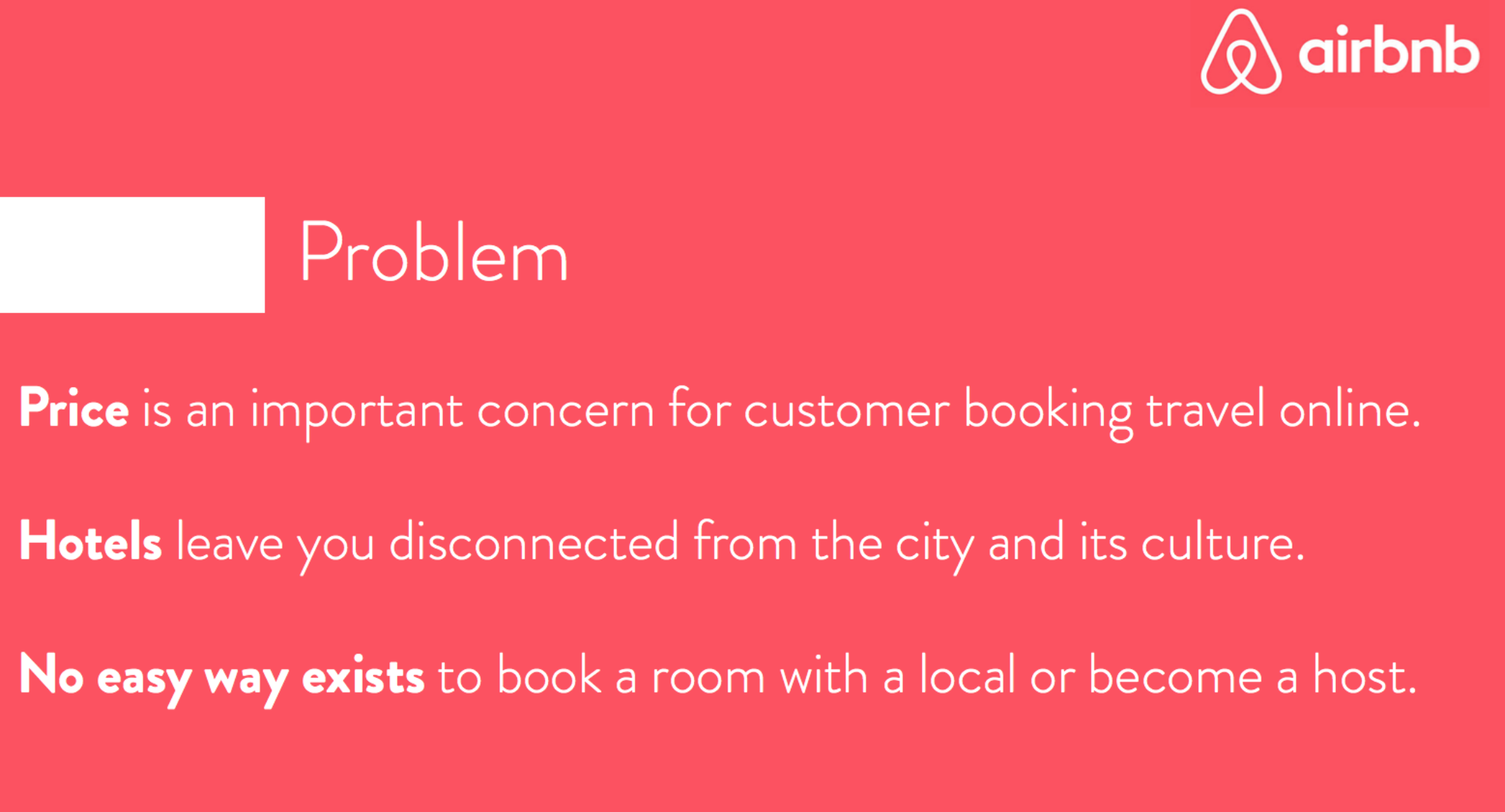
Three lines.
Price matters to people booking travel online.
Hotels leave you disconnected from the city and its culture.
No easy way exists to book a room with a local, or to become a host.
The first two are the guest’s problem. The third is both sides at once.
That’s the line most first-time marketplace founders miss. They describe the buyer’s pain and forget the seller has one too. A marketplace with no supply is a website.
Airbnb pitched the host’s problem on slide two. Hosts became the company.
Slide 3: A Marketplace in Three Icons
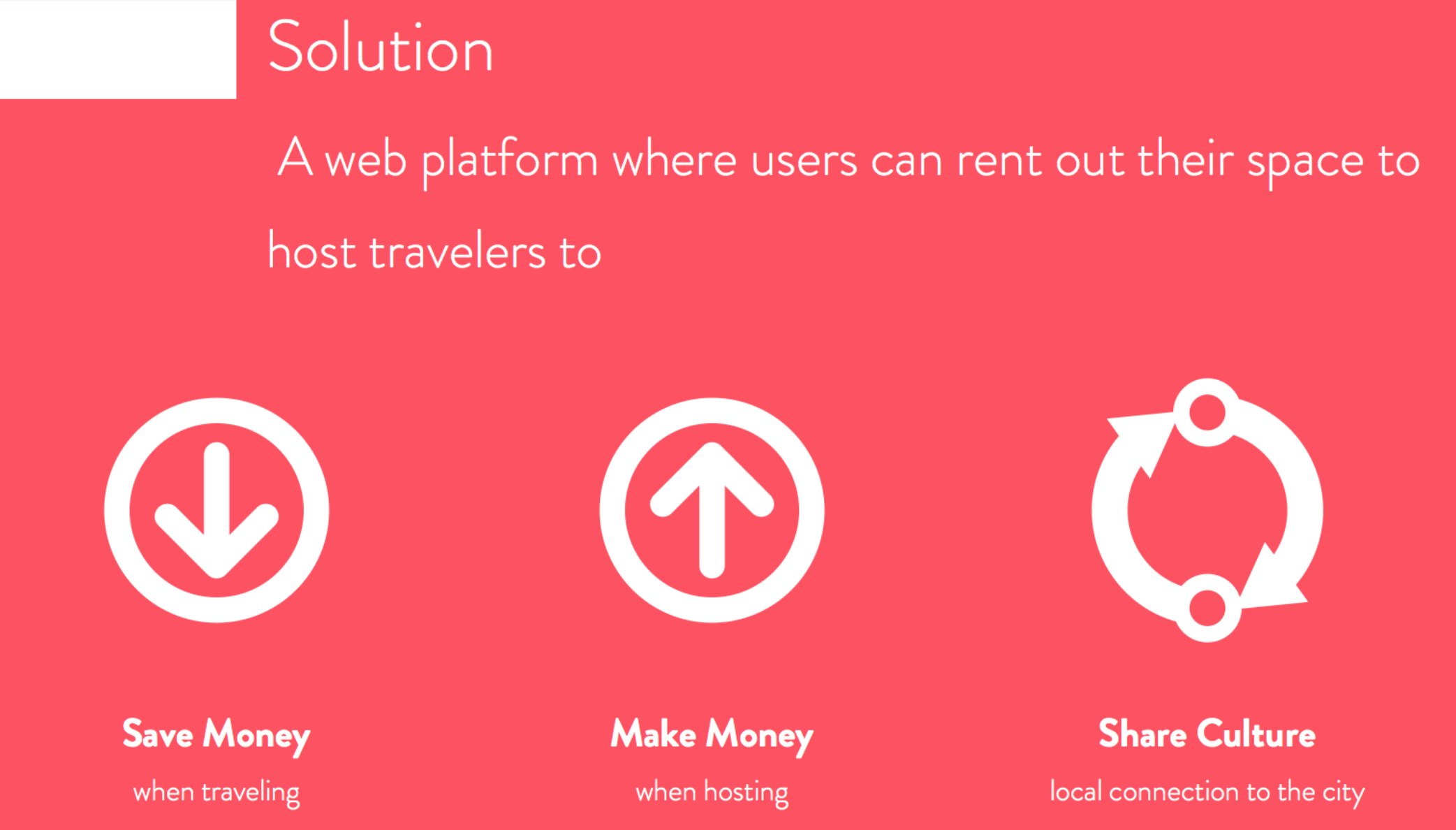
Save money when travelling.
Make money when hosting.
Share culture with a local connection to the city.
Two economic promises, one emotional one. One for each side of the marketplace, and one for both.
Every two-sided business should be able to draw this slide. If you can’t say what each side gets in three words, the investor will assume one side gets nothing.
Slide 4: Proof Borrowed From Someone Else
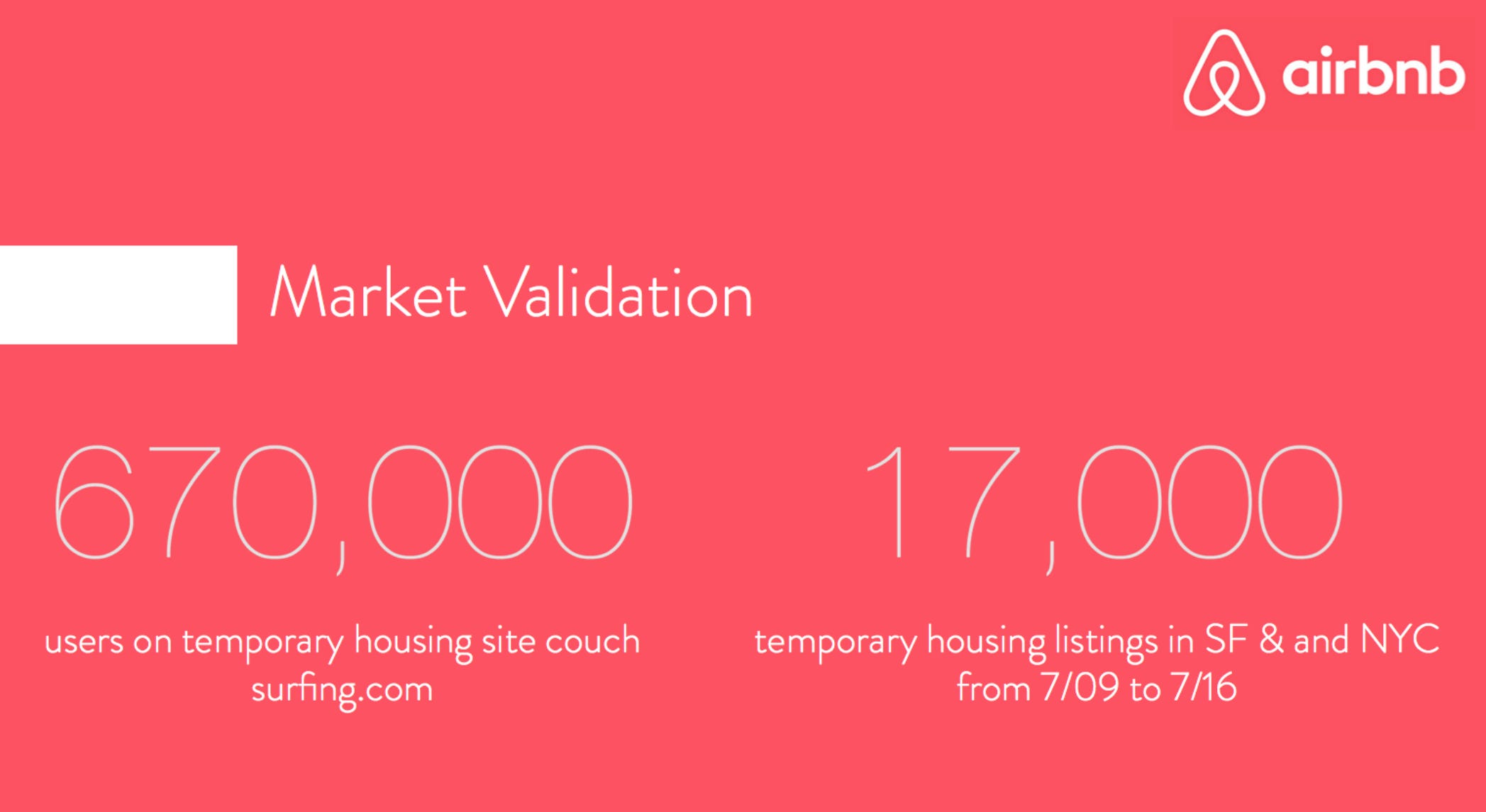
Two numbers.
670,000 users on CouchSurfing.
17,000 temporary housing listings on Craigslist in San Francisco and New York, in one week.
Not one of those users or listings belonged to Airbnb.
That’s the genius of the slide. With almost no traction of its own, the deck proved demand by pointing at people already doing the behaviour on worse products. Strangers sleeping on strangers’ sofas. Strangers renting rooms off a classified ad.
If people will do it badly for free, they’ll do it well for a fee.
It’s the right move for a company with nothing yet. It’s also a slide with an expiry date, and later in the deck you’ll see what replaced it.
Our Most-Read Articles Right Now
🔥 The Pitch Deck Test Investors Use in 30 Seconds — Now You Can Too How your deck really lands, before the silent no.
🔥 The Way VCs Actually Calculate Your Valuation The return maths that sets your price before the meeting starts.
🔥 I Ran a Startup Through a VC Investment Committee. It Died in Four Minutes. The memo and the verdict, before you walk in.
📈 The 169 VCs Leading Rounds Right Now Who actually led a round in the last ninety days.
Then Comes Slide Five
Four slides in, the deck is doing almost everything right.
A one-line company. A problem for both sides. A marketplace in three icons. Demand proven before there was any to show.
Then the market slide.
Three circles. The biggest says 1.9 billion trips.
That’s the number founders remember. It’s the number they copy.
It isn’t the number an investor prices.
One of the other two is. Take it to the business model on slide seven and multiply.
The answer is the fifth rejection email.
Almost word for word.
What’s Below the Paywall
The Full Airbnb Pitch Deck. All 12 slides, ready to download, from the cover to the two competitive advantage slides
Slide 5: The Number Investors Actually Priced. The two-line calculation that turns Airbnb’s own market slide into “too small for our model”, and how to run it on yours before an investor does
Slide 7: The Business Model Maths. What the deck’s revenue line told a venture fund, set against the exit a fund needs to return itself
Wrong in Both Directions. What the deck projected for 2008 to 2011, what Airbnb actually booked, and the one kind of error investors never forgive
Slide 8: The Growth Hack Hidden in Four Words. The line at the bottom of the adoption slide that became one of the most studied growth moves in startup history
Slides 9 to 12: Competition and Advantage. The two-by-two every investor has seen ten thousand times, the claim the deck contradicts one slide later, and the advantage that sat sixth of six and turned into the moat
If Airbnb Pitched This Deck in 2026. The three slides it would add, the one it would rewrite, and five moves to take into your own deck
Paid subscribers also get: 60+ additional tools across every stage of fundraising and company building: investor research, pitch deck screening, meeting prep, term sheet analysis, financial models, and the full investor database library.
Start your 7-day free trial → Cancel anytime.
