Here’s something most fundraising advice will never tell you.
Your deck probably isn’t the problem.
The problem is that you’re reading it like a founder, and investors read it like a filter.
Those are two completely different documents.
Brought to you by Deel: $1,000,000 for a 5-minute application.
Most founders spend months trying to get in front of the right investor.
This flips it.
Deel just launched The Pitch, presented by J.P. Morgan - a global startup tournament deploying $15M+ into early-stage companies.
Up to 100 regional winners receive $50K.
From there, 10 founders advance globally.
Each receives a $1M SAFE.
No warm intros.
No gatekeepers.
Just product, team, and ambition.
The application takes minutes.
The upside is asymmetric.

Apply here.
The 30-Second Decision You Don’t Know Is Happening
Before any investor says a word to you, before the polite “we’ll circle back,” before the request for a follow-up call that never comes, a decision has already been made.
It happens in the first half-minute. Sometimes less.
Research across more than 1.3 million real investor sessions found that 31% of readers bounce within the first ten seconds. A third of your potential investors are gone before slide two. Another 15% drop off within the first minute. But here’s the other side of that data: 82% of investors who reach slide four finish the entire presentation. The entire war is won or lost in those opening moments.
And yet most founders have no idea what those moments look like from the other side.
This is the problem I have spent 25 years watching play out. After reviewing more than 20,000 decks, sitting through every variation of a partner meeting, and backing founders across multiple cycles, I know what early pattern recognition looks like. I know the exact moment an investor’s posture shifts from curious to closed.
Most founders never get to see that moment. They get feedback later, if they get it at all. Polite. Surface-level. Useful to no one.
That’s why I built Deck Hack.
Why the Feedback Loop is Broken
The fundraising feedback loop is broken by design.
Investors are not incentivised to tell you what they actually thought. A soft no is safer than a specific one. “Not the right fit” is a complete sentence in venture. So founders leave meetings with a vague sense that something didn’t land, but no clear view of what or why.
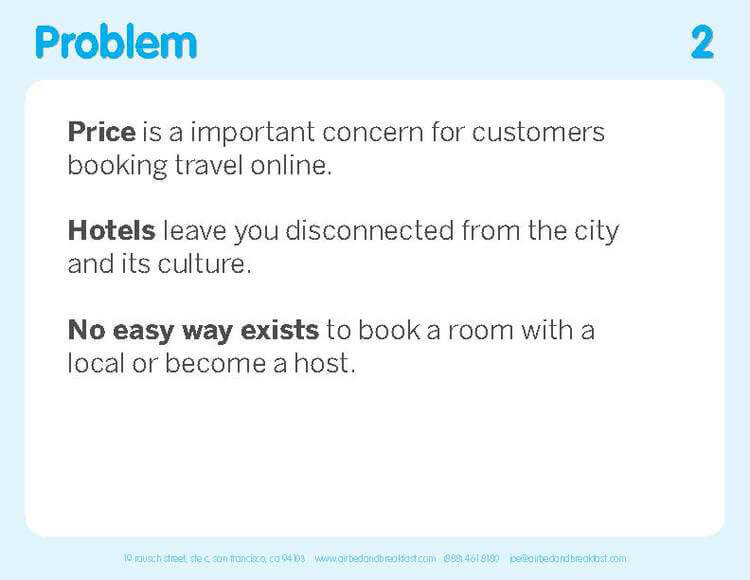
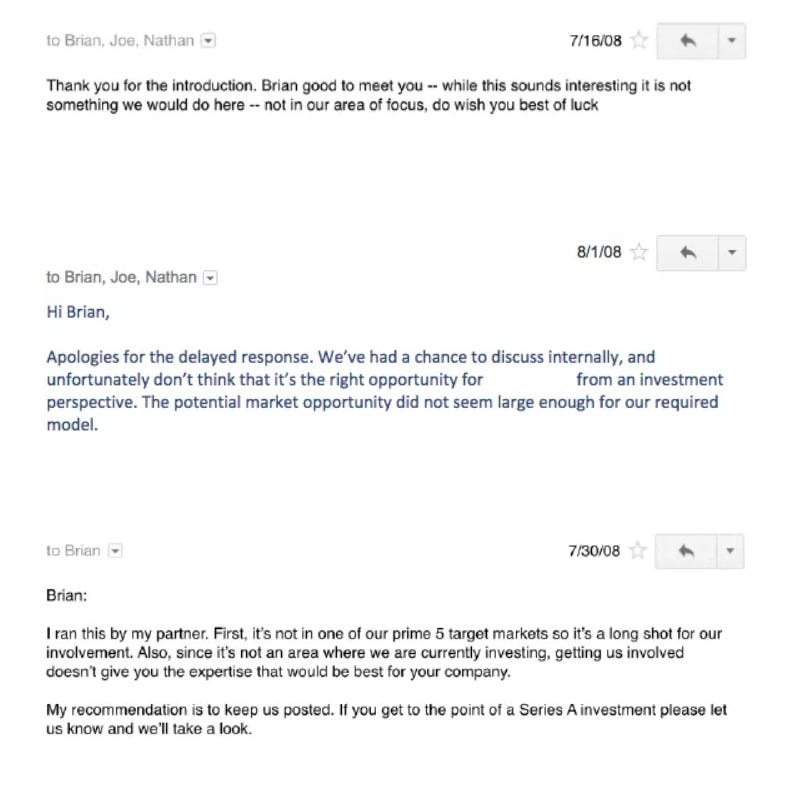
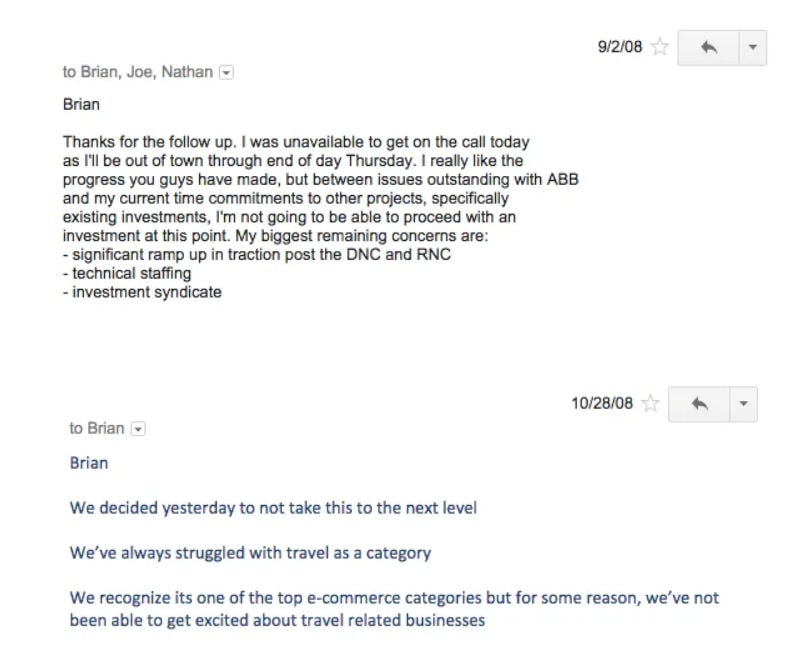
Consider what happened to Brian Chesky when he was raising the seed round for Airbnb in 2008. He pitched seven investors. Five passed. Two didn’t reply. One rejection email read: “The potential market opportunity did not seem large enough for our required model.” That $150,000 for 10% of Airbnb would be worth billions today.
The result of a broken feedback loop is a guessing game played with real stakes. You update the market slide. Nothing changes. You tighten the financials. Still quiet. You redesign the whole deck. Same result.
What you needed wasn’t a redesign. You needed to see the deck through the investor lens before you sent it anywhere.
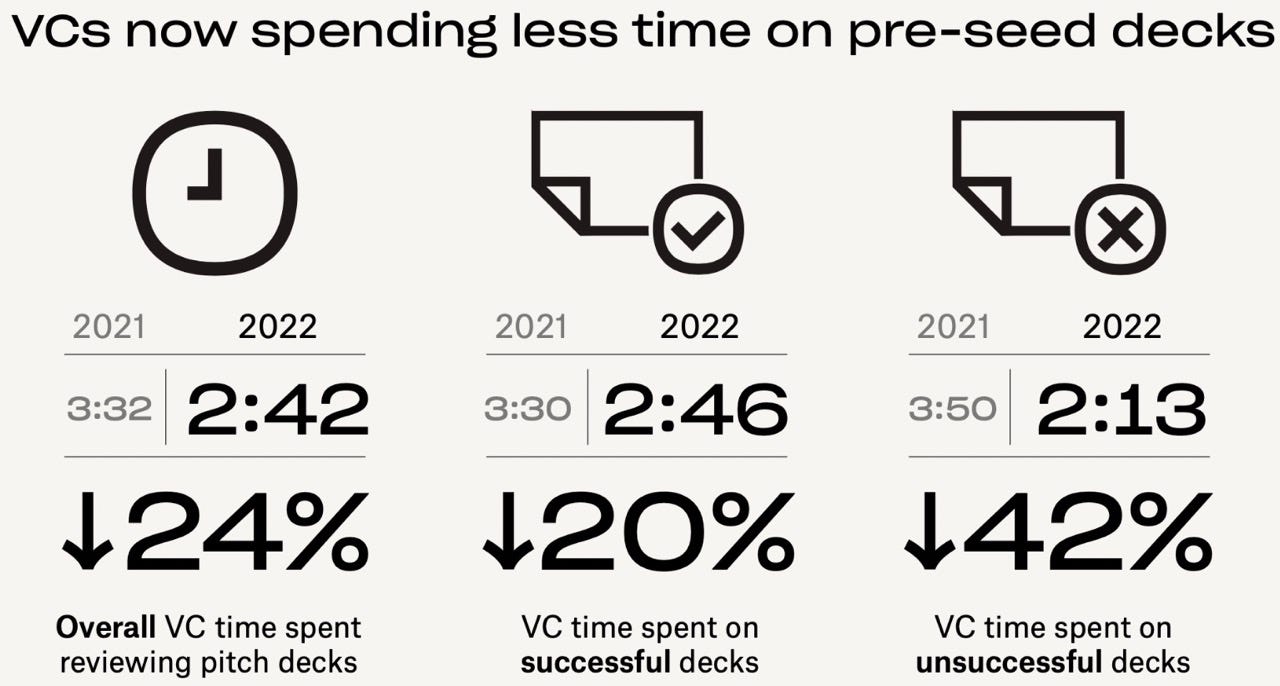
That lens is built on pattern recognition. Investors spend under three minutes on the average deck. In that window, they’re not reading your story. They’re scanning for signals: structure that holds together, a problem with urgency behind it, traction that proves real demand, a team that looks like it belongs to this problem. They’re also scanning for reasons to pass.
Not reasons to invest. Reasons to move on.
One weak signal in the first three slides can close the door before you’ve made your case.
The Numbers Behind the Problem
Average investor time on a cold deck: 2 minutes 24 seconds. Warm intros get 4 minutes 18 seconds and convert to meetings at 10x the rate. Cold decks convert at 3 to 5%. That gap tells you everything about the role your deck plays before trust is established.
A typical VC firm reviews somewhere between 500 and 3,000 decks per year and makes between 5 and 12 investments. That’s a pass rate of over 99%. The decks that survive aren’t necessarily the strongest businesses. They’re the ones that communicated clearly and quickly through a pattern-matching process that has no obligation to explain itself to you.
Here’s what investors are actually spending time on when they do read:
The Team slide gets 43% of total reading time. The Financials slide comes second. The Product slide gets the least time of any section.
Founders build decks assuming investors will linger on the product. Investors are trying to answer a different question entirely: is this a team I want to back, and can the numbers hold up?
What Deck Hack Actually Does
Most pitch deck tools do one of two things. They either help you build a deck, templates, generators, slide frameworks, or they give you generic feedback against a checklist. Neither of those is what you need when you’re preparing for a serious raise.
What you need is investor-grade pattern recognition applied to your specific deck before you walk into a room.
That’s what Deck Hack does.
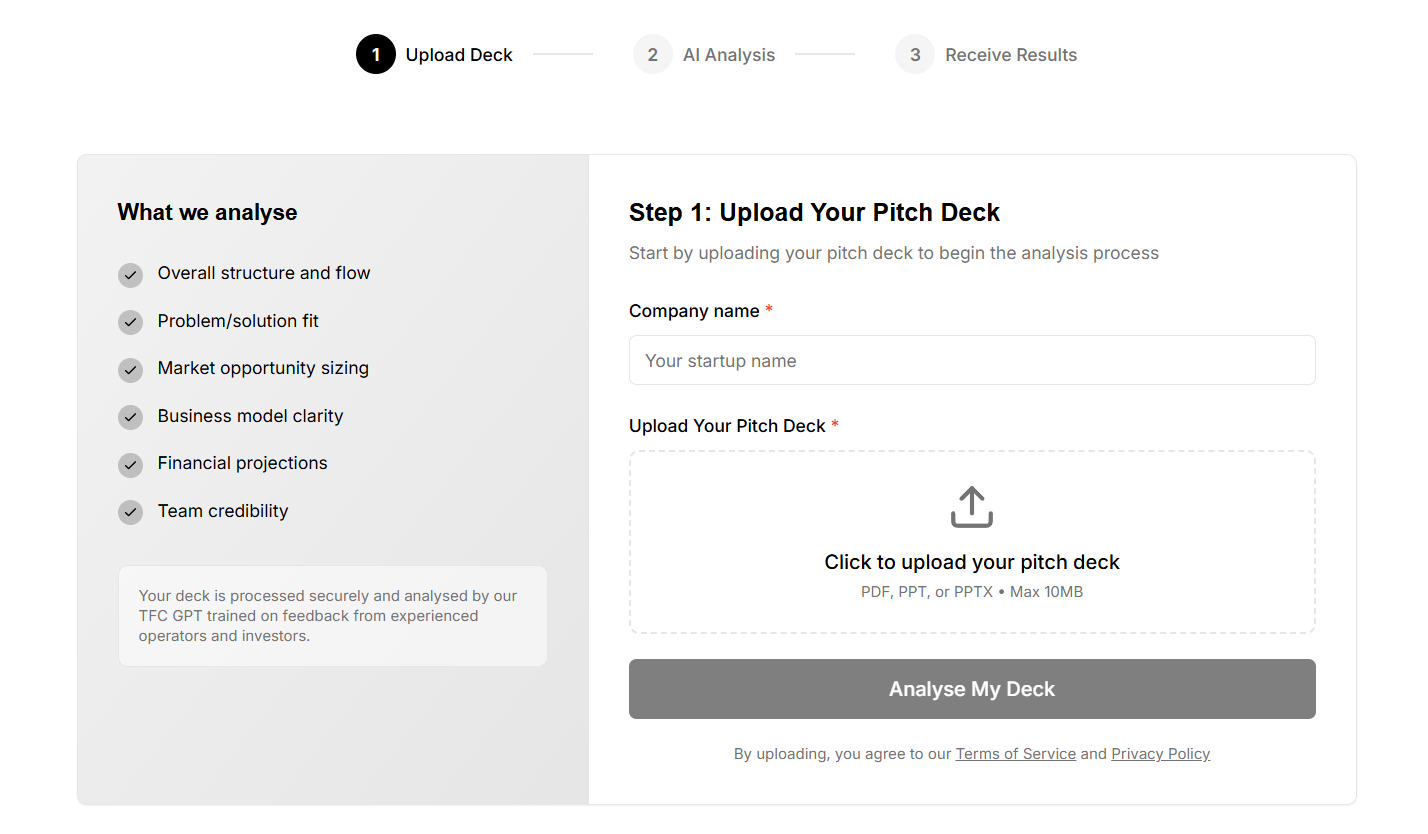
You upload your deck, PDF or PPT, and the tool analyses it in under a minute across the exact filters I use when assessing an early-stage company: narrative structure, problem clarity, market depth, business model logic, financial signals, and team execution indicators.
What’s Strong. The first output highlights the parts of your pitch that already work. This matters more than founders realise. Most feedback environments only surface problems. That creates a distorted picture. A deck with three strong signals and two weak ones can feel like a disaster when only the weak ones are visible. Knowing which parts are already landing gives you something to build from. Founders who understand their strengths communicate with more authority and conviction in the room.
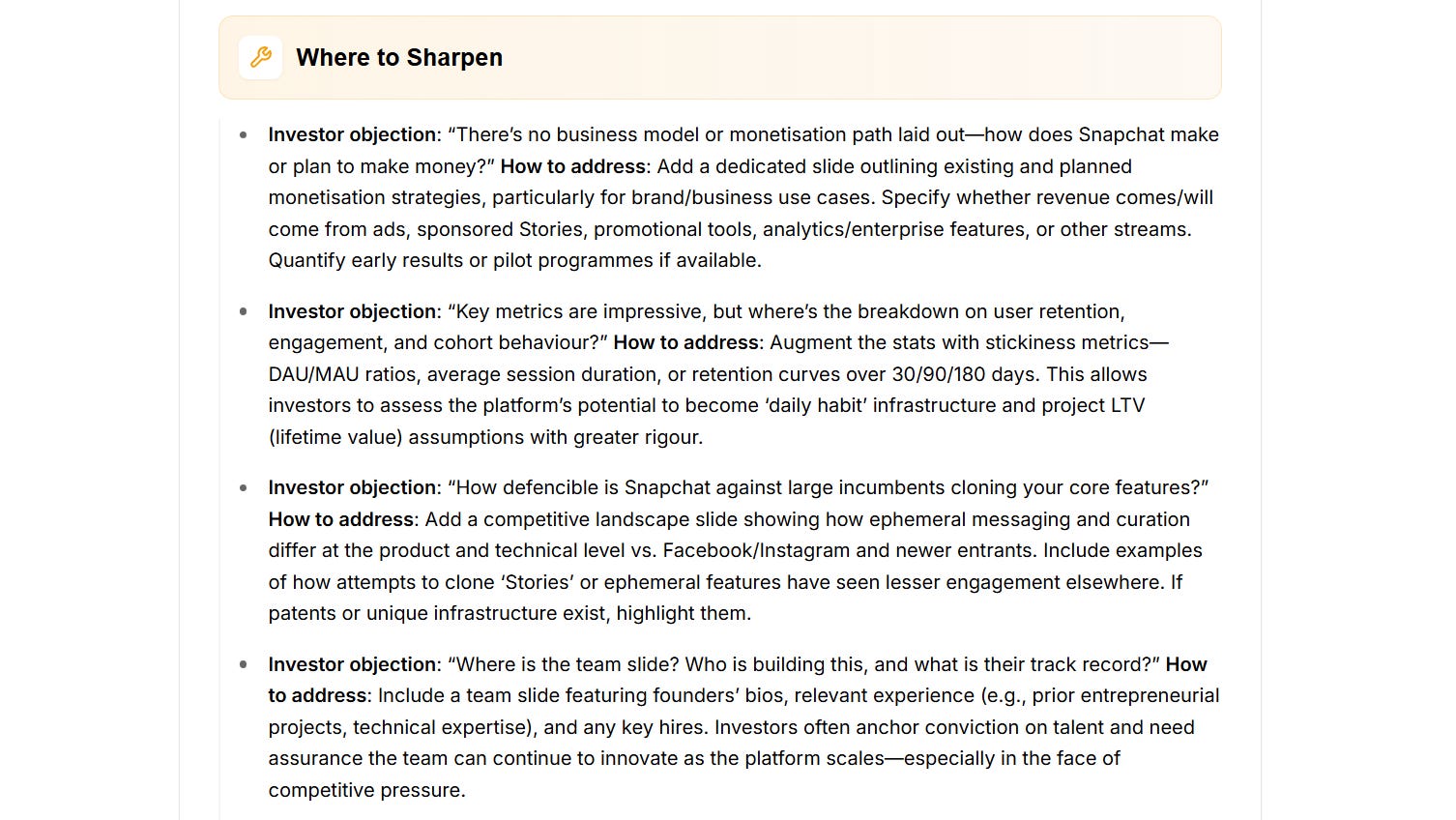
What’s Weak. This is where the real investor objections live. Not the ones they’ll mention on a call, those are surface questions. The internal ones. Is the traction repeatable? Where are the retention signals? What protects this from a well-funded competitor? Why this team for this problem specifically? The tool shows you each concern, explains why it matters, and tells you how to fix it clearly and fast. This is the kind of clarity founders usually only get after dozens of no’s.
Red Flags Identified. These are the signals that slow a process down or kill it without a clear explanation. A narrative that doesn’t connect the problem to the solution. Competitive framing that feels thin. Traction that sounds anecdotal. Market logic that leaves questions open. Weak evidence behind the model. Founders who eliminate these before a raise experience materially shorter cycles.
Tactical Recommendations. This is where insight becomes execution. Specific slide rewrites. Missing slides to add. Sequencing adjustments. Sharper framing for the business model. These are the same practical changes I make with portfolio companies when they’re preparing for investor conversations.
What the Output Actually Gives You
Most feedback tools give you a score and leave you to figure out the rest. Deck Hack ends with something more useful: your next actions.
Once the analysis is complete, you get a specific, prioritised set of improvements drawn directly from what the tool found in your deck. Not generic advice about storytelling or slide design. The exact moves that will close the gap between how your deck is reading now and how it needs to read to generate meeting requests. Slide rewrites. Missing sections to add. Sequencing changes. Sharper framing for the parts that are creating doubt.
This is the output that matters. Not a rubric. Not a template. A precise, personalised set of instructions built from the same pattern recognition I apply when I sit across from a founder in a partner meeting.
The Real Fundraising Problem
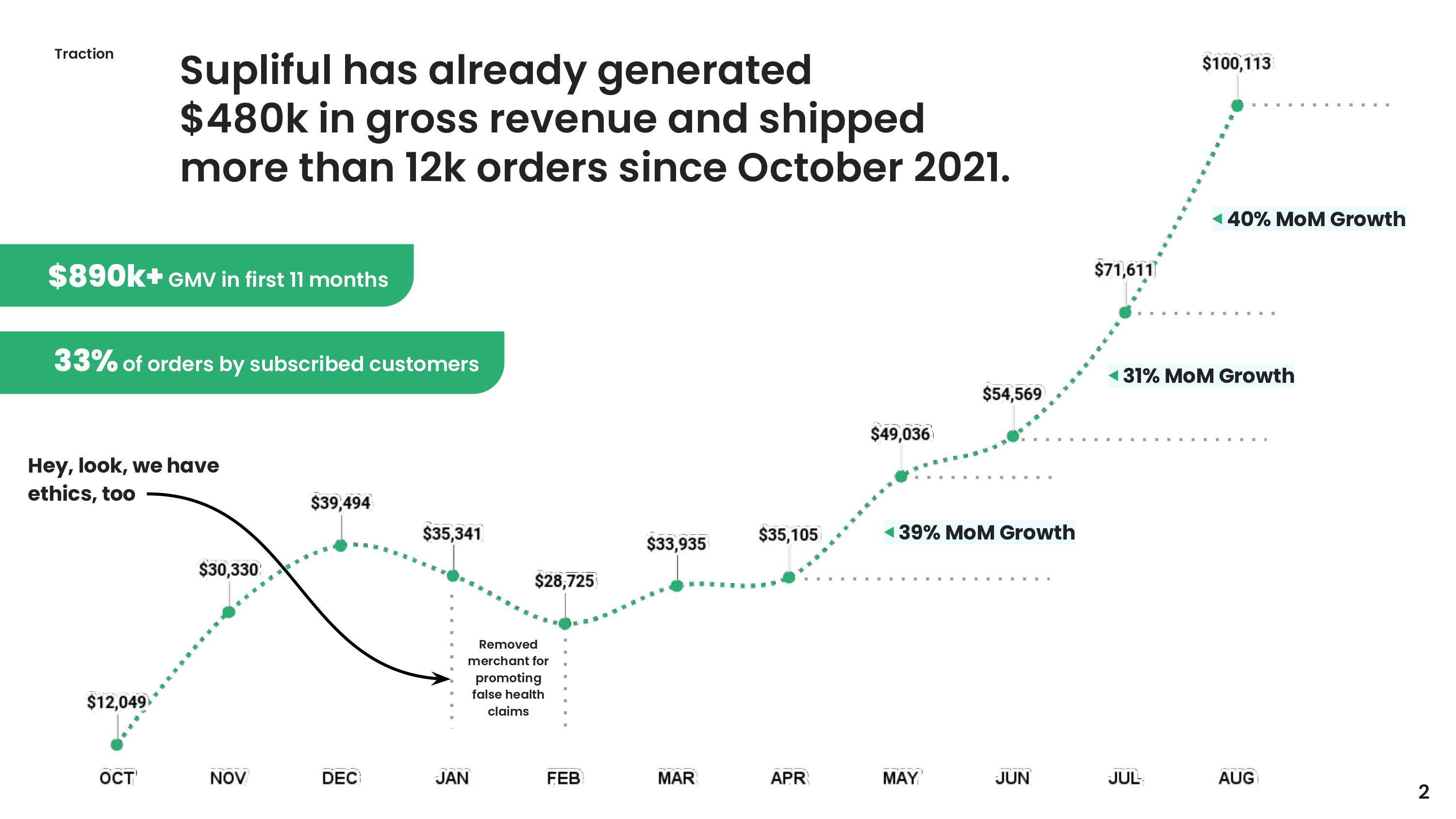
There’s a reason fewer than 1 in 400 pitches secures VC funding at the pre-seed level. It’s not that most ideas are bad. It’s that most founders and most investors are not looking at the same picture.
Founders are presenting what they’ve built and where they’re going. Investors are evaluating pattern fit, signal quality, and risk concentration in under three minutes, alongside hundreds of other decks that week.
Most fundraising friction lives in that gap.
Deck Hack exists to close it. Not by making your deck prettier. Not by giving you a template that looks like it was built for someone else’s company. By showing you, specifically, for your deck, for your business, where the gap is and what to do about it.
A calibrated pitch removes avoidable no’s. It accelerates momentum. It opens conversations that would have stayed closed.
That’s not a design problem. That’s a clarity problem. And clarity can be built.
What Paid Members Get at The Founders Corner
Deck Hack is one piece of something larger.
Over the past 25 years, I have built, scaled, and exited companies of my own, and gone on to invest in more than 500. Every tool inside The Founders Corner was built from that experience: the things I wish I had as a founder raising capital, the frameworks I actually use when evaluating teams, and the knowledge that took me decades to accumulate made usable in minutes.
There are now more than 50 tools inside the membership. Each one is built around a specific moment in the fundraising and company-building journey. Not generic advice. Not recycled content. Tools I would have used myself.
These are the five most used by members right now:
The Number That Kills More Fundraises Than Any Bad Idea - why your market size slide is silently ending your raise.
The Investors Who Actually Write Cheques In 2026 - the capital layer outside VC that most founders never find.
The Quiet Filter That Decides Your Entire Fundraise - know who is a real fit before you spend hours on outreach.
The Way VCs Actually Calculate Your Valuation - the return model investors run before the meeting even starts.
How Investors Decide If You Are Ready to Raise - the exact signals that decide fundability at every stage.
Deck Hack sits at the centre of all of it. Because none of the above matters if your deck is losing investors in the first ten seconds. Before you target the right investors, before you defend your valuation, before you walk into a partner meeting, you need to know that your deck is working as hard as you are.
Run it through Deck Hack first. Know exactly what investors see. Then raise.
Access Deck Hack