

Most founders build their investor list the same way.
They open a database.
They filter by stage and sector.
They get 400 names, most of them firms that raised their last fund in 2021.
Then they send 400 emails and wonder why the replies sound tired.
Many of those funds are mostly invested. A new cheque means taking a slot from a company they already own. The partner who replies “too early for us” can mean “too late for this fund.”

Nobody publishes one list of the funds that closed this year, so founders keep pitching the ones that closed years ago.
So we built it. 312 funds, 12 regions, every row linked to its source.
Meet The Founders Corner Team
You know the email.
“Loved meeting you. Not quite right for us at this stage. Keep us posted.”
Translation: no. And no idea why.
Was it the traction? The deck? The valuation? You never find out.
This time you can ask.
On Wednesday 25 November at 4pm GMT, we’re hosting a live call for paid subscribers and free trialists. No camera-off webinar. You bring the problem, we dig into it with you.
Straight answers. Uncomfortable ones included.
🧭 Me. MessageLabs from tiny team to $700m exit, then co-founded Notion Capital. Operator and investor.
📣 Paul Watson. Sales won’t move? Paul works out who to sell to, what to say and how to make it repeatable.
💰 David Levine. CEO of Glenluna Ventures, Principal at Manchester Angels. Story, valuation, who to approach. Wonderfully blunt.
🛠 Your tools, actually opened. Investor readiness check, the 30-second deck test, and the filter across 2,500+ investors.
Three experts on your problem would normally take three intros and a lot of diary juggling. Here, it comes with your subscription.
Places are limited. Another call on 10 December.
👉 Start your 7-day free trial and the invite is yours. Book your place:
The Fund That Has to Say Yes
A venture fund has two lives.
In the first three to five years, it makes new investments. After that, it mostly writes follow-on cheques into companies it already backs, and waits.
Carta tracks this across almost 3,000 funds. By mid-2026, funds raised in 2025 still held 61% of their capital unspent. Funds raised in 2021 held 14%.
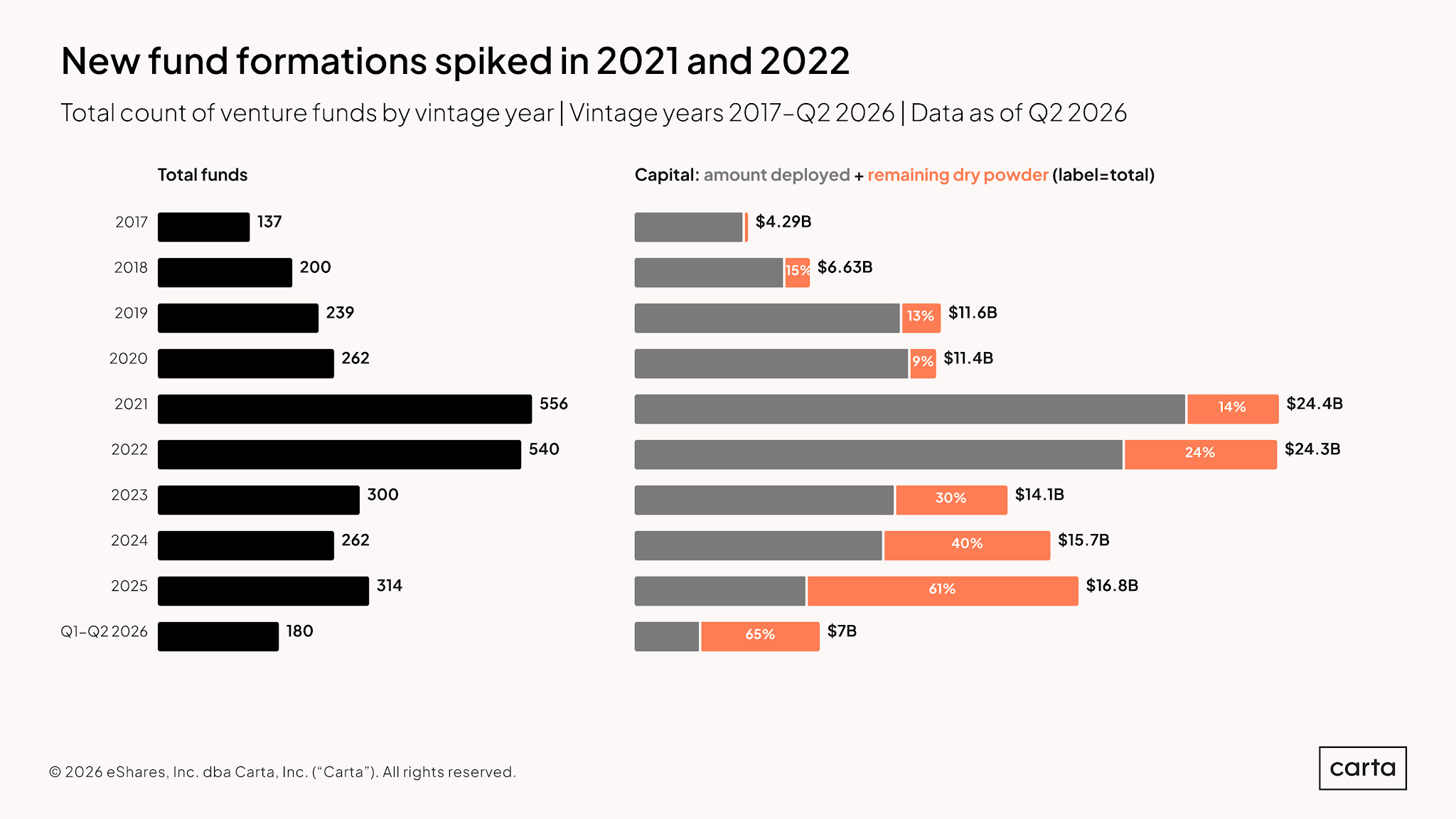
That gap is your opening.
A partner at a fund that closed in March has a mandate, a fresh pipeline to fill and LPs who expect to see the money working. A partner at a 2021 fund has a portfolio to look after and a shrinking number of new slots.
New fund + your stage + your sector = the shortest path to a yes.
The Money Went Big. The Seed Cheques Didn’t.
PitchBook and NVCA counted $108.5B raised by US venture funds through Q3, across 699 funds. That is already about 39% above the whole of 2025.
Look one level down and the picture changes. Funds of $500M or more took 78% of US capital while making up 6% of funds. Only 211 emerging firms closed a fund this year, against 927 in 2022.
Europe looks the same from the other side. Atomico’s State of European Tech report, out this week, puts the median European VC fund at $70M, down from $98M in 2024. About 100 funds close a year. None has closed above $1B in 2026.
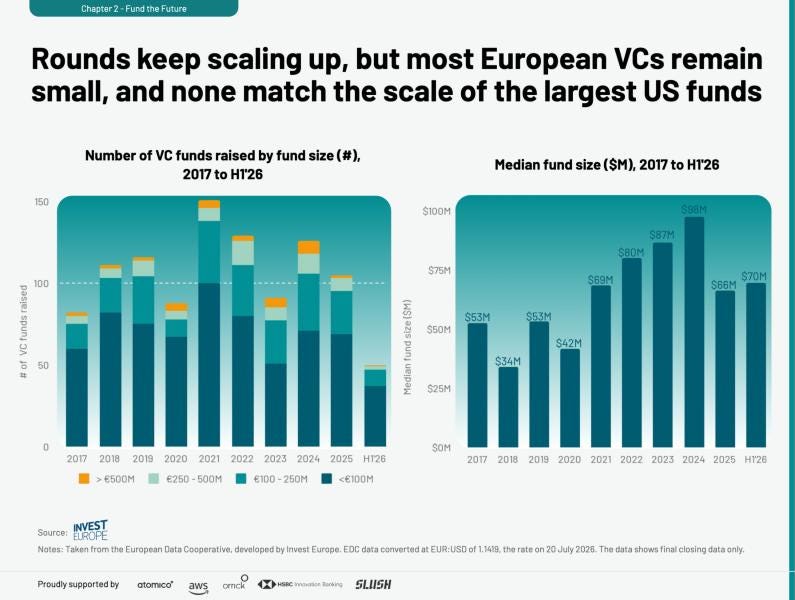
Our list shows the same shape worldwide. Of the 286 funds that disclosed a size, 159 raised under $100M and hold 10% of the capital. The 33 funds of $500M or more hold 61%.
The median fund on our list raised $81.6M.
That is the fund most pre-seed and seed founders should be talking to. The long tail of small new funds writes the first cheques.
What 312 New Funds Tell You
Of the 294 funds with a confirmed close, 184 say they back pre-seed or seed. 78 say they do Series A. 60 are a firm’s first fund.
Take one. In September, Connect Ventures announced a $55M first close of an $80M Fund V. It leads pre-seed rounds across Europe with cheques of $500K to $5M.
Funds like that matter more each year. Atomico counts a record 40,000 new European founders in 2026. Between 2021 and 2025, the number of first rounds they compete for fell 28%.
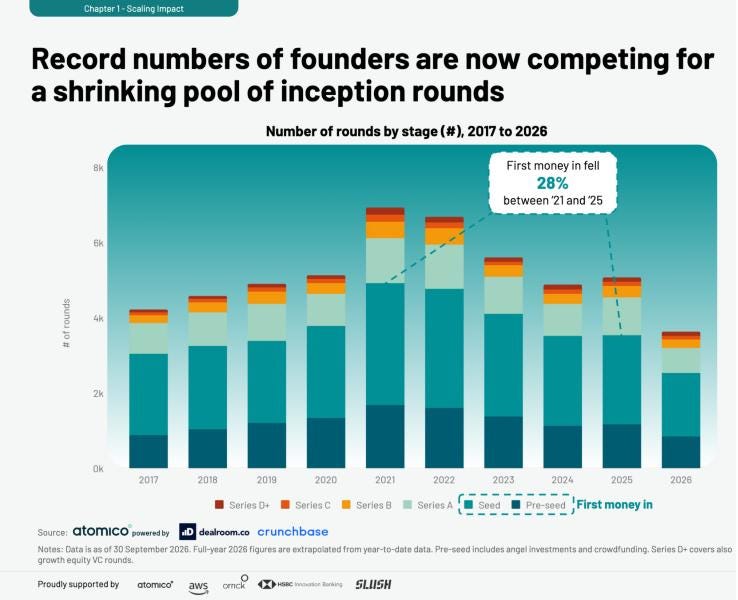
AI appears in the stated focus of 173 funds. Health shows up in 54, fintech in 45, robotics in 44 and defence in 31.
The list covers funds that announced publicly. PitchBook counts more US funds than we found, because many small funds close without a press release.
Our Most-Read Articles Right Now
🔥 The Quiet Filter That Decides Your Entire Fundraise Rank investors by real fit, and stop emailing the ones who were never going to reply.
🔥 The Only Cold Email Format Mark Cuban Actually Reads The outreach structure that earns investor replies, with the Cuban case study.
🔥 The Way VCs Actually Calculate Your Valuation (But Never Say Out Loud) The return maths that sets your price before the meeting starts.
📋 The Pitch Deck Playbook The 11-slide rubric investors score you against in under four minutes.
The Cheque Size Hiding in the Fund Size

A fund’s size tells you roughly what it can write.
Most early-stage funds plan for 20 to 40 new companies and hold back money for follow-ons. So:
First cheque ≈ fund size × 1% to 2%
Run it on real 2026 funds:
A $50M pre-seed fund. First cheques of roughly $0.5M to $1M.
Connect Ventures Fund V, $80M. Roughly $0.8M to $1.6M, inside its stated $500K to $5M range.
Now set that against what rounds cost in 2026.
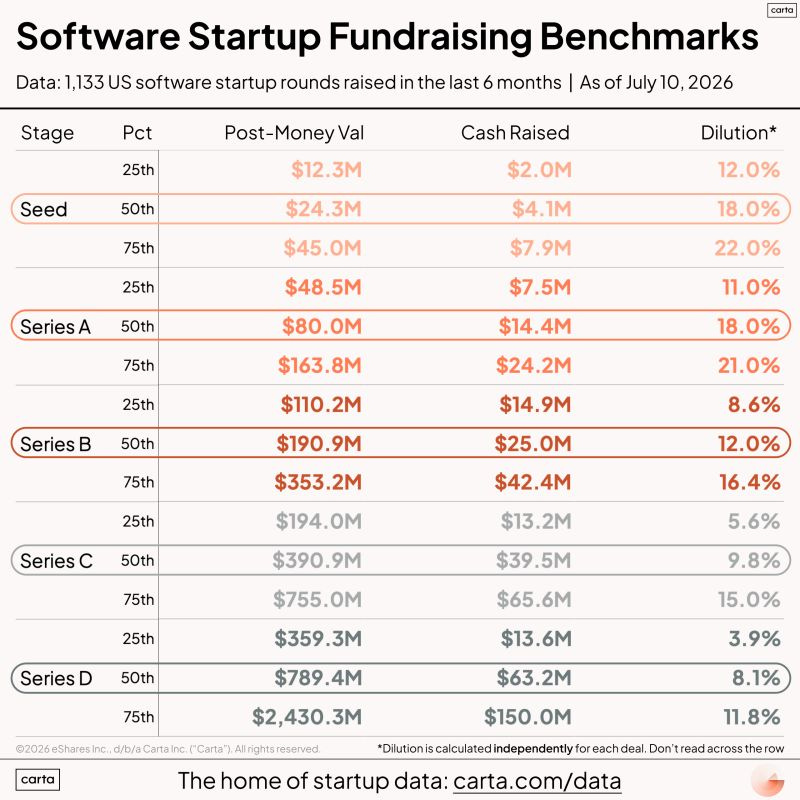
A $2M cheque into a $4.1M seed needs a fund of roughly $100M to $200M. A $7M cheque into a $14.4M Series A needs one of $350M or more.
Where a fund states its cheque size, use that number. Where it doesn’t, the formula gets you close enough to know whether to email.
Three Questions That Tell You Where the Fund Is
Carta’s Peter Walker has made the point plainly: founders can ask a VC where it is in its fund’s life. Most don’t.
Ask these in the first call:
Which fund would this investment come from?
How much of it is already committed?
How many new companies do you expect to add this year?
A vague answer to the second question usually means the fund is mostly invested.
Where Older Funds Still Win
Older funds still invest.
Carta’s data shows 2024-vintage funds still holding 40% of their capital, and a strong partner at a fund in its third year can still lead a round. A brand-new fund may be slower too, while it builds its team and process.
47 funds on our list have announced a first close and are still raising.
Some new funds fill their first year from their previous fund’s network. Check how they source before you send anything.
Even so, a fund in its first year needs new companies more than a fund in its fifth.
“The best investor for your round is often the one whose LPs are asking them, this quarter, where the money went.”
Pitch the Funds on the Clock
Founders pitch the brands they’ve heard of.
They pitch funds sized for $20M rounds with a $3M ask.
They never ask which fund the cheque would come from.
They treat a “pass” from a fully deployed fund as a verdict on the company.
The fix fits in two lines:
Start with funds that closed in the last 12 months, at your stage, in your sector.
Check the cheque fits: fund size × 1% to 2% should land within your round.
Build the list before you write the deck. The order in which you pitch decides who sets your price.
The file is waiting below.
The 2026 Fund Tracker: 312 Funds, Ranked to Your Round
Exactly what you’re downloading:
All 312 funds. Every venture fund we found that closed or launched between 1 January and 17 November 2026: firm, fund, region, HQ, size in USD and original currency, close status, date, stated stages, sectors, geography, stated cheque, named partners, website and a source link for every row
Pitch List. Enter your stage, region, three sector keywords and round size. It scores all 312 funds on stage, region, sector, cheque fit, recency and source quality, and returns your top 40 with partners and links
Estimated first cheque. Fund size × 1% to 2% for every fund, next to the stated cheque where the fund gives one
Outreach Email. A first email built from your inputs and your top-ranked fund, naming the fund it congratulates and the partner it’s addressed to
Summary. Funds, capital and median size by 12 regions, 5 size bands, 6 stage flags and 11 sector keywords, all live formulas
Market Context. The 2026 PitchBook-NVCA and Carta numbers on fundraising, concentration and deployment, with sources
Confidence flags. 126 rows from firm releases or major outlets marked High. Check Medium rows before you pitch
Filter to funds that closed in the last six months, run the Pitch List against your round, then ask the three questions on every first call.
Paid subscribers also get:
60+ additional tools across every stage of fundraising and company building: investor research, pitch deck screening, meeting prep, term sheet analysis, financial models, and the full investor database library.
Download Below
Start your 7-day free trial → Cancel anytime.