

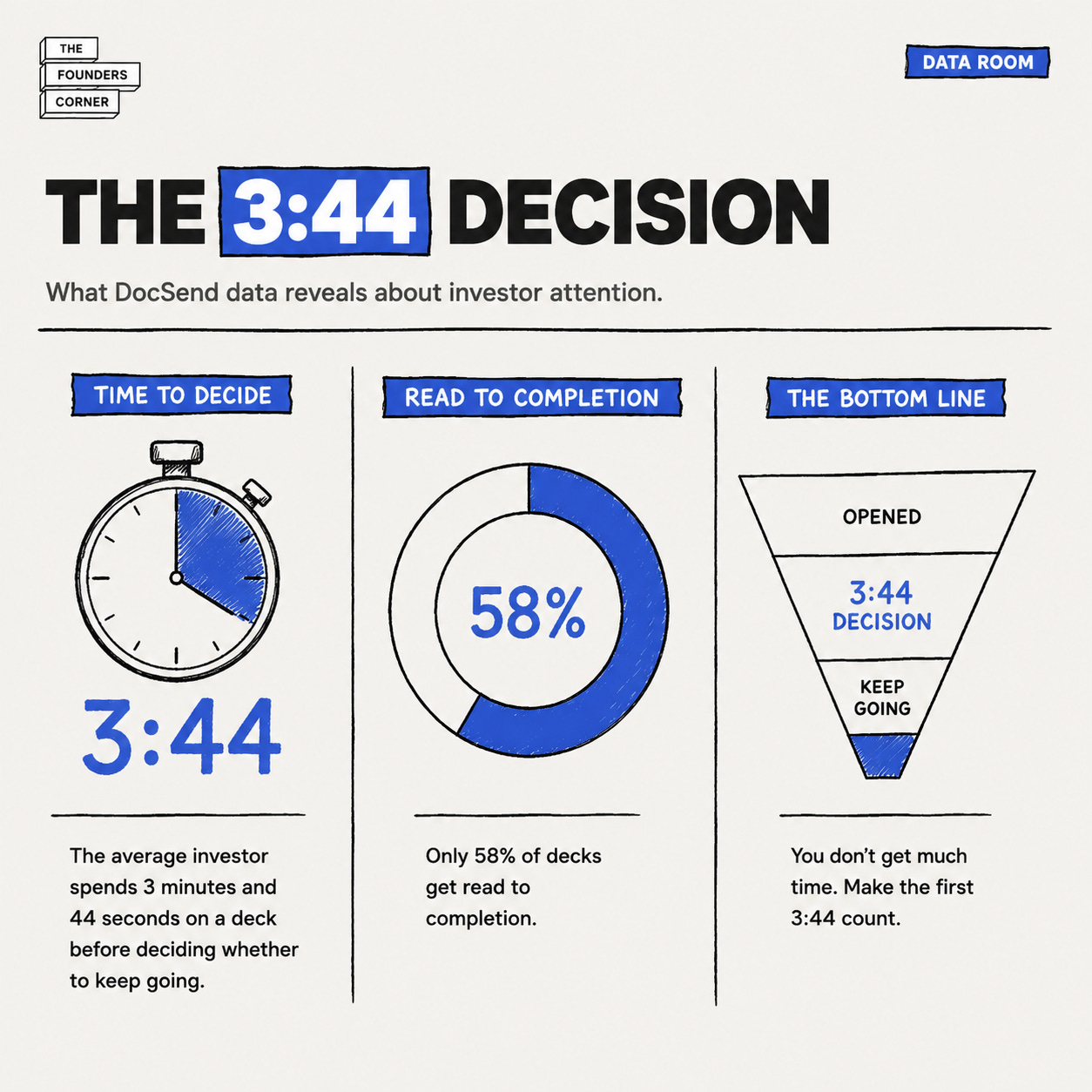
DocSend has tracked millions of investor sessions on pitch decks. The average investor spends 3 minutes and 44 seconds on a deck before deciding whether to keep going. Only 58% of decks get read to completion.
That’s the whole window. Three minutes, forty-four seconds, to go from stranger to term sheet.
Here’s what nobody tells first-time founders: the partner isn’t reading your deck fresh. They’re running it against a checklist built from the last 200 decks they’ve seen, most of which they’ve already forgotten. Your deck doesn’t need to be original. It needs to survive the checklist.
I spent a decade as an operator before I ever sat on the other side of that table: Chief Commercial Officer at a messaging security company called MessageLabs, which we grew to $200M+ in revenue before Symantec bought it for $700M. For the two decades since, I’ve been the one running the checklist, as a co-founder of Notion Capital and an investor in 500+ founders. I wrote that checklist down. It’s an 11-slide rubric. Below, three of the eleven are yours in full.
Why partners score, not read
A partner looking at five decks a day, every day, for years, doesn’t read your deck. They pattern-match it. Slide 1 gets compared to the last hundred slide 1’s. Slide 4 to the last hundred slide 4’s. That’s not cynicism. It’s the same shortcut a radiologist uses to spot the one wrong shadow on an X-ray in a glance instead of studying the whole image from scratch. Expertise is pattern recognition, bought with repetition.
The good news: patterns are learnable. You’re not trying to move a stranger emotionally. You’re trying to fit the pattern that gets filed under “yes.”
Why “make the deck prettier” is the wrong instinct
Founders who’ve raised before will tell you the same thing: the deck that closed the round was rarely the best-designed one. It was the one where every slide answered the question the previous slide raised, in the order a partner’s brain wants to receive it.
That’s the part design tools can’t fix. A rubric can.
The order is part of the score
The rubric isn’t eleven separate checks. It’s eleven checks that assume a specific order, because each slide answers the question the one before it just raised.
The one-liner raises “what do they do.” Problem raises “why does that matter.” Solution raises “how do they fix it.” By the time a partner reaches traction, they’re not asking “does this company have customers” in the abstract. They’re asking “does this trend make the promise on slide three believable.” Move a slide out of order and the partner arrives with the wrong question already loaded. A perfectly scored slide in the wrong slot still reads as off.
Two moves we see constantly: pulling competition up next to the problem slide because it feels like it belongs there early, and pushing the ask to the very last slide out of politeness. Both cost meetings.
Score each slide on its own merits. But check the sequence first: a 5 in the wrong slot reads like a 3.
The 11-slide rubric, slides 1 through 3
Each slide below gets scored the way we score it before a live pitch: the question a partner is actually asking, what a 5 looks like, what a 1 looks like, and the most common way founders fail it.
Slide 1: The one-liner
▫️ What the partner is really asking: “Do I understand what this company does in the time it takes to read one sentence?”
▫️ Score a 5: Names the customer, the product, and the value in under 12 words, with zero category jargon.
▫️ Score a 1: Any sentence that needs a second sentence to explain what the first one meant.
▫️ Weak → strong: “AI-powered logistics optimization platform for mid-market shippers” → “Flexport for last-mile delivery: 30% cheaper, no new trucks.”
⚡ Why this works: The weak version describes the category. The strong version names the comparison a partner already trusts, the customer, and the number that makes it real: all three, in one breath.
Slide 4: Traction
▫️ What the partner is really asking: “Is this a line or a point?” One data point is an anecdote. Three or more, moving one direction, is a trend a partner can underwrite.
▫️ Score a 5: A chart, not a table. Time on the x-axis. The metric that actually maps to the business model, revenue for a SaaS company, not “sign-ups.”
▫️ Score a 1: A chart that changes units halfway through: “users” for three quarters, then “revenue” for the last one, because the founder stitched together whichever number looked best each period.
▫️ Weak → strong: A bar chart labeled “Total Users” → a line chart labeled “MRR,” quarter over quarter, with the dollar figures printed on the line.
⚡ Why this works: DocSend’s data shows this slide gets the most scrutiny time on decks that get funded, and the most abandonment on decks that don’t. Partners aren’t reading the number. They’re checking whether it agrees with the slide three promise.
Slide 6: Team
▫️ What the partner is really asking: “Why are these specific people the ones who solve this specific problem?” Not “are they smart.” Why them, for this.
▫️ Score a 5: One line per founder tying a past decision directly to an unfair advantage on this exact problem.
▫️ Score a 1: A slide that reads like a LinkedIn export: titles and logos, no thread connecting them to the company.
▫️ Weak → strong: “Jane Doe, Co-Founder & CEO. Ex-Google, Stanford MBA.” → “Jane spent six years building fraud models at Google Pay. She’s the reason this company can underwrite risk nobody else can price.”
⚡ Why this works: The logos answer “were you competent somewhere else.” The rewrite answers “why you, here, now”: the question actually being scored.
🔒 The other eight slides, and the memo that finds where yours breaks
Three slides in, you’ve got the shape of how this rubric works. A raise runs you through all eleven, in order, each with its own failure pattern, and once the deck passes the slide-by-slide rubric, it still has to survive the pass where someone plays the partner and tries to kill the deal before an investor gets the chance to.
Here’s what’s behind the paywall, fully written and yours as a downloadable kit you keep and run on every version of the deck between now and your close:
✅ Slides 2, 3, 5, 7, 8, 9, 10, and 11 of the rubric (problem, solution, market sizing, business model, competition, financials, the ask, and the appendix), each scored the same way, with the specific tell that gets a deck quietly filed as “pass” before the founder even gets a rejection email.
✅ The market-sizing rebuild: the exact reframe that turns a sourceless “$40B TAM” slide into the bottom-up version a partner can’t discount on sight.
✅ The financials slide’s real job: why 68% of investors cite “unrealistic projections” as a reason for passing, and the one-line fix that stops a partner from doing that math against you in the first thirty seconds.
✅ The five-pass kill-the-deal memo: the review cycle we run on every deck before it goes to an investor: a narrative pass, a numbers pass, a market pass, a team pass, and a red-team pass that plays the most skeptical partner in the room. If your deck survives all five, it’s ready. If it doesn’t, you just found the leak before an investor did.
✅ The sequencing check: the one-page pass that tells you whether a slide is failing on its own merits or failing because it’s in the wrong slot, and exactly where to move it.
✅ The paste-ready Claude prompt that runs the entire eleven-slide rubric and all five memo passes against your actual deck outline in one sitting.
✅ The downloadable Deck Teardown Kit: every slide’s scoring criteria, the full memo template, the sequencing check, and the Claude prompt, formatted so you can run it on this raise and the next one.
Start your 7-day free trial → get the full rubric, the memo, and the kit. Cancel anytime.
Before you build another slide
Most founders treat the deck like the finish line: the thing you polish until it’s done, then send. It isn’t. It’s the artifact a checklist runs against before a human ever forms an opinion of their own.
I wish someone had handed me this rubric back when I was the one building the deck at midnight, guessing at what mattered. Built it now so you don’t have to guess either.
You just scored three of your eleven slides. Score the other eight, check the sequence, and run the memo before you send this version to anyone.
Build the rubric once. Run it on every draft.
Download below