

👋 Hey, Chris here! Welcome to BrainDumps—a weekly series from The Founders Corner. If you’ve been reading along, you know this series is a preview of a bigger project. Well, it’s finally here: The Big Book of BrainDumps is out now!
It isn’t a theory book—it’s the founder’s field manual. Inside, you’ll find 70 powerful frameworks distilled from 30+ years scaling software companies to hundreds of millions in ARR, 20+ years investing in 500+ B2B tech startups, and over $1B of shareholder value created. From raising capital to hiring your first VP of Sales, this book turns scars and successes into practical playbooks you’ll return to again and again. I expect most copies will become well-worn, scribbled on, and dog-eared—because it works.
One of the biggest myths in B2B SaaS is the belief that if your product is good enough, the market will naturally find you.
It sounds comforting. Founders build something useful, launch it into the world, and expect demand to emerge organically because the product solves a real problem. And occasionally that happens. But far more often, software businesses struggle not because the product lacks value, but because the company never truly understands who the product is most valuable for.
This is where market segmentation becomes incredibly important.
Not as a theoretical marketing exercise filled with corporate jargon and slide decks, but as a practical operating discipline that sharpens every part of the business. Product development becomes clearer. Messaging improves. Sales cycles shorten. Marketing spend becomes more efficient. Customer success becomes easier to scale.
Because ultimately, market segmentation is about focus.
It’s the process of moving from “this product could help lots of businesses” to “this product is exceptionally valuable for these very specific businesses.”
And that distinction changes everything.
Table of Contents
Most SaaS Messaging Is Far Too Broad
Segmentation Is Really About Understanding Human Behaviour
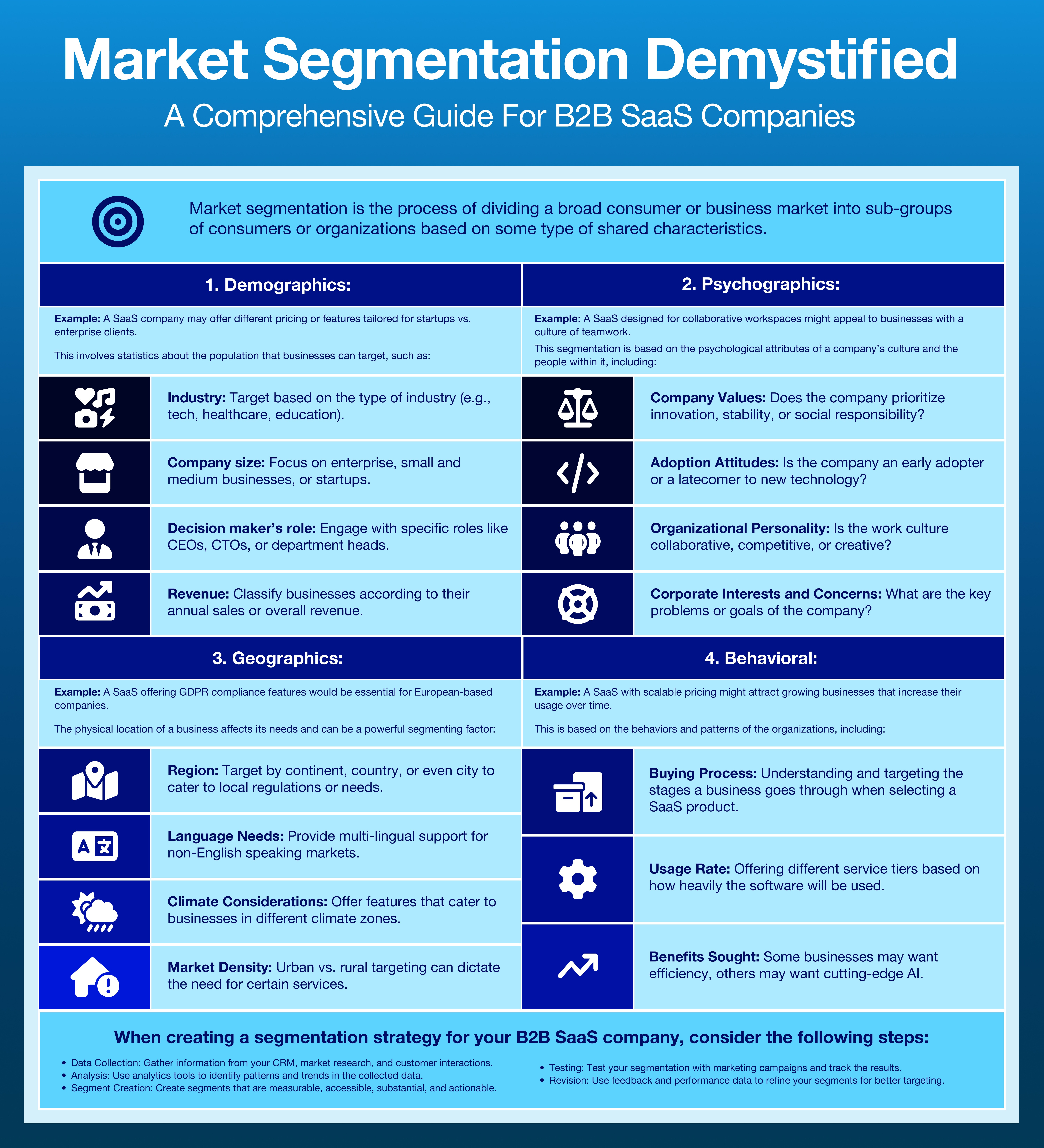
Demographics Are Only the Starting Point
Psychographics Are Where Segmentation Gets Powerful
Geography Still Matters More Than SaaS Founders Admit
Behavioural Segmentation Is Where Revenue Growth Accelerates
Segmentation Should Shape The Entire Go-To-Market Strategy
Great Segmentation Is Dynamic, Not Fixed
The Best SaaS Companies Become Obsessed With Specificity
Most SaaS Messaging Is Far Too Broad
One of the easiest ways to spot a company struggling with segmentation is through its messaging.
The website talks vaguely about “transforming workflows,” “driving efficiencies,” or “empowering organisations,” but never really speaks directly to anyone. The language feels polished but strangely generic. You finish reading it without being entirely sure whether the product is for enterprise finance teams, HR leaders, operations managers, or digital agencies.
This usually happens because the company is trying to appeal to too many audiences simultaneously.
The fear is understandable. Narrow positioning can feel risky, especially when founders worry about shrinking the size of the market. But in reality, broad messaging tends to weaken resonance rather than expand opportunity.
Because customers rarely buy software when they feel vaguely included.
They buy when they feel specifically understood.
That’s the real power of segmentation. It allows businesses to speak directly to the operational pain, motivations, and psychology of a very particular audience.
And in crowded software markets, relevance wins attention.
Segmentation Is Really About Understanding Human Behaviour
People often think market segmentation is simply about categorising customers by company size or industry vertical.
But the strongest SaaS businesses go much deeper than that.
The best segmentation work is fundamentally behavioural and psychological.
It’s understanding not only who the customer is, but how they think, what pressures they operate under, what incentives drive decisions internally, and how urgently they feel the problem your product solves.
Because two companies of identical size operating in the same industry can behave completely differently as buyers.
One leadership team may aggressively pursue innovation and operational transformation. Another may resist change entirely unless forced by external pressure. One organisation may prioritise speed and experimentation. Another may prioritise risk reduction and procurement control.
The demographics may look identical on paper.
The buying psychology is not.
That nuance matters enormously in SaaS because software adoption is rarely just a rational purchasing decision. It’s often tied to internal politics, career incentives, organisational culture, budget structures, and emotional perceptions of risk.
The companies that understand this outperform the ones relying purely on surface-level segmentation.
Demographics Are Only the Starting Point
The most obvious layer of segmentation is demographics.
In B2B SaaS this usually means understanding factors like industry vertical, company size, geography, revenue profile, or departmental ownership.
These are useful because they help narrow the playing field quickly.
A cybersecurity platform targeting enterprise financial institutions operates very differently from a workflow automation tool serving SMB marketing agencies. The sales cycles, pricing models, procurement processes, and customer expectations are entirely different.
Company size alone changes everything operationally.
Small businesses tend to prioritise speed, simplicity, and affordability. Enterprise organisations care more about governance, integrations, scalability, compliance, and stakeholder alignment. Mid-market buyers often sit somewhere between the two.
Understanding these structural differences helps shape pricing, onboarding, customer success models, and sales strategy.
But demographics only tell part of the story.
Because knowing what a company is doesn’t necessarily tell you why it buys.
Psychographics Are Where Segmentation Gets Powerful
This is the layer most SaaS companies underestimate.
Psychographics focus on mindset, culture, values, and motivations.
Does the company prioritise innovation?
Are they early adopters or cautious followers?
Do they embrace experimentation or avoid operational risk?
Is leadership ambitious and growth-focused, or heavily efficiency-driven?
Does the organisation value speed over process?
These questions dramatically influence buying behaviour.
A fast-growing technology company with a culture of experimentation may adopt new SaaS tools quickly because innovation itself is part of its identity. Meanwhile, a heavily regulated enterprise business may require layers of internal validation before considering change at all.
The operational pain may be identical.
The route to adoption is not.
This is why strong SaaS messaging often speaks less about features and more about strategic identity.
The best companies position themselves not simply as software vendors, but as enablers of the future their customers want to become.
And that emotional layer matters far more than most founders initially realise.
Geography Still Matters More Than SaaS Founders Admit
There’s a tendency in modern software culture to assume geography no longer matters because software is inherently global.
But in reality, geographic segmentation still plays a major strategic role.
Different regions operate with different regulatory environments, pricing expectations, procurement processes, and communication norms.
Selling into the United States differs dramatically from selling into Europe. European markets may require stronger GDPR positioning. Asian markets may behave differently around hierarchy and consensus-building. Some countries embrace self-service SaaS adoption while others remain relationship-driven.
Even language itself changes conversion dynamics.
And beyond regulation or localisation, geographic segmentation also affects operational scalability. Support expectations, timezone alignment, and implementation resources all become important as businesses expand internationally.
The strongest SaaS operators recognise that “global” does not mean “identical.”
Expansion requires adaptation.
Behavioural Segmentation Is Where Revenue Growth Accelerates
Perhaps the most commercially valuable segmentation layer is behavioural analysis.
This focuses on how customers actually interact with products and buying decisions.
How frequently do they use the platform?
Which features drive engagement?
What events trigger upgrades?
What behaviour predicts churn?
Which customers expand fastest?
Which use cases create the highest retention?
These patterns reveal where the real value sits inside the product.
Some customers may only need lightweight functionality. Others may become deeply embedded power users. Some buy for efficiency savings. Others buy because the product enables strategic growth or competitive differentiation.
Understanding these behavioural differences allows SaaS companies to refine everything from onboarding to pricing strategy.
It also reveals which customers are likely to become long-term high-value accounts.
Because not all revenue is equal.
Segmentation Should Shape The Entire Go-To-Market Strategy
One of the mistakes many businesses make is treating segmentation as purely a marketing exercise.
In reality, it should influence every part of the company.
Product teams should use segmentation to prioritise features around the needs of high-value customer groups.
Sales teams should tailor outreach and positioning based on buyer psychology and operational pain points.
Customer success teams should adapt onboarding experiences depending on customer maturity and intended use cases.
Leadership teams should allocate resources toward the segments generating the strongest long-term economics.
Even fundraising narratives improve when founders can clearly articulate who their ideal customers are and why those customers adopt the product so effectively.
The companies that scale successfully are usually the ones where segmentation becomes embedded operationally rather than existing as a static strategy document.
Great Segmentation Is Dynamic, Not Fixed
Markets evolve constantly.
Customer priorities shift. Economic conditions change. Technology adoption accelerates. Competitive landscapes move quickly.
The segmentation strategy that worked two years ago may quietly become outdated.
That’s why the strongest SaaS operators revisit segmentation regularly.
They analyse where retention is strongest.
They monitor which verticals are adopting fastest.
They evaluate where CAC is improving or deteriorating.
They identify emerging behavioural patterns.
And they continuously refine their understanding of where product-market fit is deepest.
This adaptability matters because SaaS businesses rarely stay static for long.
As products evolve, the ideal customer often evolves alongside them.
The Best SaaS Companies Become Obsessed With Specificity
Ultimately, market segmentation is not about reducing opportunity.
It’s about increasing relevance.
The strongest software companies don’t win because they appeal vaguely to everyone. They win because they become exceptionally valuable to very particular groups of customers.
That specificity creates momentum.
It sharpens positioning.
It improves conversion.
It strengthens retention.
It accelerates referrals.
It simplifies product decisions.
And over time, it compounds into category authority.
Because in software, growth rarely comes from shouting at the entire market.
It comes from deeply understanding the people who matter most — and building everything around serving them extraordinarily well.
Most founders lose their raise before they send the first email.
The ones who close have an edge others don’t: the single metric quietly tanking 70% of pitches, exactly which investors are deploying capital right now (and it’s not who you think), how to spot a real prospect in 90 seconds, the number VCs need to see before they’ll even take the meeting, and the unfakeable signals that separate fundable from “not yet.”
That edge comes from 30 years sitting across from founders, 500+ investments, and the patterns that separate the funded from the rejected.
We’ve distilled it into 50+ premium tools. One subscription unlocks all of it.
Start with these five — they’ve already changed the game for thousands of founders:
The Number That Kills More Fundraises Than Any Bad Idea – One slide. That’s all it takes. Here’s the metric killing your raise without you knowing it.
The Investors Who Actually Write Cheques in 2026 – Forget the usual suspects. This is where real capital moves. Faster. Earlier. Better odds.
The Quiet Filter That Decides Your Entire Fundraise – Every investor is running this filter before you pitch. Know it now, or learn it the hard way.
The Way VCs Actually Calculate Your Valuation – They have a number in mind before you walk in. What is it? And how do you hit it?
How Investors Decide If You’re Ready to Raise – It’s not luck or timing. These are the exact criteria investors use. Know them, and you change everything.
Read one before your next meeting. Your raise depends on it.
Congratulations on the launch, Chris: there’s a big difference between frameworks that sound good in theory and ones forged through years of building, investing and making tough decisions.