

You’ve felt it.
That moment when your team crosses a certain size and something changes. The energy shifts. Decisions slow down. The people who used to carry everything start looking tired. Or looking elsewhere. New hires seem capable on paper but somehow nothing moves faster.
You assumed it was a management problem. A culture problem. A communication problem.
It’s not. It’s a mathematics problem.
And once you see it, you can’t unsee it.
Brought to you by Nume.ai
Nume is building something most founders quietly wish they had: an AI CFO that actually watches the numbers.
Connect your bank and accounting tools like Xero or QuickBooks, and Nume continuously analyses the financial heartbeat of your company.
When something changes, you don’t find out weeks later buried in spreadsheets.
You get alerted instantly in Slack.
Inside Nume, you can also ask questions in plain English:
How long is our runway if hiring continues?
What changed in our burn this month?
Which expenses are driving the increase?
Nume answers instantly, grounded in your real financial data.
No spreadsheets.
No digging through reports.
No £15K+ fractional CFO.
Just a live, intelligent layer on top of your numbers - the kind founders usually only see when it’s already too late.

You can try Nume here with a 14-day free trial.
Then, use code CHRIS50 for 50% off your first month.
The Law Nobody Talks About in Fundraising Rooms
In 1963, a British physicist named Derek J. de Solla Price published a book called Little Science, Big Science. He wasn’t writing about startups. He was analysing scientific output: who writes papers, who gets cited, who dominates a field.

What he found was disturbing in its precision.
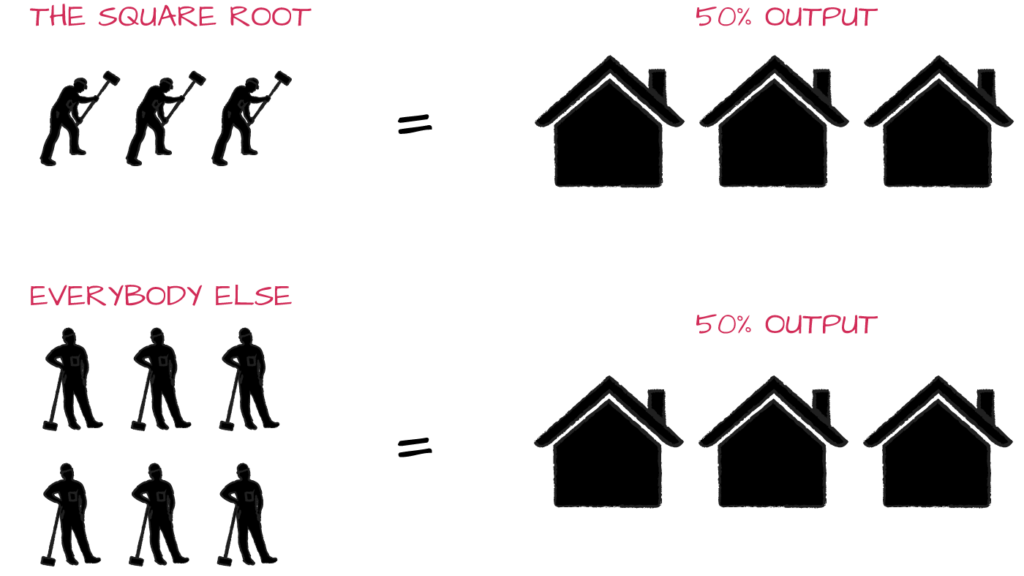
In any productive group, the square root of the total number of people does 50% of the work.
That’s it. That’s Price’s Law.
Ten people in your team? Three of them produce half the output. A hundred? Ten people carry half the company. A thousand? Thirty-two people are responsible for half of everything. Ten thousand? A hundred people are doing the work while nine thousand nine hundred fill seats.
Price wasn’t theorising. He was observing a pattern that repeated across every productive domain he studied. It showed up in academic publishing. It showed up in sales teams. It showed up in engineering departments. It showed up in startups before the word startup even existed.
The pattern doesn’t care about your culture deck. It doesn’t care about your values. It just is.
Why This Gets Worse. Not Better. As You Grow.
Here’s what makes Price’s Law genuinely alarming for founders.
At four people, it’s fine. Two people doing half the work, two doing the other half. Everyone is roughly pulling their weight. The ratio is survivable.
But then you raise. You hire. You scale.
At 25 people, five are carrying half. At 100, ten are carrying half. The number doing the work stays small — almost stubbornly small — while the number doing the other half keeps growing.
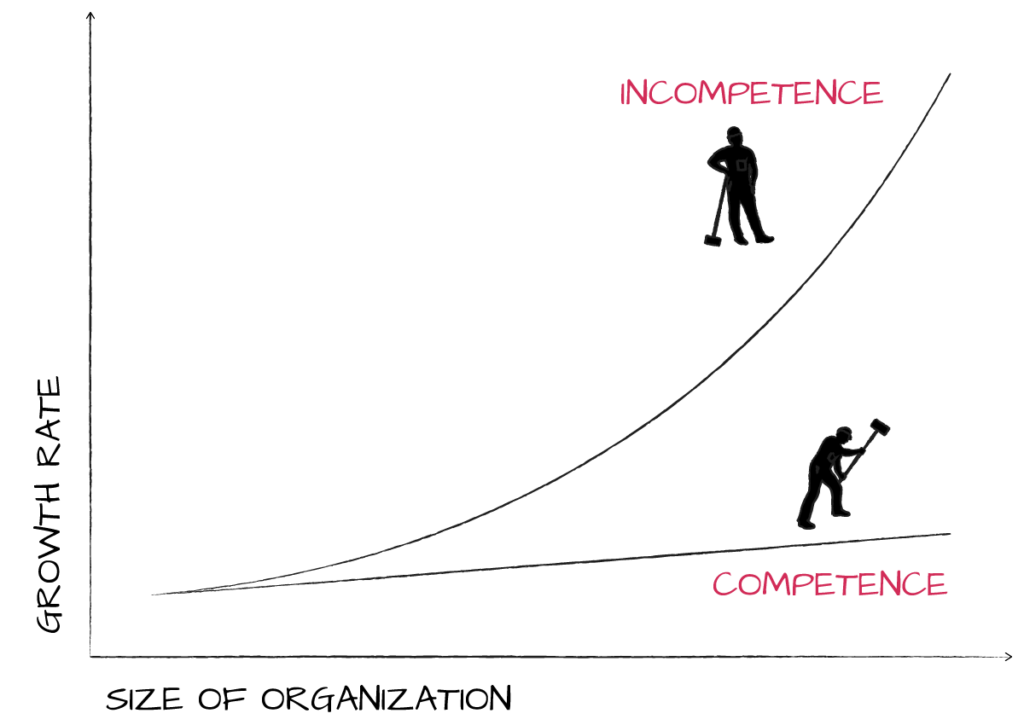
And here’s the part that matters: competence grows linearly. Incompetence grows exponentially.
Jordan Peterson, who popularised Price’s Law in a viral lecture, put it like this: as organisations grow, the distance between the best and the rest doesn’t stay the same. It widens. Every time you double the team, the top performers become relatively rarer. And the cost of carrying everyone else becomes greater.
This is why so many funded startups hit a wall between 20 and 50 people. Not because growth is hard. Because at that size, Price’s Law starts biting. The square root is still producing half the output. But now the non-square-root half is a lot more people, a lot more salary, and a lot more noise.
“As your company grows, incompetence grows exponentially and competence grows linearly.” — Jordan Peterson
The Fundraising Dimension Nobody Tells You
Here’s where Price’s Law stops being an academic curiosity and starts becoming a live issue in your fundraising conversations.
Investors know this pattern. Even the ones who’ve never heard the name.
When a VC sits across from you and asks about your team, they’re not just evaluating CVs. They’re running a mental model: is this founder aware of the distribution of output in their own company? Do they know who their square root is? Have they built a team where the top performers are protected, incentivised, and irreplaceable? Or have they built a team that will collapse the moment the best two or three people walk out?
Most founders can’t answer these questions with precision.
They know their headcount. They know their org chart. But they don’t know, with specificity, which three people on a fifteen-person team are responsible for half of everything that matters. They haven’t identified the pattern. They haven’t stress-tested it.
To an investor, that’s a structural risk. Not a people problem. A structural risk.
And it shows up in due diligence in ways founders don’t anticipate. Key person dependencies. Concentration of knowledge. Single points of failure. Founder-led bottlenecks. All of these are downstream expressions of a Price’s Law problem that was never diagnosed.

The Death Spiral You Need to Know About
There is a consequence of Price’s Law that most founders discover too late.
Your top performers know they’re your square root. They feel it every day. They carry the weight. They solve the problems nobody else can solve. They ship the things that matter.
And they are, almost by definition, the most employable people in your company.
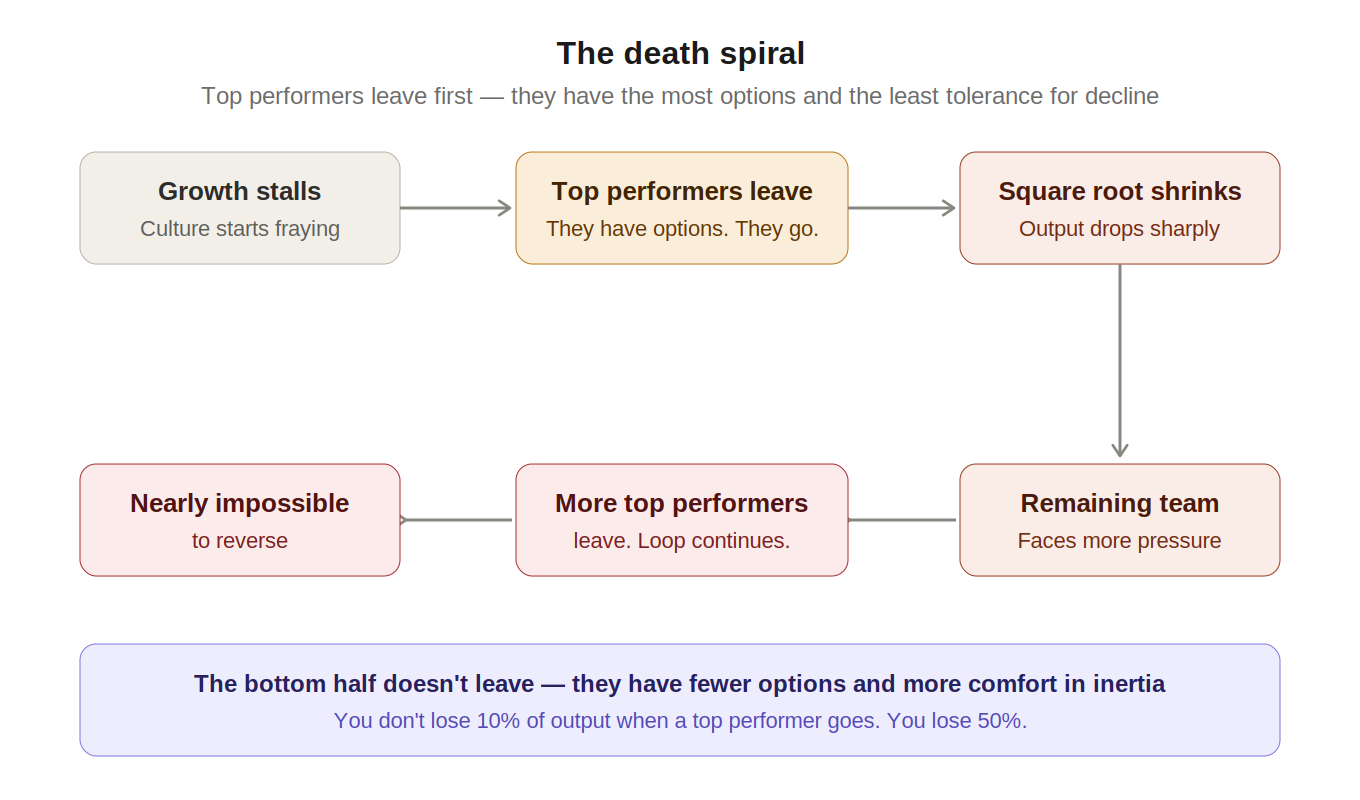
When things start going wrong — when growth stalls, when morale dips, when the culture starts fraying — who leaves first?
Not the bottom half. The bottom half stays. They have fewer options, less urgency, and more comfort in inertia.
The top performers leave first. They have options. They’re already being recruited. And the moment they start to feel that the company they’re carrying isn’t worth carrying any more, they’re gone.
What follows is almost impossible to reverse.
Top performers leave. The square root shrinks. The remaining team produces less. The company struggles more. The remaining top performers face more pressure. They leave too.
It’s not a metaphor. It’s a documented pattern in scaling companies. And the founders who avoid it are the ones who saw it coming. Who understood the law, identified their square root, and built the systems to protect them before the pressure arrived.
What the Pattern Looks Like in Practice
Here’s how Price’s Law plays out at different stages and what it means for how you build.
At 5 to 10 people (pre-seed / seed)
At this size, the law is relatively benign. Two or three people doing half the work means you’re functionally a high-output small team. The risk here isn’t Price’s Law itself. It’s founder dependency. If the co-founders are the square root, the company has no resilience. A VC looking at a five-person team wants to see that at least one or two of the non-founder team members are genuinely exceptional. Not just competent. Exceptional.
At 15 to 30 people (post-seed, Series A)
This is where Price’s Law starts showing up in your metrics without you naming it. A handful of people are closing most of the deals, shipping most of the product, solving most of the problems. If you don’t know who they are — explicitly, with evidence — you’re flying blind. And if you lose one of them, you’ll feel it in your numbers within 60 days.
At 50 to 100 people (Series B+)
At this size, the law is a governance issue. You have enough people that the square root is now producing 50% of the output while a much larger group produces the other half. The drag coefficient is real. The best companies at this stage have systems for continuously identifying, retaining, and concentrating their square root. Not hoping it stays in place.
The Investor Signal You’re Missing
Here’s the practical fundraising implication that almost no founder leverages.
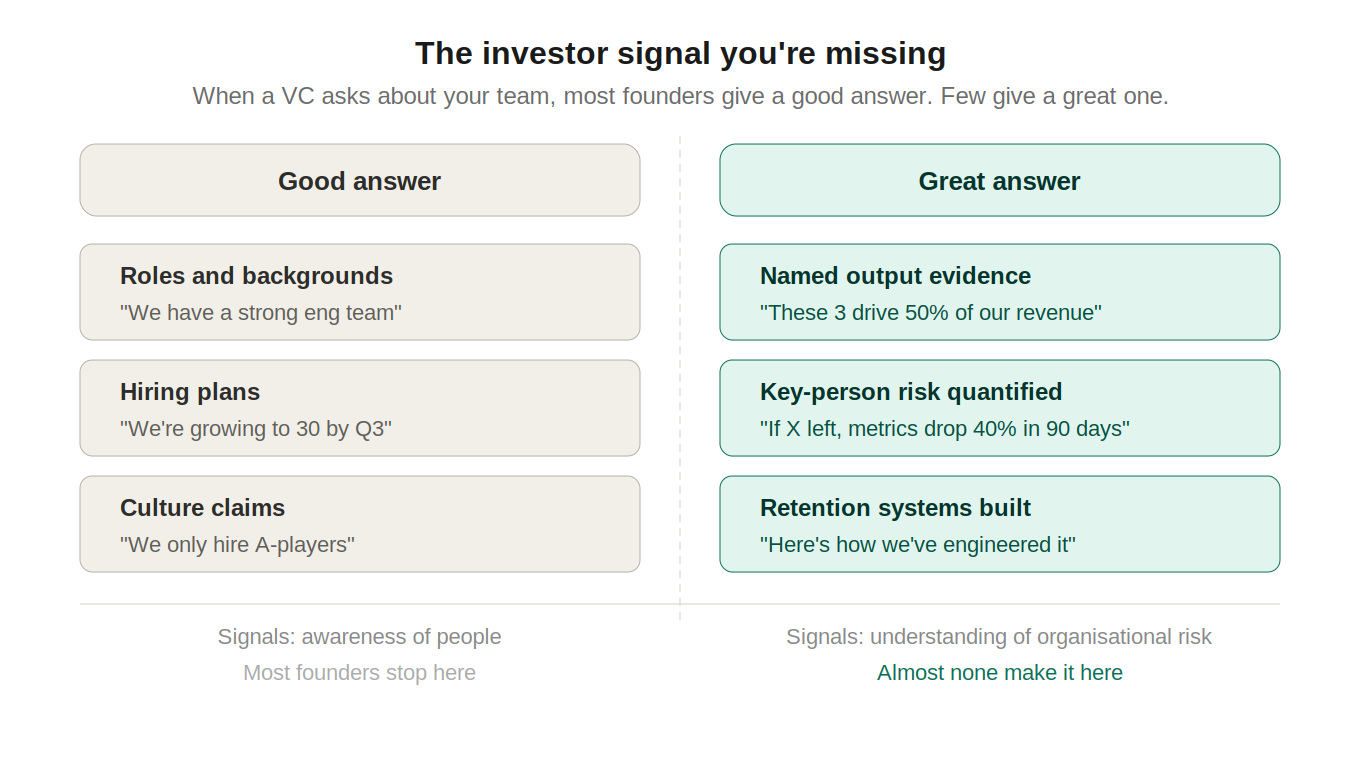
When a VC asks about your team, the standard answer is a description of roles, backgrounds, and hiring plans. That’s a good answer.
A great answer is evidence that you understand the distribution of output in your own company.
Not vague assertions about culture. Not “we only hire A-players.” Specific, structured awareness: these are the three people who drive the majority of our commercial output. Here’s the evidence. Here’s how we identify, retain, and develop them. Here’s what happens to our numbers if any one of them leaves. And here’s how we’ve mitigated that dependency.
That answer tells an investor something most founders never communicate: this founder understands the structural realities of scaling a team. They’re not naive about the distribution of talent. They’ve already done the diagnostic work.
That’s the difference between a founder who talks about people and a founder who has genuinely thought about organisational risk.
The Three Questions Price’s Law Forces You to Answer
Before your next fundraising conversation, sit down and answer these three questions honestly. If you can’t answer all three specifically and with evidence, you haven’t done the work yet.
1. Who is your square root right now? And can you prove it?
Not by feel. By output data. Who is closing the deals? Who is shipping the code that matters? Who is solving the problems nobody else can solve? If you have 20 people and can’t name the four carrying the company, an investor will notice before you do.
2. What is the single-person dependency risk in your team?
If your single best engineer, salesperson, or operator left tomorrow, what would happen to your metrics in 90 days? This is the key-person risk question every investor is quietly asking. The founders who have a real answer to it — not a platitude, a real answer — are the ones who demonstrate organisational maturity.
3. What have you built to protect and develop your top performers?
Compensation structures, equity refresh schedules, explicit recognition, reduced friction, involvement in strategy. The companies that retain their square root don’t do it by accident. They’ve engineered it. Can you describe what you’ve built?
Answer all three honestly, specifically, with evidence. And you’ve turned a routine team question into one of the strongest moments in your fundraise.
The Honest Truth About Scaling Teams
Most founders think the goal of hiring is addition.
Add ten people, get ten people’s worth of output.
That is not how teams work. That is not how Price’s Law works.
Add ten people and you get three people’s worth of additional output from the square root. And seven people’s worth of drag, communication overhead, and coordination cost from everyone else.
This isn’t a criticism of the people you hire. It’s a description of how productive groups function at every size, in every domain, across every industry Price studied.
The founders who scale effectively aren’t the ones who hire fastest. They’re the ones who identify the law operating in their own team, build deliberately around it, and never lose sight of who their square root actually is.
The ones who don’t? They hit 40 people and wonder why things feel harder than they did at 15.
If this resonated, I write about fundraising, investor psychology, and what actually moves the needle at the earliest stages. Every week.
Before you go, these other articles are essential reading for any founder preparing to raise or scale:
Are You Actually YC-Ready? The four-question diagnostic that separates funded founders from rejected ones.
The Number That Kills More Fundraises Than Any Bad Idea - Why your TAM slide is either your strongest asset or the quiet reason you’re not getting a second meeting.
The Investors Actually Writing Cheques In 2026 - A look at a growing but misunderstood source of capital.
🔒 The Price’s Law Diagnostic
Everything above is the framework. What follows turns it into a map of your own team.
Most founders feel Price’s Law without ever naming it. They know some people are carrying more. They suspect some hires aren’t pulling weight. But they’ve never mapped it systematically. Never quantified the distribution, identified the dependencies, or stress-tested what happens if the wrong person walks out.
The diagnostic does that work for you.
Input your team structure, role by role. Answer a series of targeted questions about output, leverage, dependencies, and retention risk. The diagnostic scores your team across four dimensions:
Square Root Identification — who is actually generating disproportionate output, and how concentrated is that output?
Dependency Mapping — where are your single points of failure, and how exposed are you?
Retention Risk — how vulnerable are your top performers, and what signals are already present?
Investor Readiness — how would your current team composition read in a due diligence conversation?
Each dimension gives you a score and specific, actionable guidance. Most founders discover a concentration risk they knew existed but had never quantified. Some discover a dependency they didn’t know was there.
Better to find it now, in a diagnostic, than in a partner meeting.
The goal isn’t a score. It’s a map of the risk you’re carrying and the steps to reduce it.
→ Access the Diagnostic as a paid subscriber.
Run the Diagnostic →