

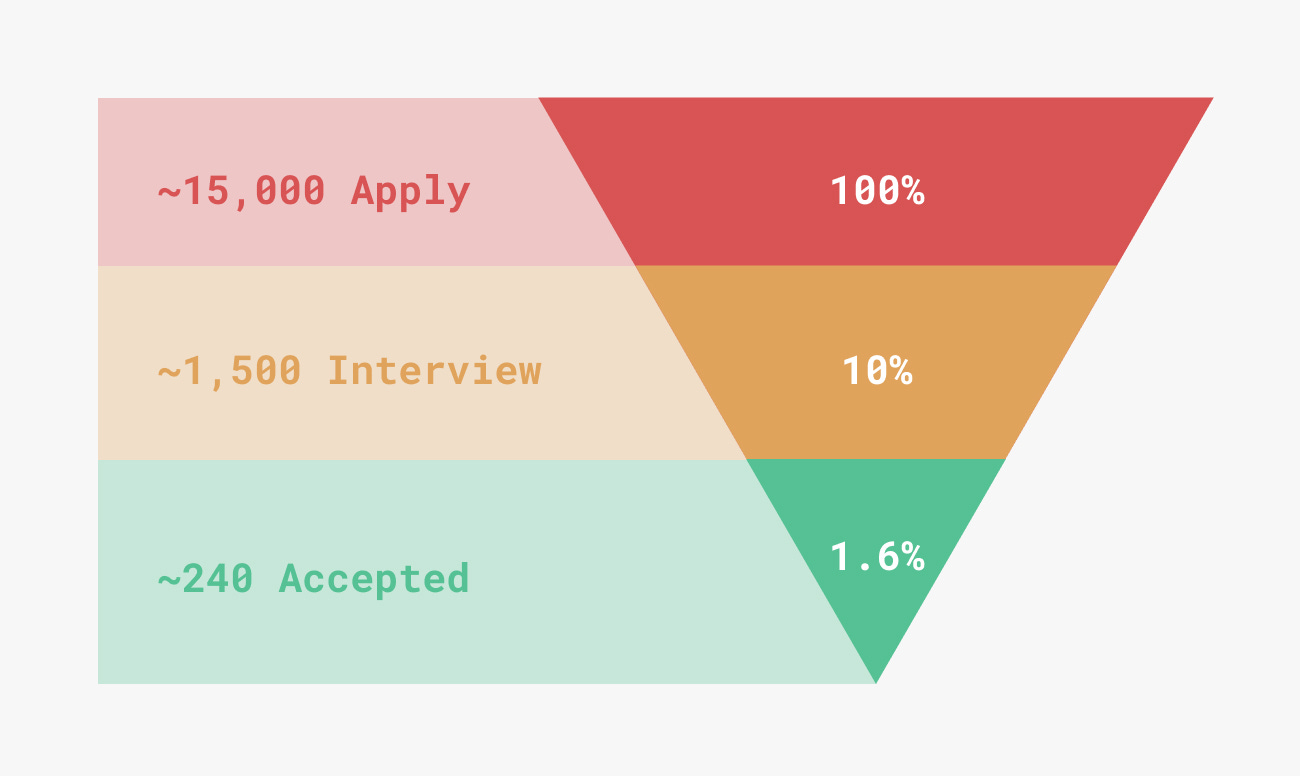
Every batch, Y Combinator receives north of 40,000 applications.
They fund roughly 200.
That’s a sub-1% acceptance rate - tighter than Harvard, MIT, and Stanford combined. And yet, thousands of founders submit applications every single cycle completely convinced they’ve got a real shot.
Most of them are wrong.
Not because their ideas are bad. Not because they lack ambition. They’re wrong because they’ve never held their startup up against the actual framework YC uses to evaluate founders. They’re pitching a story. YC is running a diagnostic.
Here’s the thing nobody tells you: the diagnostic has a pattern. It becomes obvious once you’ve read enough partner interviews, rejection postmortems, and alumni retrospectives. And once you see it, you can’t unsee it.
This piece breaks it down - the four questions YC is really asking, the 10 categories on their 2026 wishlist, and the 60-second video that most applicants completely botch.
By the end, you’ll know whether you’re ready. That answer might be uncomfortable. It’s also the most useful thing you’ll read before you apply.
Brought to you by Nume.ai
Nume is building something a lot of founders quietly wish they had: an AI CFO that actually watches the numbers.
Connect your bank and accounting tools like Xero or QuickBooks, and Nume continuously analyses the financial heartbeat of your company.
When something changes, you don’t find out weeks later while reviewing spreadsheets. You get alerts directly in Slack.
You can also ask questions in plain English:
How long is our runway if hiring continues?
What changed in our burn this month?
Which expenses are driving the increase?
The answers come instantly, grounded in your real financial data.
No spreadsheets.
No digging through reports.
No £15K/year fractional CFO.
Just a live view of the numbers founders usually discover too late
You can try Nume here with a 14-day free trial.
Then, use code CHRIS50 for 50% off your first month.
What YC Is Actually Evaluating
Paul Graham famously wrote that YC is looking for founders, not ideas. It’s a great line. It’s also incomplete.
What YC is really doing is running a signal-detection problem. Given a very short window, limited information, and enormous volume, they’re trying to identify the founders most likely to build something that matters. Fast.
The evaluation isn’t arbitrary or impressionistic. It follows a pattern - and that pattern breaks down into four questions. Miss any one of them, and it doesn’t matter how good the rest of your application is.
Here’s what they’re actually asking.
Question 1: Are you all-in?
YC funds full-time founders. Not people who are “transitioning.” Not people still consulting on the side while they build. The question isn’t whether you’re enthusiastic; it’s whether you’ve made the kind of irreversible commitment that signals you’re serious.
Have you quit? Have your co-founders quit? If not, why not?
YC has funded plenty of founders who were mid-leap, who quit the week before applying. What they don’t fund is hedging. The presence of a day job isn’t just a logistical detail. It’s a signal about risk tolerance. And risk tolerance is precisely what YC is betting on when they write that $500K check.
Question 2: Do you understand the problem?
This is where most founders reveal themselves and not in the way they hope.
They can describe what their product does. They struggle to describe, with precision, the underlying problem. Why it exists. Who suffers from it. Why it hasn’t been solved before. And what makes this exact moment the right time to solve it.
YC partners will push hard on the “why now” question. Markets, technology, and regulation create windows. The best founders can point to exactly what changed — a new API, a regulatory shift, a behavioural inflection - that makes their company possible today but impossible yesterday.
If you can’t articulate the window, you can’t defend the urgency.
And if you can’t defend the urgency, you’re not getting an interview.
Question 3: Do you have signs of demand?
This is the most uncomfortable question for pre-launch founders. It’s also unavoidable.
YC is not asking for $1M ARR. They’re asking for evidence that real people have this problem and that some version of your solution compelled them to engage.
That evidence takes many forms: letters of intent, pilot customers, a waitlist that converted at an unusual rate, interviews that generated referrals, a prototype that people asked to keep using. The form matters less than the authenticity.
What YC is filtering out is founders who are building solutions for imaginary problems they’ve never stress-tested with real humans. Those founders are everywhere. Don’t be one of them.
Question 4: Can you execute the solution?
Execution credibility is a combination of technical ability, domain expertise, and demonstrated output.
Have you shipped anything? What’s the quality of what you’ve already built? Why is this team, specifically, the right team to win this market?
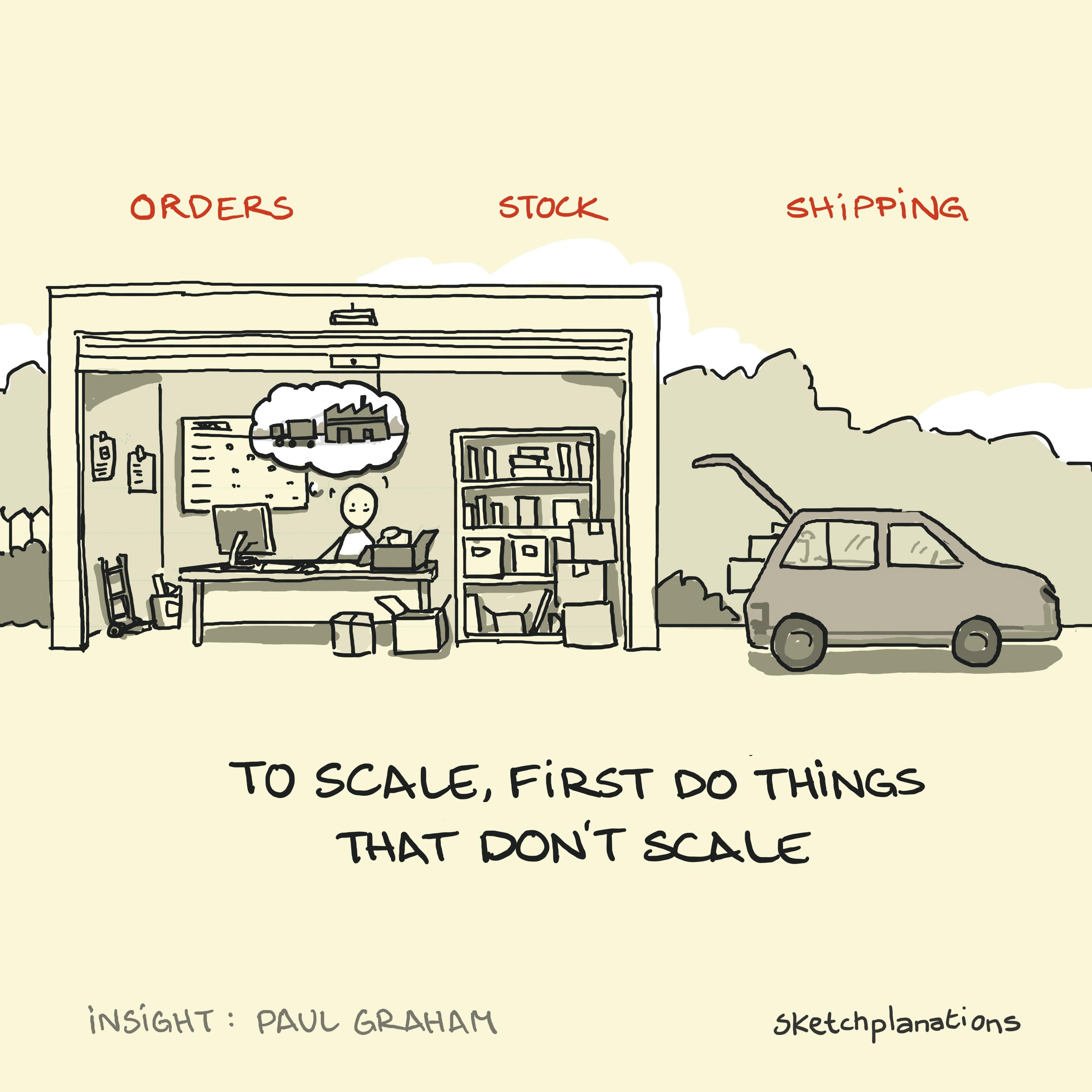
The unfair advantage question gets at this directly. “We work harder than our competition” is not an unfair advantage. A co-founder who spent a decade inside the industry you’re disrupting, a proprietary dataset no one else can access, a technical insight that only three people in the world understand - those are unfair advantages.
If you can’t name yours in one sentence, you haven’t found it yet.
“The most common mistake founders make in YC applications isn’t lying - it’s performing. YC partners have read 40,000 applications. They know what performed insight looks like.”
YC’s 2026 Wishlist: The Request for Startups
Here’s something most founders applying to YC don’t do.
They read the application. They watch the alumni interviews. They study the questions. What they don’t do is read the Request for Startups - YC’s published list of the exact categories where they most want to fund companies.
That’s a mistake.
Every year, YC publishes the RFS as a signal: we’ve thought hard about where the world is going, and we believe these categories will produce the next generation of exceptional companies. When your startup maps to an RFS category, you’re not just pitching a product - you’re pitching alignment with a thesis the partners have already committed to.
The partners have a mental model for what success looks like in that space. You’re not asking them to build one from scratch.
Here are the 10 categories on YC’s 2026 wishlist:
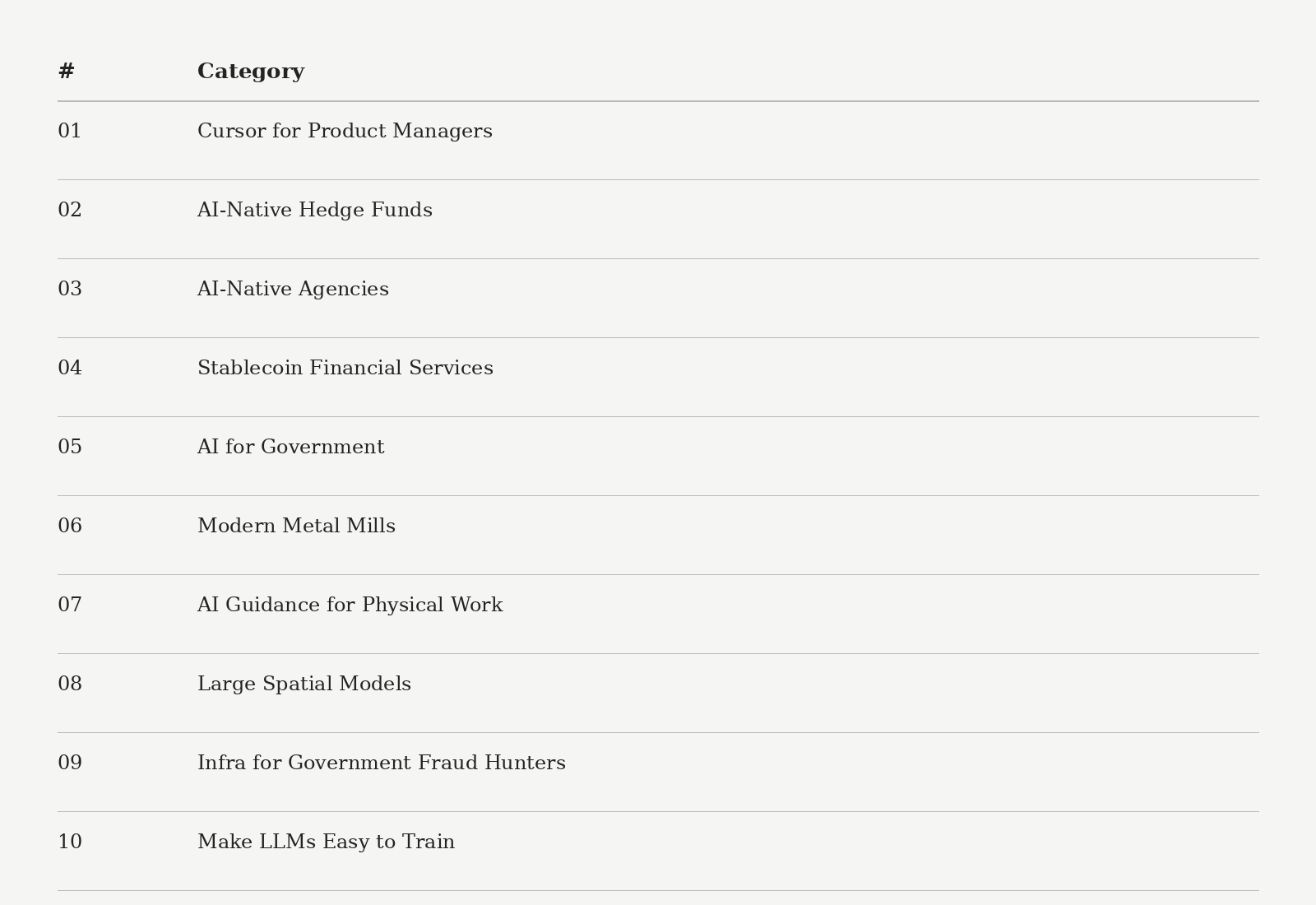
Read that list carefully. There’s a thesis running through it.
YC is betting heavily on AI-native businesses - not wrappers, not AI-enhanced features, but companies where AI is architecturally central to the value proposition. They’re also betting on the physical world: metal mills, spatial models, guidance for physical work. The “software eats the world” era is giving way to “software meets atoms.”
And critically they’re betting on government. Not as a cautious, slow-burn vertical. As a genuine frontier for technology companies willing to do the hard work of operating in regulated, complex environments.
Why does this matter for your application? Because knowing which RFS category you’re closest to is one thing. Knowing how to frame your pitch in the language of that category is another entirely. If you’re building in the AI for Government space, your application shouldn’t read like a generic GovTech pitch. It should demonstrate that you understand the structural opportunity - and why your company is positioned to own it.
The 60-Second Video That Most Founders Get Completely Wrong
One minute.
That’s what you get. One minute for a partner who has watched thousands of these to decide whether you’re worth a second look. And the vast majority of founders spend that minute doing exactly the wrong thing.
They describe the product. They read from notes. They emphasise features. They spend 40 seconds on what they’re building and 10 seconds on why they’re the right people to build it.
YC partners have been explicit: they want to see the founders, not a slide deck. They want energy, directness, conviction. They want to come away from 60 seconds feeling like they just met people they’d want to work with for the next three years.
Here’s the structure that actually works:
→ Who you are (0–10s) Name, background, one line. Don’t over-explain. Your credibility comes through elsewhere.
→ What you build (10–25s) One sentence on what the company does. Not a feature list. The core value proposition, stated simply.
→ Traction (25–40s) The most compelling signal you have. Users, revenue, growth rate, a notable customer. Make it concrete - a number, not a vibe.
→ Why you (40–55s) The unfair advantage. Why is this team, specifically, going to win? Say it directly.
→ The close (55–60s) Confident. Direct. You want an interview. Say so.
The hardest part isn’t the structure - it’s the compression. Saying something true and compelling in one sentence requires more work than saying it in five. This is the core skill the video tests: can you communicate your startup with the clarity of someone who has thought about it obsessively? Or does it come out with the fuzziness of someone still figuring it out?
YC can tell the difference in about 15 seconds.
“The video is not a product demo. It’s a first impression. YC wants to meet the founder, not tour the product.” - YC Alumni, W23
The Written Application: What YC Is Trying to Hear
The questions on the YC application have changed over the years. The underlying test hasn’t.
YC wants to understand the problem, the market, the business model, and the team. But here’s where most founders go wrong: they answer comprehensively when they should be answering compellingly.
YC partners read fast. They’re scanning for signal, not completeness. An answer that leads with its most compelling sentence, makes one clear claim, and stops - that’s more persuasive than an answer that covers every angle. Every hedge you add dilutes the signal.
The founders who write strong YC applications have usually locked in one principle: be specific where most people are vague.
When asked about competitors, don’t write “there are several existing solutions in the market.” Name them. Say exactly how you’re different. Specificity signals that you actually know your market and that you’re not afraid of the comparison.
When asked about traction, don’t write “we have strong early interest.” Write: “14 paying customers at $1,200/month, NPS of 72 after 60 days.” The number doesn’t need to be large. It needs to be real.
The mistake that kills otherwise strong applications: Founders confuse “thorough” with “convincing.” A YC application that reads like a business school case study, carefully balanced, evenly hedged, reads to a partner as a founder without strong convictions. The best applications read like someone who is absolutely certain about a few things, honest about what they don’t yet know, and itching to go build.
That’s the voice you’re going for.
If You Get the Interview: What Happens Next
Ten minutes.
Two to three partners. Rapid-fire questions. No warm-up. Designed to be slightly uncomfortable because discomfort reveals things that preparation hides.
The most common failure mode isn’t a bad answer. It’s the founder who prepared answers instead of internalising understanding. When a partner asks an unexpected variant of a question you’ve rehearsed, the rehearsed answer becomes a liability. You hear the pivot in real time, the pause, the “well, so, basically what I mean is…”, and it signals that the founder has a story about the startup rather than genuine understanding of it.
The preparation that works looks different: stress-test your own thinking until you’ve found the weakest points. The partners will find them anyway. Better to find them first and either fix them or have an honest answer ready.
The questions YC comes back to, again and again:
Why this problem?
Why now?
Why you?
What are you most wrong about?
What’s the one thing that has to be true for this to work?

Answer all five honestly, specifically, in under 90 seconds each, and you’re in better shape than 95% of the people walking into that room.
Most of them won’t have done that work.
The Honest Truth About Getting In
YC cannot be gamed.
The partners have seen every angle, every framing trick, every way a founder can make a weak company sound strong. What works isn’t cleverness - it’s actually having a real thing.
The founders who get in share a few qualities. They’ve talked to more customers than feels necessary. They’ve built more than feels safe for a company at their stage. And they have a quality of directness, in how they talk about their startup, in how they answer hard questions, in how they describe what they don’t know, that only comes from having thought about it so long and so hard that they’ve burned through all the comfortable vagueness.
That directness isn’t a personality trait. It’s a product of doing the work.
The single most useful thing you can do before submitting your YC application is sit down and run yourself through the four core questions with zero charity. Not “do I have traction”, but “what is my specific traction number and is it actually compelling?” Not “do I understand the problem”, but “can I explain in two sentences why this problem exists and why it hasn’t been solved?”
The founders who do this work, who close the gap between their self-image and their actual state, are the ones who show up with something real to say.
The ones who don’t? They perform. And YC spots it immediately.
🔒 The YC Readiness Bundle
Everything above is free. What follows turns that framework into action.
We’ve built three tools for founders who want to move from understanding to doing - to actually run their startup through the YC framework before they apply.
Tool 1: YC Readiness Assessment
A structured diagnostic built on real YC evaluation patterns. You’ll be scored across four dimensions:
Commitment — Are you genuinely all-in?
Problem understanding — Do you see it with precision?
Demand signals — Do you have real, specific evidence?
Execution ability — Can you build it?
Each dimension gives you a score and specific, actionable guidance. Most founders discover one or two blind spots they didn’t know they had. Better to find them now than in the interview room.
Tool 2: YC Category Fit Finder
Input your startup description. We test it against all 10 of YC’s 2026 RFS categories - their official wishlist. You’ll see exactly where you score strongest, which category is your best fit, and what specific framing will sharpen your pitch for that category.
If your startup doesn’t fit any RFS category, we’ll tell you that too and what it means for your strategy.
Tool 3: YC Video Script Builder
Answer a series of targeted questions about your startup, your team, and your traction. We generate a complete, structured 60-second script in YC’s preferred format - who you are, what you build, your strongest traction signal, why you’re the right team, and a confident close.
Ready to read, refine, and record.
→ Access all three tools as a paid subscriber.
These aren’t templates. They’re built on the patterns in this article - the same framework YC actually uses. Run yourself through them before you apply.
Unlock the YC Bundle →