

👋 Hey, Chris here! Welcome to BrainDumps—a weekly series from The Founders Corner. If you’ve been reading along, you know this series is a preview of a bigger project. Well, it’s finally here: The Big Book of BrainDumps is out now!
It isn’t a theory book—it’s the founder’s field manual. Inside, you’ll find 70 powerful frameworks distilled from 30+ years scaling software companies to hundreds of millions in ARR, 20+ years investing in 500+ B2B tech startups, and over $1B of shareholder value created. From raising capital to hiring your first VP of Sales, this book turns scars and successes into practical playbooks you’ll return to again and again. I expect most copies will become well-worn, scribbled on, and dog-eared—because it works.There’s a subtle but important difference between having goals and actually using them well.
Most companies, at least on paper, are not short of ambition. There are targets, plans, roadmaps, quarterly priorities - plenty of activity that looks like direction. But if you look a little closer, what often emerges is something less coherent. Teams are busy, but not always aligned. Metrics are tracked, but not always meaningful. Progress is happening, but not always in the direction that truly matters.
The issue isn’t a lack of goals. It’s a lack of clarity around how those goals are structured, communicated, and executed.
Goal-setting, when done well, is one of the most powerful tools a founder has. It creates focus, aligns teams, and turns abstract ambition into something tangible. But when done poorly, it becomes noise; another layer of activity that creates the illusion of progress without delivering it.
What separates the two is not effort, but structure.
Over the years, a number of frameworks have emerged that help bring discipline to goal-setting. On their own, each offers a slightly different lens. But taken together, they form a toolkit that can fundamentally change how a business sets direction and measures progress.
Table of Contents
The Need for Precision: Why SMART Still Matters
The Power of Ambition: How OKRs Change The Game
Thinking Bigger: The Role of BHAGs
Bringing It All Together: The Balanced Scorecard
The Need for Precision: Why SMART Still Matters
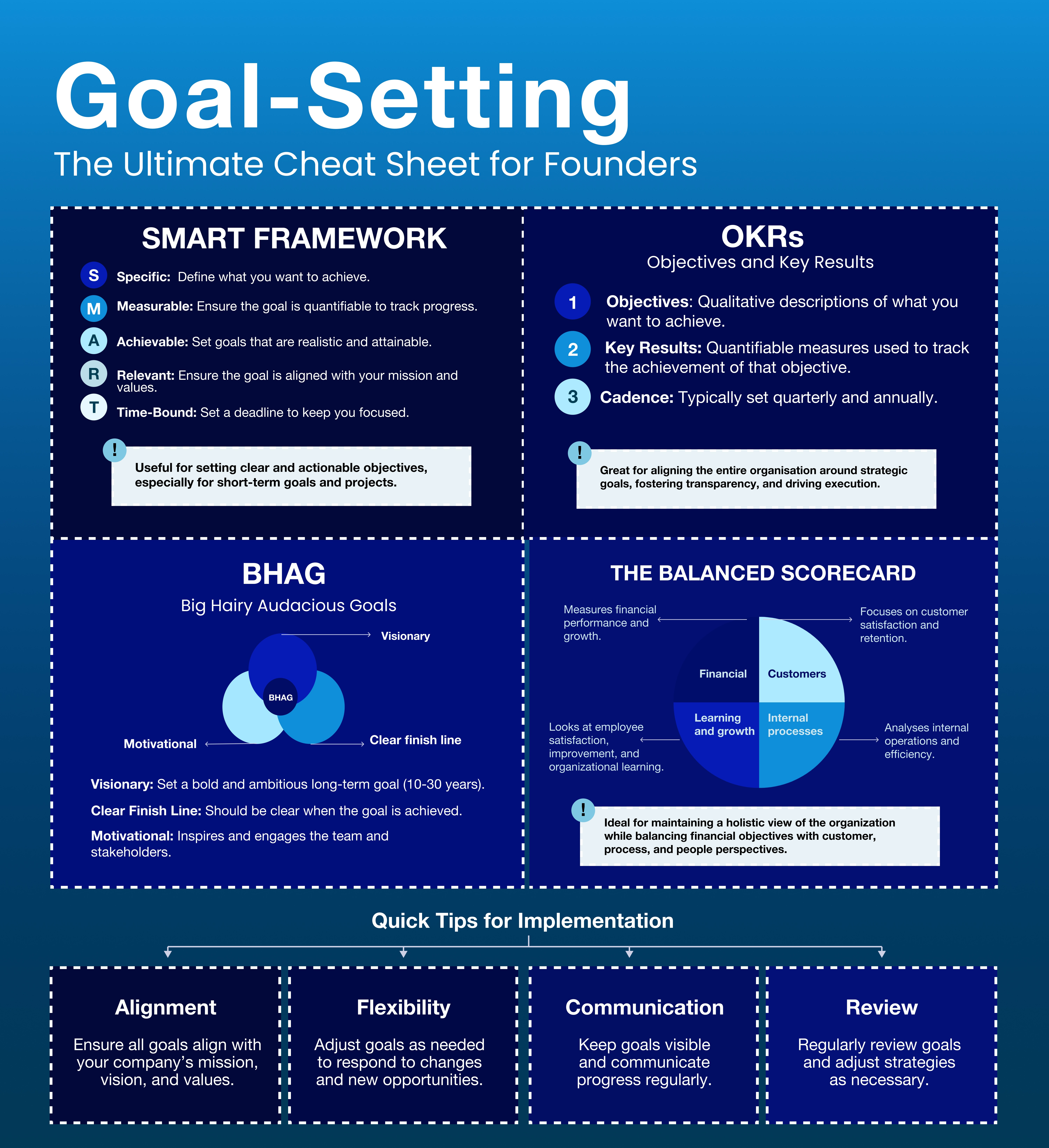
It’s easy to dismiss the SMART framework as something basic, almost overly simplistic. Specific, Measurable, Achievable, Relevant, Time-bound, it’s been around for decades, and because of that, it’s often overlooked.
But its longevity points to something important.
Most goals fail not because they are too ambitious, but because they are too vague.
“Grow revenue.” “Improve retention.” “Expand into new markets.”
These are intentions, not goals. They don’t provide clarity on what success actually looks like, nor do they create accountability. Without specificity, teams interpret them differently, progress becomes difficult to measure, and momentum quickly dissipates.
SMART goals force precision.
They require you to define exactly what you’re trying to achieve, how you’ll measure it, and within what timeframe. That clarity removes ambiguity and creates a shared understanding across the business.
In practice, this might mean shifting from “increase revenue” to something like “grow monthly recurring revenue by 20% over the next two quarters by expanding into the healthcare segment.” It’s a small change in wording, but a significant shift in clarity.
SMART doesn’t make goals more exciting, but it makes them executable.
The Power of Ambition: How OKRs Change The Game
Where SMART goals bring precision, OKRs introduce ambition.
Objectives and Key Results are designed not just to define what needs to happen, but to push teams beyond what feels comfortable. They create a tension between where you are and where you want to be, encouraging progress that might not happen under more conservative targets.
An objective sets the direction, something qualitative, aspirational, and meaningful. A key result defines how success will be measured, specific, quantifiable outcomes that indicate progress.
The combination is powerful.
For example, an objective might be to “become the leading platform for SMB accounting.” On its own, that’s a vision. But when paired with key results, market share targets, retention rates, customer growth, it becomes something measurable and actionable.
What makes OKRs particularly effective is their cadence. They are typically set on a quarterly or annual basis, which creates a rhythm of reflection and adjustment. Teams are encouraged to review progress regularly, learn from what’s working (and what isn’t), and recalibrate.
Unlike traditional targets, OKRs are not meant to be hit perfectly. In fact, consistently achieving 100% of your OKRs often suggests they aren’t ambitious enough. The value lies in the stretch.
They create alignment, but they also create momentum.
Thinking Bigger: The Role of BHAGs
While SMART goals and OKRs operate within relatively short time horizons, there’s another layer of goal-setting that plays a very different role.
The Big Hairy Audacious Goal, often referred to as a BHAG, is not about quarterly performance or even annual growth. It’s about long-term vision. Something bold enough to feel slightly uncomfortable, but clear enough to inspire action.
A BHAG might span 10, 20, or even 30 years. It’s not designed to be immediately achievable. It’s designed to create direction.
What makes BHAGs powerful is their ability to align people around a shared ambition. They provide a sense of purpose that goes beyond day-to-day execution, giving teams a reason to push through the inevitable challenges that come with building something meaningful.
But they only work if they are grounded in reality.
A BHAG that feels disconnected from the business lacks credibility. One that is too safe lacks inspiration. The balance lies in setting something ambitious enough to stretch the organisation, while still being tangible enough to believe in.
In many ways, the BHAG is the emotional anchor of your strategy. It doesn’t tell you what to do next quarter. It tells you why any of it matters at all.
Bringing It All Together: The Balanced Scorecard
If SMART goals provide clarity, OKRs drive ambition, and BHAGs create vision, the Balanced Scorecard brings structure.
It ensures that your goals are not just focused on one dimension of the business, but reflect a broader view of what success actually looks like.
Financial performance matters, but it is only one piece of the puzzle. Customer outcomes, internal processes, and the organisation’s ability to learn and grow all play a role in shaping long-term success.
The Balanced Scorecard forces you to consider all of these perspectives simultaneously.
It’s not enough to grow revenue if customer satisfaction is declining. It’s not enough to improve efficiency if the organisation is not developing the capabilities needed for the future.
By setting objectives across multiple dimensions, you create a more balanced approach to growth, one that reduces the risk of over-optimising in one area at the expense of another.
In practice, this often leads to more thoughtful decision-making.
Trade-offs become clearer. Priorities become more deliberate. And the business starts to operate with greater alignment between short-term performance and long-term health.
The real value of combining these frameworks is not in the frameworks themselves, but in the discipline they create. When an organisation commits to being specific about its near-term targets, ambitious in its annual goals, bold in its long-term vision, and balanced in how it measures progress, it builds a culture of intentional growth. That culture, more than any single goal, is what separates businesses that drift from those that compound.
-Chris Tottman
Most founders lose their raise before they send the first email.
The ones who close know what the others don’t: the silent number killing most pitches, which investors are writing cheques right now, how to cut their list before wasting weeks, the return model VCs run before you speak, and the exact signals that mark you fundable.
That edge comes from 30 years in the room and 500+ investments, compressed into 50+ tools built for exactly where you are.
A paid subscription unlocks all of it.
The five most-used resources right now:
The Number That Kills More Fundraises Than Any Bad Idea - your market size slide is silently ending raises that should close. Most founders never know why.
The Investors Who Actually Write Cheques in 2026 - capital sitting outside traditional VC. Quieter money. Faster decisions. More stages.
The Quiet Filter That Decides Your Entire Fundraise - know who’s a real fit before wasting hours. The filter most founders skip until it’s too late.
The Way VCs Actually Calculate Your Valuation - the return model investors run before the meeting. Know the number they need before you name one.
How Investors Decide If You’re Ready to Raise - the exact signals that determine fundability at every stage. Not gut feel. The actual criteria.
Every one has shifted how founders approach their raise. The only variable is whether you read them before your next meeting or after.
do you think it's better to start with those SMArT Goals or jump straight into the big vision?