

👋 Hey, Chris here! Welcome to The Founders Corner. If you’ve been reading along, you’ll know I have very little patience for theory that doesn’t survive contact with a real buyer.
This series is a preview of a new book I’ve written with my partners Richard Blundell and Paul Watson — The Selling Software Algorithm: The Go-to-Market Navigation System for B2B Software Leaders.
It isn’t a strategy deck dressed up as a book. Between the three of us we’ve spent close to seven decades inside B2B software as founders, operators, investors and coaches — building companies, exiting some, and quietly breaking a few along the way, which is where most of the real learning lives. Through our work at Vencha we’ve now supported hundreds of founders trying to do the single hardest thing in software: turn a clever product into predictable commercial traction in a market that’s noisy, cautious, and more crowded than it has ever been.
One pattern shows up again and again. Companies rarely struggle because the product is bad. They struggle because they have no navigation system for going to market. This book is that system.
We’ve spent two articles getting precise about who you’re selling to.
The Economic Buyer, understood as a human being with ambition, pressure and personal risk, not a job title. The Perfect Customer Profile, the exact kind of company where your value is inevitable rather than merely possible. That’s real work, and if you’ve done it, you’re already ahead of most of the market.
But precision about who doesn’t close anything on its own.
Because software isn’t bought on logic. It’s bought when business pain becomes impossible to ignore. You can have the right buyer, in the right company, and still lose the deal, because nothing you’ve said has made staying the same feel more dangerous than changing. That’s the job of this chapter: finding the one or two pains so sharp your buyer feels compelled to act now, and willing to fight for you when procurement slows things down and the organisation’s inertia pushes back.
Table of Contents
Most Founders Get Pain Backwards
Borrow the Oldest Trick in Advertising
Build the Pain Slide, Not the Pitch Deck
The First Rule of Testing: Don’t Sell Anything
The Pain Wheel: From Ten Down to Three
The Solution Slide Is the Mirror Image of the Pain
Weaponise the Three Pains, Respectfully
1. Most Founders Get Pain Backwards
Ask most founders what pain their software solves and you’ll get a list. Sometimes a long one. Efficiency gained, time saved, cost reduced, risk mitigated, workflows streamlined — all true, and all, on their own, useless. Breadth doesn’t create conviction. Ten irritations laid side by side just look like a features page with better adjectives.
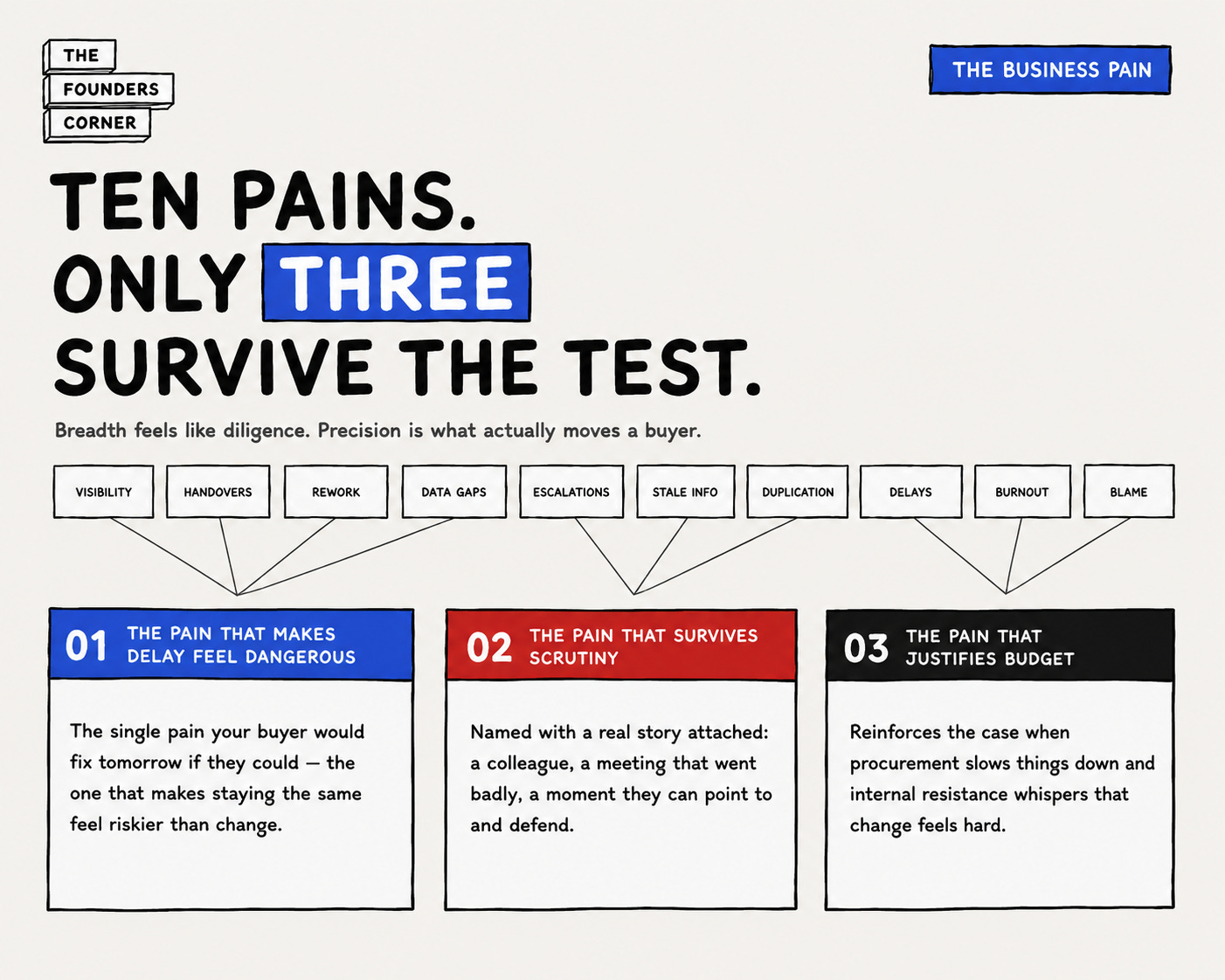
What actually moves a deal isn’t ten reasons to change. It’s one or two pains so sharp the Economic Buyer can’t rationalise doing nothing for another quarter, backed by a second and third pain that reinforce the case when someone in procurement asks why this can’t wait.
That’s a different kind of work than most go-to-market teams do. It’s not cataloguing everything that’s broken inside your customer’s business. It’s uncovering the hierarchy of pain — the one thing that makes delay feel dangerous, and the two things that back it up when internal resistance appears, as it always does.
And here’s the part that trips people up: pain doesn’t live in strategy documents. It lives in the quiet apology a manager makes when targets slip. In the tension between two departments who’ve stopped trusting each other’s numbers. In the dread that creeps in before a Monday morning stand-up. Until you can name that, precisely, no amount of ROI modelling will move the needle.
2. Borrow the Oldest Trick in Advertising
Before we get into how you find those pains, it’s worth understanding why naming them works at all.
Think about how transformation gets sold in fitness, health or cosmetics. The before-and-after photo. The classic image of a smile before and after orthodontic work. No explanation is required — the brain registers instantly what’s wrong, what’s possible, and what staying the same costs.
B2B software runs on the identical psychological mechanism, even though nobody’s showing anyone their teeth. The transformation here is professional rather than physical: chaos to control, friction to flow, apology to confidence. The “before” isn’t a face, it’s a process — a workflow, a handover, a spreadsheet that shouldn’t still exist. But the effect is the same. When you show a buyer their own broken process laid bare, and then show them what life looks like without it, you force them to confront the cost of inaction in a way that a features list, however well argued, never will.
That’s the entire logic behind what we call a Pain Slide and a Solution Slide. The before, and the after.
Want to get in front of 250k+ founders and investors?
For sponsorship opportunities across The Founders Corner newsletter and LinkedIn (160k followers), email: founderscornermedia@gmail.com
3. Build the Pain Slide, Not the Pitch Deck
A Pain Slide is the B2B equivalent of the “before” photo. Its job is to lay bare the messy, fragmented, exhausting reality your Perfect Customer is currently living inside — and it should be uncomfortable to look at, because the world it’s describing is uncomfortable to work in.
You build it by gathering your team, again, and asking everyone in customer success, product, sales and support to write down every pain they’ve observed or heard, not just the functional frustration but the emotional one — the moment of embarrassment, the stress, the confusion. Spread it across a wall. Cluster it. Patterns will emerge fast; certain frustrations will show up so often their significance becomes impossible to miss.
Then shape those clusters into a story. Follow one user through a working day, or one workflow from start to finish, and reveal the friction one layer at a time — a progressive reveal in a tool like PowerPoint or Miro, not a static wall of chaos. The first click shows a single task beginning. The next reveals a missing piece of information. The next, the first duplication of effort. Gradually the slide gets heavier, noisier, more familiar — spreadsheets stacking up, “sorry for the delay” email threads, handwritten workarounds. That’s deliberate. The slide should feel exhausting because the process it depicts is exhausting.
Done well, a Pain Slide is a mirror. The buyer doesn’t just see inefficiency. They see the reputational risk and political cost their team has been quietly absorbing for years. And once they see it, they can’t unsee it.
4. The First Rule of Testing: Don’t Sell Anything
Here’s where most founders sabotage their own good work. They build a strong Pain Slide, fall in love with it, and skip straight to using it as a pitch.
Don’t. Test it first, with real Economic Buyers who sit inside your Perfect Customer Profile — people who actually live the pain you think you’re solving. Aim for around ten conversations. Frame them honestly, as structured research rather than a sales call: there’s nothing to buy and nothing to decide, you just want to check whether what you’ve mapped reflects their world.
That framing matters more than it sounds like it should. It disarms the buyer and shifts them out of “being sold to” and into “helping you get it right” — which means they’ll tell you the truth. Walk them through the Pain Slide slowly, one reveal at a time, and watch as much as you listen. The lean forward, the raised eyebrow, the rueful laugh — these tell you more than their most polished sentence will.
Real validation is unmistakable. Buyers get specific. They name colleagues. They relive a meeting that went badly. Polite agreement — “yeah, that looks about right” with no detail behind it — is a warning sign, not a win. Politeness kills truth, and truth is what you’re there to collect.
One discipline above all others: resist the urge to pitch. When a buyer describes a pain you recognise, every instinct says “we can fix that.” The moment you say it, you’ve stopped being a researcher and started being a salesperson, and their guard goes back up. Sit with the discomfort. If the pain is real, they’ll ask for the solution in their own time.
5. The Pain Wheel: From Ten Down to Three
By the end of a handful of these conversations, you’ll usually be looking at more pain than you started with, not less. Organisations accumulate pain the way stones accumulate in a riverbed — some merely inconvenient, others corrosive. To make sense of it, we use something we call the Pain Wheel: the ten most significant pains surfaced across your team’s whiteboarding and your early testing, laid out as a hypothesis for the buyer to react to.
Presented this way, ranking becomes instinctive in a way it never is in the abstract. Ask which pains they see every day, which ones derail projects, which ones cause friction across their teams, which ones expose them personally. Their reasoning tells you whether a pain is functional (it slows work down), emotional (it drains morale or credibility) or strategic (it exposes the business to real threat) — and some sit far closer to the buyer’s heart than others.
Walk through the top pain, then the second, then the third, asking each time what it costs and what it disrupts. Don’t rush this part. You’re not extracting data, you’re uncovering meaning, and by the end you’ll almost always see three pains rise clearly above the rest — the ones with stories attached, with stakes attached, with consequences attached. The remaining seven stay part of the narrative, but they’re convincers now, not protagonists.
This is the moment the whole chapter is built around. It’s the clarity no amount of desk research could ever hand you, and it’s what lets everything downstream — your messaging, your demo, your outreach — be grounded in evidence instead of hope.
6. The Solution Slide Is the Mirror Image of the Pain
Once the Pain Slide is tested and refined, build its opposite: the Solution Slide. If the Pain Slide is the storm, this is the calm that follows — the ordered, confident picture of what life looks like once the pain is gone. Not a prettier product overview, and not a features list wearing a nicer font. It has to be built around the specific top three pains your testing surfaced, not your own view of what matters, or it won’t land with anything like the same force.
Bring it into a second testing call, but don’t open with it. Start by playing back what you heard the first time, and ask what’s lingered in the buyer’s mind since. That reawakens the pain before you offer the relief. Then walk through the Solution Slide calmly, inviting the buyer to critique it — what would be politically hard internally, what might block adoption, who holds the veto. Those objections aren’t setbacks. They’re the headwinds you’ll actually face in a real sale, handed to you for free.
It’s also where you find the buyer’s personal win. Ask what would be different for them — less stress, a target finally hit, a Board update they no longer dread. When someone tells you that, you’ve found the emotional anchor that carries a deal through everything that tries to stall it later.
And if the second call ends badly — “this really isn’t for us” — that’s not a failure either. It’s a far cheaper lesson than discovering the same thing twelve months and a lot of wasted marketing spend from now.
7. Weaponise the Three Pains, Respectfully
Once you’ve earned your three visceral pains, the job is to embed them everywhere, deliberately, so the business can’t drift back into generic language.
Your website should stop sounding like every other software company and start sounding like your Economic Buyer’s internal monologue — because in a world of infinite noise, the only messages that cut through are the ones that feel painfully specific. Your outbound should stop asking for time and start describing their reality back to them, calmly, so the right person recognises themselves in a sentence. Your demo should stop explaining what your product does and start relieving the pain you already know, in detail, is keeping them up.
Here’s what that looks like written down, using the same formula from articles one through three:
Our software is perfect for the COO or Head of Operations in UK-based logistics and field service businesses with 250 to 2,000 employees, turning over £25m–£300m, who run multi-site operations on spreadsheets and email. They’re struggling with three visceral pains: operational visibility that collapses under pressure, repeated service failures caused by manual handovers and stale data, and constant internal firefighting that’s burning out their teams and putting their own credibility at risk.
Notice what that does. It names the buyer. It draws hard boundaries around the company. It names how they’re currently coping. And it describes pain with emotional weight attached, not just process inefficiency. You feel the world it’s describing. That’s what you’re aiming for — not ten “nice to fix” irritations, but three “cannot continue like this” truths that justify budget, survive scrutiny, and get defended internally when the organisation’s inertia inevitably pushes back.
Get that right, and pricing gets easier too, because you’re no longer negotiating software. You’re helping someone justify removing a pressure that’s already been costing them reputation, energy and control.
—Chris Tottman
Most founders lose their raise before they ever send the first email.
The ones who close have something the rest don’t: they know exactly how investors read a pitch deck before you’re even in the room, which AI prompts are quietly transforming how founders prepare, how to turn a cold outreach into a warm conversation, what a two-minute briefing can do that a ten-slide deck can’t, how to stress-test your pitch before an investor ever sees it, and how to build a fundraising narrative that actually sticks.
That edge isn’t luck. It’s 30 years sitting across the table from founders, 500+ investments, and the patterns that quietly decide who gets funded and who gets ghosted — now distilled into a system you can use today.
We’ve packaged all of it into 60+ premium tools. One subscription.
Start your 7-day free trial → Cancel anytime.
Start with these six. They’ve already changed the outcome for thousands of founders before you — here’s what happens when it’s your turn:
Your Pitch Deck’s First Reader Isn’t Who You Think — Before any human sees it, something else decides its fate. Know what it is before you hit send.
The 6 Claude Prompts That Change How You Raise — Most founders use AI to write emails. The ones closing rounds use it like this instead.
The Claude Prompt That Turns a Cold Outreach Warm — One prompt. The difference between ignored and in the room.
The Two-Minute Investor Briefing — Investors don’t have time. This format respects that — and gets the meeting anyway.
I Asked Claude to Reject My Pitch — Here’s What It Found — The holes investors find but never tell you about. Find them first.
How to Build Your Fundraising Narrative — Not your deck. Not your numbers. The story that makes both of them land.
Every raise has two sides: the founders who get the meeting, and the ones who wonder why they didn’t. Upgrade now — and make sure you’re on the right one.
The part about polite agreement being a warning sign is so important. “Yeah, that looks about right” feels positive, but there’s no energy in it. The moment people start naming colleagues and describing their workaround, the conversation changes completely.