

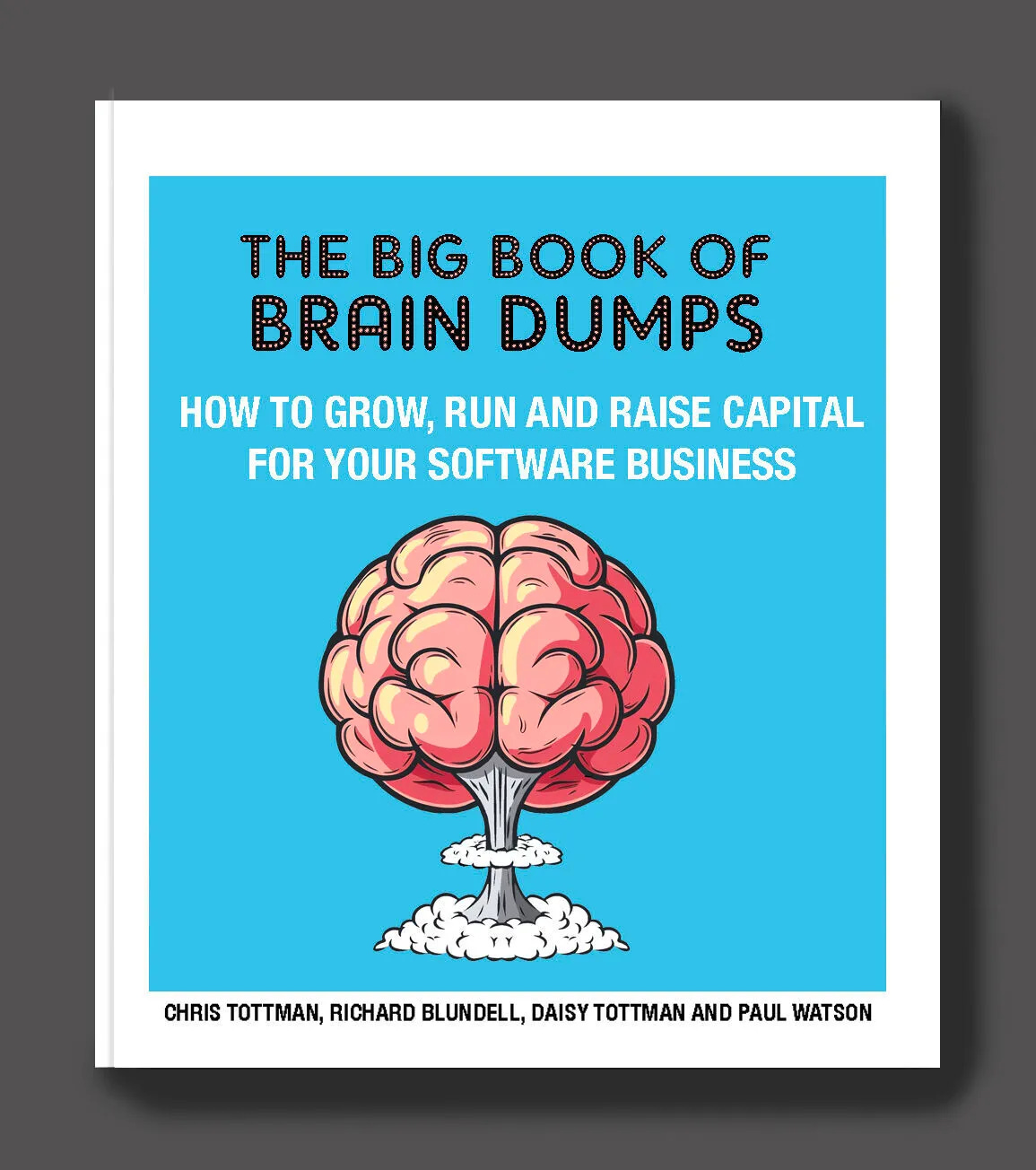
👋 Hey, Chris here! Welcome to BrainDumps—a weekly series from The Founders Corner. If you’ve been reading along, you know this series is a preview of a bigger project. Well, it’s finally here: The Big Book of BrainDumps is out now!
It isn’t a theory book—it’s the founder’s field manual. Inside, you’ll find 70 powerful frameworks distilled from 30+ years scaling software companies to hundreds of millions in ARR, 20+ years investing in 500+ B2B tech startups, and over $1B of shareholder value created. From raising capital to hiring your first VP of Sales, this book turns scars and successes into practical playbooks you’ll return to again and again. I expect most copies will become well-worn, scribbled on, and dog-eared—because it works.
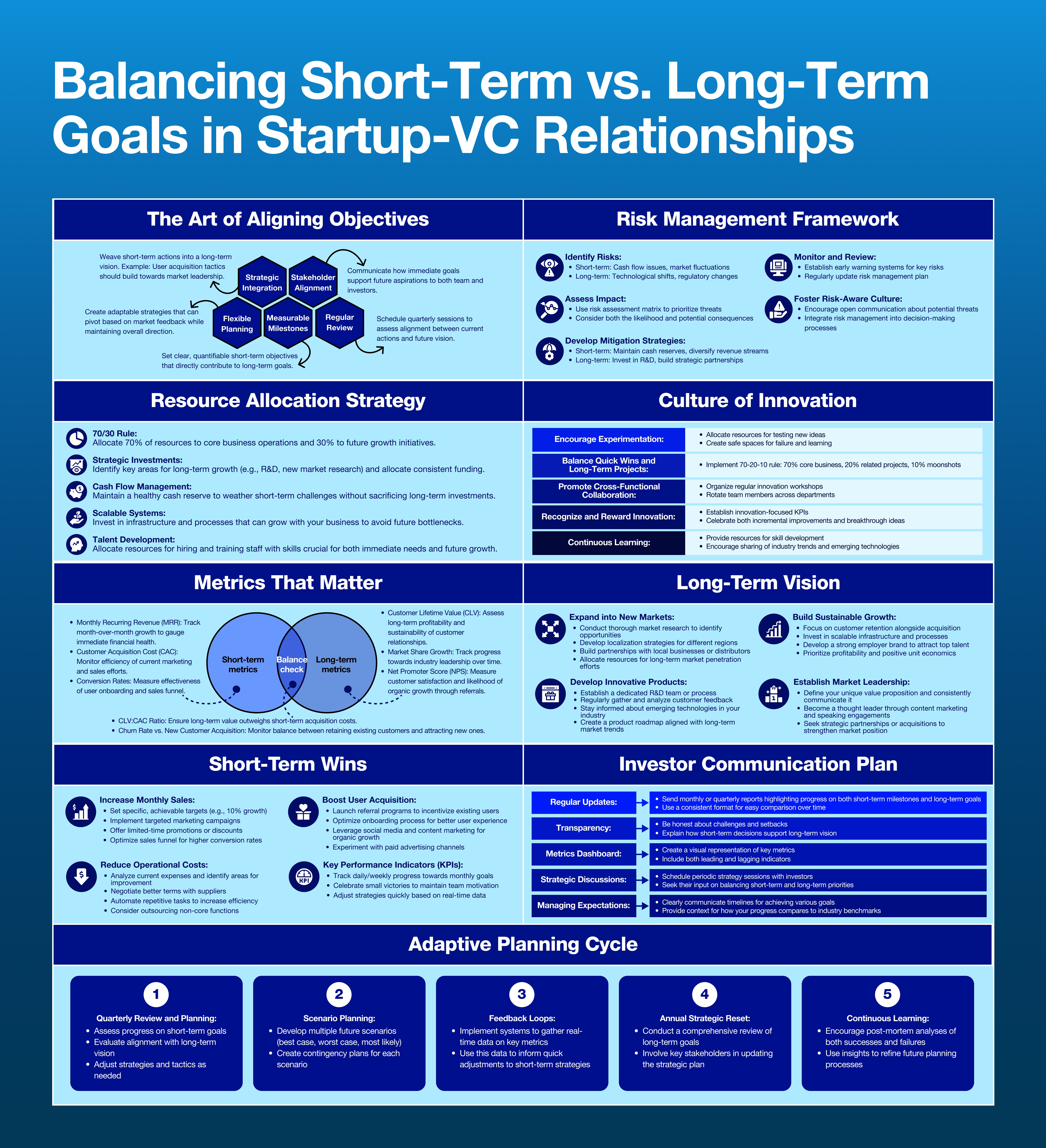
If fundraising is an art, scaling a startup with VC partners is a balancing act — a delicate tension between what needs to happen this quarter and what truly matters over the next decade.
Founders often get pulled in two directions:
On one side, VCs want clear, near-term milestones to justify continued support.
On the other, your company’s survival depends on building systems, products, and capabilities that take time.
Most of the conflict, stress, and misalignment between founders and investors comes from not managing this balance deliberately.
This BrainDump breaks down the frameworks, systems, and communication patterns that high-performing Founders use to keep both sides aligned — and prevent short-term pressures from killing long-term potential.
Let’s dig into each one.
Table of Contents
The Art of Aligning Objectives
Risk Management Framework
Resource Allocation Strategy
Culture of Innovation
Metrics That Matter
Long-Term Vision
Short-Term Wins
Investor Communication Plan
Adaptive Planning Cycle
Final Word
1. The Art of Aligning Objectives
Alignment doesn’t happen by accident — it happens by design.
This section identifies the six core goals that must be explicitly aligned between the founder and their investors:
Market expansion
Revenue growth
Product innovation
Operational excellence
Sustainability
Talent development
Founders get into trouble when they assume everyone shares the same definition of “success”.
Investors run portfolios. Founders run companies. The incentives aren’t always identical.
The key is clarity:
✔ What does “growth” mean?
✔ What does “success” look like?
✔ What is the agreed time horizon?
✔ What trade-offs are acceptable?
✔ What isn’t on the table?
If you don’t define alignment early, misalignment becomes inevitable.
2. Risk Management Framework
Founders often think VCs are risk-seeking.
They’re not. They’re risk-managed.
This section focuses on the three layers of risk founders must actively address:
Strategic risk — Are you focused on the right initiatives?
Financial risk — Can you survive volatility?
Operational risk — Can you execute reliably as you scale?
The founders who win investor trust are the ones who show they understand the risks — and have realistic plans to mitigate them.
Short-term risk management builds long-term confidence.
3. Resource Allocation Strategy
If you want to see a founder’s true priorities, ignore the pitch deck.
Look at the budget.
This part identifies the major categories of resource allocation that VCs scrutinise:
R&D and product innovation
Go-to-market investment
Hiring and capability building
Operational infrastructure
Margin protection
Future-proofing experiments
The core challenge:
How do you fund what drives today without starving what makes you dominant tomorrow?
The best founders build budgets in layers:
Foundation → Acceleration → Innovation → Optionality
It’s not just spending. It’s sequencing.
4. Culture of Innovation
Most companies don’t die because they fail to innovate — they die because they fail to innovate consistently.
This section outlines how founders can build a culture that balances discipline with exploration:
Encourage experimentation
Reward learning as much as outcomes
Protect time for innovation
Set boundaries on “shiny object syndrome”
Build mechanisms for rapid iteration
Innovation without guardrails creates chaos.
Guardrails without innovation creates stagnation.
The culture you design determines which fate you choose.
5. Metrics That Matter
Not all KPIs are created equal — and the wrong metrics create the wrong behaviours.
This part distils the core metrics investors watch:
Product adoption
Customer success signals
Unit economics
Revenue efficiency
NRR and logo retention
Operational leverage
Short-term metrics show momentum.
Long-term metrics show resilience.
Exceptional founders structure dashboards that track both simultaneously.
6. Long-Term Vision
This is where great founders differentiate themselves.
In the short term, you need:
Revenue
Traction
Growth
Narrative control
But long-term vision requires:
Market positioning clarity
Category creation or domination pathway
Scalable operational systems
Strategic moat development
Investors want evidence that you’re not just building a company — you’re building an inevitability.
Your long-term vision shouldn’t be fluffy. It should be a strategy with teeth.
7. Short-Term Wins
Short-term wins matter more than founders think — not because they prove success, but because they prove repeatability.
Short-term wins give investors:
✔ Confidence
✔ Momentum
✔ Proof of execution
✔ Validation of assumptions
But founders must choose these wins wisely.
A short-term win that derails long-term strategy is not a win — it’s a distraction.
The art is picking the tactical victories that ladder up to strategic inevitability.
8. Investor Communication Plan
Miscommunication is the silent killer of founder-investor relationships.
This section lays out the playbook for staying aligned:
Scheduled investor updates
Clear milestone reporting
Honest disclosure of risks
Transparency around pivots
Cannons before fireworks: big decisions before big announcements
When communication is proactive and consistent, trust compounds.
When it’s sporadic and reactive, trust collapses.
9. Adaptive Planning Cycle
Startups don’t win by sticking to a plan.
They win by updating the plan faster than competitors.
This cycle emphasises:
Quarterly priority setting
Monthly performance reviews
Continuous feedback loops
Strategic recalibration
Investor alignment updates
Rapid execution adjustments
Rigid plans break.
Adaptive plans bend — and keep moving.
This is how founders balance short-term urgency with long-term strategy without losing their footing.
The Final Word:
Balancing short-term and long-term goals isn’t a conflict.
It’s a discipline.
Founders who master this discipline build trust, avoid burnout, make smarter decisions, and maintain alignment with their investors through every turbulent stage.
It’s not about choosing between today and tomorrow —
it’s about building a company that performs today because it’s designed for tomorrow.
-Chris Tottman
Investors do not buy busy founders.
Investors buy transferable value and the ability to react when plans need reassessment.
The founders who really break away treat short-term wins as the required proof points for the longer, more complex vision.
That's the real skill here.