

👋 Hey, Chris here! Welcome to The Founders Corner. If you’ve been reading along, you’ll know I have very little patience for theory that doesn’t survive contact with a real buyer.
This series is a preview of a new book I’ve written with my partners Richard Blundell and Paul Watson — The Selling Software Algorithm: The Go-to-Market Navigation System for B2B Software Leaders.
It isn’t a strategy deck dressed up as a book. Between the three of us we’ve spent close to seven decades inside B2B software as founders, operators, investors and coaches — building companies, exiting some, and quietly breaking a few along the way, which is where most of the real learning lives. Through our work at Vencha we’ve now supported hundreds of founders trying to do the single hardest thing in software: turn a clever product into predictable commercial traction in a market that’s noisy, cautious, and more crowded than it has ever been.
One pattern shows up again and again. Companies rarely struggle because the product is bad. They struggle because they have no navigation system for going to market. This book is that system.
Last time we sorted your accounts into four zones and found the small, dense corner of the market where your effort actually compounds. That’s the end of the analysis. It is not the end of the work.
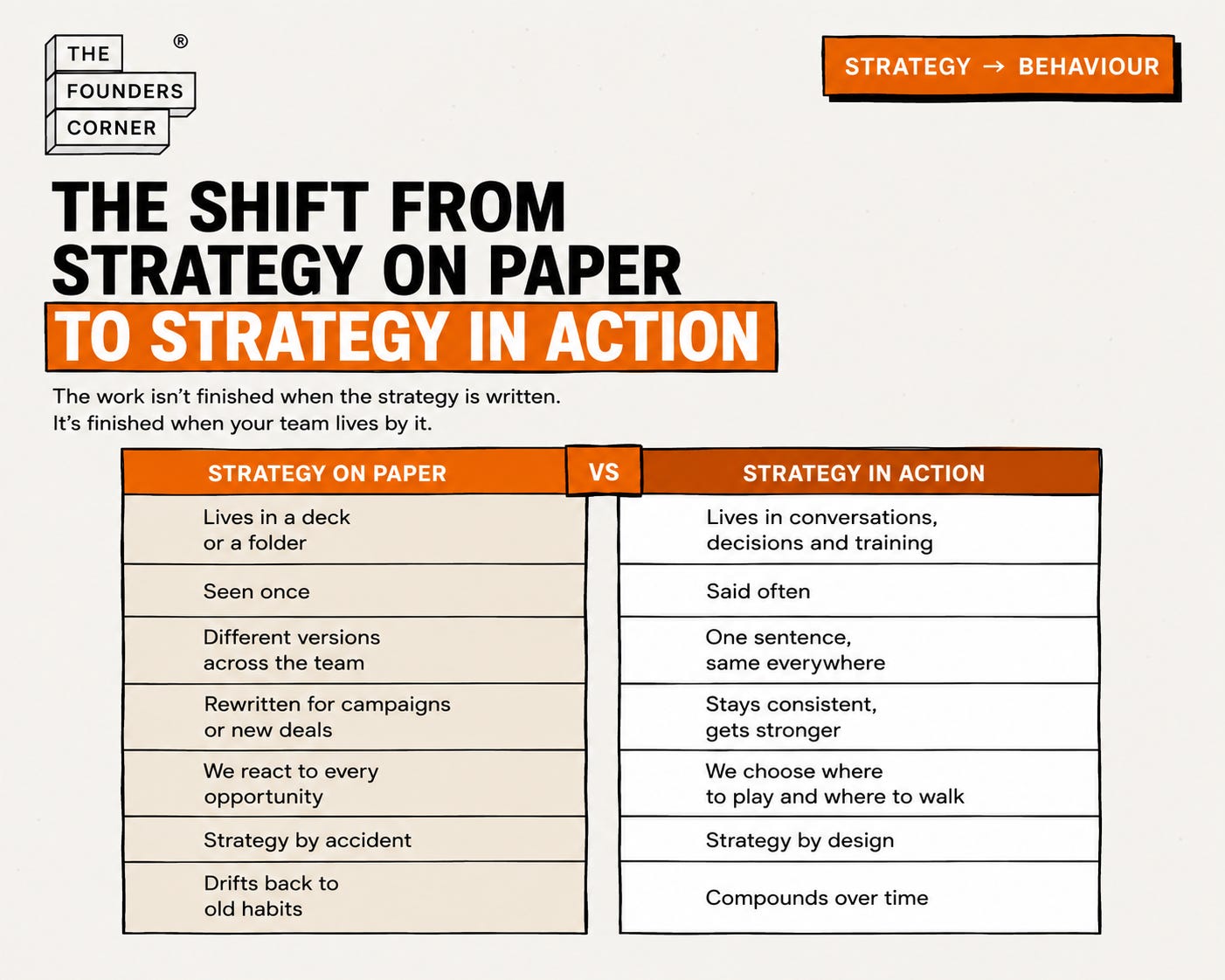
Because here’s what happens next in almost every company that does this properly. The team runs the sessions. The whiteboards fill up. Someone types it all into a deck, the deck gets a nice cover slide, and it goes into a folder called Strategy. Six weeks later the sales pitch has drifted back to where it was, marketing is briefing against last year’s positioning, and a feature request from a Respond zone account has quietly made it onto the roadmap. Nobody decided to abandon the work. It just stopped being said out loud.
That’s the difference between clarity as a document and clarity as behaviour. And the transition between them is the one piece of work a founder cannot delegate, cannot outsource, and cannot do at arm’s length.
Table of Contents
A Simple Example: The Poster Nobody Reads
One Sentence, Every Bracket Filled
Why Language Becomes Behaviour
The Shift from Discoverer to Guardian
How Clarity Actually Erodes
Focus Is Not Forever, But It Has to Outlast the Doubt
What You Genuinely Cannot Hand Over
Making It Real Inside Your Business
A Simple Example: The Poster Nobody Reads
Walk into most software companies and you’ll find a value statement on a wall somewhere. Reception, usually, or the meeting room with the good chairs. It has been professionally set in a nice typeface. It has been there for two years.
Now ask three people to say it without looking. The sales lead gives you a version about efficiency. The product lead gives you a version about the platform. The marketing lead gives you the version from the website, which is different again because it was rewritten for a campaign in March and nobody circled back.
None of them is being careless. Each is repeating the version they need for their own job. The poster didn’t fail because it was wrong. It failed because it was never something anyone had to say, only something everyone had seen.
The test of whether the work landed is not whether the team has read it. It’s whether the team can play it back to you, unprompted, in front of a customer, six months later.
One Sentence, Every Bracket Filled
The output of everything in this series is a single sentence, and it looks like this:
Our software is perfect for [a clearly defined and understood Economic Buyer] in [a tightly defined Perfect Customer Profile] who’s struggling with [the three most visceral pains our software solves].
Each bracket has to be earned rather than guessed. The Economic Buyer must be the person who signs the cheque, owns the budget line, and carries the accountability for fixing the problem — not the person who takes the first meeting. The Perfect Customer Profile must be narrow enough that you recognise it instantly and qualify without hesitation. And the three pains must not be “nice to fix”. They must be “we cannot continue like this”.
Here’s a worked example, purely to show the level of specificity you’re aiming for. It isn’t meant to fit your business; it’s meant to model how tight the brackets need to be.
Our software is perfect for the COO or Head of Operations in UK-based logistics and field service businesses with 250 to 2,000 employees and turnover between £25m and £300m. They run multi-site operations and rely heavily on spreadsheets and email to coordinate scheduling, handovers and compliance. They’re struggling with operational visibility that collapses under pressure, repeated service failures caused by manual handovers and stale data, and constant internal firefighting that is burning out teams and putting leadership credibility at risk.
Notice what makes it work. It names the buyer. It puts boundaries around the type of company. It describes how they cope today, which is what makes the pain recognisable. Nothing in it could be said by a competitor about a different market.
If your version could be read aloud by three companies in your category without anyone noticing, you haven’t finished.
Want to get in front of 250k+ founders and investors?
For sponsorship opportunities across The Founders Corner newsletter and LinkedIn (160k followers), email: founderscornermedia@gmail.com
Why Language Becomes Behaviour
There’s a reason we push so hard on people being able to say it rather than having seen it.
Language is the mechanism by which strategy actually reaches decisions. A salesperson who can say the sentence disqualifies a bad-fit prospect on the first call without needing permission. A product manager who can say it pushes back on a one-off feature request without it becoming a political argument. A marketer who can say it writes a headline that a buyer recognises themselves in.
None of those people are consulting the strategy folder. They’re using the sentence as a filter, in the moment, under mild time pressure, which is the only condition that matters.
So put it everywhere it will be repeated rather than everywhere it will be seen. Onboarding packs. The top of every marketing brief. Sales training. The first slide of the QBR. The framing question in roadmap discussions: does this make us better for that buyer, in that company, against one of those three pains?
Your goal is not that the team has seen it. Your goal is that the team can say it and play it back to you, because once it becomes language, it becomes behaviour.
If you’re building right now, you’ll need these:
243 Ways to Fund Your Startup Without Giving Up a Share: 243 programmes across 63 regions, and the eligibility gate that quietly disqualifies most applicants.
15 Claude Skills That Run Your Entire Raise: install once, and your story stops drifting somewhere around investor number forty.
The Investors Who Are Actually Writing Cheques In H2: 287 family offices your warm intro list doesn’t know exist.
The Claude Guide Every Founder Should Run Before Fundraising: nine prompts that replicate the screen your deck meets before a partner ever opens it.
How to Build Your Fundraising Narrative with Claude: the five-prompt sequence that puts your story in the order it needs to land, not the order it happened to you.
The Shift from Discoverer to Guardian
In the early stages, the founder is the connective tissue. You’re the one who understands why the product exists, what problem it was born to solve, what compromises were made along the way, and how the market has responded so far. That vantage point belongs to nobody else, and it’s why defining the Economic Buyer, defining the Perfect Customer and validating pain are leadership work rather than tasks to be handed off.
But once clarity is earned, your role changes. You move from discoverer to guardian.
That’s a genuinely different job, and most founders never consciously make the switch. Discovery is energising: you’re learning, the picture is sharpening, every conversation adds something. Guarding is unglamorous. It’s saying no to reasonable-sounding things, repeatedly, in rooms where you’re the only person with the full context. There is no dopamine in it at all.
It’s also the phase where the value of everything you’ve built either compounds or quietly leaks away.
How Clarity Actually Erodes
It never goes in one decision. We’ve watched this happen enough times to describe the sequence almost exactly.
The company gains early traction. Confidence rises. An inbound lead arrives from an adjacent segment and it seems churlish to turn down revenue. A partnership is proposed that would open a different market. An investor asks about expansion, and the honest answer — we’re deliberately staying narrow for another four quarters — feels weaker in the room than it is on paper.
So the website gets a little more generic, because it now has to cover two audiences. The sales deck becomes a catalogue of benefits rather than an argument. The roadmap absorbs a request no other customer has ever made. And the pipeline refills with polite conversations that feel encouraging and never close.
Every individual step was defensible. The aggregate is a company that no longer knows who it’s for.
The tell is usually the deck. When your slides start listing what the product can do rather than who it’s for, the drift has already happened.
Focus Is Not Forever, But It Has to Outlast the Doubt
None of this is an argument for staying narrow permanently. Expansion isn’t wrong. It just has to be earned, and the thing that earns it is proof — repeatability so obvious that nobody in the business is still asking whether it’s real.
The difficulty is that the doubt always arrives before the proof does. There’s a stretch, usually longer than you’d like, where the focus is working but the evidence isn’t yet overwhelming, and that’s precisely when the pressure to widen is strongest. Your job in that window is to keep the arrow pointed at the bullseye until repeatability is undeniable.
Clarity, once earned, is powerful. It’s also fragile, and it has to be actively defended.
What You Genuinely Cannot Hand Over
To be clear about where the line sits, because plenty of this work can and should be shared.
You can delegate building the market map, running the enrichment, managing the campaigns, and most of the execution that follows. What you can’t delegate is the judgement layer: deciding who the Economic Buyer is, deciding what counts as in-profile and what doesn’t, and holding those decisions when they become inconvenient.
Two practical points. First, many founders attempt this work alone and never quite finish it, because the business is too close to the problem. That’s not a criticism, it’s human nature, and independent facilitation helps enormously — it keeps the process honest and stops the team drifting into consensus statements that feel safe and change nothing. Partial clarity is often more dangerous than none at all.
Second, put a date in the diary. Revisit the sentence quarterly and ask what evidence would make you change it. Guarding clarity isn’t the same as refusing to update it. It’s refusing to update it for the wrong reasons.
Making It Real Inside Your Business
Write your version of the sentence this week, with the whole leadership team in the room, and don’t leave until every bracket is filled with something specific enough to be uncomfortable.
Then do the three things that turn it from a document into behaviour. Say it out loud in the next all-hands, and ask two people at random to repeat it back. Put it at the top of the next marketing brief and the next roadmap discussion, and use it as the filter rather than the preamble. And name, explicitly, what you’re going to stop doing as a result, because a strategy with no casualties isn’t a strategy.
This is what Builder Step 7 exists to produce: your completed algorithm statement, assembled from the buyer, profile and pain work you’ve already done, in language your team can actually repeat.
Selling Software Algorithm Builder, Step 7: Your Algorithm (recreated illustrative mockup based on the tool’s documented output; a fictional example company is shown)
Clarity is not the reward for doing the work. It’s the thing you now have to protect.
-Chris Tottman
Most strategy work fails quietly, not because it was wrong, but because it was written down once and never said again.
The Selling Software Algorithm Builder Step 7 turns your buyer, profile and pain work into a single sentence your team can repeat, and shows you where your current messaging disagrees with it.
Start your 7-day free trial → Cancel anytime.