

Most founders approach grants the same way.
They Google “startup grants 2026.” They find a listicle with twelve entries, eight of which are American. They click three links. Two are dead. One leads to a programme that closed in 2023.
They conclude the whole category is a waste of time and go back to building the deck.
Meanwhile, US federal innovation programmes alone deploy over $4 billion a year into small companies. The European Innovation Council has €1.4 billion committed for 2026. Innovate UK, NRC IRAP, Bpifrance, CDTI, Enterprise Singapore and the Israel Innovation Authority add billions more.
None of it takes equity. None of it takes a board seat. None of it appears on your cap table.
The problem isn’t that the money doesn’t exist. The problem is that almost nobody tells you what actually disqualifies you.
We’ve spent weeks fixing that. The result is a directory of 243 non-dilutive programmes across 63 regions, every one checked against source in August 2026. Award sizes, cadences, realistic odds, direct apply links, and the specific eligibility gate that silently rules most applicants out before anyone reads a word of their submission.
Want to get in front of 250k+ founders and investors?
For sponsorship opportunities across The Founders Corner newsletter and LinkedIn (160k followers), email: founderscornermedia@gmail.com
Why Grant Applications Actually Fail
Not because the idea was weak. Because founders write grant applications the way they write pitch decks.
Those are opposite skills.
When you pitch an investor, you are selling a distribution of outcomes. Your job is to make the top of that distribution feel plausible. You lead with the best number. You compress the risk into one slide nobody reads properly. Optimism is the product.
A grant assessor is doing something completely different.
Take Innovate UK as the clearest published example. Your application goes to three to five independent assessors. Each scores individual questions out of 10 against a rubric published before you apply. Scores are moderated across the whole round. Success rates sit in the 10% to 25% band, lower in oversubscribed competitions.
Which means the realistic funding bar is a mid-80s percentage, not the 70 you were expecting.
Assessors are not hunting for reasons to fund you. They are hunting for reasons to deduct.
Three things follow from that, and each one inverts a habit that serves you well in a partner meeting.
1. Unhedged optimism is a deduction, not a strength. Innovation bodies exist to fund the removal of technical uncertainty. If your application reads like there is no meaningful risk left, you have just argued that you don’t need the grant. Name the hard unknown. Then show a credible plan to resolve it.
2. Every sub-clause is a scoring line. Grant questions are three or four questions stapled together with “and.” Founders answer the interesting part, run out of word count, and skip the last clause. That clause carried marks.
3. Scope is checked before merit. Eligibility and scope screening happens before an assessor reads a word of your technical case. A brilliant project in the wrong competition dies without anyone ever reading it.
Stop pitching. Start scoring.
Grants Are Five Different Products Wearing One Word
This is the second reason founders write the category off.
They hear “grant,” picture one thing, and go straight to the hardest version of it.
Layer 1: Credits. Infrastructure and tooling burn. $1k to $350k in kind. Live in days. Near certain at entry tier.
Layer 2: Fellowships and micro-grants. Funds the founder personally, not the company. $500 to $250k. Two to twelve weeks. Assesses you, not your traction.
Layer 3: Tax relief. Pays you back for work you already did. 15p to 27p per £1 spent. One accounting cycle. Near certain if eligible.
Layer 4: Innovation grants. A defined R&D project. $50k to £2m. Four to nine months. Scored against a published rubric.
Layer 5: Blended deep tech. Scale-up and market entry. €2.5m grant plus optional equity. Six to twelve months. Around 3%.
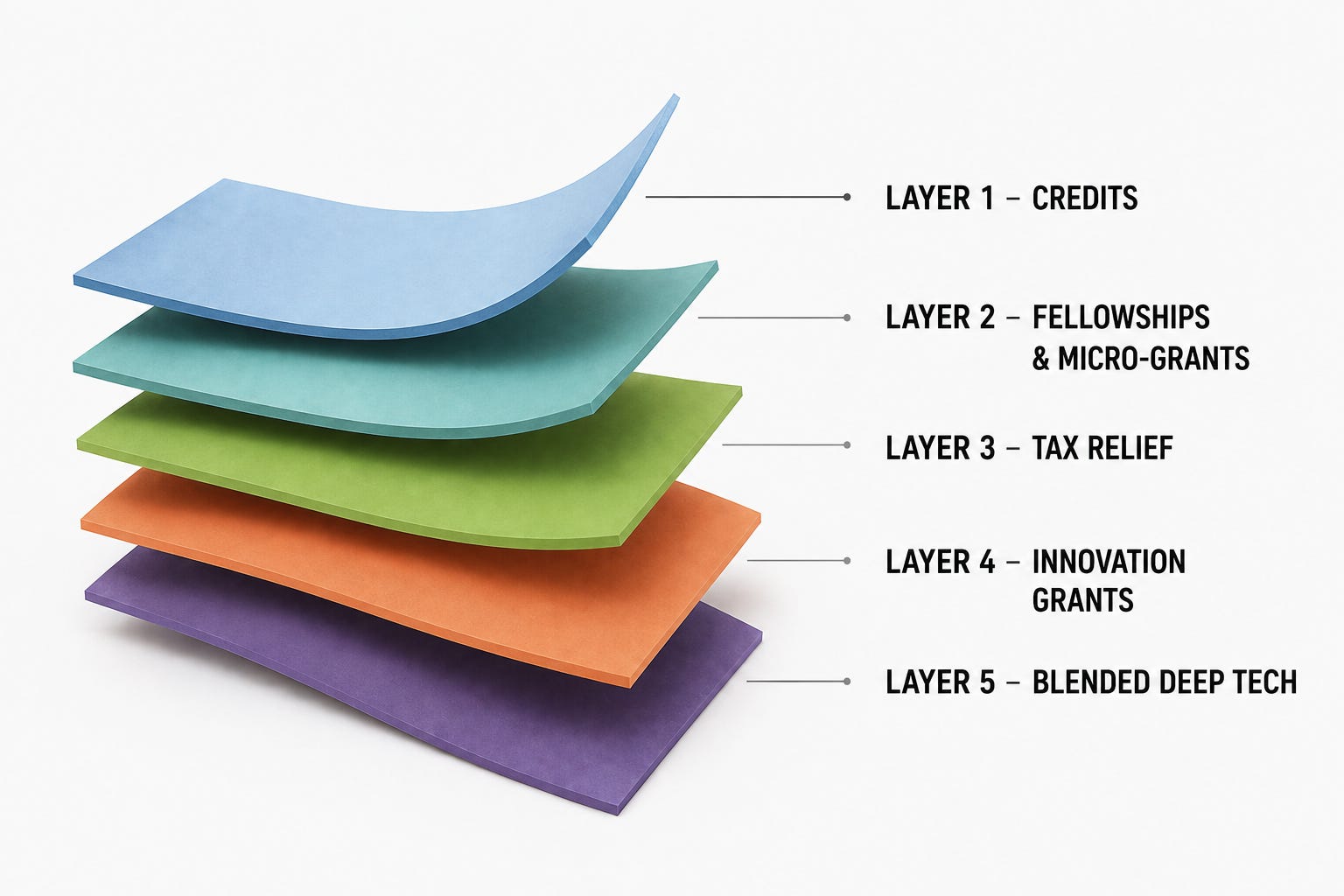
Almost every founder who “looks into grants” goes straight to Layer 4. It is simultaneously the slowest, the most competitive and the most writing-intensive of the five.
Layers 1 and 3 are close to guaranteed money for a company that already qualifies, at a fraction of the effort.
Sequenced properly, each layer buys the runway to work on the next one.
What Each Entry Includes
Every one of the 243 entries gives you nine things:
1. Award size. The real number, not the marketing ceiling. Where a headline figure is only reachable via VC nomination, we say so.
2. Layer. Which of the five above, so you can sort by effort rather than by size.
3. Region. 63 of them, from US state match programmes to Indian state schemes.
4. Stage fit. Pre-incorporation, pre-revenue, post-Phase II, scale-up. Applying at the wrong stage is the most common wasted application.
5. Cadence or next deadline. Monthly, quarterly, annual, rolling, or a specific 2026 date.
6. Effort. Low, medium, high, very high. A Layer 1 credit is an afternoon. An EIC Accelerator bid is a campaign.
7. Realistic odds. Drawn from published success rates where funders publish them. A planning aid for ranking your effort, not a promise.
8. The eligibility gate. The single most valuable field, and the one no other list has. Written as the specific thing that disqualifies people, not as generic criteria.
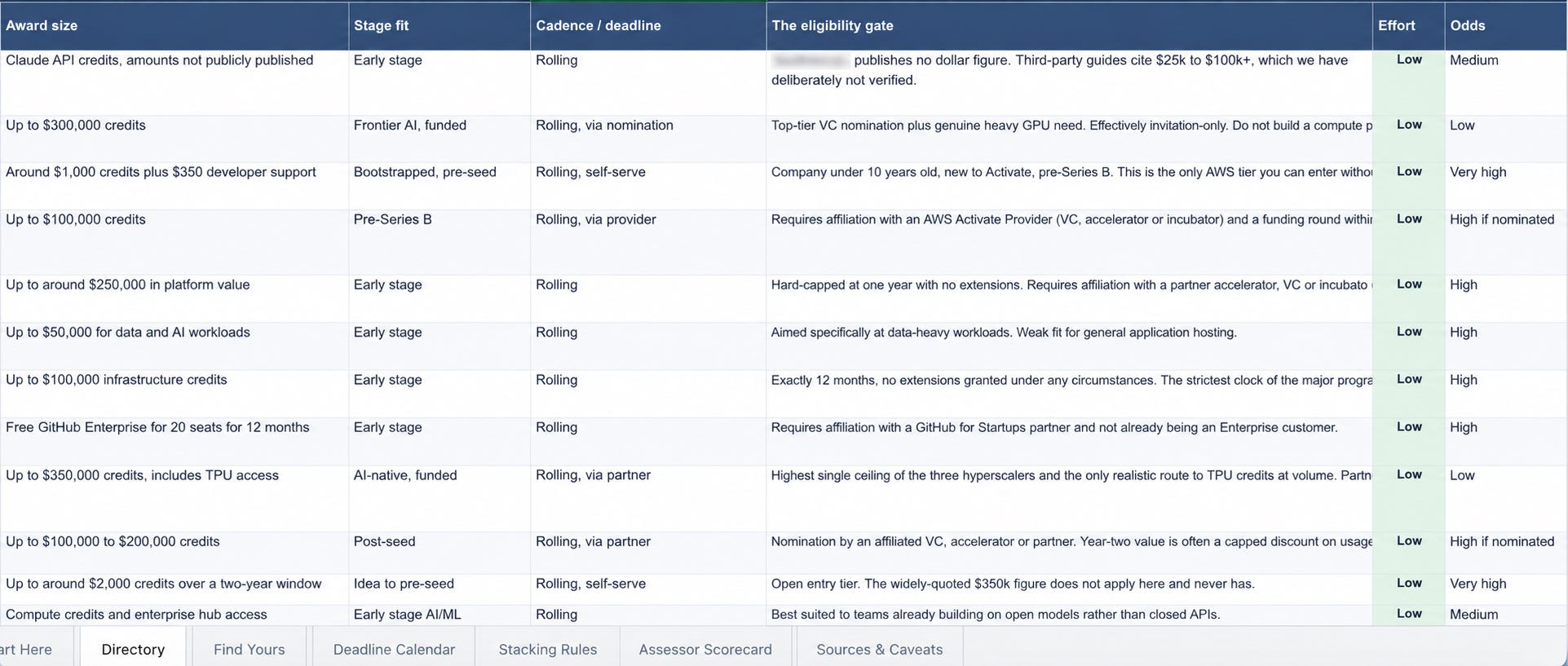
9. Data confidence. Verified against source, directional, or amount unpublished. So you know which figures to double-check before you build a plan around them.
Our Most-Read Articles Right Now
🔥 You get one meeting. Here’s how to prepare for it in 20 minutes with Claude. Most founders spend their prep time on the pitch. The founders who close rounds spend it on the investor.
🔥 The 300+ AI Investors Actually Worth Your Time 305 named individuals, not funds. LinkedIn URLs, real theses, and a specific warm intro playbook for each one.
🔥 I asked Claude to reject my pitch until it couldn’t. Then I raised. The preparation system founders are using to walk into VC meetings already knowing every question that kills deals.
📈 The Number That Kills More Fundraises Than Any Bad Idea Every investor asks it. Most founders get it wrong. Why your market size slide is either your strongest asset or the quiet reason you’re not getting a second meeting.
📋 The 8 Checks That Can Kill a Signed Term Sheet 15% to 25% of signed term sheets never make it to a closed round. Not because the business got worse.
📋 The Due Diligence Playbook: What VCs Actually Analyse Before They Invest An inside look at how venture capital firms evaluate founders, financials, structure and scalability before committing capital.
A Taste of What’s Inside
Four entries from across the directory.
Enhanced R&D Intensive Support (ERIS), HMRC United Kingdom · Layer 3 · Up to 26.97p per £1, paid in cash
For loss-making SMEs whose R&D spend is at least 30% of total expenditure. No pitch, no assessor, no competition. A pre-revenue UK startup spending £400,000 a year on qualifying development is looking at a cash credit near £100,000. The gate: first-time claimants must notify HMRC within six months of the end of the period of account. Miss it and an otherwise valid claim is void.
NSF SBIR/STTR, National Science Foundation United States · Layer 4 · Up to $305,000 Phase I, $1.25m Phase II
Deep tech, any field of science and engineering. NSF takes no equity and you keep your IP. The gate: you cannot submit a full proposal at all until you file a three-page Project Pitch and are formally invited. Processing takes around three weeks and you are limited to two pitches per submission window. Burn both on weak pitches and you are locked out until the next window.
Amber Grant, WomensNet US and Canada · Layer 2 · $10,000 monthly, plus larger year-end awards
At least 50% women-owned. Short application, small fee. The quiet advantage: because it runs monthly, you compete against one month of applicants rather than a year’s worth. That makes the odds structurally better than almost anything else in the directory.
i-Lab (Concours d’innovation), Bpifrance France · Layer 4 · Non-repayable subsidy up to €600,000, no equity taken
One of Europe’s most prestigious deep tech awards. The gates: a French-incorporated company (founders of any nationality), a genuinely scientific or engineering core, and applications are expected in French. Software-only ideas rarely qualify. Around a 5% full-award rate, so treat it as a campaign, not an opportunistic bid.
Four completely different shapes of money: a near-certain tax credit, a gated federal grant, a monthly micro-grant with unusually good odds, and a competitive European deep tech award.
The directory covers all of it, and the 239 other programmes across every layer, stage and geography.
The Geography Breakdown
243 programmes. 63 regions.
United States. All eleven SBIR agencies plus ARPA-E and ARPA-H, NSF I-Corps, and the state match programmes that turn a $295,000 federal award into $445,000 if you happen to be incorporated in the right place.
United Kingdom. Innovate UK Smart Grants, Women in Innovation, KTPs and Innovation Loans, plus all three devolved nations. Scottish Enterprise, Business Wales, Invest NI. Growth Hubs and council-level schemes that decide in two to four weeks.
Europe. The full EIC suite and Horizon Europe clusters, Eurostars, plus the national programmes that almost no English-language list covers properly: EXIST, ZIM and the German Research Allowance, Bpifrance’s ladder from Bourse French Tech to i-Lab to ADD, Spain’s NEOTEC and CDTI, the Dutch WBSO and MIT, Enterprise Ireland, Vinnova, Innovation Norway and Business Finland.
Rest of world. Canada’s four IRAP streams plus SR&ED and the provincial layer. Singapore, India’s central and state stack, Israel, Australia, New Zealand, Hong Kong, the UAE, and pan-African programmes.
What to Do This Week
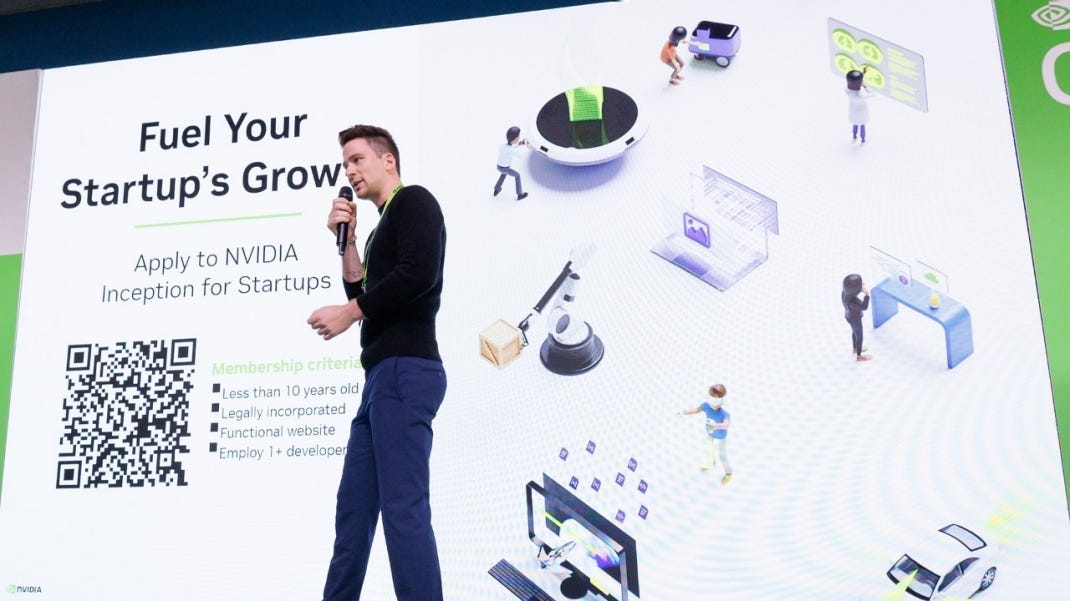
Claim your Layer 1 credits. An afternoon of forms. Start with NVIDIA Inception, which is free, open globally at any stage, and materially improves your standing with the hyperscaler programmes. Then build a spreadsheet with one column for expiry date. Founders routinely let five figures of credit lapse because nobody owned the calendar.
Start any registration that gates everything else. SAM.gov takes three to six weeks and blocks every US federal application until it is active. DPIIT recognition in India takes two to three weeks and gates almost every central scheme. Both are free, and neither requires you to have chosen a programme yet.
Book an hour with your accountant about Layer 3. If you are UK-based and doing genuine technical work, this is almost certainly the largest predictable non-dilutive cheque available to you, and most founders treat it as year-end admin rather than a financing decision with a hard deadline.
Then, and only then, shortlist four Layer 4 programmes. A grant application takes 40 to 200 hours. Four is a campaign. Twelve is a fantasy.
The Traps That Kill Applications Before Anyone Reads Them
Almost none of these are about the quality of your idea.
You started too late. Registrations, consortium formation and national co-filings eat weeks before you can submit anything. A Eurostars proposal takes four to eight weeks to prepare, and the national documentation is due within days after the deadline. Founders lose to the calendar far more often than to the competition.
You spent money you were about to be given. Canada’s NRC IRAP agrees funding before you incur the expense. Costs already spent are disqualified. Applying after the work is done wastes the entire application.
You burned an attempt on a draft. Rounds are finite and several programmes cap resubmissions. Submitting something that scores in the low 70s is not a free option. It costs an attempt, six to twelve months of waiting, and it attaches your name to a weak application.
You applied to something that no longer exists. Seven major programmes still appearing on widely-circulated 2026 lists have closed or been renamed. SDTC folded into IRAP. Callaghan Innovation was disestablished. Accelerating Commercialisation closed in 2023. EIT Manufacturing shut in April 2026. Every one of those is still being recommended somewhere.
One Rule Before You Apply to Anything
Print the published assessment criteria and put them next to your draft.
Map every paragraph you write to a specific scoring line. Where the criteria use a particular word, use that word instead of your more elegant synonym.
Assessors are reading forty applications in a fortnight. They are scanning for the thing they were told to look for.
“The best founders don’t spray and pray. They submit four applications that matter. That takes knowing exactly which four you’re actually eligible for, before you write a single word.”
The Bottom Line
Founders don’t miss grant money because they build badly. They miss it because they search badly.
They read a list that’s shallow, stale and 80% American. They go straight to Layer 4, the slowest and hardest of the five. They write the application like a pitch deck. Then they find the disqualifying eligibility rule in week three of drafting instead of week zero.
And the clock is always further along than it looks. Three major windows sit inside the next two weeks: the EIC Accelerator cut-off on 2 September, the NIH standard due date on 5 September, and Eurostars Call 11 closing 10 September. Every one has a lead time in front of it longer than the time remaining.

Which is exactly the point. The next cut-offs are 4 November and 7 January, and whether you make those is being decided this week by whether your registrations are already running.
243 programmes. 63 regions. Every eligibility gate written out. Every figure dated.
What One Row is Worth
One ERIS claim on £400,000 of qualifying development returns roughly £100,000 in cash. No pitch. No assessor. No competition.
One state match turns a $295,000 federal award into $445,000.
One missed HMRC notification voids the whole claim, however much qualifying R&D you actually did.
A Premium subscription costs less than an hour of the adviser you would otherwise pay to find any of it.
SAM.gov takes three to six weeks. EIC Step 1 takes four to six. Neither requires you to have picked a programme yet, and the file tells you which to start today.
📥 The Full 243-Programme Directory
Seven tabs, built to be used in twenty minutes rather than read for an hour.
✓ Find Yours. Start here. A region-by-layer matrix showing exactly how many programmes exist for you and which to open first. A UK founder sees 28. A Canadian sees 21. Ten seconds to know where to look.
✓ The Directory. All 243, filterable by region, layer, stage and effort. Award size, cadence, realistic odds, direct apply link. Plus the eligibility gate on every single row, written as the specific thing that disqualifies people rather than as generic criteria.
✓ A built-in tracker. Mark each programme Shortlisted, Applying, Submitted or Won from a dropdown, and your progress rolls up to the front page automatically. This is a working file you reopen weekly, not a PDF you read once.
✓ Deadline Calendar. Every major cycle through to Q2 2027, with the registration or pre-gate lead time you have to clear first, and therefore your true start date.
✓ Stacking Rules. Which instruments legally combine and which cancel each other out. The US stack that turns a $295,000 federal award into $445,000. The European ceiling that quietly shrinks a later, larger award if you’ve already drawn against it. And the six conditions that void an otherwise valid claim.
✓ Assessor Scorecard. Score your draft across the eight dimensions a panel actually marks. It returns your weighted percentage against the mid-80s bar and tells you plainly whether to submit. Score below it and you’ve just saved an attempt and six to twelve months.
✓ Sources and Caveats. Every source named, every figure dated. Plus the seven programmes still circulating on 2026 lists that have quietly closed or been renamed, so you don’t lose a month applying to one that no longer exists.
Download Below
Start your 7-day free trial → Cancel anytime.