

👋 Hey, Chris here! Welcome to BrainDumps—a weekly series from The Founders Corner. If you’ve been reading along, you know this series is a preview of a bigger project. Well, it’s finally here: The Big Book of BrainDumps is out now!
It isn’t a theory book—it’s the founder’s field manual. Inside, you’ll find 70 powerful frameworks distilled from 30+ years scaling software companies to hundreds of millions in ARR, 20+ years investing in 500+ B2B tech startups, and over $1B of shareholder value created. From raising capital to hiring your first VP of Sales, this book turns scars and successes into practical playbooks you’ll return to again and again. I expect most copies will become well-worn, scribbled on, and dog-eared—because it works.
Most founders think about strategic planning far too late.
In the early stages of building a business, strategy often feels secondary to execution. The focus is naturally consumed by product development, customer acquisition, fundraising, hiring, firefighting, and survival. There’s always another feature to release, another investor update to send, another sales call to jump on. Momentum becomes the operating system.
And for a while, that’s entirely normal.
But eventually every growing company reaches a point where speed alone is no longer enough. Complexity increases. Teams expand. Decisions multiply. Priorities begin competing with one another. Different departments start interpreting success differently. Without realising it, the business begins drifting—not because people are working less hard, but because they’re no longer moving in exactly the same direction.
That’s the point where strategic planning stops being a theoretical exercise and becomes operationally essential.
Because the real purpose of strategy is not to produce a beautiful PowerPoint deck that gets revisited once a year. The purpose of strategy is alignment. It’s creating clarity around where the company is heading, why it matters, what priorities matter most right now, and how resources should actually be allocated to get there.
In other words, strategic planning is not about predicting the future perfectly.
It’s about making better decisions consistently.
Table of Contents
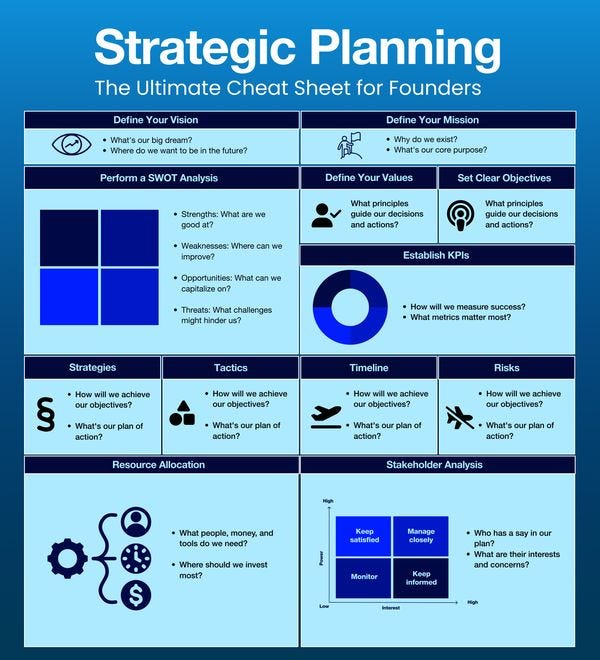
Every Strategic Plan Begins With Vision
Mission Is What Grounds the Business
SWOT Analysis Still Matters More Than People Admit
Values Quietly Shape Every Decision
Strategy Without Execution Is Just Theatre
Resource Allocation Is the Real Strategy
Stakeholder Management Becomes Increasingly Critical As You Scale
Great Strategic Planning Is Dynamic, Not Static
Strategic Planning Is Ultimately About Clarity
Every Strategic Plan Begins With Vision
The strongest businesses almost always possess a remarkably clear sense of identity.
They know where they’re going.
They know why they exist.
And critically, they know what they are not trying to become.
That clarity usually begins with vision.
A vision statement should define the future state the business is trying to create. Not next quarter’s targets, but the bigger picture. It’s the aspirational layer of the company that gives people something larger to rally around.
The best vision statements create direction without prescribing every step.
Tesla’s vision is “to accelerate the world’s transition to sustainable energy.” Shopify wants “to make commerce better for everyone.” These statements are powerful because they operatebeyond products. They describe movements, not features.
And that matters more than many founders realise.
Because when a company grows, people need context for decision-making. Teams move faster when they understand the destination. A strong vision acts as a compass during periods of uncertainty, helping leaders prioritise opportunities, investments, and trade-offs without constantly needing top-down instruction.
Without that clarity, businesses often become reactive rather than intentional.
Mission Is What Grounds the Business
If vision defines the future, mission defines purpose.
This is the layer many businesses either rush through or overcomplicate. But in reality, the mission should answer a deceptively simple question:
Why does this company exist?
The answer matters because businesses that scale successfully are usually solving meaningful pain for real people. The clearer the mission becomes internally, the easier it is to align teams around delivering that value consistently.
A mission statement creates operational focus.
It influences hiring.
It shapes culture.
It affects customer experience.
It guides product priorities.
And over time, it becomes deeply connected to brand perception itself.
What’s often interesting is that the strongest missions tend to remain surprisingly stable even as products evolve dramatically. Companies may pivot features, pricing models, target audiences, or delivery mechanisms, but the core mission often survives intact because it represents the underlying problem the business was built to solve.
And in high-growth environments where change is constant, that stability matters enormously.
SWOT Analysis Still Matters More Than People Admit
There’s a tendency in startup culture to dismiss traditional strategic tools as outdated corporate thinking.
But some frameworks endure because they continue to work.
SWOT analysis is one of them.
Simple though it may seem, the discipline of honestly evaluating strengths, weaknesses, opportunities, and threats forces leadership teams to confront reality. And strategic planning without realism quickly turns into fantasy.
Strengths identify what gives the company leverage.
Weaknesses expose operational friction or capability gaps.
Opportunities reveal where momentum may exist externally.
Threats force acknowledgement of competitive or market risk.
The exercise itself is less important than the conversations it creates.
Because the value of strategic planning often emerges from alignment during debate rather than the final document itself.
Strong leadership teams are rarely unanimous initially. Sales may see opportunity where finance sees risk. Product teams may prioritise innovation while customer success worries about scalability. The process of strategic planning forces these competing perspectives into the open.
And that tension is healthy.
Values Quietly Shape Every Decision
One of the most underrated aspects of strategic planning is values.
Founders often think of values as cultural wallpaper—something written on office walls or careers pages. But in reality, values become operational filters that shape thousands of decisions over time.
A company that genuinely prioritises customer obsession behaves differently from one optimised primarily around short-term efficiency.
A company that values innovation will tolerate experimentation and failure differently from one that values predictability and operational control.
The important thing is not which values you choose.
The important thing is whether leadership actually uses them when making decisions.
Because values only become real when they cost something.
Strategy Without Execution Is Just Theatre
This is where many strategic plans fail.
Leadership teams spend weeks crafting ambitious goals, defining priorities, and building impressive-looking roadmaps, only for the strategy to quietly disappear beneath day-to-day operational chaos.
The problem is rarely ambition.
The problem is translation.
A strategic plan only becomes meaningful when it cascades into execution.
That means defining concrete objectives.
Creating measurable KPIs.
Establishing timelines.
Allocating resources.
Assigning ownership.
And continuously reviewing progress.
The best strategic planning frameworks recognise that execution requires structure.
This is why successful businesses often break strategy down into layers.
Strategies define the broad approach.
Tactics define the practical actions.
KPIs define measurement.
Timelines create accountability.
Resource allocation ensures focus.
Without these operational layers, strategy remains conceptual.
And concepts don’t scale businesses. Execution does.
Resource Allocation Is the Real Strategy
One of the harshest realities of leadership is that strategy is ultimately revealed through allocation decisions.
Not through speeches.
Not through slides.
Not through vision statements.
Through resources.
Where does the company invest time?
Where does capital flow?
Which teams grow fastest?
Which projects get prioritised?
Which customers receive attention?
Which opportunities get ignored?
These decisions expose the real strategy of the business, regardless of what leadership says publicly.
This becomes particularly important during scaling phases because resources are always finite. Every investment carries an opportunity cost.
The strongest operators understand that strategic planning is fundamentally about focus.
Trying to pursue too many priorities simultaneously is one of the fastest ways to dilute execution quality across the entire organisation.
Stakeholder Management Becomes Increasingly Critical As You Scale
Another element many founders underestimate is stakeholder analysis.
In small businesses, communication tends to happen organically. Everyone is close enough to understand what’s happening. But as organisations grow, complexity increases rapidly.
Customers, investors, employees, partners, regulators, and leadership teams all begin exerting different pressures on the business.
Strategic planning must account for this reality.
Who has influence over success?
Whose priorities matter most right now?
Where could friction emerge?
Which relationships require deeper investment?
Ignoring stakeholder dynamics is often what causes otherwise strong strategies to fail during implementation.
Because strategy rarely breaks due to lack of intelligence.
It usually breaks due to lack of alignment.
Great Strategic Planning Is Dynamic, Not Static
One of the biggest misconceptions about strategy is that it should provide certainty.
In reality, strategic planning should provide adaptability.
Markets evolve. Competitors emerge. Customer behaviour changes. Technology shifts. Economic conditions fluctuate. Businesses that cling rigidly to outdated plans often become dangerously disconnected from reality.
The strongest strategic operators review constantly.
They measure performance regularly.
They reassess assumptions honestly.
They adapt priorities quickly.
And they treat strategy as a living process rather than an annual event.
This is especially true in software businesses where market conditions can change dramatically within quarters rather than years.
Agility is no longer optional.
Strategic Planning Is Ultimately About Clarity
At its core, strategic planning is not really about forecasting.
It’s about reducing confusion.
It ensures people understand what matters most.
It aligns effort around meaningful priorities.
It creates consistency in decision-making.
And perhaps most importantly, it prevents businesses from slowly drifting into operational chaos as they scale.
Because growth without strategic clarity can actually become dangerous.
Teams become busy but ineffective.
Resources become fragmented.
Leadership becomes reactive.
And execution quality begins deteriorating quietly beneath surface momentum.
The businesses that scale sustainably are rarely the ones moving fastest in every direction.
They are the ones moving deliberately in the right direction.
That’s what strategy really does.
It creates coherence.
And in modern business, coherence is one of the most valuable competitive advantages a company can possess.
Most founders lose their raise before they send the first email.
The ones who close know something others don’t: the single metric that’s quietly tanking 70% of pitches, exactly which investors are deploying capital right now (and it’s not who you think), how to spot a real prospect in 90 seconds, what number VCs need to see before they’ll even listen, and the unfakeable signals that separate fundable from “not yet.”
That knowledge comes from 30 years sitting across from founders, 500+ investments, and the patterns that separate the funded from the rejected.
We’ve built it into 50+ tools. One subscription unlocks all of it.
Start with these five, they’ve changed the game for thousands of founders:
The Number That Kills More Fundraises Than Any Bad Idea – One slide. That’s all it takes. Here’s the metric killing your raise without you knowing it.
The Investors Who Actually Write Cheques in 2026 – Forget the usual suspects. This is where real capital moves. Faster. Earlier. Better odds.
The Quiet Filter That Decides Your Entire Fundraise – Every investor is running this filter before you pitch. Know it now, or learn it the hard way.
The Way VCs Actually Calculate Your Valuation – They have a number in mind before you walk in. What is it? And how do you hit it?
How Investors Decide If You’re Ready to Raise – It’s not luck or timing. These are the exact criteria investors use. Know them, and you change everything.
Read one before your next meeting. Your raise depends on it.
Every founder says their priorities are X, Y, & Z. Then you look at where time and budget go and you discover the real strategy - been there too😅 great article, Chris!