

👋 Hey, Chris here! Welcome to BrainDumps—a weekly series from The Founders Corner. If you’ve been reading along, you know this series is a preview of a bigger project. Well, it’s finally here: The Big Book of BrainDumps is out now!
It isn’t a theory book—it’s the founder’s field manual. Inside, you’ll find 70 powerful frameworks distilled from 30+ years scaling software companies to hundreds of millions in ARR, 20+ years investing in 500+ B2B tech startups, and over $1B of shareholder value created. From raising capital to hiring your first VP of Sales, this book turns scars and successes into practical playbooks you’ll return to again and again. I expect most copies will become well-worn, scribbled on, and dog-eared—because it works.
There’s a quiet assumption that creeps into most businesses as they start to grow.
You build something, you find early customers, you get a sense of momentum, and somewhere along the way you begin to believe you understand your market, your positioning, and your path forward. Decisions start to feel more intuitive. Strategy becomes something you “just know.”
And for a while, that works.
But then growth slows, or competition intensifies, or something shifts in the market that you didn’t anticipate. What felt clear suddenly becomes murky. The playbook that worked before starts to lose its edge, and you find yourself asking harder questions—about your customers, your product, your positioning, and even your direction.
What’s really happening in that moment is not a failure of execution. It’s a lack of structured understanding.
Most founders don’t suffer from a shortage of ideas. They suffer from a shortage of frameworks to test those ideas against reality.
This is where business analysis, when done properly, becomes one of the most powerful advantages you can build.
Not as a theoretical exercise, and not as something reserved for consultants or corporate strategy teams, but as a practical toolkit for making better decisions in uncertain environments.
Table of Contents
The Problem With "Gut Feel" Strategy
Understanding Where You Are: Diffusion of Innovation
Understanding Where You’re Going: The S-Curve
Escaping Competition: Blue Ocean Thinking
Making the Business Visible: The Business Model Canvas
Connecting Strategy to Execution: VMOST
Understanding the World Around You: PESTLE
The Real Power Comes From Combining Them
From Guesswork to Clarity
Closing Thoughts
The Problem With "Gut Feel" Strategy
In the early days of a company, intuition plays an important role. You move quickly, you make decisions with incomplete information, and you rely heavily on instinct. That’s part of the game.
But as the business scales, intuition alone becomes a liability.
The complexity increases. More customers, more competitors, more moving parts. And without a structured way to analyse what’s happening, it becomes very easy to misread signals. You double down on the wrong segment. You misjudge the timing of a product shift. You assume demand where it doesn’t exist, or miss it where it does.
The danger isn’t making decisions—it’s making decisions without a clear lens.
The most effective founders don’t abandon instinct, but they complement it with frameworks that bring clarity, challenge assumptions, and expose blind spots.
And there are a handful of frameworks that, when used together, give you a surprisingly complete view of your business.
Understanding Where You Are: Diffusion of Innovation
One of the most common strategic mistakes is misunderstanding where your product actually sits in its adoption journey.
You might believe you’ve built something ready for mass adoption, but in reality, you’re still serving early adopters. Or you might assume the market isn’t interested, when in fact you’re simply failing to bridge the gap to the next segment.
The Diffusion of Innovation framework forces you to confront this.
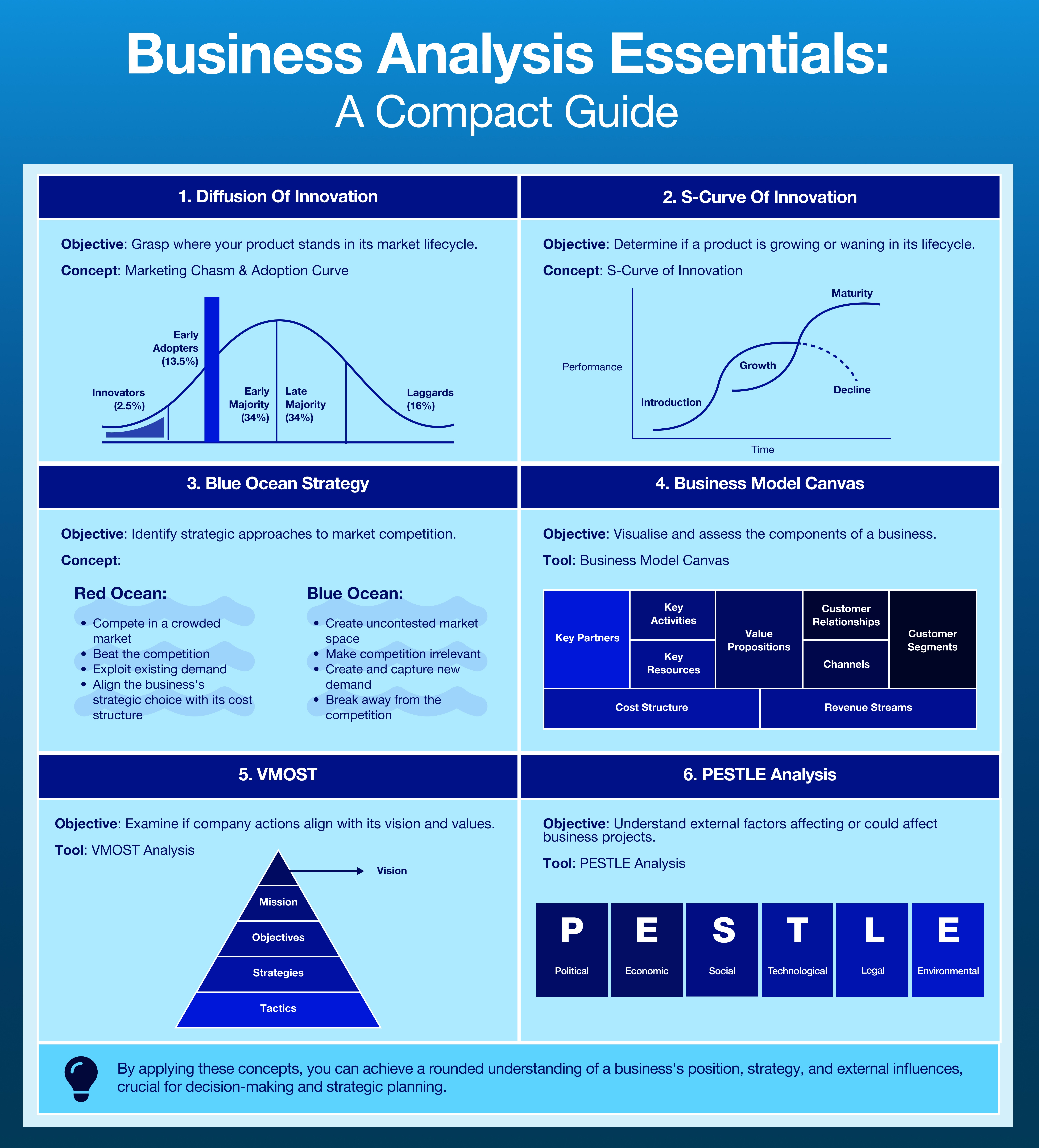
It breaks the market into distinct groups—innovators, early adopters, early majority, late majority, and laggards—and highlights a critical truth: each group behaves differently. They buy for different reasons, respond to different messaging, and require different levels of proof.
What works for early adopters—vision, innovation, possibility—doesn’t work for the early majority, who are far more pragmatic and risk-averse.
This is where many products stall.
They fail not because the product isn’t good, but because the messaging and go-to-market strategy haven’t evolved with the audience. The transition from early adopters to the early majority is one of the hardest shifts to make, and without recognising it, you can spend months—or years—pushing against resistance that isn’t about the product at all.
It’s about timing and positioning.
Understanding Where You’re Going: The S-Curve
Closely related to this is the S-Curve of Innovation, which looks not just at adoption, but at performance over time.
Every product, every innovation, follows a similar trajectory. Early progress is slow, often frustratingly so. Then momentum builds, growth accelerates, and eventually, performance begins to plateau.
The mistake many companies make is assuming that growth will continue indefinitely.
It doesn’t.
At some point, the curve flattens. Improvements become incremental. Gains require disproportionately more effort. And if you’re not paying attention, you can find yourself optimising a product that has already peaked.
The S-Curve forces a different question: are we still in a growth phase, or are we approaching maturity?
Because the strategy required for each stage is very different.
If you’re early, the focus should be on learning, iterating, and finding product-market fit. If you’re in growth, it’s about scaling what works. But if you’re approaching maturity, the conversation needs to shift toward reinvention—new markets, new products, new ways of creating value.
The hardest part is recognising when that shift needs to happen.
Escaping Competition: Blue Ocean Thinking
At some stage, every company feels the pressure of competition.
Pricing becomes tighter, differentiation becomes harder, and the market starts to feel crowded. The natural response is to compete harder—better features, lower prices, more aggressive sales tactics.
But this often leads to a race to the bottom.
The Blue Ocean framework offers an alternative. Instead of competing within existing boundaries, it challenges you to redefine them entirely.
Rather than asking, “How do we beat our competitors?”, it asks, “How do we make the competition irrelevant?”
This isn’t easy, and it isn’t always obvious. But when it works, it’s transformative.
You’re no longer fighting for share in an existing market—you’re creating a new one.
Companies like Slack and Zoom didn’t win because they outperformed competitors on traditional metrics. They won because they reframed the problem, simplified the experience, and made adoption dramatically easier.
Blue Ocean thinking is less about incremental improvement and more about reimagining value.
Making the Business Visible: The Business Model Canvas
If Blue Ocean thinking helps you define where to play, the Business Model Canvas helps you understand how everything fits together.
It’s deceptively simple—a visual map of your business broken down into key components: value proposition, customer segments, revenue streams, channels, resources, and more.
But what makes it powerful is not the structure itself, but the conversations it creates.
It forces you to articulate assumptions that are often left unspoken. Who exactly are we serving? Why do they buy? How do we reach them? Where does the revenue actually come from?
More importantly, it reveals misalignment.
You might have a strong product but unclear distribution. A clear target market but an inconsistent value proposition. Or revenue streams that don’t fully align with the value you’re delivering.
By laying everything out in one place, the Business Model Canvas turns abstract strategy into something tangible—and, crucially, something you can challenge and refine.
Connecting Strategy to Execution: VMOST
One of the most persistent gaps in business is the distance between high-level ambition and day-to-day activity.
Everyone talks about vision and strategy, but far fewer organisations successfully translate that into execution.
That’s where the VMOST framework comes in—Vision, Mission, Objectives, Strategy, and Tactics.
It creates a hierarchy that connects the “why” to the “what” and the “how.”
The vision defines where you’re going. The mission explains why it matters. Objectives translate that into measurable outcomes. Strategy outlines the approach. And tactics define the specific actions.
It sounds straightforward, but in practice, this is where many companies struggle.
Strategies exist, but they aren’t clearly linked to objectives. Tactics are executed, but they don’t always support the broader strategy. Teams are busy, but not always aligned.
VMOST forces coherence.
It ensures that every action has a clear line back to the bigger picture.
Understanding the World Around You: PESTLE
All of the frameworks so far focus on the internal dynamics of your business. But no business operates in isolation.
Markets shift. Regulations change. Technologies evolve. Economic conditions fluctuate.
PESTLE analysis provides a structured way to look outward, assessing Political, Economic, Social, Technological, Legal, and Environmental factors that could impact your business.
This is not about predicting the future with precision. It’s about avoiding surprises.
Are there regulatory changes on the horizon that could affect your product? Are economic trends influencing your customers’ ability to spend? Are new technologies emerging that could either disrupt or enhance your offering?
Too often, companies react to these shifts after they happen. PESTLE encourages you to anticipate them.
And in fast-moving industries, that anticipation can be the difference between leading and lagging.
The Real Power Comes From Combining Them
Individually, each of these frameworks is useful.
Together, they become something far more powerful.
The Diffusion of Innovation and S-Curve help you understand timing—where you are and what comes next. Blue Ocean and the Business Model Canvas shape how you compete and create value. VMOST connects your ambition to execution. And PESTLE ensures you stay grounded in the reality of the external environment.
Used collectively, they give you a multi-dimensional view of your business.
Not just what you’re doing, but why it’s working—or why it isn’t.
From Guesswork to Clarity
At its core, business analysis is not about complexity. It’s about clarity.
It’s about replacing assumptions with insight, instinct with structure, and reactive decisions with deliberate ones.
The founders who build enduring companies are not necessarily the ones with the best ideas. They’re the ones who understand their environment most clearly and adapt fastest as it changes.
Frameworks don’t make decisions for you.
But they do something arguably more important—they help you see the landscape as it really is.
And once you can see clearly, better decisions tend to follow.
If you’re building, scaling, or rethinking your business right now, the question isn’t whether you need more ideas.
It’s whether you have the right lenses to evaluate the ones you already have.
Because in the end, strategy isn’t about doing more.
It’s about understanding better.
Closing Thoughts
There’s a temptation, when you encounter frameworks like these, to treat them as a checklist—something to work through once and then file away. That would be missing the point entirely.
The real value isn’t in the frameworks themselves. It’s in the habit of returning to them.
Markets evolve. Teams grow. Assumptions that were true twelve months ago may no longer hold. The business you’re running today is not the same business you’ll be running in two years—and the clarity you need to navigate it will have to be rebuilt, repeatedly, as the landscape shifts beneath you.
That’s not a problem. That’s the work.
The founders and leaders who compound over time aren’t those who found the right answer once. They’re the ones who built a practice of asking better questions, consistently, even when—especially when—things appear to be going well.
So use these frameworks not as a destination, but as a discipline. Return to them when you’re stuck. Return to them when you’re growing. Return to them when the path ahead feels obvious, because that’s often precisely when the blind spots are largest.
Clarity isn’t a moment. It’s a muscle.
And like any muscle, it only gets stronger with use.
-Chris Tottman
Most founders don’t lose their raise in the meeting.
They lose it before they ever send the first email.
The ones who close know things the others don’t. They know the number that silently kills more raises than any bad pitch. They know which investors are actually writing cheques right now and which ones are just taking meetings. They know how to cut their list before they burn weeks on the wrong outreach. They know the return model a VC runs before you’ve even opened your mouth. And they know exactly what signals mark you as fundable before the conversation even begins.
That edge doesn’t come from blog posts. It comes from 30 years in the room and 500+ investments, compressed into a library of 50+ tools and playbooks built for the exact moment you’re in right now.
A paid subscription unlocks all of it.
The five members are using most right now:
The Number That Kills More Fundraises Than Any Bad Idea - your market size slide is ending raises that should never have failed. Most founders never find out why. This does.
The Investors Who Actually Write Cheques in 2026 - the capital layer sitting outside traditional VC that most founders walk straight past. Quieter money. Faster decisions. Fewer hoops. More stages.
The Quiet Filter That Decides Your Entire Fundraise - know who’s a real fit before you waste hours finding out the hard way. The filter most founders skip — and only understand once it’s too late.
The Way VCs Actually Calculate Your Valuation - the return model investors run before the meeting starts. Know the number they need to see before you walk in and name one.
How Investors Decide If You’re Ready to Raise - the exact signals that determine fundability at every stage. Not guesswork. Not gut feel. The actual criteria.
Every one of these has shifted how a founder in this community approaches their raise. The only variable is whether you read them before your next investor meeting — or after it.
The uncomfortable version of this is that most founders already know three or four of these frameworks. They've read the books. They've sat through the workshops. The gap was never awareness.
The gap is that frameworks are easy to apply when they confirm what you already believe and almost impossible to take seriously when they don't. A PESTLE analysis that says your timing is wrong gets filed away. A Blue Ocean canvas that shows your "differentiation" is actually just a feature nobody asked for gets redrawn until it looks better.
The founders who scale are the ones who let the framework win the argument against their own conviction. Which is, if you think about it, the hardest thing to ask of someone who built the company on conviction in the first place.
excellent piece it reaffirm3s a few things and opened my eyes to a few others. Well at least to look out for. https://substack.com/@csarticles/note/p-197634877?r=8co1m9