

👋 Hey, Chris here! Welcome to BrainDumps—a weekly series from The Founders Corner. If you’ve been reading along, you know this series is a preview of a bigger project. Well, it’s finally here: The Big Book of BrainDumps is out now!
It isn’t a theory book—it’s the founder’s field manual. Inside, you’ll find 70 powerful frameworks distilled from 30+ years scaling software companies to hundreds of millions in ARR, 20+ years investing in 500+ B2B tech startups, and over $1B of shareholder value created. From raising capital to hiring your first VP of Sales, this book turns scars and successes into practical playbooks you’ll return to again and again. I expect most copies will become well-worn, scribbled on, and dog-eared—because it works.
Every SaaS founder begins in acquisition mode.
In the early stages, there’s almost no alternative. You need customers. You need traction. You need momentum. Revenue validates the product, investors want proof of market demand, and the business itself needs evidence that the problem you’re solving is painful enough for companies to pay to fix it.
So naturally, most of the early energy inside a software company becomes focused on growth.
Lead generation.
Outbound campaigns.
Content marketing.
Paid acquisition.
Partnerships.
Cold outreach.
Product launches.
Everything revolves around one objective: bringing new customers through the door.
And for a while, that’s exactly the right approach.
But eventually every SaaS company encounters a critical strategic shift — the moment where leadership realises that growth alone is not enough. Because acquiring customers may create momentum, but retaining them is what ultimately creates enterprise value.
This is one of the defining transitions in SaaS.
The companies that scale sustainably understand when to prioritise acquisition, when to prioritise retention, and how to rebalance resources as the business matures.
The companies that don’t often end up trapped on an exhausting treadmill where new sales constantly mask deeper operational weaknesses underneath the surface.
Because in subscription software, the economics of retention are profoundly powerful.
Table of Contents
Early-Stage SaaS: Acquisition Is Survival
The Danger of Becoming Addicted to Acquisition
Scaling SaaS Changes the Entire Equation
Retention Is Really About Delivering Continuous Value
Mature SaaS Businesses Are Built on Retention
Retention Creates Predictability — And Predictability Creates Scale
The Best SaaS Companies Master Both
Great SaaS Businesses Don’t Just Sell Software — They Build Relationships
Growth Gets the Headlines. Retention Builds the Business
Early-Stage SaaS: Acquisition Is Survival
At the beginning, acquisition dominates because it has to.
Without customers, there is no product validation. No recurring revenue. No usable customer feedback loops. No real understanding of product-market fit.
Early-stage SaaS businesses need volume of learning as much as they need revenue itself.
This is why founders often spend the first few years heavily weighted toward acquisition-focused activity. The objective is not perfection. The objective is traction.
You need users interacting with the product.
You need real-world implementation experience.
You need to understand buying behaviour.
You need to refine positioning.
You need to uncover operational friction quickly.
And perhaps most importantly, you need proof that customers care enough about the problem to keep paying for a solution.
At this stage, aggressive customer acquisition makes sense.
Inbound content strategies help establish credibility. Paid advertising creates visibility quickly. Partnerships and integrations extend reach. Outbound sales generate early conversations before brand awareness exists.
The emphasis is speed.
Because young SaaS businesses live and die based on their ability to create momentum before resources run out.
The Danger Of Becoming Addicted To Acquisition
The problem is that many SaaS businesses never emotionally leave this phase.
Acquisition becomes addictive because new customers create visible progress. Revenue grows. Pipeline expands. Investors feel optimistic. Dashboards look healthy.
Meanwhile, retention issues can remain partially hidden beneath top-line growth.
This is where dangerous growth patterns begin emerging.
The company spends aggressively acquiring customers while quietly leaking them out the back door. Churn increases, but the organisation rationalises it away because new sales continue masking the underlying weakness.
For a period of time, this can look like success.
Until acquisition costs begin rising.
And they almost always do.
Competition increases. Paid channels become more expensive. Attention becomes harder to capture. Sales cycles lengthen. Buyers become more sophisticated. Suddenly the economics that once looked scalable begin tightening dramatically.
At that point, retention becomes impossible to ignore.
Scaling SaaS Changes The Entire Equation
As SaaS companies move from early traction into true scaling mode, the economics of the business fundamentally change.
Customer acquisition remains important — enormously important — but retention begins carrying far greater strategic weight.
This happens for several reasons.
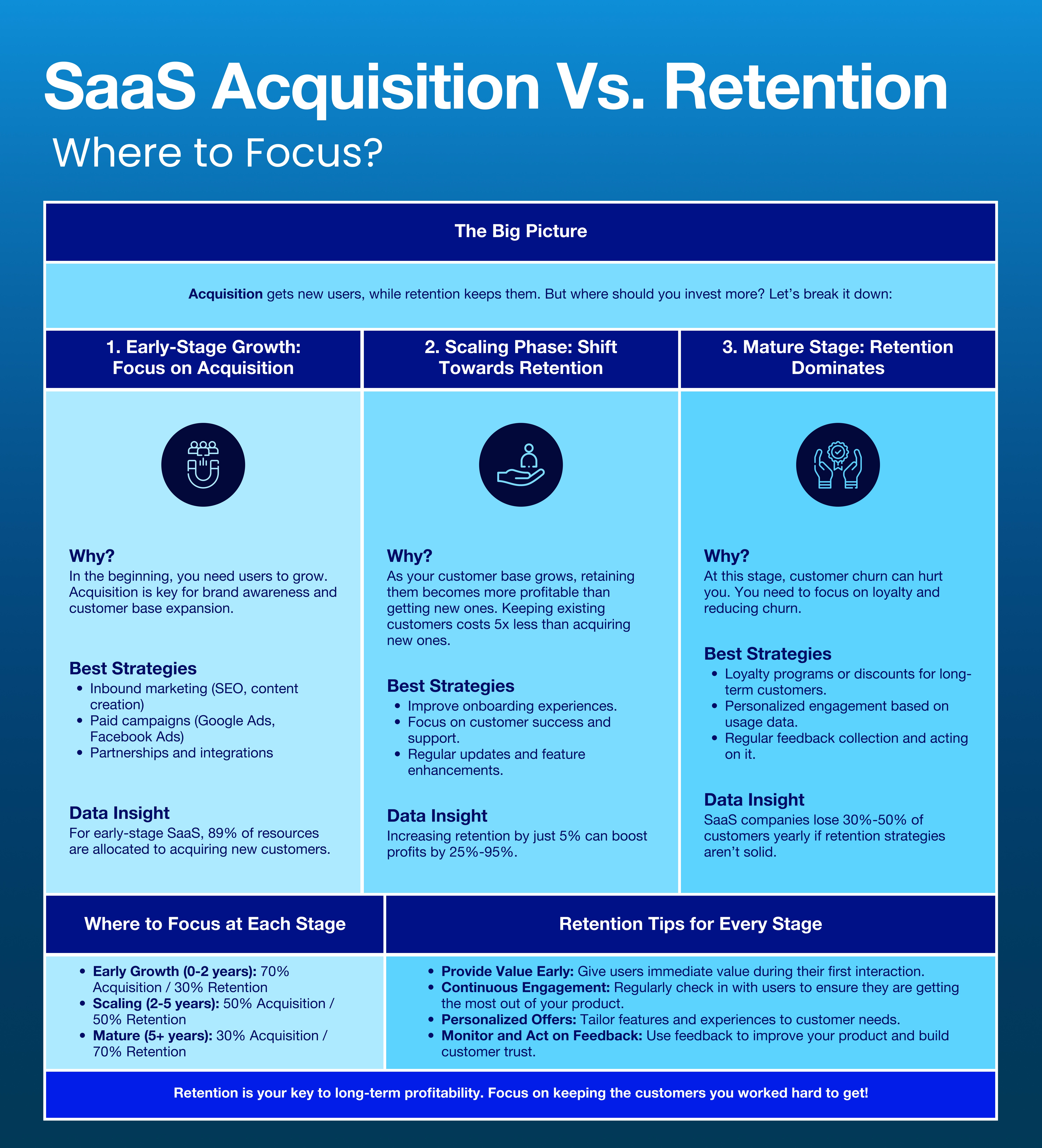
First, retaining customers is dramatically cheaper than acquiring new ones. The cost difference is often staggering. Research consistently shows that acquiring a new customer can cost five times more than retaining an existing one, sometimes significantly more in enterprise software.
Second, retained customers compound in value over time.
They upgrade plans.
They expand usage.
They buy additional modules.
They refer peers.
They provide case studies.
They deepen product dependency.
In other words, long-term customers become exponentially more valuable than short-term customers.
This is where metrics like Net Revenue Retention become critically important because they reveal whether existing customers are growing in value after the initial sale.
Strong retention transforms SaaS economics completely.
Retention Is Really About Delivering Continuous Value
One of the biggest misconceptions about retention is that it’s primarily a customer support problem.
It isn’t.
Retention is fundamentally a product and value delivery problem.
Customers stay when software becomes operationally indispensable.
That means:
Onboarding matters.
Implementation matters.
User adoption matters.
Education matters.
Product evolution matters.
The strongest SaaS companies become obsessed with reducing “time-to-value” — the amount of time it takes customers to experience meaningful business impact after adoption.
Because the faster customers experience value, the deeper the product becomes embedded into workflows.
And once software becomes embedded operationally, churn drops dramatically.
This is why scaling SaaS businesses invest heavily into customer success functions. Not simply to solve support tickets, but to proactively ensure customers are continuously extracting value from the platform.
The best customer success teams are not reactive helpdesks.
They are retention engines.
Mature SaaS Businesses Are Built On Retention
As software companies mature, retention increasingly becomes the centre of gravity.
At this stage, the customer base itself becomes one of the company’s most valuable assets. Losing customers is no longer just disappointing — it becomes financially dangerous because churn now directly impacts long-term growth efficiency.
Mature SaaS businesses understand this deeply.
They focus heavily on customer engagement strategies, expansion opportunities, loyalty initiatives, and personalised experiences because preserving customer relationships creates far more value than endlessly chasing new acquisition at escalating costs.
This doesn’t mean acquisition disappears.
Far from it.
But the balance shifts significantly.
The company moves from “How quickly can we add customers?” toward “How deeply can we grow and retain the customers we already have?”
That transition is one of the defining markers of SaaS maturity.
Retention Creates Predictability — And Predictability Creates Scale
One of the reasons investors love strong SaaS retention metrics is because retention creates predictability.
Predictable revenue allows businesses to plan confidently.
Hiring becomes easier.
Cash flow improves.
Forecasting stabilises.
Operational leverage increases.
Valuations rise.
A SaaS company with exceptional retention becomes significantly more resilient because growth no longer relies entirely on constant acquisition pressure.
The customer base itself starts driving growth organically through expansion and longevity.
That’s where SaaS becomes truly powerful as a business model.
The Best SaaS Companies Master Both
The acquisition-versus-retention debate is often framed incorrectly.
It’s not really about choosing one over the other.
It’s about understanding which deserves greater strategic emphasis at different stages of growth.
Early-stage companies must prioritise acquisition because they need validation and momentum.
Scaling companies must balance both because growth efficiency begins mattering more.
Mature companies lean heavily toward retention because protecting and expanding the customer base creates long-term profitability.
The mistake is becoming unbalanced.
Too much acquisition focus without retention creates fragile growth.
Too much retention focus too early can suffocate expansion and market penetration.
The best SaaS operators understand the timing of the shift.
Great SaaS Businesses Don’t Just Sell Software — They Build Relationships
Ultimately, the companies that retain customers exceptionally well tend to understand something deeper.
Customers are not simply buying functionality.
They are buying:
Outcomes.
Reliability.
Confidence.
Operational improvement.
Strategic advantage.
The strongest SaaS businesses continuously reinforce that value long after the initial contract is signed.
They educate customers.
They evolve alongside customer needs.
They deepen integrations.
They create community.
They become embedded partners rather than replaceable vendors.
That’s why the best SaaS companies often achieve astonishing retention rates.
The software stops feeling optional.
Growth Gets The Headlines. Retention Builds The Business.
There’s no doubt acquisition creates excitement.
New logos feel energising.
Revenue spikes create momentum.
Growth charts attract attention.
But retention is what quietly determines whether a SaaS business is genuinely durable.
Because sustainable software companies are not built purely through customer acquisition.
They are built through customer longevity.
And eventually, every founder realises the same thing:
Winning the customer is only the beginning.
Keeping them is the real business.
Most founders lose their raise before they ever send the first email.
The ones who close have something the rest don’t: they know the single metric quietly killing 70% of pitches, which investors are actually deploying capital right now (it’s not who you think), how to spot a real prospect in 90 seconds, the number VCs need to see before they’ll even take the meeting, and the unfakeable signals that separate “fundable” from “not yet.”
That edge isn’t luck. It’s 30 years sitting across the table from founders, 500+ investments, and the patterns that quietly decide who gets funded and who gets ghosted.
We’ve packaged all of it into 50+ premium tools. One subscription. Everything unlocked.
Start with these five — they’ve already changed the outcome for thousands of founders before you:
The Number That Kills More Fundraises Than Any Bad Idea — One slide. That’s all it takes. Here’s the metric killing your raise without you knowing it.
The Investors Who Actually Write Cheques in 2026 — Forget the usual suspects. This is where real capital is moving right now. Faster. Earlier. Better odds.
The Quiet Filter That Decides Your Entire Fundraise — Every investor runs this filter before you even open your mouth. Know it now, or learn it the hard way — after the “no.”
The Way VCs Actually Calculate Your Valuation — They already have a number in their head before you walk in. What is it — and how do you hit it?
How Investors Decide If You’re Ready to Raise — It’s not timing. It’s not luck. These are the exact criteria investors use — know them, and everything changes.
These five are free to read. The other 45+ tools that founders use to actually close their round? That’s what premium unlocks.
Your next raise depends on which side of this you’re on. Upgrade now.
This really resonates from the lifecycle side. The teams that escape the acquisition trap tend to treat retention as a system rather than a reaction when a quarter looks weak. In practice that means finding the moments where a customer actually feels value, then building the onboarding and engagement journey around those moments instead of around the sale. Acquisition fills the top of the funnel, but that journey is what turns retained revenue into the printing money effect you described. Really enjoyed this.
Acquisition is crucial for early-stage SaaS companies. Retention becomes more important as the business grows. Balancing both strategies leads to long-term success. How do you ensure your company focuses on retention effectively?