

👋 Hey, Chris here! Welcome to BrainDumps—a weekly series from The Founders Corner. If you’ve been reading along, you know this series is a preview of a bigger project. Well, it’s finally here: The Big Book of BrainDumps is out now!
It isn’t a theory book—it’s the founder’s field manual. Inside, you’ll find 70 powerful frameworks distilled from 30+ years scaling software companies to hundreds of millions in ARR, 20+ years investing in 500+ B2B tech startups, and over $1B of shareholder value created. From raising capital to hiring your first VP of Sales, this book turns scars and successes into practical playbooks you’ll return to again and again. I expect most copies will become well-worn, scribbled on, and dog-eared—because it works.

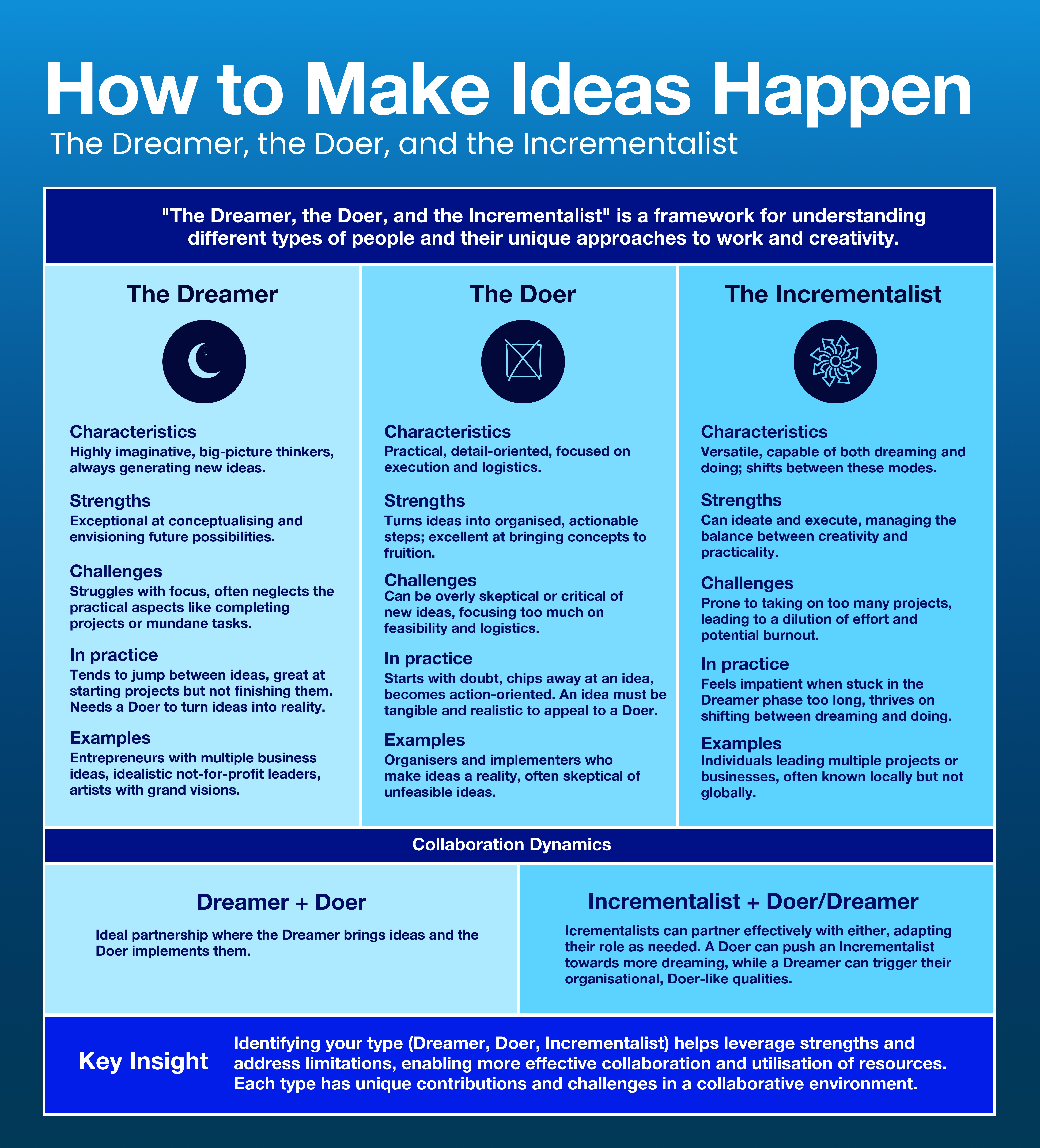
Every founder has lived this moment.
A brilliant idea emerges in a meeting. Energy spikes. Possibilities feel endless. And then… nothing happens.
Weeks pass. Momentum fades. The idea quietly dies.
This isn’t a failure of intelligence or ambition. It’s almost always a failure of team dynamics.
Scott Belsky’s framework — The Dreamer, the Doer, and the Incrementalist — explains why. More importantly, it shows leaders how to turn ideas into reality without burning out teams or suffocating creativity.
Once you see this pattern, you start spotting it everywhere.
Table of Contents
The Real Problem Isn’t Ideas — It’s Translation
The Dreamer: Where Innovation Begins
The Doer: Where Ideas Become Real
The Incrementalist: The Most Underrated Role
Why Dreamers and Doers Clash (And Why That’s Normal)
The Leader’s Job: Orchestrate, Don’t Dominate
Why This Matters So Much for Founders
The Hidden Insight
The Takeaway
Coming Next
The Real Problem Isn’t Ideas — It’s Translation
Most organisations don’t suffer from a lack of ideas.
They suffer from a lack of alignment between how people think and how work gets done.
The Dreamer, Doer, and Incrementalist framework gives us a language for understanding these differences — and for designing teams that actually execute.
Let’s break each role down.
The Dreamer: Where Innovation Begins
Dreamers are the origin point of progress.
They thrive in possibility. They ask “What if?” when others ask “Why bother?” They imagine futures that don’t yet exist and challenge assumptions that everyone else takes for granted.
Dreamers:
Generate bold ideas
Push boundaries
Reframe problems
See patterns before they’re obvious
They are the spark.
But sparks alone don’t build companies.
Dreamers often struggle with:
Structure
Deadlines
Operational detail
Constraints like budgets or timelines
Left unsupported, Dreamers can become frustrated — feeling misunderstood, slowed down, or dismissed as “unrealistic.”
Their value isn’t diminished by this.
It simply needs translation.
The Doer: Where Ideas Become Real
Doers live at the opposite end of the spectrum.
They care less about what could be and more about what will get done. Their strength lies in focus, structure, and execution.
Doers:
Turn ideas into plans
Break work into steps
Ship, deliver, and follow through
Maintain momentum when enthusiasm fades
Without Doers, nothing scales. Nothing ships. Nothing survives contact with reality.
But Doers have blind spots too.
They can:
Resist ambiguity
Shut down ideas that feel half-formed
Optimise execution before direction is clear
Default to “what’s worked before”
Without Dreamers, Doers risk building efficient paths to the wrong destination.
The Incrementalist: The Most Underrated Role
Sitting between Dreamer and Doer is the Incrementalist — the bridge that makes collaboration possible.
Incrementalists:
See the big picture and the details
Translate vision into workable steps
Balance ambition with realism
Drive progress through continuous improvement
They are rarely the loudest voice in the room, but they are often the reason things move forward.
Their challenge?
Because they can operate in multiple modes, they’re often pulled in too many directions — stretched thin, context-switching constantly, and quietly absorbing organisational friction.
Great leaders protect Incrementalists.
Average leaders burn them out.
Why Dreamers and Doers Clash (And Why That’s Normal)
Dreamer–Doer tension isn’t dysfunction.
It’s friction created by difference.
Dreamers can feel constrained.
Doers can feel overwhelmed by ambiguity.
Without awareness, this tension turns personal:
“They’re unrealistic.”
“They don’t get it.”
“They slow everything down.”
With awareness, it becomes productive:
Vision flows into execution
Constraints sharpen creativity
Ideas evolve instead of dying
Incrementalists often act as translators here — converting possibility into progress.
The Leader’s Job: Orchestrate, Don’t Dominate
This framework isn’t about labelling people.
It’s about designing collaboration intentionally.
Great leaders:
Identify dominant working styles
Build teams with balance, not clones
Create space for each role to contribute
Prevent one style from overpowering the others
Ask yourself:
Who are the Dreamers on my team?
Who ensures things actually ship?
Who connects vision to execution?
If your team is missing one of these roles, execution will suffer — guaranteed.
Why This Matters So Much for Founders
Founders are often extreme Dreamers or extreme Doers.
That’s not a flaw — it’s often why the company exists at all.
But problems arise when:
Founders assume everyone thinks like them
One style dominates decision-making
Complementary perspectives are ignored
Execution systems don’t match creative ambition
The companies that scale are the ones where founders build teams to compensate for their own bias.
That’s leadership maturity.
The Hidden Insight
This framework explains why so many “great ideas” fail — and why some average ideas win.
Success doesn’t come from brilliance alone.
It comes from alignment between imagination, execution, and momentum.
When Dreamers, Doers, and Incrementalists are aligned:
Ideas don’t stall
Teams don’t fracture
Progress compounds
When they’re not, energy dissipates and execution collapses.
The Takeaway
You don’t need more ideas.
You don’t need better execution.
You need better orchestration.
The magic happens when leaders stop asking, “Who’s right?”
and start asking, “What role is missing here?”
Because when Dreamers feel heard, Doers feel empowered, and Incrementalists feel valued — ideas stop dying in meetings and start shaping reality.
Coming Next
As you can see, so much of this comes down to how founders lead.
Next, we’ll explore a leadership philosophy that sits at the heart of high-trust, high-performance teams — and why it’s quietly becoming one of the most powerful models in modern startups:
Servant Leadership: Why the Best Founders Lead by Serving First.
-Chris Tottman
The most successful teams I've seen aren't necessarily the ones with the smartest people; they're the ones where the "Doers" are actually empowered to say no to the "Dreamers" when necessary to get things across the finish line.
Definitely resonates with what I've seen in my teams, thanks Chris!
Good input for an article on core drivers I'm writing at the moment