

👋 Hey, Chris here! Welcome to BrainDumps—a weekly series from The Founders Corner. If you’ve been reading along, you know this series is a preview of a bigger project. Well, it’s finally here: The Big Book of BrainDumps is out now!
It isn’t a theory book—it’s the founder’s field manual. Inside, you’ll find 70 powerful frameworks distilled from 30+ years scaling software companies to hundreds of millions in ARR, 20+ years investing in 500+ B2B tech startups, and over $1B of shareholder value created. From raising capital to hiring your first VP of Sales, this book turns scars and successes into practical playbooks you’ll return to again and again. I expect most copies will become well-worn, scribbled on, and dog-eared—because it works.
If you strip away the perks, the bonuses, the office redesigns and the engagement surveys, one question remains:
What actually motivates people to do exceptional work?
For decades, businesses tried to answer that question with incentives, targets, and performance management systems. And while those tools have their place, they only scratch the surface.
Sustainable motivation — the kind that drives innovation, resilience, and discretionary effort — runs deeper.
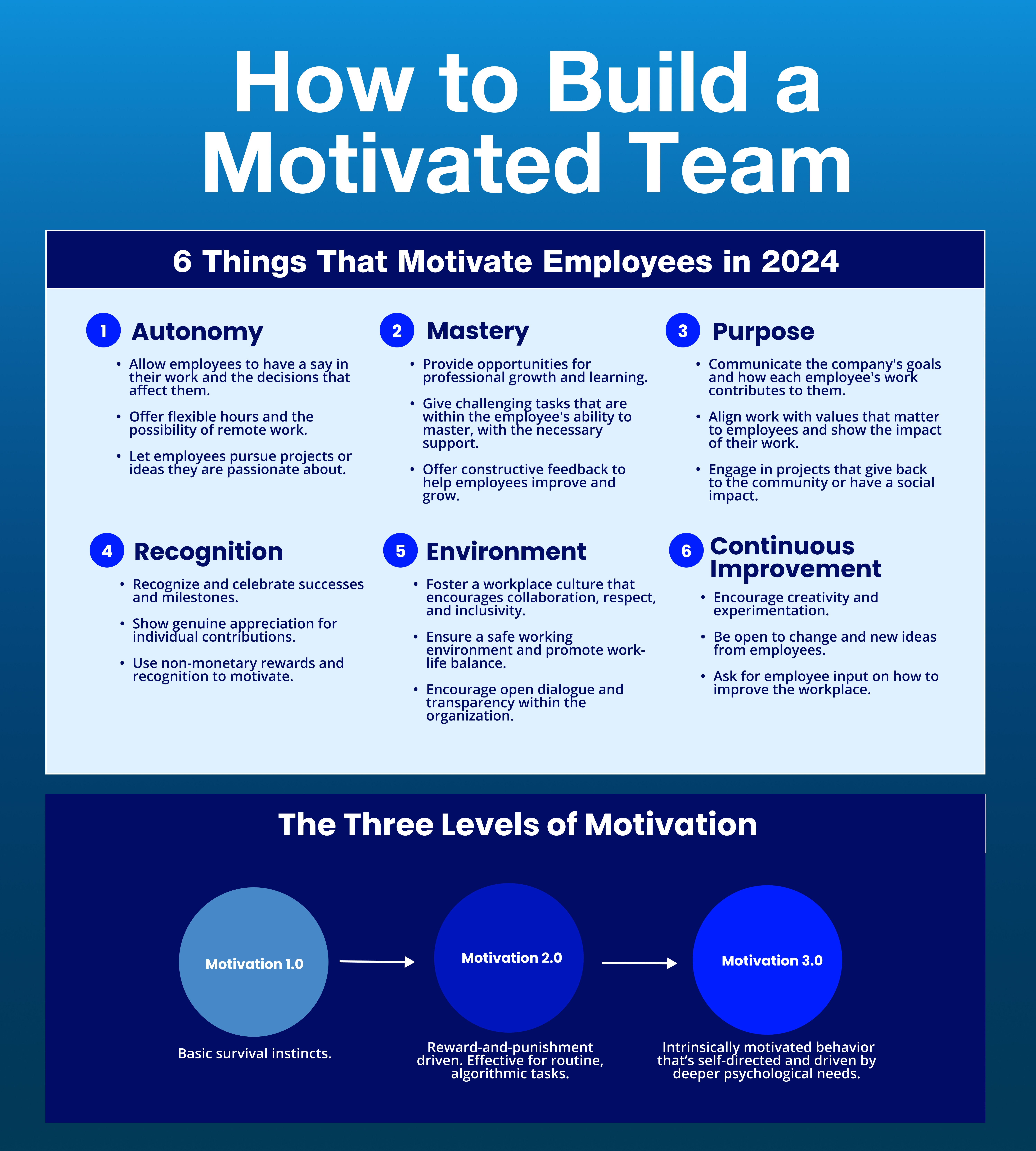
Drawing on the principles popularised by Daniel Pink in Drive, and reinforced by modern organisational psychology, we can distil team motivation into six essential pillars:
Autonomy
Mastery
Purpose
Recognition
Environment
Continuous Improvement
Together, these form the foundation of a high-performing, inspired team.
Let’s unpack each of them — not as bullet points, but as leadership responsibilities.
Table of Contents
Autonomy: Trust Fuels Performance
Mastery: Growth Is a Core Human Need
Purpose: Connect the Work to Something Bigger
Recognition: Appreciation Multiplies Effort
Environment: Culture Is a Motivational Multiplier
Continuous Improvement: Give People a Voice in the Future
The Evolution of Motivation: From 1.0 to 3.0
Motivation as Strategy, Not Sentiment
When Motivation Falters
Final Thought
1. Autonomy: Trust Fuels Performance
At the heart of modern motivation lies autonomy — the desire to direct our own work.
People want ownership. They want to feel that their judgement matters. They want to influence how they achieve outcomes, not simply be told what to do.
There’s an old leadership expression that captures this perfectly: “Don’t buy a dog and bark yourself.”
If you hire capable people and then micromanage their every move, you don’t create excellence. You create disengagement.
Autonomy doesn’t mean a lack of accountability. It means clarity of outcome paired with flexibility of approach.
Leaders can foster autonomy by:
Allowing flexibility in how and when work is completed.
Giving team members ownership over projects.
Involving them in decisions that affect their roles.
Encouraging experimentation within defined guardrails.
When people feel trusted, they tend to behave in ways that justify that trust.
Control may produce compliance.
Autonomy produces commitment.
2. Mastery: Growth Is a Core Human Need
Beyond control, people are driven by progress.
Mastery — the pursuit of becoming better at something that matters — is one of the most powerful intrinsic motivators available to leaders.
Employees want to develop. They want to stretch. They want to feel that today’s version of themselves is stronger than yesterday’s.
That doesn’t happen by accident.
It requires:
Challenging assignments that sit just beyond the comfort zone.
Access to coaching and development resources.
Constructive feedback delivered with care and clarity.
Space to fail, reflect, and improve.
Mastery is not about perfection. It’s about momentum.
When leaders design roles that encourage skill-building and learning — rather than stagnation — they tap into a powerful source of internal energy.
A stagnant team disengages.
A growing team accelerates.
3. Purpose: Connect the Work to Something Bigger
Autonomy and mastery create energy. Purpose gives that energy direction.
Purpose answers the question: Why does this work matter?
People are far more motivated when they understand how their contribution connects to a larger mission. This connection transforms tasks into meaning.
Purpose operates on multiple levels:
Aligning individual goals with company objectives.
Demonstrating the impact of work on customers.
Reinforcing the organisation’s values and societal contribution.
Showing how roles contribute to long-term strategy.
Leaders often underestimate how frequently they must communicate purpose. It cannot be a once-a-year slide in a strategy deck. It must be reinforced consistently.
When people believe they are building something that matters, effort becomes personal.
And personal effort is powerful.
4. Recognition: Appreciation Multiplies Effort
Motivation is not sustained by salary alone.
Recognition — genuine, specific, timely appreciation — reinforces behaviour and builds belonging.
Financial rewards have their place, but they are rarely the primary driver of sustained engagement. Public praise, thoughtful gestures, and personalised appreciation often have a deeper impact.
Recognition works best when it is:
Specific (“This is exactly what you did well…”)
Immediate (close to the event)
Authentic (not formulaic or generic)
Visible (when appropriate)
A simple, well-timed acknowledgment can fuel weeks of discretionary effort.
People want to feel seen.
When they do, they show up stronger.
5. Environment: Culture Is a Motivational Multiplier
Even the most capable individual will struggle in the wrong environment.
Motivation flourishes in cultures defined by:
Respect
Inclusion
Collaboration
Psychological safety
Psychological safety — the belief that one can speak up without fear of embarrassment or punishment — is foundational. Without it, innovation declines and disengagement rises.
Leaders shape environment through everyday behaviours:
How they respond to mistakes.
How they handle disagreement.
How they distribute credit.
How they model vulnerability.
A supportive environment does not eliminate standards. It strengthens them.
When people feel safe, they contribute fully.
When they feel threatened, they retreat.
6. Continuous Improvement: Give People a Voice in the Future
High-performing teams don’t just execute — they evolve.
Continuous improvement is a motivator because it signals that voices matter. It invites contribution. It turns employees into co-creators rather than passive recipients.
Leaders can encourage this by:
Seeking feedback regularly.
Acting visibly on suggestions.
Encouraging experimentation.
Empowering teams to solve process inefficiencies.
Creating structured forums for innovation.
When people believe they can shape the system, not just operate within it, engagement deepens.
Improvement becomes shared responsibility — and shared pride.
The Evolution of Motivation: From 1.0 to 3.0
Understanding modern motivation also requires recognising how it has evolved.
Motivation 1.0 was survival-based. It was rooted in basic instincts. In modern workplaces, this level is largely irrelevant.
Motivation 2.0 introduced rewards and punishments — the classic carrot-and-stick model. While effective in simple, repetitive environments, it struggles in complex, creative settings. It drives short-term compliance, not long-term engagement.
Motivation 3.0 reflects the shift toward intrinsic drivers — autonomy, mastery, and purpose. It recognises that knowledge work, creativity, and innovation thrive when people are internally motivated.
Modern teams do not want to be managed through fear or bonuses alone. They want to be trusted, developed, and inspired.
Organisations that remain anchored in Motivation 2.0 thinking will struggle to compete with those operating at 3.0.
Motivation as Strategy, Not Sentiment
Building a motivated team is not about morale. It is about performance.
Motivated teams:
Exceed targets.
Innovate faster.
Retain talent.
Adapt to change.
Demonstrate resilience under pressure.
Motivation is not a “soft” topic. It is a strategic lever.
Leaders who invest in intrinsic drivers — autonomy, mastery, purpose — while reinforcing recognition, environment, and improvement create systems where energy sustains itself.
And when motivation is strong, everything compounds.
When Motivation Falters
Of course, no business travels in a straight line.
There will be setbacks. Missed targets. Strategic pivots. Funding pressures. Market shocks.
During these moments, motivation can fracture quickly.
The key is early diagnosis:
Has autonomy been replaced with micromanagement?
Has mastery stagnated?
Has purpose become unclear?
Has recognition faded?
Has culture deteriorated?
Has improvement stalled?
Motivation rarely collapses overnight. It erodes gradually.
Leaders who understand the mechanics of motivation can intervene before disengagement becomes structural.
Final Thought
Motivation cannot be mandated.
It must be cultivated.
It is built through trust, growth, meaning, appreciation, safety, and shared ownership of progress.
When you get this right, your team does more than hit targets. They care. They stretch. They innovate. They stay.
And in a competitive world, that may be your greatest advantage.
-Chris Tottman
Chris, lovely post and congratulations on the book. Your BrainDumps continue to inspire a lot of us.
One question though, where’s the audiobook? It feels like the sort of thing many of us would happily listen to while walking, driving, or sailing.
And I do wonder if the bigger opportunity might be beyond audio… perhaps gradually encoding the BrainDump methodology itself so people can bring problems to it and see how the framework applies.
Cheers Neil :)
Great article! 👏