

👋 Hey, Chris here! Welcome to BrainDumps—a weekly series from The Founders Corner. If you’ve been reading along, you know this series is a preview of a bigger project. Well, it’s finally here: The Big Book of BrainDumps is out now!
It isn’t a theory book—it’s the founder’s field manual. Inside, you’ll find 70 powerful frameworks distilled from 30+ years scaling software companies to hundreds of millions in ARR, 20+ years investing in 500+ B2B tech startups, and over $1B of shareholder value created. From raising capital to hiring your first VP of Sales, this book turns scars and successes into practical playbooks you’ll return to again and again. I expect most copies will become well-worn, scribbled on, and dog-eared—because it works.
One of the biggest shifts that happens as a software company grows is the moment the business stops being driven purely by instinct and starts being driven by numbers.
In the early days, momentum is often enough. You can feel whether things are working. Customers are signing up, demos are increasing, the pipeline feels healthy, and the product is evolving quickly enough to keep pace with demand. Decisions happen fast because the company is still close to the customer and close to the problem.
But eventually intuition alone stops scaling.
As the business grows, complexity arrives quietly. Marketing channels multiply. Customer acquisition costs creep upward. Churn begins to hide inside headline growth figures. Teams become larger, more specialised, and more disconnected from the raw signals that once felt obvious. At that point, the companies that continue to scale successfully are usually the ones that learn how to measure what truly matters.
And that’s where SaaS metrics become far more than just dashboard vanity.
The best operators in software don’t use metrics to impress investors. They use them to understand reality.
Because underneath every successful SaaS company sits a handful of numbers quietly telling the truth about whether the business is genuinely healthy or simply growing noisily.
Table of Contents
Metrics Are Not the Business — But They Reveal the Business
Monthly Recurring Revenue: The Heartbeat of SaaS
Churn Is the Silent Killer
CAC and LTV: The Economics That Decide Everything
Different Stages Require Different Metrics
Growth Hacking Is Really About Reducing Friction
The Companies That Win Usually Understand Retention Best
Metrics Should Drive Decisions, Not Anxiety
The Real Job of SaaS Metrics
Metrics Are Not the Business — But They Reveal the Business
One of the mistakes many founders make is becoming obsessed with metrics without understanding what those metrics are actually trying to tell them.
Metrics are signals.
They are indicators of momentum, friction, efficiency, retention, product-market fit, operational quality, and ultimately survivability.
The challenge is that not all metrics matter equally at every stage of growth.
A pre-seed SaaS business should not obsess over the same numbers as a company approaching $20M ARR. Likewise, a company still searching for product-market fit will destroy itself if it begins behaving like a mature efficiency-focused business too early.
Context matters.
The smartest SaaS operators understand that metrics evolve alongside the company itself.
Monthly Recurring Revenue: The Heartbeat of SaaS
At the centre of almost every software company sits Monthly Recurring Revenue — MRR.
This is the core economic engine of subscription software because it represents predictability. Unlike traditional project businesses where revenue constantly resets, SaaS creates recurring income streams that compound over time.
That recurring nature changes everything.
It creates visibility. It improves valuation. It allows companies to plan ahead with confidence.
But MRR on its own can also be deceptive.
A company growing rapidly while simultaneously leaking customers through churn is often far weaker than it appears. Likewise, businesses can artificially inflate MRR through unsustainable discounting or aggressive sales tactics that later collapse under poor retention.
The metric matters, but the quality of the revenue matters more.
That’s why experienced SaaS leaders never look at MRR in isolation. They examine the mechanics beneath it.
Where is growth actually coming from?
Are customers staying?
Are accounts expanding?
Is acquisition efficient?
Is the product genuinely sticky?
Those questions matter more than the headline number itself.
Churn Is the Silent Killer
If MRR is the heartbeat of SaaS, churn is the blood loss.
And it’s astonishing how many businesses underestimate its long-term impact.
A company can spend enormous sums acquiring customers while quietly losing them out the back door fast enough to destroy long-term growth economics. Early-stage companies often ignore churn because acquisition creates the illusion of progress. But over time churn compounds negatively in exactly the same way recurring revenue compounds positively.
Retention is ultimately what separates durable SaaS companies from fragile ones.
This is why world-class SaaS operators become obsessed with understanding customer behaviour after the sale.
Are users adopting the product properly?
Are they achieving value quickly enough?
Is onboarding frictionless?
Do customers understand the full capability of the platform?
Are they embedding the product deeply into workflows?
Because the truth is most churn doesn’t happen suddenly. It begins much earlier through disengagement, weak onboarding, unclear value, or a failure to evolve alongside customer needs.
The best SaaS companies don’t simply sell software.
They operationalise customer success.
CAC and LTV: The Economics That Decide Everything
At some point every SaaS founder encounters the brutal reality of customer acquisition costs.
Growth is exciting until you realise how expensive growth can become.
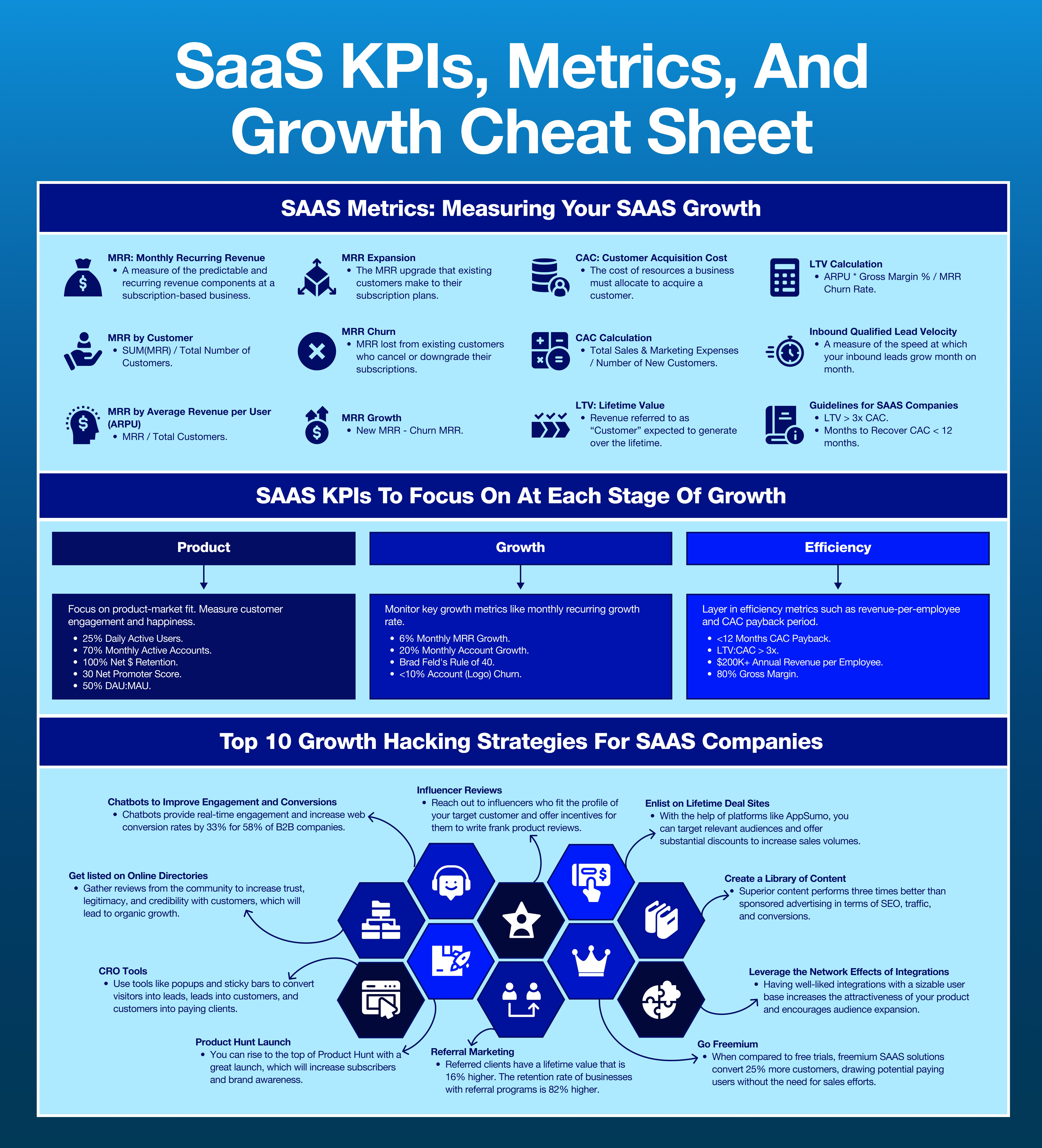
Customer Acquisition Cost — CAC — measures how much it costs to acquire a customer across marketing and sales activity. Lifetime Value — LTV — estimates how much revenue that customer will generate over the duration of the relationship.
Together, these two metrics tell you whether your business model actually works.
A healthy SaaS company typically aims for an LTV:CAC ratio somewhere around 3:1. In simple terms, customers should generate significantly more value than they cost to acquire.
But the relationship between these numbers is where strategy becomes incredibly important.
If CAC rises too high, scaling becomes dangerous.
If LTV is weak, retention problems likely exist.
If CAC payback periods stretch too long, cash flow pressure intensifies.
And if acquisition becomes dependent on paid channels alone, growth can become fragile very quickly.
This is why sustainable SaaS growth almost always involves building multiple acquisition loops simultaneously.
Content. Referrals. Partnerships. Integrations. Product-led growth. Community. SEO. Network effects.
The strongest SaaS businesses reduce dependence on paid acquisition over time because they build systems where growth increasingly feeds itself.
Different Stages Require Different Metrics
One of the most important things founders need to understand is that SaaS metrics evolve with the maturity of the business.
Early-stage companies should focus heavily on product metrics.
At this stage the critical question is simple: do users actually care enough to keep using the product?
Activation rate, feature adoption, onboarding completion, engagement levels, and time-to-value become hugely important because they reveal whether product-market fit is beginning to emerge.
Growth-stage companies shift focus toward acquisition and scalability metrics.
Now the emphasis moves toward pipeline efficiency, CAC payback, MRR growth, lead conversion rates, and expansion revenue. The business is no longer simply validating demand — it’sattempting to scale demand efficiently.
Mature SaaS companies become increasingly operationally focused.
Revenue per employee, gross margin, net revenue retention, support efficiency, and profitability become critical because scaling complexity can quietly destroy margins if operational discipline disappears.
The danger comes when companies focus on the wrong metrics for their stage.
Optimising efficiency too early can suffocate growth.
Ignoring efficiency too long can kill profitability.
Knowing what matters now is one of the great leadership disciplines in SaaS.
Growth Hacking Is Really About Reducing Friction
The phrase “growth hacking” has become slightly overused in startup culture, but underneath the buzzword sits a genuinely important principle.
The best growth strategies reduce friction.
They make discovery easier.
They make adoption easier.
They make sharing easier.
They make buying easier.
That’s why some of the most effective SaaS growth strategies are often surprisingly simple.
Referral programmes work because trust transfers between peers faster than advertising ever can.
Content marketing works because education builds credibility long before sales conversations begin.
Product integrations work because they embed your platform directly into existing workflows.
Freemium models lower barriers to experimentation.
Customer success stories create social proof that reduces perceived risk.
Even chatbots — when implemented properly — simply reduce friction between curiosity and action.
The common thread running through all successful SaaS growth strategies is accessibility.
The easier you make it for customers to experience value, the faster growth compounds.
The Companies That Win Usually Understand Retention Best
There’s a reason the strongest SaaS businesses become almost obsessive about retention.
Because retention fundamentally changes the economics of growth.
Acquiring a customer once is expensive. Retaining them for years is transformative.
Long-term customers expand. They refer others. They become advocates. They provide feedback. They increase switching costs. They improve predictability. And perhaps most importantly, they create operating leverage.
This is why Net Revenue Retention has become such a critical metric in modern SaaS.
NRR measures whether existing customers are growing in value over time after accounting for churn and expansion. A company with strong NRR can continue growing even before new acquisition is added into the equation.
That’s incredibly powerful.
It means the product is not simply being purchased. It’s becoming embedded.
Metrics Should Drive Decisions, Not Anxiety
One of the dangers of modern SaaS culture is that founders can become overwhelmed by dashboards.
There are now hundreds of metrics available to track, benchmark, analyse, and optimise. Entire industries have emerged around measurement tooling. But more data does not automatically create better decisions.
The goal is not to track everything.
The goal is to understand the few metrics that genuinely explain the health of your business.
Because metrics are only useful if they influence behaviour.
A dashboard nobody acts upon is just decoration.
The best SaaS leaders use metrics to sharpen focus, challenge assumptions, uncover bottlenecks, and allocate resources intelligently. They understand that numbers are not there to replace judgement — they exist to strengthen it.
The Real Job of SaaS Metrics
Ultimately, SaaS metrics are not really about reporting.
They are about visibility.
They help founders understand where momentum is accelerating, where friction is building, and where hidden weaknesses may exist long before they become existential problems.
The companies that scale successfully are rarely the ones with the prettiest dashboards.
They are the ones that understand what the numbers are actually trying to tell them.
Because beneath every metric sits a story.
A story about customers.
A story about value.
A story about product-market fit.
A story about operational discipline.
And very often, a story about whether the business is truly built to last.
That’s the real purpose of measurement in SaaS.
Not vanity.
Not reporting.
Not investor theatre.
Clarity.
Most founders lose their raise before they send the first email.
Not because their idea is weak. Not because the market is wrong. Because they’re walking into rooms blind — while the founders who close are playing a completely different game.
They know the single metric quietly tanking 70% of pitches. They know which investors are actually deploying capital right now — and it’s not who you’d expect. They know how to spot a real prospect in 90 seconds, what number VCs need to see before they’ll even listen, and the unfakeable signals that separate fundable from “not yet.”
That edge comes from 30 years sitting across from founders, 500+ investments, and the hard-won patterns that separate the funded from the rejected.
We’ve built it into 50+ tools. One subscription unlocks all of it.
Start here. These five have changed the game for thousands of founders:
🔴 The Number That Kills More Fundraises Than Any Bad Idea — One slide. That’s all it takes. Here’s the metric destroying your raise without you even knowing it.
🟠 The Investors Who Actually Write Cheques in 2026 — Forget the usual suspects. This is where real capital moves. Faster. Earlier. Better odds.
🟡 The Quiet Filter That Decides Your Entire Fundraise — Every investor is running this filter before you’ve said a word. Know it now, or learn it the hard way.
🟢 The Way VCs Actually Calculate Your Valuation — They have a number in mind before you walk in. Here’s how to find it — and hit it.
🔵 How Investors Decide If You’re Ready to Raise — It’s not luck. It’s not timing. These are the exact criteria investors use. Know them, and you change everything.
Read one before your next meeting. Your raise depends on it.
Founders naturally stare at the number that makes them feel good.
The useful number is usually the one that ruins lunch.