

👋 Hey, Chris here! Welcome to BrainDumps—a weekly series from The Founders Corner. If you’ve been reading along, you know this series is a preview of a bigger project. Well, it’s finally here: The Big Book of BrainDumps is out now!
It isn’t a theory book—it’s the founder’s field manual. Inside, you’ll find 70 powerful frameworks distilled from 30+ years scaling software companies to hundreds of millions in ARR, 20+ years investing in 500+ B2B tech startups, and over $1B of shareholder value created. From raising capital to hiring your first VP of Sales, this book turns scars and successes into practical playbooks you’ll return to again and again. I expect most copies will become well-worn, scribbled on, and dog-eared—because it works.
Brought to you by Tendem by Toloka
Your backlog is not the problem. Execution is.
You do not need another tool.
You need work done.
The tasks that slow you down are always the same: too small to hire for, too complex to delegate, too important to trust to AI alone. So they sit. And your roadmap slips.
Tendem fixes that.
Describe the task in plain language. AI agents do the heavy lifting. A vetted human expert finishes it to a standard you can actually ship.
What comes back is not a draft. It is done.
Research, data, product, growth, content.
4–36 hour turnaround. Pricing upfront from $3.
Built by Toloka, the team behind human-in-the-loop systems used by frontier AI labs.
Hand off a task →
Use code CHRISTOTTMAN10 for $50 off your first task.
There’s a moment in most scaling companies where the language starts to get confusing.
People talk about targets, metrics, goals, objectives, numbers to hit, numbers to track. Dashboards multiply. Reports get shared. Leadership meetings start to revolve around performance updates. And somewhere in all of that, two acronyms tend to get used almost interchangeably—OKRs and KPIs.
On the surface, they seem similar. Both are about measurement. Both are about performance. Both are about progress.
But in practice, they serve very different purposes.
And when those purposes get blurred, something subtle but important happens. The business either becomes very good at maintaining the status quo, or very good at setting ambitious goals—but rarely both at the same time.
Understanding the difference between OKRs and KPIs isn’t just a matter of terminology. It’s about understanding how to balance ambition with execution, and how to ensure that your business is both moving forward and staying on track.
Table of Contents
The Core Tension: Progress vs Performance
Why Confusion Creates Friction
OKRs: Creating Direction and Momentum
KPIs: Protecting The Core of The Business
The Different Rhythms of Each
Alignment vs Accountability
Where The Real Power Lies
A Practical Shift in Thinking
From Measurement to Momentum
The Core Tension: Progress vs Performance
At the heart of this distinction is a simple but powerful idea.
OKRs are about progress.
KPIs are about performance.
That might sound like semantics, but it’s not.
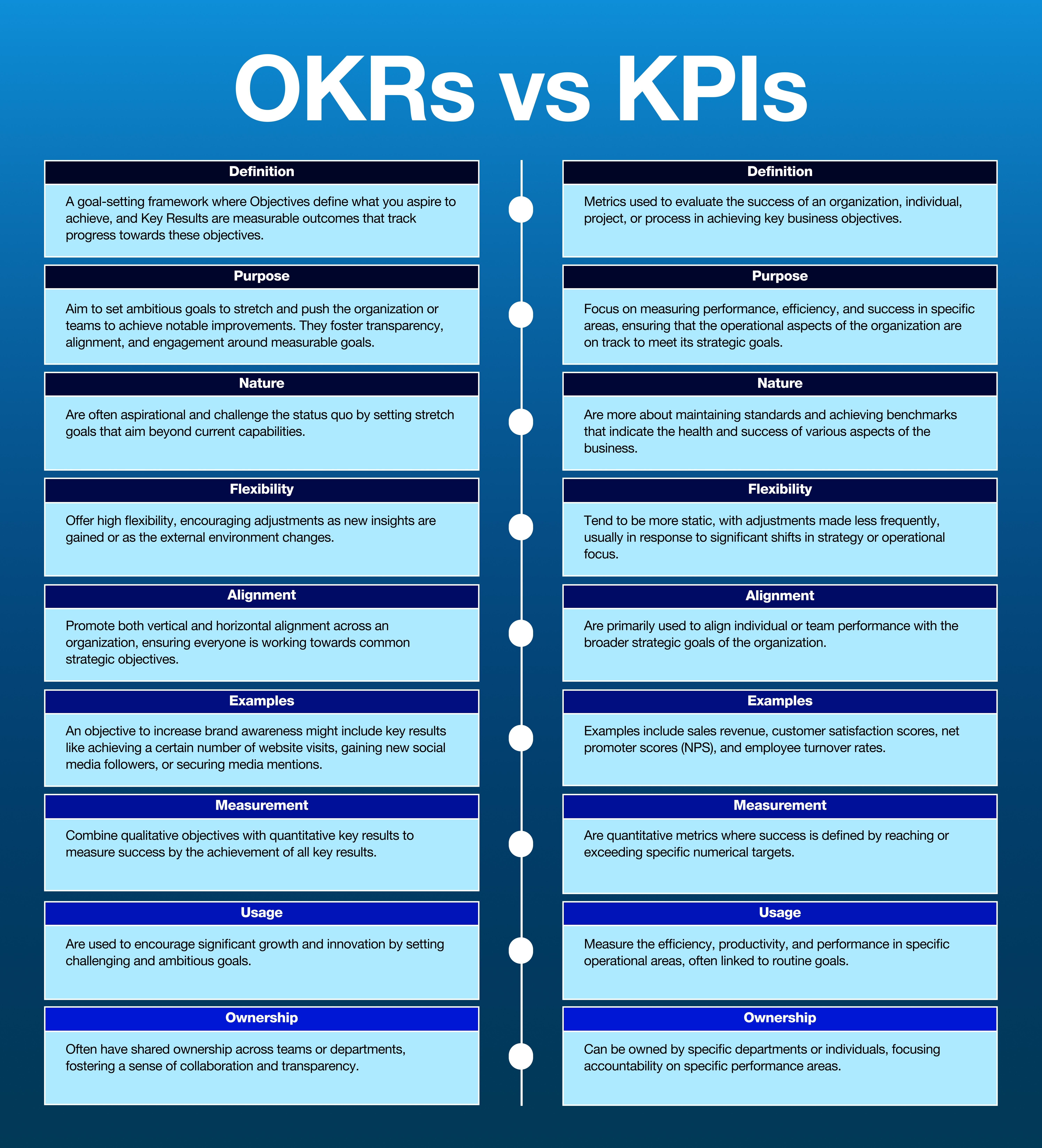
OKRs (Objectives and Key Results) are designed to push the business forward. They define what you want to achieve in the future and create a structured way of measuring whether you’re getting there. They are inherently forward-looking, aspirational, and often slightly uncomfortable.
A good OKR stretches the organisation. It sets a direction that requires effort, creativity, and, in many cases, a willingness to operate beyond what feels safe.
KPIs (Key Performance Indicators) operate differently. They are about maintaining and monitoring the health of the business as it exists today. They measure how well specific functions, teams, or processes are performing against established standards.
Where OKRs ask, “Where are we trying to go?”, KPIs ask, “How well are we operating right now?”
Both questions matter. But they are not the same question.
Why Confusion Creates Friction
The problem arises when these two concepts are used interchangeably.
If you treat KPIs like OKRs, you end up setting operational metrics as aspirational goals. The result is often uninspiring targets that don’t drive meaningful change. Teams hit their numbers, but the business doesn’t move forward in any significant way.
On the other hand, if you treat OKRs like KPIs, you risk turning ambitious objectives into rigid performance benchmarks. Teams feel pressure to hit 100% of their targets, which discourages risk-taking and leads to conservative goal-setting.
In both cases, the system breaks down.
You either optimise for stability at the expense of growth, or you chase growth without maintaining the foundations that support it.
The balance lies in understanding that OKRs and KPIs are not competing frameworks. They are complementary.
OKRs: Creating Direction and Momentum
OKRs exist to drive change.
They start with an objective: something qualitative, directional, and meaningful. It’s not just a metric; it’s a statement of intent. It answers the question: what do we want to achieve, and why does it matter?
The key results then define how success will be measured. They bring structure to the ambition, translating a high-level objective into something tangible and trackable.
What makes OKRs powerful is their nature.
They are not designed to be easy. In fact, if you consistently achieve every OKR you set, it’s often a sign that you’re not aiming high enough. The purpose is to stretch the organisation, to create movement that wouldn’t happen otherwise.
They also operate on a cadence. Quarterly, sometimes annually, they are reviewed, adjusted, and reset. This creates a rhythm of reflection and learning, allowing the business to adapt as conditions change.
OKRs are, in essence, the engine of progress.
They define where you’re going and create the momentum to get there.
KPIs: Protecting The Core of The Business
While OKRs push the business forward, KPIs ensure it doesn’t fall apart in the process.
Every organisation has a set of core metrics that define its health. Revenue growth, customer retention, churn rate, system uptime, sales conversion rates. These are the indicators that tell you whether the business is functioning as it should.
KPIs track these metrics over time.
They are not aspirational in the same way OKRs are. They are benchmarks. They define what “good” looks like and provide a consistent way of measuring performance.
What makes KPIs valuable is their stability.
They don’t change frequently. They create continuity. They allow leaders to spot trends, identify issues early, and ensure that the fundamentals of the business remain strong.
If OKRs are about pushing boundaries, KPIs are about maintaining discipline.
The Different Rhythms of Each
Another important distinction lies in how often these frameworks evolve.
OKRs are dynamic. They are designed to change as the business learns and adapts. Each cycle brings new objectives, new priorities, and new challenges. This flexibility is what makes them effective in fast-moving environments.
KPIs, by contrast, are relatively static.
They may be refined over time, but they don’t shift dramatically from quarter to quarter. Their purpose is to provide a consistent view of performance, not to reflect changing ambition.
This difference in rhythm is important.
If everything changes all the time, you lose stability. If nothing changes, you lose momentum.
OKRs and KPIs together create a balance between the two.
Alignment vs Accountability
There’s also a subtle difference in how these frameworks drive behaviour within a team.
OKRs are often shared across functions. They create alignment by ensuring that different teams are working toward the same outcomes. Marketing, product, sales: all contributing to a common objective.
This shared ownership fosters collaboration.
KPIs, on the other hand, tend to be more specific. They are often tied to individual roles or functions, creating clear accountability for performance.
A sales leader might own pipeline conversion rates. A customer success team might own retention metrics. An engineering team might own system reliability.
Both forms of ownership are necessary.
Alignment ensures everyone is moving in the same direction. Accountability ensures that specific areas of the business are performing as they should.
Where The Real Power Lies
The real advantage doesn’t come from choosing one framework over the other.
It comes from using both, intentionally.
OKRs set the direction. They define what success looks like in the future and push the organisation to move toward it.
KPIs monitor the journey. They ensure that as you move, you don’t lose control of the fundamentals that keep the business stable.
Together, they create a dual system.
One drives ambition. The other enforces discipline.
And when those two forces are in balance, something powerful happens. The business grows, but it grows in a way that is sustainable. Teams are challenged, but not destabilised. Progress is made without sacrificing performance.
A Practical Shift in Thinking
For many founders, the shift is not about adopting new frameworks, but about using existing ones more deliberately.
Ask yourself a simple question.
Which of our metrics are about maintaining performance, and which are about driving progress?
If everything sits in one category, you likely have an imbalance.
Too many KPIs, and you risk stagnation.
Too many OKRs, and you risk instability.
The goal is not to eliminate one in favour of the other, but to create a system where both can coexist, each serving its purpose.
From Measurement to Momentum
In the end, both OKRs and KPIs are tools.
They don’t create success on their own. But they shape how a business thinks, how it prioritises, and how it executes.
Used well, they turn measurement into momentum.
They ensure that you’re not just tracking what’s happening, but actively shaping what comes next.
And in a world where most companies are busy but not always moving forward, that distinction is what separates activity from progress.
-Chris Tottman
Most founders don’t lose their raise in the meeting.
They lose it before they ever send the first email.
The ones who close know things the others don’t. They know the number that silently kills more raises than any bad pitch. They know which investors are actually writing cheques right now and which ones are just taking meetings. They know how to cut their list before they burn weeks on the wrong outreach. They know the return model a VC runs before you’ve even opened your mouth. And they know exactly what signals mark you as fundable before the conversation even begins.
That edge doesn’t come from blog posts. It comes from 30 years in the room and 500+ investments, compressed into a library of 50+ tools and playbooks built for the exact moment you’re in right now.
A paid subscription unlocks all of it.
The five members are using most right now:
The Number That Kills More Fundraises Than Any Bad Idea - your market size slide is ending raises that should never have failed. Most founders never find out why. This does.
The Investors Who Actually Write Cheques in 2026 - the capital layer sitting outside traditional VC that most founders walk straight past. Quieter money. Faster decisions. Fewer hoops. More stages.
The Quiet Filter That Decides Your Entire Fundraise - know who’s a real fit before you waste hours finding out the hard way. The filter most founders skip — and only understand once it’s too late.
The Way VCs Actually Calculate Your Valuation - the return model investors run before the meeting starts. Know the number they need to see before you walk in and name one.
How Investors Decide If You’re Ready to Raise - the exact signals that determine fundability at every stage. Not guesswork. Not gut feel. The actual criteria.
Every one of these has shifted how a founder in this community approaches their raise. The only variable is whether you read them before your next investor meeting — or after it.
I’ve seen this happen with so many growing companies. The moment teams become obsessed with tracking everything, they slowly stop taking the kind of risks that actually create growth.
Choose the fewest things to measure that roll up to my podium methodology 👏