

👋 Hey, Chris here! Welcome to BrainDumps—a weekly series from The Founders Corner. If you’ve been reading along, you know this series is a preview of a bigger project. Well, it’s finally here: The Big Book of BrainDumps is out now!
It isn’t a theory book—it’s the founder’s field manual. Inside, you’ll find 70 powerful frameworks distilled from 30+ years scaling software companies to hundreds of millions in ARR, 20+ years investing in 500+ B2B tech startups, and over $1B of shareholder value created. From raising capital to hiring your first VP of Sales, this book turns scars and successes into practical playbooks you’ll return to again and again. I expect most copies will become well-worn, scribbled on, and dog-eared—because it works.

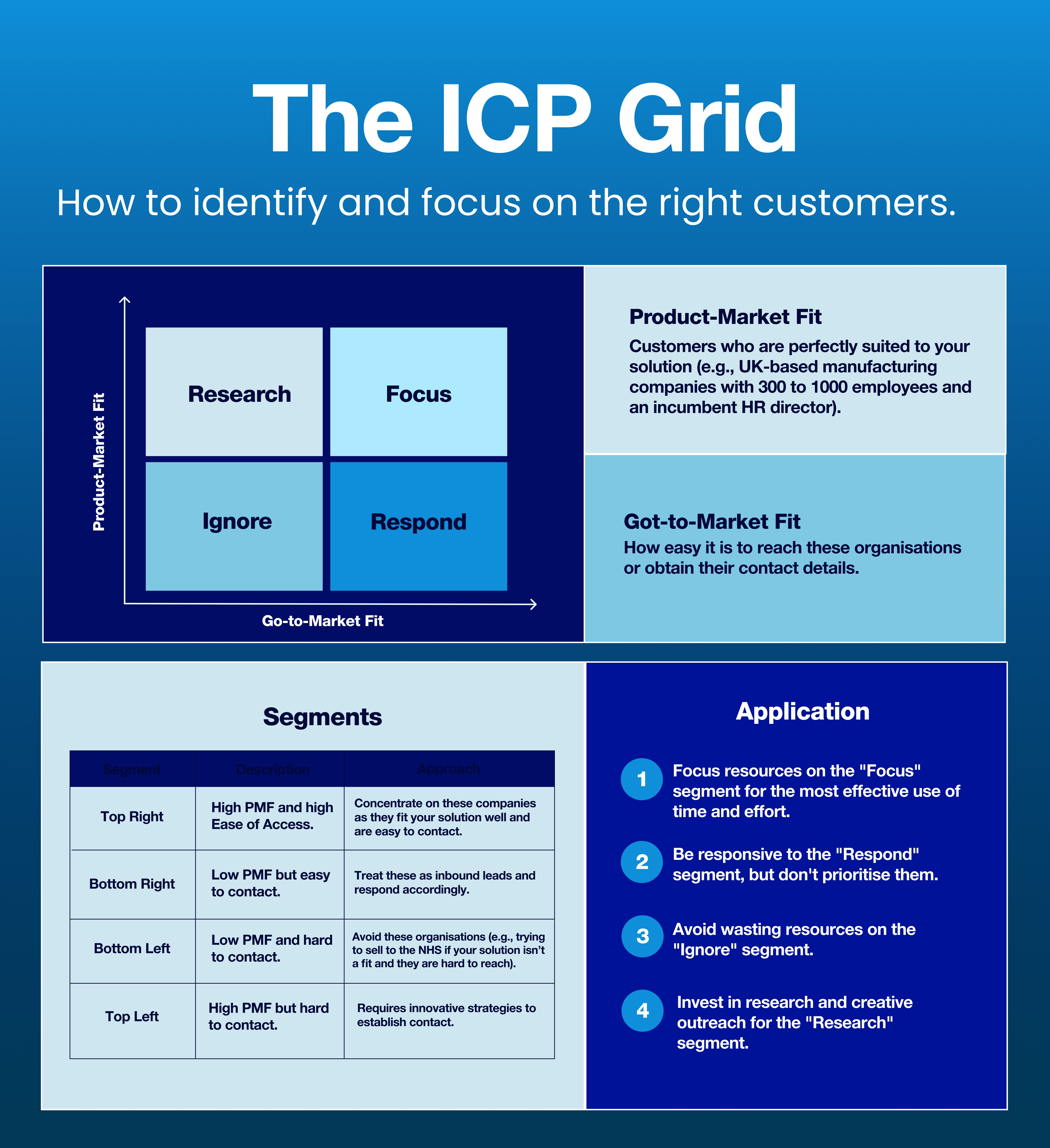
One of the most common mistakes we see in B2B software is also one of the most understandable.
Founders build something promising, gain a little traction, raise some capital, and suddenly begin imagining the enormous size of the market in front of them. Every industry feels addressable. Every segment feels possible. Every inbound enquiry looks like revenue waiting to happen.
The temptation is obvious: if the product could theoretically help everyone, why narrow the focus?
But this is exactly where many SaaS businesses begin to lose momentum.
Because in the early stages of scaling, focus is not restrictive — it’s accelerative.
And nowhere is that clearer than when defining your Ideal Customer Profile.
The reality is that most software companies don’t fail because their product lacks value. They fail because they never become sufficiently specific about who that value is for. Their messaging stays broad. Their sales process becomes inconsistent. Their marketing loses precision. Product priorities drift in too many directions at once.
The result is predictable: slower deals, weaker positioning, confused buyers, and an organisation constantly chasing opportunities that were never truly a fit in the first place.
That’s why one of the most powerful strategic exercises any founder can undertake is building a proper ICP Grid.
Not as a theoretical marketing exercise, but as an operational lens for deciding where the company should focus its finite energy.
Table of Contents
Product-Market Fit and Go-to-Market Fit Are Not the Same Thing
The Four Quadrants That Change How You Think About Customers
Why Narrowing Your Market Actually Accelerates Growth
The “Respond” Quadrant Is Where Founders Lose Time
Ignore More Markets Than You Pursue
The “Research” Quadrant Holds Future Expansion Opportunities
The Best ICP Work Goes Far Beyond Industry Segmentation
ICP Clarity Changes Everything Operationally
The Companies That Scale Fastest Usually Feel “Too Narrow” At First
Product-Market Fit and Go-to-Market Fit Are Not the Same Thing
One of the reasons ICP work is so valuable is because it forces leadership teams to distinguish between two concepts that are often incorrectly bundled together: Product-Market Fit and Go-to-Market Fit.
They sound similar, but they solve very different questions.
Product-Market Fit asks whether your solution genuinely solves a meaningful problem for a particular customer type. Are they feeling the pain intensely enough? Does your product create clear value? Is the speed-to-value obvious? Are you solving something operationally painful, strategically important, or commercially urgent?
Go-to-Market Fit, meanwhile, asks a much more practical question:
How easy is it to actually reach and sell to those organisations?
This distinction matters enormously.
A market can be a perfect fit for your product while simultaneously being an extremely poor fit operationally for an early-stage SaaS company.
Take healthcare or government procurement as examples. Your solution may genuinely solve a critical problem within those sectors, but if procurement cycles take eighteen months, require endless compliance reviews, and involve multiple stakeholder layers before contracts are signed, the market may simply be too slow-moving for your current stage of growth.
That doesn’t make it a bad market forever.
It just may not be the right market right now.
And understanding that distinction can dramatically accelerate growth.
The Four Quadrants That Change How You Think About Customers
The beauty of the ICP Grid lies in its simplicity.
On one axis sits Product-Market Fit.
On the other sits Go-to-Market Fit.
Together they create four strategic zones that fundamentally alter how founders think about opportunity.
At the top-right sits the most important quadrant in the entire exercise: Focus.
These are the customers where both Product-Market Fit and Go-to-Market Fit are high. The pain is obvious. The value proposition resonates quickly. Decision-makers are accessible. Sales cycles are manageable. The organisation understands the problem you solve, and your messaging lands immediately.
This is your bullseye.
This is where early-stage SaaS companies should be concentrating almost all their commercial energy.
Because the fastest path to scale is not broad market expansion.
It’s dominating a tightly defined segment where your product already fits naturally.
Why Narrowing Your Market Actually Accelerates Growth
This is often emotionally difficult for founders.
Reducing focus can feel like shrinking ambition. Investors talk endlessly about massive TAMs. Pitch decks celebrate giant market opportunities. Narrowing the ICP can initially feel like voluntarily limiting growth.
In reality, the opposite is usually true.
The narrower your positioning becomes, the easier everything else gets.
Messaging sharpens.
Sales conversations improve.
Case studies become more relevant.
Referrals increase.
Onboarding becomes smoother.
Product priorities become clearer.
Marketing efficiency improves dramatically.
And most importantly, close rates rise because prospects feel immediately understood.
Great SaaS businesses rarely begin broad.
They begin specific.
Salesforce initially focused on sales teams. Shopify focused on small online merchants. HubSpot focused heavily on SMB inbound marketing teams. Slack first exploded inside technology companies before expanding outward.
The pattern repeats constantly.
Market leadership often begins with obsession over a very specific audience.
The “Respond” Quadrant Is Where Founders Lose Time
One of the most dangerous areas on the ICP Grid is the bottom-right quadrant: Respond.
These are organisations that are relatively easy to reach but where Product-Market Fit is weak.
And they are incredibly seductive.
They attend webinars.
They respond to outbound.
They request demos.
They generate activity.
But underneath the surface, the urgency isn’t really there.
The pain is weaker.
The implementation urgency is lower.
The product may only partially fit their workflows.
And the internal need for change is often far less visceral than it initially appears.
These deals consume enormous energy.
Sales cycles drag.
Procurement stalls.
Adoption weakens.
Expansion opportunities shrink.
The problem is not necessarily that these customers are “bad.” The problem is that they distract teams away from the Focus quadrant where momentum compounds much faster.
Many early-stage SaaS companies quietly burn years pursuing “almost-fit” customers.
Ignore More Markets Than You Pursue
Perhaps the hardest leadership discipline in scaling SaaS is learning what not to chase.
The bottom-left quadrant — Ignore — represents segments where both Product-Market Fit and Go-to-Market Fit are weak.
These markets are difficult to access and unlikely to receive meaningful value from the product even if acquired.
This is the graveyard of wasted sales effort.
Yet many companies still pursue these accounts because they want every opportunity to convert into pipeline.
But strategy is not about saying yes to everything.
Strategy is about intentional exclusion.
The strongest operators understand that focus creates leverage. Every hour spent pursuing low-fit accounts is an hour not invested into the segments most likely to generate compounding returns.
Great businesses become disciplined enough to ignore distraction.
The “Research” Quadrant Holds Future Expansion Opportunities
The final quadrant — Research — is often where future growth lives.
These are markets where Product-Market Fit is strong, but Go-to-Market Fit remains difficult.
The pain exists. The solution resonates. But access is challenging.
This could involve enterprise markets with long buying cycles, heavily regulated sectors, complex procurement environments, or geographies where the company lacks brand presence.
Importantly, these markets are not “bad” opportunities.
They are simply future opportunities.
This is where strategic creativity becomes important. Partnerships, channel strategies, integrations, account-based marketing, and thought leadership can all gradually improve Go-to-Market Fit over time.
But the key principle remains the same:
Do not prematurely prioritise difficult markets before dominating easier ones.
Momentum matters too much in the early stages.
The Best ICP Work Goes Far Beyond Industry Segmentation
One of the biggest misconceptions about ICP definition is that it’s simply about selecting industries or company sizes.
In reality, the best ICP work becomes deeply qualitative.
High-growth companies often make better customers than stagnant ones because urgency exists internally. Businesses undergoing transformation adopt faster than businesses defending the status quo.
Operational maturity matters.
Buying psychology matters.
Leadership ambition matters.
Technology adoption behaviour matters.
Some customers buy because they need efficiency. Others buy because they want competitive advantage. Others buy because internal political pressure is forcing change.
Understanding these nuances creates far stronger positioning than simple demographic targeting alone.
The best SaaS companies know not only who their ideal customer is — they understand why those customers buy.
ICP Clarity Changes Everything Operationally
Once an ICP becomes genuinely clear, the effects ripple across the entire organisation.
Marketing becomes sharper because campaigns speak directly to specific pain points.
Sales teams improve because qualification becomes faster and cleaner.
Product teams gain clarity because feature prioritisation aligns around real customer needs rather than edge-case requests.
Customer success improves because onboarding becomes repeatable and predictable.
Even fundraising conversations improve because investors can see evidence of focused market penetration rather than scattered experimentation.
Clarity compounds.
The Companies That Scale Fastest Usually Feel “Too Narrow” At First
One of the strange psychological realities of defining an ICP properly is that it often feels uncomfortable.
The market suddenly appears smaller.
Opportunities appear more selective.
The company says “no” more frequently.
That discomfort is usually a sign the exercise is working.
Because the businesses that scale fastest are rarely the ones trying to serve everybody simultaneously.
They are the ones that become extraordinarily valuable to a very specific group first.
Only later do they expand outward.
This is how category leaders are built.
Not through breadth initially.
Through depth.
And for most SaaS founders, learning that lesson earlier would save years of wasted effort.
Most founders lose their raise before they send the first email.
The ones who close know something others don’t: the single metric that’s quietly tanking 70% of pitches, exactly which investors are deploying capital right now (and it’s not who you think), how to spot a real prospect in 90 seconds, what number VCs need to see before they’ll even listen, and the unfakeable signals that separate fundable from “not yet.”
That knowledge comes from 30 years sitting across from founders, 500+ investments, and the patterns that separate the funded from the rejected.
We’ve built it into 50+ tools. One subscription unlocks all of it.
Start with these five, they’ve changed the game for thousands of founders:
The Number That Kills More Fundraises Than Any Bad Idea – One slide. That’s all it takes. Here’s the metric killing your raise without you knowing it.
The Investors Who Actually Write Cheques in 2026 – Forget the usual suspects. This is where real capital moves. Faster. Earlier. Better odds.
The Quiet Filter That Decides Your Entire Fundraise – Every investor is running this filter before you pitch. Know it now, or learn it the hard way.
The Way VCs Actually Calculate Your Valuation – They have a number in mind before you walk in. What is it? And how do you hit it?
How Investors Decide If You’re Ready to Raise – It’s not luck or timing. These are the exact criteria investors use. Know them, and you change everything.
Read one before your next meeting. Your raise depends on it.