

👋 Hey, Chris here! Welcome to BrainDumps—a weekly series from The Founders Corner. If you’ve been reading along, you know this series is a preview of a bigger project. Well, it’s finally here: The Big Book of BrainDumps is out now!
It isn’t a theory book—it’s the founder’s field manual. Inside, you’ll find 70 powerful frameworks distilled from 30+ years scaling software companies to hundreds of millions in ARR, 20+ years investing in 500+ B2B tech startups, and over $1B of shareholder value created. From raising capital to hiring your first VP of Sales, this book turns scars and successes into practical playbooks you’ll return to again and again. I expect most copies will become well-worn, scribbled on, and dog-eared—because it works.
Every startup story celebrates growth.
More customers.
More revenue.
More people.
But buried beneath those headlines is a quieter, harder truth:
As your company grows, the leadership style that made you successful can become your biggest liability.
This BrainDump captures one of the most important — and least discussed — realities of scaling a business: founders must change faster than their companies do.
Let’s unpack how leadership needs to evolve across each stage of growth — and why resisting that evolution is one of the most common causes of scale-up failure.
Table of Contents
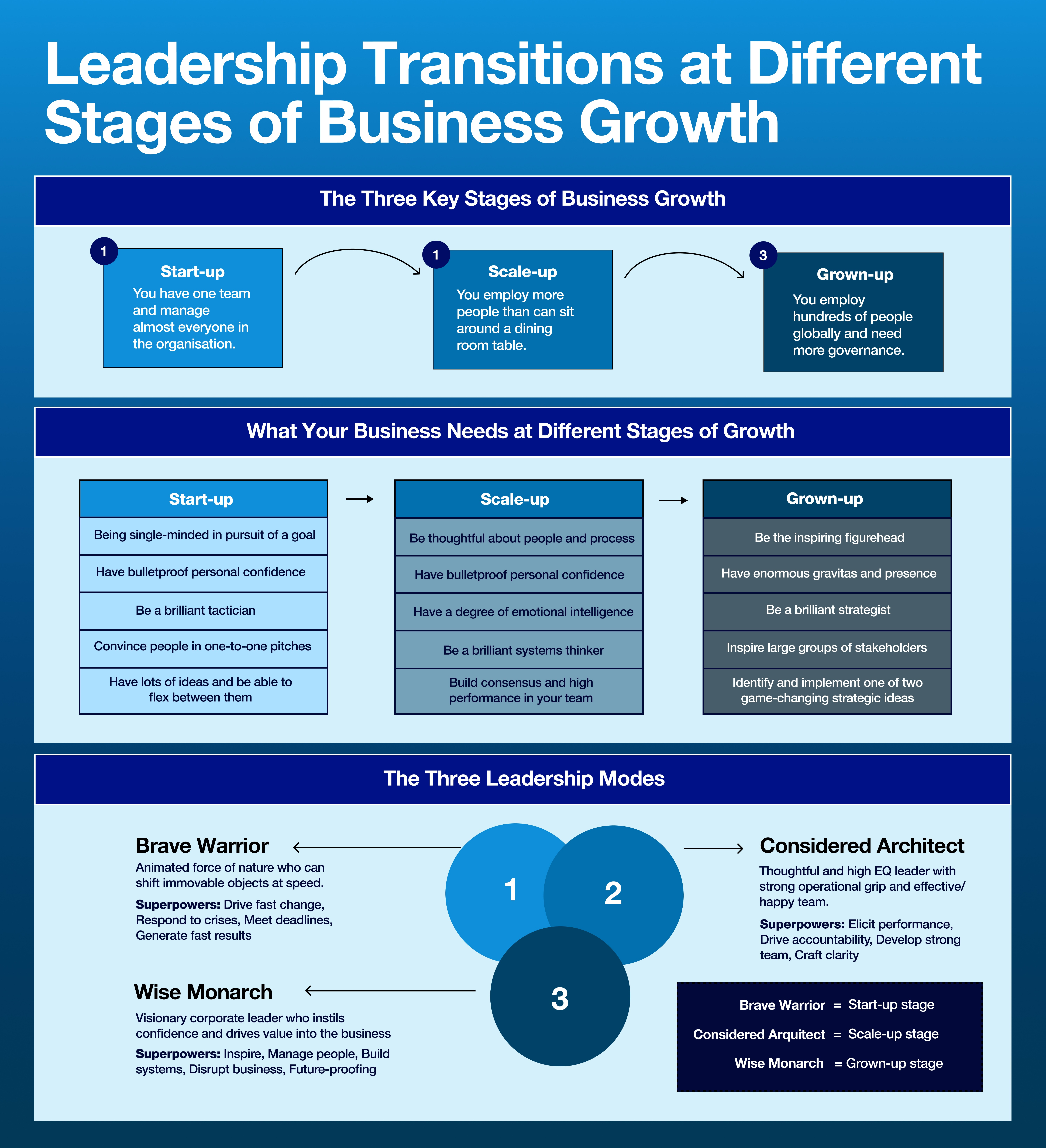
The Three Stages of Business Growth
Stage 1: Startup — Survival, Speed, and Scrappiness
Stage 2: Scale-Up — Complexity Enters the Room
Stage 3: Grow-Up — From Company to Institution
The Real Leadership Trap
The Three Leadership Modes, Together
What Investors Are Really Watching
The Takeaway
The Three Stages of Business Growth
Most companies don’t grow linearly. They grow in phases — each with different risks, priorities, and leadership demands.
1. Startup
2. Scale-up
3. Grow-up
The mistake founders make is assuming the same behaviours work in all three.
They don’t.
Stage 1: Startup — Survival, Speed, and Scrappiness
At the startup stage, leadership is intensely personal.
You are the company.
You’re:
Close to customers
Deep in the product
Making decisions hourly
Wearing every hat
Moving faster than structure allows
This is where the Brave Warrior leadership mode dominates.
The Brave Warrior
Acts decisively with limited information
Pushes through ambiguity
Sets pace and urgency
Leads from the front
Optimises for speed over perfection
This style is essential early on. Without it, nothing ships and nothing survives.
But here’s the danger:
what feels like leadership at this stage often becomes micromanagement later.
What the Business Needs at Startup
At this phase, your business needs:
Rapid iteration
Personal sacrifice
Hands-on problem solving
Tight feedback loops
Bias toward action
The founder’s instinctive leadership style is often perfectly matched to the company’s needs.
This alignment is why early success can be deceptive.
Stage 2: Scale-Up — Complexity Enters the Room
Scale-up is where things start to break.
Customers multiply.
Teams expand.
Decisions compound.
Communication slows.
What worked before — fast decisions, gut instinct, personal heroics — starts to creak under pressure.
This is where founders must shift toward the Wise Monarch mode.
The Wise Monarch
Sets direction rather than executing everything
Builds systems and repeatability
Delegates authority intentionally
Focuses on leverage, not effort
Thinks in terms of process, not firefighting
This transition is emotionally hard.
Founders often feel:
Less useful
Further from the action
Slower
Out of control
But scale requires abstraction.
If the founder remains the bottleneck, growth stalls.
What the Business Needs at Scale-Up
At this stage, your company needs:
Predictability
Middle management
Clear accountability
Standardised processes
Performance metrics
Cultural consistency
Founders who fail here often say:
“No one can do it as well as I can.”
They’re usually right — and still wrong.
Stage 3: Grow-Up — From Company to Institution
Grow-up is where companies either mature — or fracture.
The organisation is now large enough that:
Culture must be intentional
Strategy spans years, not months
Leadership must scale beyond individuals
Decision-making is distributed
The founder is no longer the centre of gravity
This is where leadership must evolve into the Considered Architect.
The Considered Architect
Designs systems, not tasks
Shapes culture deliberately
Builds leaders, not followers
Thinks in decades
Balances short-term performance with long-term resilience
At this stage, leadership is less visible — but far more impactful.
The founder’s influence is embedded in:
Structure
Values
Governance
Incentives
Talent systems
This is the hardest shift of all — because success now depends on what you don’t personally do.
What the Business Needs at Grow-Up
A grow-up business needs:
Strategic clarity
Leadership depth
Cultural durability
Risk management
Sustainable performance
Institutional memory
Founders who cling to early-stage behaviours here often create chaos without realising it.
The Real Leadership Trap
The most dangerous moment for founders isn’t failure.
It’s early success.
Because success reinforces behaviours — even when those behaviours are stage-specific.
The founders who scale best ask themselves repeatedly:
“What does the business need from me now — not what I’m good at?”
That question requires humility.
The Three Leadership Modes, Together
The BrainDump captures this evolution elegantly:
Brave Warrior → Startup
Wise Monarch → Scale-up
Considered Architect → Grow-up
Great founders don’t abandon earlier modes — they integrate them.
They know when to act, when to delegate, and when to design.
What Investors Are Really Watching
Investors don’t just assess whether your company can grow.
They assess whether you can grow with it.
They’re asking:
Can this founder let go?
Can they build leaders?
Can they think systemically?
Can they evolve their identity?
Leadership transitions are one of the biggest hidden risks in scaling — and one of the biggest hidden signals of long-term success.
The Takeaway
Scaling a company is not just a business challenge.
It’s an identity challenge.
Founders who succeed don’t cling to who they were — they become who the company needs next.
And that evolution — uncomfortable, unfamiliar, and often lonely — is what separates companies that plateau from companies that endure.
-Chris Tottman
The reminder that founders must evolve faster than the company is spot on, and the Brave Warrior → Wise Monarch → Considered Architect model captures the real, uncomfortable work of scaling leadership
This is really spot on great read I'm pinning this infographic to a wall somewhere. I'd recommend to any founder to have a coach, have someone to hold you accountable outside of the business, and to help you think "on" the business not "in" it and help signal when to change gears. As a CTO it helped me signal when to step away from the keyboard, because leaders doing work in the trenches can create more problems later down the line than you think.