

👋 Hey, Chris here! Welcome to The Founders Corner. If you’ve been reading along, you’ll know I have very little patience for theory that doesn’t survive contact with a real buyer.
This series is a preview of a new book I’ve written with my partners Richard Blundell and Paul Watson — The Selling Software Algorithm: The Go-to-Market Navigation System for B2B Software Leaders.
It isn’t a strategy deck dressed up as a book. Between the three of us we’ve spent close to seven decades inside B2B software as founders, operators, investors and coaches — building companies, exiting some, and quietly breaking a few along the way, which is where most of the real learning lives. Through our work at Vencha we’ve now supported hundreds of founders trying to do the single hardest thing in software: turn a clever product into predictable commercial traction in a market that’s noisy, cautious, and more crowded than it has ever been.
One pattern shows up again and again. Companies rarely struggle because the product is bad. They struggle because they have no navigation system for going to market. This book is that system.
Last time, we built the Solution Slide and tested it until Economic Buyers started telling us, unprompted, what would be politically difficult about buying from us. That gave you a playback they could recognise and a map of the internal resistance still ahead.
This time, we step back from the individual and look at the organisation around them again.
Table of Contents
Why Every Deal Needs a Door, and a Doorkeeper
Champion and Economic Buyer Are Not the Same Job
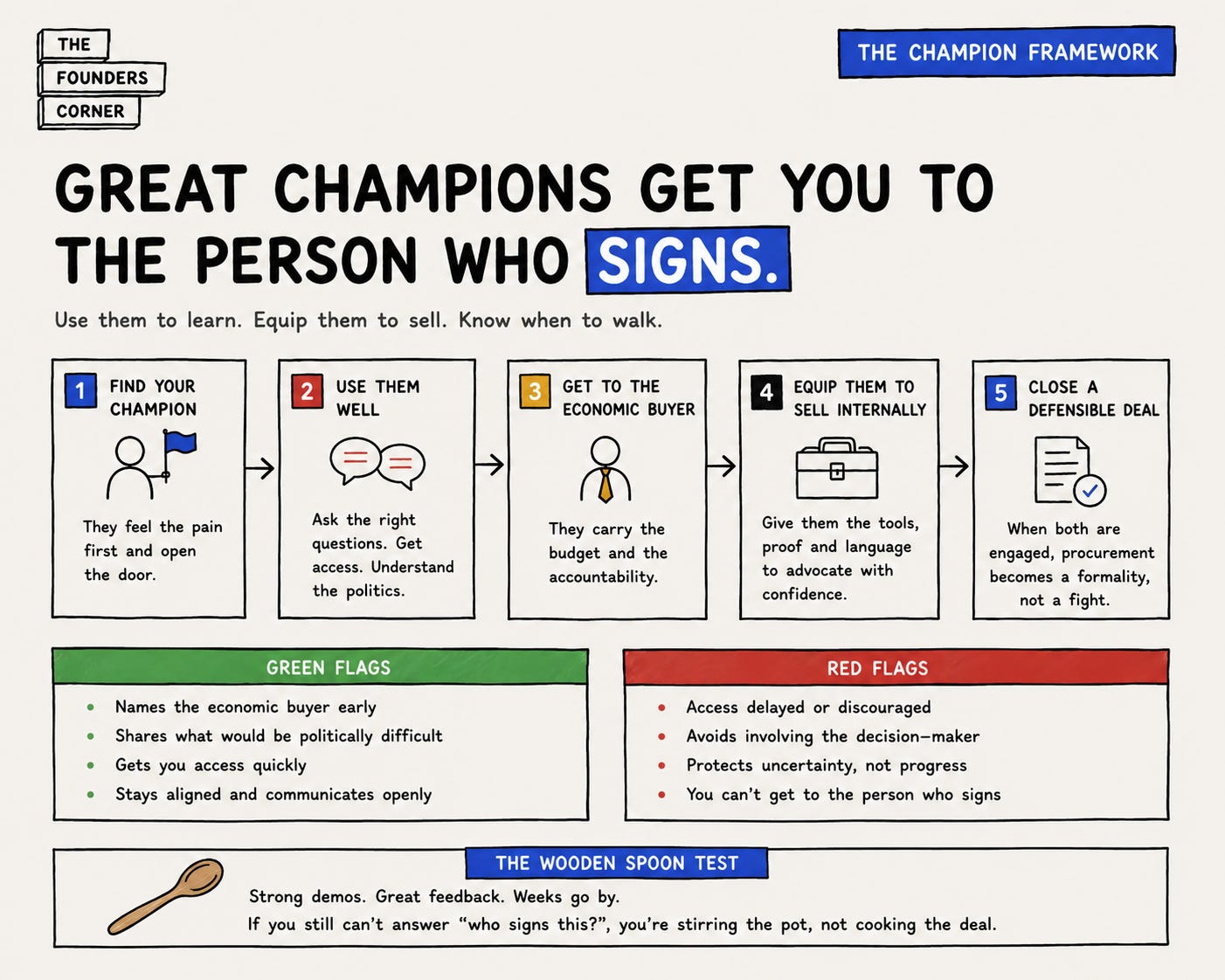
The Wooden Spoon Test: How to Know You’re Stirring, Not Cooking
What to Actually Ask a Champion
When a Champion Becomes a Red Flag
Equipping Your Champion to Sell Internally, Without You in the Room
From Ten Testing Calls to Your Finished Algorithm
Why Every Deal Needs a Door, and a Doorkeeper
No Founder gets a straight line to the person who signs. Between you and the Economic Buyer sits someone who noticed the problem first, felt it personally, and got excited enough to take your call, forward your email, or book the second meeting. That person is your Champion, and without them, most deals never start.
The mistake isn’t having a Champion. The mistake is stopping there. A Champion can open a door. They cannot, on their own, walk you through it, sign what’s on the other side, or defend the decision when someone senior asks hard questions about it later.
Want to get in front of 250k+ founders and investors?
For sponsorship opportunities across The Founders Corner newsletter and LinkedIn (160k followers), email: founderscornermedia@gmail.com
Champion and Economic Buyer Are Not the Same Job
It helps to be blunt about what each of these people actually wants, because it’s rarely the same thing.
The Champion cares about their day getting easier. They’re close to the workflow, close to the friction, and close enough to the pain that they recognise it the moment you describe it back to them. They speak your language fluently because they live the problem daily. That’s exactly why they’re so easy to mistake for the person who can say yes.
The Economic Buyer cares about something different: whether the decision is defensible. Not whether the software is clever, not whether the demo went well, but whether buying it can be justified to a CEO, a Board, or a Finance team asking why this and why now. They carry the budget line and the accountability that comes with it, and no amount of Champion enthusiasm transfers that accountability to them by osmosis.
Frameworks like MEDDICC exist precisely because this confusion is so common and so costly. Metrics, Decision Criteria, Decision Process, Identify Pain, Champion, Competition, all matter, but early in a deal, it’s the gap between Champion and Economic Buyer that tells you whether an opportunity has a pulse or is just warm noise.
The Wooden Spoon Test: How to Know You’re Stirring, Not Cooking
Keep a wooden spoon somewhere visible. Not as a gimmick, as a diagnostic.
If you can build a strong relationship with a Champion, run excellent demos for their team, gather positive feedback, and refine proposals for weeks, and still find yourself unable to answer the simple question “who signs this,” you are stirring the same pot over and over. Adding ingredients. Adjusting the seasoning. Convincing yourself something is cooking, when nothing is ever going to come to the boil.
This isn’t usually because your Champion misled you. It’s because enthusiasm without authority does not create sales, however genuine the enthusiasm is.
What to Actually Ask a Champion
Once you can name your Champion clearly, the second testing discipline begins: using them properly, rather than just liking them.
Ask what would be politically difficult about this internally. Ask who else needs to be comfortable before a decision like this gets made. Ask what’s happened before when a similar project stalled, and why. A good Champion, treated as a research partner rather than a warm lead, will tell you almost everything you need to know about the real shape of the deal, including the parts that never show up in a demo.
Ask, too, for access. Not access for a pitch, access for accuracy. Framing a request for time with the Economic Buyer as necessary to avoid recommending the wrong thing internally lands very differently to a vague ask for “alignment,” and it rarely feels like an imposition to a Champion who genuinely wants the project to succeed.
If you’re raising right now, don’t skip these
The Number That Kills More Fundraises Than Any Bad Idea: one slide, one metric, and it’s quietly killing raises without founders ever knowing it.
The Quiet Filter That Decides Your Entire Fundraise: every investor runs this before you even open your mouth. Learn it now, not after the “no.”
The Way VCs Actually Calculate Your Valuation: they already have a number in their head before you walk in. Here’s how to hit it.
How Investors Decide If You’re Ready to Raise: it’s not timing, it’s not luck. These are the exact criteria they’re using on you right now.
The Pitch Deck Test Investors Use: the same test gets applied to every deck that crosses their desk, including yours.
When a Champion Becomes a Red Flag
Access delayed once is normal. Diaries are difficult and priorities shift. Access delayed repeatedly, deflected, or quietly discouraged is a signal, and it’s usually not a technology signal, it’s a confidence signal.
Champions who resist involving the ultimate decision-maker are often protecting uncertainty rather than protecting progress. Sometimes they’re not yet sure the project will get funded. Sometimes they’re worried about how it will look if they’ve championed something that goes nowhere. Either way, the earlier you notice this pattern, the more months of wasted proposal-writing and feature-adjusting you save yourself.
Be prepared, at least mentally, to walk away from deals that never clear this bar. A Champion who cannot or will not open the door to the Economic Buyer, after several professional attempts, is telling you something true about how real this opportunity is.
Equipping Your Champion to Sell Internally, Without You in the Room
Assuming access does open up, your job shifts. A good Champion will be in rooms you’re never invited to, explaining your solution to people who’ve never met you, using language you didn’t choose. Your responsibility is to make that easier for them, not harder.
Give them a version of your Pain and Solution Slides they can present themselves, stripped of anything that only makes sense with you narrating it. Give them a short, plain-English summary of the business case, written the way an Economic Buyer talks, not the way a software company talks. Give them the proof points, the reference customer, the metric, the before-and-after, so that when someone senior pushes back, they’re not improvising.
Champions who feel equipped advocate with more confidence. Champions who feel exposed go quiet exactly when you need them to speak up.
From Ten Testing Calls to Your Finished Algorithm
Across ten or more of these conversations, the same pattern starts repeating. The Champions who move fastest are the ones who name the Economic Buyer early, without being asked twice. The ones who stall are almost always protecting something, usually uncertainty about whether this will actually happen. That repetition is the evidence. It turns a founder’s instinct into a commercial discipline the whole team can run without you in the room.
This is exactly what Builder Step 3 exists to hold: the Champion Profile, assembled from who opened the door, what they told you about the politics behind it, and how quickly they got you to the person who signs.
Next in the series, we look at what happens once the Champion and the Economic Buyer are both engaged, and turn to the Mutual Success Plan: the document that quietly does the work of making procurement feel like a formality rather than a fight.
-Chris Tottman
Most founders build a Solution Slide from what they wish were true rather than what ten buyers actually told them.
That’s the gap the Selling Software Algorithm Builder exists to close. Step 3 assembles your algorithm sentence from what you’ve already tested, so your whole team can repeat it word for word. Built your algorithm sentence below:
Start your 7-day free trial → Cancel anytime.
