

👋 Hey, Chris here! Welcome to BrainDumps—a weekly series from The Founders Corner. If you’ve been reading along, you know this series is a preview of a bigger project. Well, it’s finally here: The Big Book of BrainDumps is out now!
It isn’t a theory book—it’s the founder’s field manual. Inside, you’ll find 70 powerful frameworks distilled from 30+ years scaling software companies to hundreds of millions in ARR, 20+ years investing in 500+ B2B tech startups, and over $1B of shareholder value created. From raising capital to hiring your first VP of Sales, this book turns scars and successes into practical playbooks you’ll return to again and again. I expect most copies will become well-worn, scribbled on, and dog-eared—because it works.
There’s a point in most companies where OKRs enter the conversation.
Sometimes it’s after a period of rapid growth, when things start to feel a little chaotic and the leadership team wants more structure. Sometimes it’s driven by investors, or by new hires who’veseen them work elsewhere. And sometimes it’s simply because the business has outgrown informal goal-setting and needs a more disciplined way to align.
On paper, OKRs feel like the answer.
They promise clarity, alignment, focus, and momentum. A simple framework that connects ambition to execution and ensures everyone is pulling in the same direction.
But in practice, most OKR implementations fall short.
Not because the framework is flawed, but because it’s misunderstood. Objectives become vague statements. Key results become task lists. Reviews turn into reporting exercises rather than learning moments. And over time, the system loses credibility.
The issue isn’t OKRs themselves. It’s how they’re constructed.
Because a well-crafted OKR set is not just a collection of goals—it’s a way of thinking about how progress actually happens inside a business.
Table of Contents
It Starts With the Objective (And This Is Where Most Go Wrong)
Key Results: Where Ambition Meets Measurement
The Missing Layer: Tasks (Where Execution Actually Happens)
What Separates Good OKRs From Great Ones
The Cultural Shift That Makes OKRs Work
Common Pitfalls (And Why They Keep Happening)
A More Practical Way to Think About It
From Goals to Momentum
It Starts With the Objective (And This Is Where Most Go Wrong)
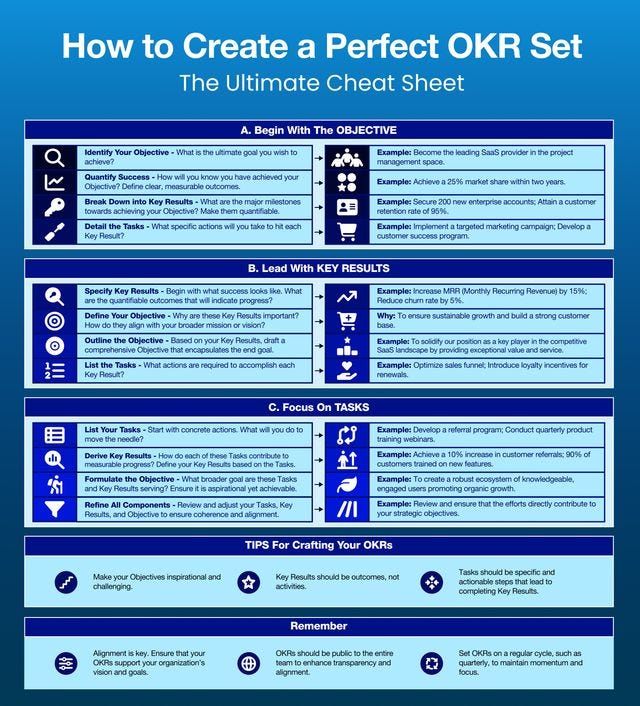
Every OKR begins with an objective, and this is where the tone is set.
An objective is not a metric. It’s not a task. It’s not even a target in the traditional sense. It’s a statement of intent—something that defines what you’re trying to achieve and why it matters.
Done well, it should feel directional and meaningful. Something a team can rally around.
Done poorly, it becomes either too vague to be useful or too specific to be inspiring.
“Improve customer experience” sounds good, but it lacks clarity. “Reduce churn by 5%” is measurable, but it’s not really an objective—it’s already drifting into key result territory.
The balance lies somewhere in between.
A strong objective might be something like “Become the most trusted platform for mid-market finance teams” or “Transform our onboarding experience into a competitive advantage.” It gives direction, creates energy, and leaves room for interpretation.
That last part is important.
An objective should invite thinking, not dictate it.
Key Results: Where Ambition Meets Measurement
If the objective defines the destination, key results define how you’ll know you’re getting there.
This is where precision matters.
Key results should be specific, measurable, and time-bound. They are not activities—they are outcomes. This distinction is critical, and it’s one of the most common points of failure.
“Launch a new feature” is not a key result.
“Increase feature adoption by 30%” is.
The difference is subtle but significant. One tracks effort. The other tracks impact.
A good set of key results typically sits between three and five metrics. Enough to provide a clear picture of progress, but not so many that focus is diluted.
They should also strike a balance between ambition and realism. If they’re too easy, they don’t drive change. If they’re too unrealistic, they demotivate the team.
The goal is tension—the kind that pushes people to think differently about how they achieve results.
The Missing Layer: Tasks (Where Execution Actually Happens)
One of the things that often gets overlooked in OKR discussions is the role of tasks.
Strictly speaking, tasks are not part of the OKR framework. But in practice, they are essential.
Because while objectives and key results define what needs to happen, tasks define how it happens.
This is where strategy becomes execution.
If a key result is to “increase customer retention by 10%,” the tasks might include running customer interviews, improving onboarding flows, launching targeted engagement campaigns, or introducing new product features.
These are the actions that move the needle.
The mistake many teams make is jumping straight from objectives to tasks without properly defining key results. This leads to activity that isn’t clearly tied to outcomes, and over time, it becomes difficult to assess whether the work being done is actually effective.
The structure matters.
Objective → Key Results → Tasks.
When that chain is clear, execution becomes far more focused.
What Separates Good OKRs From Great Ones
At a surface level, OKRs are simple. But the difference between good and great lies in how they’re crafted and used.
The best OKRs share a few common characteristics.
They are outcome-driven. Every key result measures impact, not activity.
They are limited in number. Too many objectives create noise. Focus is where the value lies.
They are transparent. Everyone in the organisation can see them, understand them, and connect their work to them.
And perhaps most importantly, they are regularly reviewed.
OKRs are not static. They are living tools that evolve as the business learns. Quarterly reviews are not just about tracking progress—they are about understanding what’s working, what isn’t, and why.
That learning loop is where much of the value comes from.
The Cultural Shift That Makes OKRs Work
What often gets missed in discussions about OKRs is that they are not just a framework—they are a cultural shift.
They require a level of openness that not every organisation is used to. Goals are visible. Progress is visible. Misses are visible.
This transparency can feel uncomfortable, particularly in environments where failure is not openly discussed.
But it’s also what makes the system powerful.
When teams can see how their work contributes to broader objectives, alignment improves. When progress is tracked openly, accountability increases. And when results are reviewed honestly, learning accelerates.
OKRs, when done properly, create a culture of clarity.
Common Pitfalls (And Why They Keep Happening)
Despite their simplicity, OKRs are surprisingly easy to get wrong.
One of the most common mistakes is turning key results into task lists. This usually happens when teams are more comfortable measuring activity than impact.
Another is setting too many objectives. It often comes from a desire to cover everything, but in reality, it dilutes focus and reduces effectiveness.
There’s also a tendency to treat OKRs as rigid targets rather than directional tools. Teams feel pressure to hit 100%, which discourages ambition and leads to conservative goal-setting.
And finally, there’s the issue of follow-through.
OKRs are set with enthusiasm, but over time, they fade into the background. Reviews become inconsistent, and the system loses its relevance.
None of these issues are unique. They are simply the result of applying a framework without fully embracing how it’s meant to work.
A More Practical Way to Think About It
At its core, creating a strong OKR set is not about filling out a template.
It’s about answering three simple questions:
What are we trying to achieve? How will we measure success? What needs to happen to get us there?
The framework provides structure, but the thinking behind it is what really matters.
When that thinking is clear, OKRs become more than just a planning tool. They become a way of aligning effort, focusing attention, and driving meaningful progress.
From Goals to Momentum
In the end, the value of OKRs is not in the document you create at the start of a quarter.
It’s in what happens after.
Do they shape decisions? Do they influence priorities? Do they help the team focus on what matters most?
If the answer is yes, then they’re working.
If not, then it’s not the framework that’s the problem—it’s how it’s being used.
Because when OKRs are done well, they do something subtle but powerful.
They turn ambition into momentum.
And in a business environment where distraction is constant and priorities are always competing, that momentum is often the difference between progress and drift.
Most founders lose their raise before they send the first email.
The ones who close know something others don’t: the single metric that’s quietly tanking 70% of pitches, exactly which investors are deploying capital right now (and it’s not who you think), how to spot a real prospect in 90 seconds, what number VCs need to see before they’ll even listen, and the unfakeable signals that separate fundable from “not yet.”
That knowledge comes from 30 years sitting across from founders, 500+ investments, and the patterns that separate the funded from the rejected.
We’ve built it into 50+ tools. One subscription unlocks all of it.
Start with these five, they’ve changed the game for thousands of founders:
The Number That Kills More Fundraises Than Any Bad Idea – One slide. That’s all it takes. Here’s the metric killing your raise without you knowing it.
The Investors Who Actually Write Cheques in 2026 – Forget the usual suspects. This is where real capital moves. Faster. Earlier. Better odds.
The Quiet Filter That Decides Your Entire Fundraise – Every investor is running this filter before you pitch. Know it now, or learn it the hard way.
The Way VCs Actually Calculate Your Valuation – They have a number in mind before you walk in. What is it? And how do you hit it?
How Investors Decide If You’re Ready to Raise – It’s not luck or timing. These are the exact criteria investors use. Know them, and you change everything.
Read one before your next meeting. Your raise depends on it.
Growth rarely breaks because a company lacks goals. It breaks when goals are disconnected from focus, ownership, and the systems required to execute consistently.
That is what makes frameworks like OKRs valuable when used well: they force clarity around what matters, who owns it, and whether activity is actually producing progress.
The same principle applies to extraordinary business outcomes. Ambition matters, but compounding requires a structure that turns direction into leverage over time.
I explore that broader framework in The Billionaire Gap: The Billionaire Formation Model in Full.
A related issue is here:
https://drrichardbushart.substack.com/p/issue-7-the-billionaire-formation?r=8cv3bq&utm_campaign=post&utm_medium=web&showWelcomeOnShare=true
Always Reach Higher,
Dr. Richard Bushart
Great read, Chris. I think it’s becoming incredibly easy for teams to generate more tasks & more output now and without clear key results, you can end up very productive on paper but in the wrong direction. Happens both inside companies and with solo ventures too.