

👋 Hey, Chris here! Welcome to BrainDumps—a weekly series from The Founders Corner. If you’ve been reading along, you know this series is a preview of a bigger project. Well, it’s finally here: The Big Book of BrainDumps is out now!
It isn’t a theory book—it’s the founder’s field manual. Inside, you’ll find 70 powerful frameworks distilled from 30+ years scaling software companies to hundreds of millions in ARR, 20+ years investing in 500+ B2B tech startups, and over $1B of shareholder value created. From raising capital to hiring your first VP of Sales, this book turns scars and successes into practical playbooks you’ll return to again and again. I expect most copies will become well-worn, scribbled on, and dog-eared—because it works.
This might feel like teaching granny to suck eggs.
Of course you know what a CEO does.
You understand what a CTO is responsible for.
You’ve heard of a CFO.
But here’s the uncomfortable truth:
Most founders don’t misunderstand job titles.
They misunderstand capability architecture.
And that misunderstanding quietly creates bottlenecks, misalignment, politics, and painfully expensive hiring mistakes.
The startup C-Suite isn’t about hierarchy.
It’s about making sure the right functions are owned, aligned, and scalable.
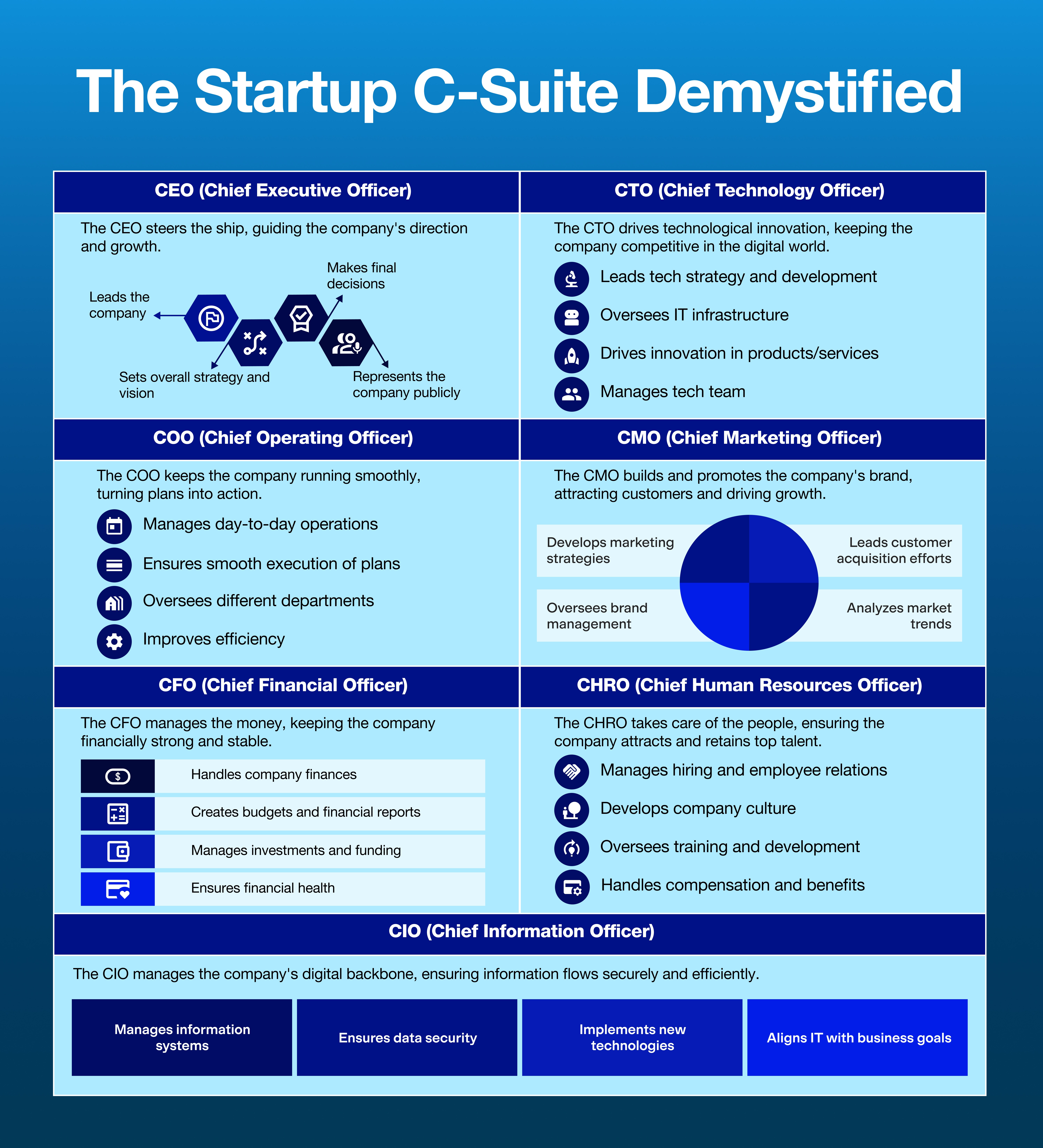
Let’s demystify what each role really does — and more importantly, how they interlock.
Table of Contents
The CEO: Direction, Alignment, and Accountability
The CTO: Innovation with Discipline
The COO: The Execution Engine
The CMO: Narrative, Positioning, and Demand
The CFO: The Guardian of Fuel
The CHRO: Culture at Scale
The CIO: The Invisible Backbone
Fractional Leadership Is Not a Weakness
The Interconnection Effect
The Founder Evolution Problem
The Real Takeaway
Coming Next: Hiring Leaders Who Can Scale
The CEO: Direction, Alignment, and Accountability
The Chief Executive Officer is the ultimate decision-maker and public face of the company.
But in a startup, “CEO” isn’t just a title. It’s tension.
The CEO must:
Define and communicate vision
Set strategic priorities
Allocate capital and attention
Represent the business externally
Shape culture through behaviour
Early-stage founders often confuse activity with leadership.
True CEO work isn’t doing everything.
It’s deciding what matters most — and ensuring everyone else knows too.
As the company grows, the CEO must evolve from operator to orchestrator. From Brave Warrior to Considered Architect.
The CEO’s greatest responsibility isn’t control.
It’s alignment.
The CTO: Innovation with Discipline
The Chief Technology Officer is frequently misunderstood — especially in technical founding teams.
Early-stage CTOs might:
Write code
Architect systems
Ship product
Recruit engineers
But as scale increases, the CTO’s job shifts dramatically.
Now they must:
Define long-term technical vision
Ensure infrastructure scalability
Manage technical risk
Align product roadmap with business strategy
Avoid catastrophic tech debt
The CTO sits at the intersection of possibility and practicality.
A great CTO doesn’t just build what’s requested.
They anticipate what the business will need before it knows it needs it.
Without that foresight, agility dies quietly.
The COO: The Execution Engine
If the CEO sets direction and the CTO builds capability, the COO makes the machine run.
The Chief Operating Officer:
Translates strategy into systems
Coordinates departments
Removes friction
Improves internal efficiency
Establishes operational accountability
In many scale-ups, the COO is the turning point.
They convert founder energy into repeatable processes.
Without a strong operational backbone, growth becomes chaotic instead of compounding.
The CMO: Narrative, Positioning, and Demand
Startups don’t just build products. They build perception.
The Chief Marketing Officer owns:
Brand positioning
Customer acquisition strategy
Messaging clarity
Market differentiation
Growth experimentation
Marketing isn’t decoration.
Positioning determines pricing power.
Messaging determines conversion.
Brand determines trust.
The CMO shapes how the world experiences your company.
And in competitive markets, perception is leverage.
The CFO: The Guardian of Fuel
The Chief Financial Officer is often hired too late.
Founders assume finance equals bookkeeping.
It doesn’t.
A strong CFO:
Designs capital strategy
Oversees forecasting and runway
Manages investor relationships
Balances burn against ambition
Instils fiscal discipline
Growth without financial control feels exciting — right until it doesn’t.
The CFO ensures that ambition doesn’t outrun sustainability.
The CHRO: Culture at Scale
When headcount is small, culture feels organic.
When headcount doubles, culture becomes fragile.
The Chief Human Resources Officer (or Head of People in earlier stages) owns:
Recruitment strategy
Leadership development
Compensation design
Performance frameworks
Cultural reinforcement
Startups that ignore structured people strategy often face:
Retention issues
Misalignment
Leadership burnout
Culture doesn’t scale accidentally.
It must be engineered.
The CIO: The Invisible Backbone
In software-driven companies, data is both asset and vulnerability.
The Chief Information Officer ensures:
Systems integration
Information security
Infrastructure resilience
Technology alignment with business goals
As complexity increases, the digital backbone becomes mission-critical.
The CIO protects operational continuity — quietly, but decisively.
Fractional Leadership Is Not a Weakness
Early-stage founders rarely need a full C-Suite immediately.
They often use:
Fractional CFOs
Part-time marketing leaders
Interim COOs
Advisory boards
That’s smart — if ownership is clear.
The mistake isn’t part-time leadership.
The mistake is unclear accountability.
Every critical function must be owned.
Titles are optional. Responsibility is not.
The Interconnection Effect
The C-Suite is not a collection of silos. It’s an integrated system.
The CEO sets direction
The CTO enables innovation
The COO ensures execution
The CMO drives demand
The CFO secures sustainability
The CHRO protects culture
The CIO safeguards infrastructure
Weakness in one area creates friction everywhere else.
Alignment across these functions is what allows companies to pivot without breaking.
The Founder Evolution Problem
As discussed in earlier chapters, leadership must evolve with scale.
The micromanaging founder must become strategic.
The coding CTO must become architectural.
The firefighting COO must become systemic.
C-Suite roles expand and abstract over time.
The founders who scale successfully recognise when job definitions need to change — before performance forces them to.
The Real Takeaway
The startup C-Suite is not about prestige.
It’s about capability density.
You’re not hiring titles.
You’re building structural resilience.
The right leadership structure:
Increases speed
Reduces friction
Improves decision quality
Enhances investor confidence
Protects long-term sustainability
Get it wrong, and growth feels exhausting.
Get it right, and growth becomes controlled acceleration.
Coming Next
Now that we’ve clarified who sits in the C-Suite, the next logical question is:
How do you hire leaders who can scale — not just operate?
Because in startups, technical brilliance alone is never enough.
-Chris Tottman
I love how you defined here the evolution of each key role, especially for founders. But do you have any tips on when this evolution becomes necessary? Is it after a certain raise, revenue marker, or head count?
The point about hiring a CFO too late is one I've seen play out more times than I can count. Finance gets treated as bookkeeping until the runway gets short, and by then the options are usually worse.