

👋 Hey, Chris here! Welcome to The Founders Corner. If you’ve been reading along, you’ll know I have very little patience for theory that doesn’t survive contact with a real buyer.
This series is a preview of a new book I’ve written with my partners Richard Blundell and Paul Watson — The Selling Software Algorithm: The Go-to-Market Navigation System for B2B Software Leaders.
It isn’t a strategy deck dressed up as a book. Between the three of us we’ve spent close to seven decades inside B2B software as founders, operators, investors and coaches — building companies, exiting some, and quietly breaking a few along the way, which is where most of the real learning lives. Through our work at Vencha we’ve now supported hundreds of founders trying to do the single hardest thing in software: turn a clever product into predictable commercial traction in a market that’s noisy, cautious, and more crowded than it has ever been.
One pattern shows up again and again. Companies rarely struggle because the product is bad. They struggle because they have no navigation system for going to market. This book is that system.
Last time, we turned three visceral pains into a content framework your team can actually write against.
This time, we look at what happens to that content once a buyer stops googling and starts asking an AI model instead.
Here’s the failure mode this piece exists to prevent. A company does the pain work properly, writes genuinely good content against it, publishes on a sensible cadence, and watches organic traffic tick up. Meanwhile a buyer three hundred miles away describes that exact pain to a model, gets back three companies to look at, and none of them is yours. Nobody rejected you. You were never in the room to be rejected.
Table of Contents
A Simple Example: The Shortlist You Never Saw
A Question Founders Rarely Ask Themselves
Why This Matters More Than It Looks Like It Should
Using the Buyer’s Own Pain Language as the Test
Three Prompts Worth Running Before Friday
What Actually Gets You Cited
This Is Not Traditional SEO
What the Sceptics Get Right
Where Your Pain Language Comes Back In
Auditing Your Own Visibility
A Simple Example: The Shortlist You Never Saw
Think about the last time you bought software for your own business. Not a big platform decision with a committee attached. Something mid-sized, where you knew roughly what you wanted and needed to find out who does it.
There’s a decent chance you didn’t open a search engine at all. You described the problem to a model in your own words, read the answer, asked a follow-up, and came away with two or three names worth a look. Maybe you checked a review site afterwards to make sure the model hadn’t invented anything. Then you went to those two or three websites, and only those.
Now flip it around. Somewhere in your market, a buyer did exactly that this week about the problem you solve.
They described the workaround they’re using. They asked what else is out there. They got an answer, delivered in a confident paragraph, with a small number of companies named in it.
You will never see that conversation. There’s no referral header, no search console entry, no form fill, nothing in the CRM. The only trace it leaves in your business is an absence: a deal you never heard about, won by a competitor who was in the answer.
A Question Founders Rarely Ask Themselves
Most founders can tell you their domain authority, their organic traffic, and roughly where they rank for a handful of keywords. Those numbers get reported monthly and argued over quarterly.
Ask the same founder what ChatGPT or Claude says when a buyer asks it to recommend a solution to their exact pain, and the answer is usually silence. Not disagreement. Silence, followed by “that’s a good question.”
That silence is the gap. A growing share of buyer research now happens inside a conversation with a model rather than on a results page, and most companies have no idea whether they exist in that conversation at all.
What makes it awkward is that it costs nothing to check. This isn’t a capability gap or a budget problem. It’s a blind spot that stays a blind spot because nobody has been given the job of looking.
Why This Matters More Than It Looks Like It Should
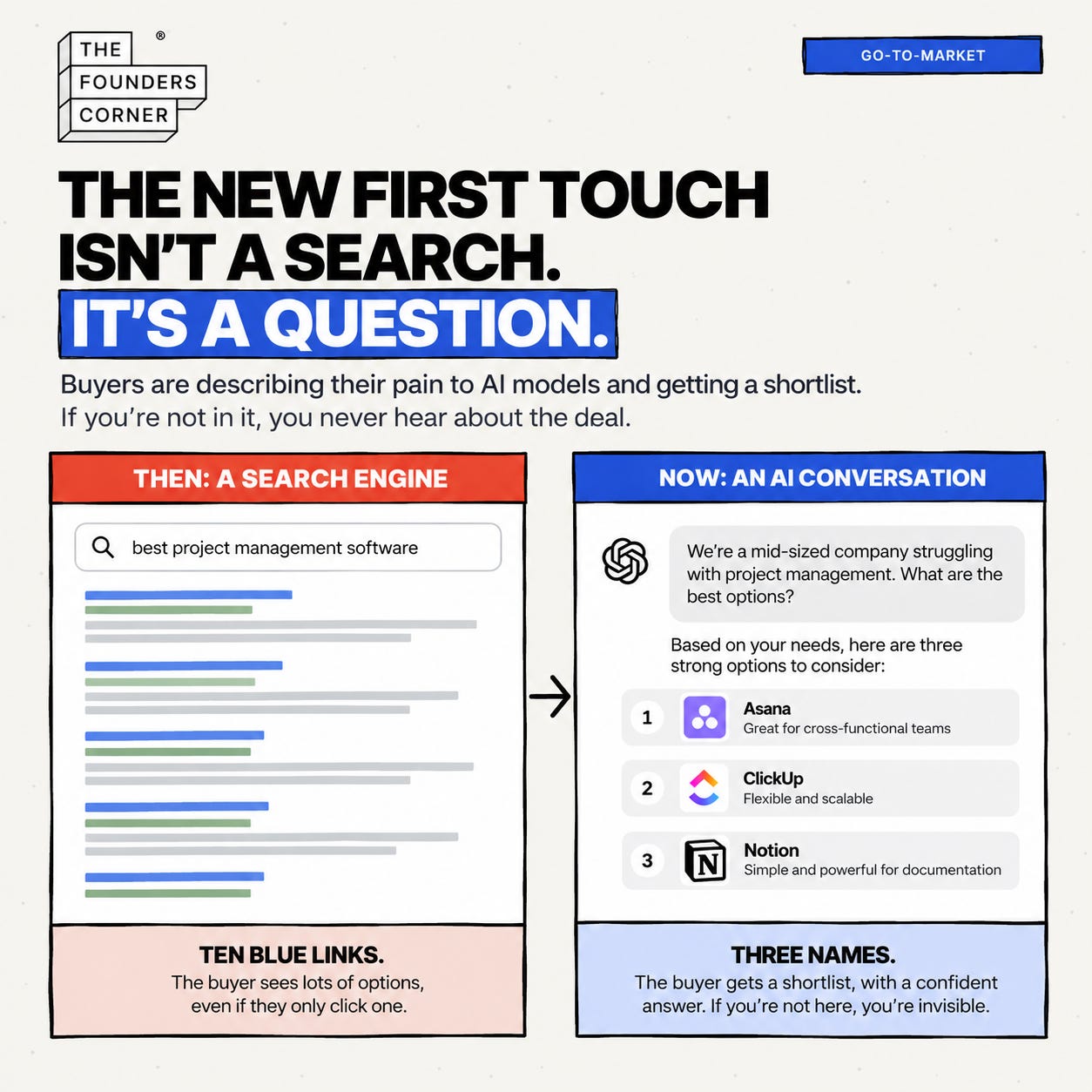
A search engine shows ten blue links and lets the buyer choose. The buyer sees who else exists, even if they click the first result. Position four still gets seen.
A model doesn’t do that. It picks an answer, sometimes with a couple of alternatives, and states it with confidence. There is no position four.
So if you’re not in the answer, you haven’t slipped down a ranking. You’ve disappeared from the conversation entirely, for a buyer who never opened a search engine and will never know you were an option.
Traditional search punishes you with less traffic. Model-mediated search punishes you with absence.
And the second one is much harder to notice, because absence doesn’t show up in any dashboard you currently look at. Your traffic can be flat and healthy while an entire category of first touches happens somewhere you can’t see.
Want to get in front of 250k+ founders and investors?
For sponsorship opportunities across The Founders Corner newsletter and LinkedIn (160k followers), email: founderscornermedia@gmail.com
Using the Buyer’s Own Pain Language as the Test
Here’s where most people get the test wrong on the first attempt.
They open a model and type “is [company name] any good”. It says something flattering, everyone relaxes, and the exercise gets marked as done.
That test tells you almost nothing. You’ve handed the model your name, so of course the answer is about you. What you need to know is whether you appear when the buyer doesn’t yet know you exist.
So ask the questions your Perfect Customer would actually type, in their own words, using the language you captured during pain testing. Not your category name. Not your product name. Their description of the problem, in the register they used when they were talking to you about it.
“Alternatives to manual exception tracking spreadsheets” tells you far more than “is [company name] any good”, because it tests discovery rather than reputation.
This is also the moment you find out whether your pain testing was any good. If you can’t write five queries in your buyer’s voice without inventing them, that’s not an AI visibility problem. That’s a discovery problem wearing a different hat, and the fix is upstream.
Three Prompts Worth Running Before Friday
You don’t need a tool to start. You need twenty minutes and an honest note of what comes back.
One: the cold discovery prompt. Describe the pain, the type of company and the constraint, exactly as your buyer would. “We’re a 400-person logistics business coordinating multi-site handovers in spreadsheets and it keeps failing. What software exists for this?” Note every company named, in order.
Two: the workaround prompt. Name the thing they’re doing instead of buying. “What are the alternatives to running compliance reporting out of Excel?” Most of your real competition is a workaround, not a competitor, and models answer this question far more often than anyone tracks.
Three: the shortlist prompt. Ask it to compare. “Compare the main options for X for a mid-market UK operator.” This is the one that shows you how you’re framed when you do appear, which is a separate problem from whether you appear at all. Being named as the cheap option, or the one for small teams, is a positioning issue you’d otherwise never discover.
Run each one two or three times and in more than one model. The answers vary, and the variation itself is data. Keep the notes somewhere shared, because this only becomes useful when you can compare it against the same prompts in ninety days.
If you’re building right now, you’ll need these:
243 Ways to Fund Your Startup Without Giving Up a Share: 243 programmes across 63 regions, and the eligibility gate that quietly disqualifies most applicants.
15 Claude Skills That Run Your Entire Raise: install once, and your story stops drifting somewhere around investor number forty.
The Investors Who Are Actually Writing Cheques In H2: 287 family offices your warm intro list doesn’t know exist.
The Claude Guide Every Founder Should Run Before Fundraising: nine prompts that replicate the screen your deck meets before a partner ever opens it.
How to Build Your Fundraising Narrative with Claude: the five-prompt sequence that puts your story in the order it needs to land, not the order it happened to you.
What Actually Gets You Cited
Models lean toward content with three properties, and none of them is length.
It answers one specific question plainly. A page that resolves a single question in its first hundred words is far more useful to a model assembling an answer than a page that circles a topic for two thousand words before committing to anything.
It’s structured clearly enough to extract. Headings that say what the section contains. Answers near the top rather than withheld for the reveal. Lists where lists are genuinely the right shape. This is not a style preference; it’s the difference between being usable and being skipped.
It carries some signal of who you are. A named author with a traceable history. A consistent description of the company across your site, your profiles, your directory listings and anywhere else you appear. Structured data that confirms what you do rather than leaving it to be inferred. Models are pattern-matching for corroboration, and inconsistency reads as noise.
Generic “about us” copy rarely gets cited, because it describes a company rather than answering anything.
A direct comparison page that names the workaround your buyer is currently using, explains plainly why it breaks down at a certain scale, and is honest about when it’s still the right answer, gets cited far more often. It’s answering a question someone actually asked.
This Is Not Traditional SEO
This is the part that catches experienced teams out, because it sounds like a job they already do.
Ranking for a keyword and being the answer inside a model’s response are related but no longer the same game, and the gap between them has widened fast.
Moz analysed close to 40,000 queries in February 2026 and found that 88% of citations in Google’s AI Mode did not appear in the organic top ten for the same query. Only around one cited URL in ten matched a top-ten ranking. Ahrefs, looking at 863,000 keywords in the same period, found that the share of AI Overview citations coming from top-ten organic pages had fallen to 38%, down from 76% roughly seven months earlier.
Take the direction rather than the decimal points, because the methodologies differ and these numbers will keep moving. The direction is unambiguous: a page can rank perfectly respectably and still never be pulled into a generated answer.
The mechanism behind it matters for what you do next. These systems don’t answer the question they were given. They fan it out into a set of related sub-questions, search against each one, and assemble a response from across all of them. Your beautifully optimised page for the head term never enters the picture, because the model was answering six narrower questions you never wrote a page for.
The practical implication is uncomfortable and quite freeing. Some of your best-performing traditional content needs a second pass, written to answer one question directly rather than to cover a topic broadly. That’s usually an editing job on work you’ve already done, not a new content programme.
Worth saying plainly: none of this is a reason to abandon organic search. It still drives real pipeline for most B2B software companies. This is an additional surface, not a replacement one.
What the Sceptics Get Right
There’s a version of this argument that overshoots, and it’s worth giving it a fair hearing before you rebuild anything.
The answers are unstable. Ask the same question twice and you’ll get different companies named. Anyone selling you a single visibility score as though it were a rank position is overstating what the data can bear.
Buyers also don’t take the answer on faith. TrustRadius’s 2026 buying research found that the overwhelming majority of buyers who used AI in their purchase journey went on to fact-check what it told them, at least some of the time. Gartner’s 2026 survey found a similar pattern: buyers use generative AI during purchases, then turn to a rep to validate what they found. Reviews, demos, references and peers still decide deals.
And the headline forecasts have been oversold. Gartner’s much-quoted February 2024 prediction — that traditional search volume would fall 25% by 2026 as AI chatbots absorbed queries — gets waved around at board meetings far more often than anyone actually models what it would mean for their own numbers.
So the sober version is this. Models rarely close the deal. They build the shortlist.
That’s still the part of the funnel you care most about, because Forrester’s Buyers’ Journey Survey put the proportion of business buyers using AI somewhere in their most recent purchase at 94% in its 2026 read, up from 89% the year before — and found generative AI named as a meaningful information source more often than vendor websites, product experts or sales.
Being wrong about this is asymmetric. If you overinvest, you’ve written clearer content and tidied your structured data. If you underinvest, you’re absent from the list before the evaluation starts.
Where Your Pain Language Comes Back In
Notice what this whole exercise runs on.
It runs on the three visceral pains you extracted from testing calls. It runs on the Perfect Customer Profile that tells you which buyer’s vocabulary to use. It runs on knowing which workaround they’re currently living with, which is something you only learn by asking.
That’s the argument for doing this now rather than last year. A team without the pain work has nothing to type into the prompt except their own category language, which is exactly the language a buyer doesn’t use. They end up testing whether they show up for the phrase they invented, which is a test you can pass while still being invisible.
“Your buyer doesn’t search for your category. They describe their bad Tuesday. Everything you’ve built in this series is a record of how they describe it.”
The work you’ve already done in this series is, in effect, a transcript of how your market talks when nobody’s selling to them. That transcript is the test set. It’s worth considerably more than a keyword list.
Auditing Your Own Visibility
Do the twenty-minute version this week: five queries in your buyer’s language, run across two models, results written down. Then decide who owns re-running them quarterly, because a single reading is a snapshot and the whole point is the trend.
Then fix the two cheapest things. Make your entity consistent everywhere you appear, so the same description of what you do shows up on your site, your profiles and your listings. And rewrite your three strongest pages so each answers one specific question in its first hundred words instead of building to it.
This is exactly what Step 9 of the Builder does: it runs your buyer’s actual pain language through an AI model, checks whether you get cited, and turns the gaps into structured data recommendations and content briefs shaped to be citable rather than just readable.
Next in the series, we bring all nine steps together into the one document that should outlast any single hire: the Playbook.
-Chris Tottman
Most founders have never checked whether an AI model recommends them when a buyer describes their exact pain.
The Selling Software Algorithm Builder Step 9 runs that check for you, using the buyer’s own words rather than your company name.
Audit Your AI Visibility
Link below