

👋 Hey, Chris here! Welcome to The Founders Corner. If you’ve been reading along, you’ll know I have very little patience for theory that doesn’t survive contact with a real buyer.
This series is a preview of a new book I’ve written with my partners Richard Blundell and Paul Watson — The Selling Software Algorithm: The Go-to-Market Navigation System for B2B Software Leaders.
It isn’t a strategy deck dressed up as a book. Between the three of us we’ve spent close to seven decades inside B2B software as founders, operators, investors and coaches — building companies, exiting some, and quietly breaking a few along the way, which is where most of the real learning lives. Through our work at Vencha we’ve now supported hundreds of founders trying to do the single hardest thing in software: turn a clever product into predictable commercial traction in a market that’s noisy, cautious, and more crowded than it has ever been.
One pattern shows up again and again. Companies rarely struggle because the product is bad. They struggle because they have no navigation system for going to market. This book is that system.
Last time, we turned a market map into named accounts with real people attached.
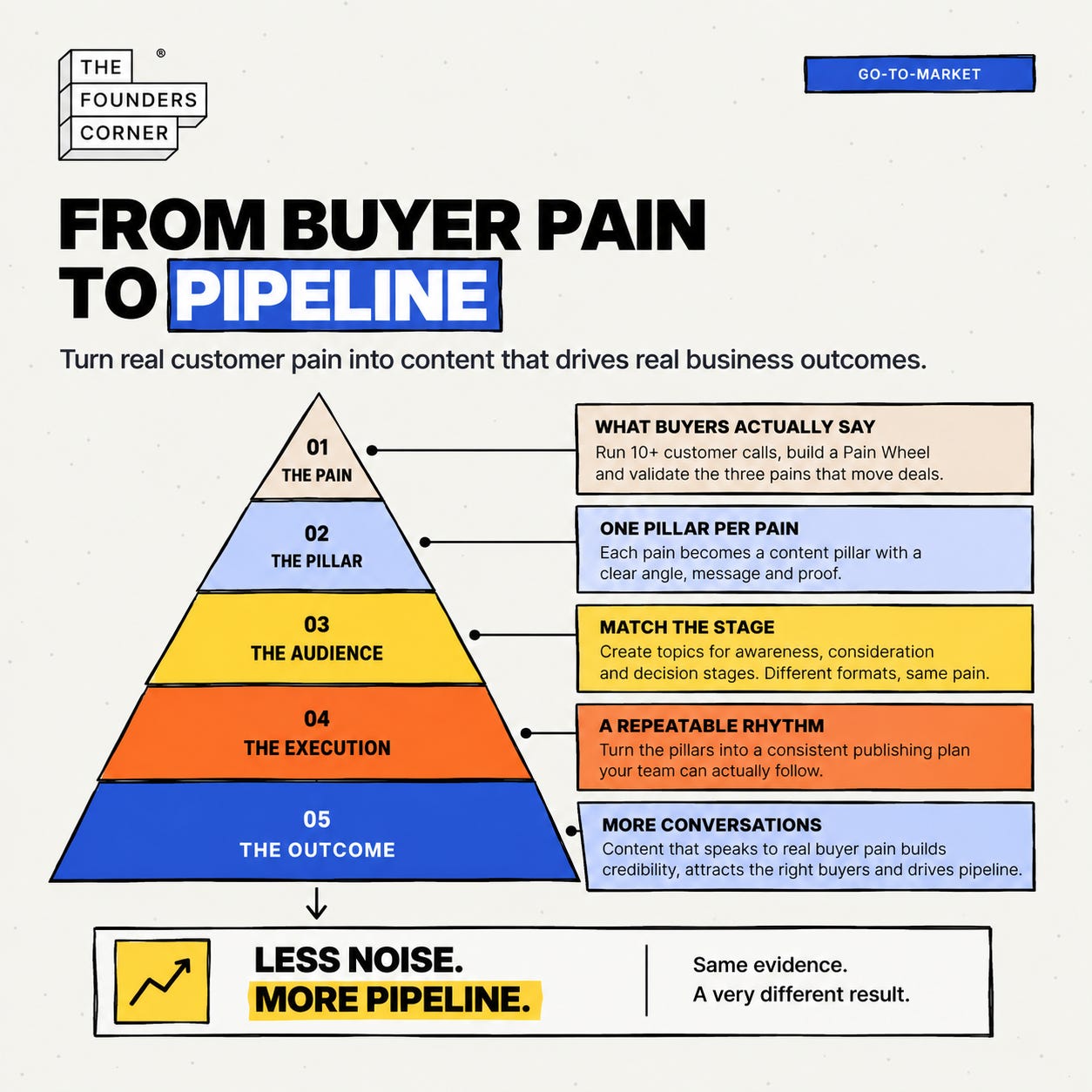
This time, we turn your three visceral pains into something your team can actually write against every week.
Here’s the failure this piece exists to prevent. A company does the pain work properly — ten testing calls, a Pain Wheel, three pains ranked by the people who’d sign the cheque — and then hands marketing a content calendar built from a trends list. The evidence sits in one folder. The publishing schedule sits in another. Nobody ever connects them, and six months of output goes out into the world carrying none of the only information the company has that its competitors don’t. The pain testing was the expensive part. Publishing content that ignores it is how you throw the return away.
Table of Contents
A Simple Example: The Post Nobody Asked For
Why Most Content Calendars Have No Spine
One Pillar Per Pain, Not One Pillar Per Feature
The Test Every Topic Has to Pass
Matching Format to Awareness Stage
The Two Stages You Should Spend Nothing On
Write in the Buyer’s Words, Not Yours
The Signature Theme That Ties It Together
The Honest Case Against Doing This
What This Replaces
What Changes on a Monday Morning
Turning Pillars Into a Real Framework
A Simple Example: The Post Nobody Asked For
Think about the last piece of content your company published.
Now answer three questions about it without opening anything. Which of your three pains was it written for? Which stage of buyer was it aimed at? And what were you hoping the reader would think at the end of the first paragraph?
In most software businesses, the honest answers are: none in particular, everyone, and that we seem knowledgeable. That’s not a marketing failure. It’s a briefing failure, and the brief was missing because nothing in the company connected the evidence to the calendar.
The tell is usually in how the topic was chosen. Ask a marketing team why they wrote last week’s post and the honest answer is often “it was our turn in the calendar.” The topic came from a trends list, a competitor’s post, or whatever felt timely — not from a pain a real Economic Buyer named out loud in a testing call while you were sitting there taking notes.
Why Most Content Calendars Have No Spine
That’s how you end up with a content library that reads well and converts nothing.
Interesting is not the same as relevant. Interesting gets you a scroll-stop, a like from someone in your own industry and occasionally a comment from a competitor. Relevant is the only thing that moves a buyer from Stage 3 to Stage 5.
And the failure is quiet, which is what makes it expensive. Nobody ever stands up and says the content plan isn’t working. The posts go out. Impressions accumulate. Someone screenshots a decent engagement week for the board pack. Meanwhile the pipeline is built almost entirely from outbound and referrals, and no one connects the two facts, because the content was never tied to anything you could measure it against in the first place.
A calendar without a spine also can’t be argued with. When every topic is defensible because any topic is defensible, the loudest opinion in the room wins the brief. That’s how a company with three tested, evidence-backed pains ends up publishing a piece about someone else’s funding round.
If you’re building right now, you’ll need these:
243 Ways to Fund Your Startup Without Giving Up a Share: 243 programmes across 63 regions, and the eligibility gate that quietly disqualifies most applicants.
15 Claude Skills That Run Your Entire Raise: install once, and your story stops drifting somewhere around investor number forty.
The Investors Who Are Actually Writing Cheques In H2: 287 family offices your warm intro list doesn’t know exist.
The Claude Guide Every Founder Should Run Before Fundraising: nine prompts that replicate the screen your deck meets before a partner ever opens it.
How to Build Your Fundraising Narrative with Claude: the five-prompt sequence that puts your story in the order it needs to land, not the order it happened to you.
One Pillar Per Pain, Not One Pillar Per Feature
The fix is structural rather than creative.
Take your three visceral pains — the ones ranked and tested across ten real conversations — and give each one its own content pillar. Not a feature. Not a use case. Not a product module. The pain, named the way the buyer named it.
Three pains, three pillars, and nothing else gets a pillar.
The distinction between a pain pillar and a feature pillar sounds pedantic until you see what each one produces. A feature pillar (”reporting”) generates topics about reporting: what good reporting looks like, five reporting mistakes, why reporting matters. All of it written from inside your product, all of it interesting mainly to people who already accept they need what you sell.
A pain pillar (”the month-end close that eats the first week of every month”) generates topics about the buyer’s world: why the close slips, what it costs in credibility when the board asks for numbers that aren’t ready, what other operations leaders have done about it. The product shows up eventually. It just isn’t the reason the reader started reading.
Every blog post, LinkedIn angle and email subject line under a pillar should trace back to the same symptom and consequence you captured in testing. Same language, same stakes, same emotional weight. Not a summary of the pain — the pain itself, approached from a different side each time.
The Test Every Topic Has to Pass
Once the pillars exist, the weekly decision gets much smaller, because most ideas now fail a single question.
Which of the three pains does this trace back to, and which stage of buyer is it for?
If a topic can’t answer both halves, it doesn’t belong in the plan yet, however interesting it is. Not “it’s wrong.” Not “it’s off brand.” Just: not yet, and not here.
That’s a harder discipline than it sounds, because the ideas that fail this test are rarely bad ideas. They’re usually the ones the team is most excited about — the timely one, the contrarian one, the one that would definitely do numbers on LinkedIn. Killing a weak idea is easy. The pillar structure exists to kill a good idea that’s pointed in the wrong direction, which is the only kind of discipline that actually changes an output.
It also does something less obvious: it makes a thin pillar visible. If one of your three pains generates four topics and the other two generate fifteen each, you’ve learned something. Either that pain isn’t as visceral as the testing suggested, or nobody on the team understands it well enough to write about it. Both are worth knowing, and both are invisible in an undifferentiated calendar.
Matching Format to Awareness Stage
A pillar tells you what to write about. It doesn’t tell you what shape the piece should take, and that depends entirely on where the buyer is on the readiness curve we covered a few weeks back.
Stage 3 buyers feel the pain but have normalised it. They believe it’s simply the price of doing business. Your job here isn’t product education, it’s problem education. Content should surface inefficiencies they recognise but haven’t yet articulated, highlight risks they’ve learned to tolerate, and gently challenge the assumption that this is just how things work. Diagnostics, maturity assessments, webinars that unpack a common operational bottleneck, case studies framed around the struggle rather than the solution. The objective isn’t urgency. It’s recognition — an article that names a frustration precisely enough that a reader thinks, someone finally described my Monday.
Stage 4 buyers accept the problem is real but doubt a viable solution exists, or that change is worth the disruption. Here the job shifts from education to reframing. Before-and-after narratives, demonstrations, visual comparisons, clear explanations of how a peer tackled the same thing. Social proof does the heavy lifting at this stage, because the question in their head is sideways rather than forwards: has someone like me done this successfully?
Stage 5 buyers are already in motion and actively evaluating. Content gets concrete and commercial: proof points, pricing context, integrations, security posture, time-to-value, implementation detail. You’re not persuading them the problem matters. You’re helping them build a business case and reducing the risk of championing you internally.
Same pain, three different pieces. A Stage 3 article about the month-end close and a Stage 5 article about the month-end close share a pillar and almost nothing else — not the format, not the opening line, not the call to action.
The Two Stages You Should Spend Nothing On
One piece of blunt advice from the book, because it saves real money.
You should not spend a single pound marketing to Stage 1 or Stage 2 buyers. They’re either unaware the problem exists or actively uninterested in changing anything. They’re not in market, they’re not persuadable, and they’ll consume budget without ever converting.
The opposite error is more common and more subtle. Most software companies build messaging exclusively for Stage 5 — the buyers actively looking right now — and then wonder why the pipeline feels thin and unpredictable. Stage 5 buyers convert fastest, but they’re the smallest slice of the market at any given moment, and every competitor you have is aiming at exactly the same people.
Stages 3, 4 and 5 together are what we call the Launching Customer Sweet Spot. Cadence your content deliberately across all three and something useful happens: cold prospects get warmed through education, belief gets built through reframing, and by the time intent crystallises, you’re not interrupting a stranger. You’re continuing a conversation they already feel part of.
Write in the Buyer’s Words, Not Yours
If you ran the pain testing properly, you’re holding something most marketing teams would pay for and can’t buy: transcripts of senior buyers describing your problem space in their own language.
Use the actual phrases. The metaphors, the throwaway complaints, the specific nouns they reached for when they got animated. Buyers trust language that sounds like them, because it signals you’ve been in the room. It signals you’ve listened.
There’s a version of the homepage swap test that works here too. Take the first two paragraphs of your next article, remove your company name, and ask whether a competitor could publish them unchanged. If they could, you’ve written about the category rather than the pain, and you’ve spent the week producing something with no fingerprint on it.
A caveat worth stating: quoting a buyer’s language is not the same as quoting a buyer. Anything traceable to a named individual from a testing call needs their explicit permission before it goes anywhere near publication.
The Signature Theme That Ties It Together
Three separate pillars can start to feel like three separate companies if nothing connects them.
A reader who finds you through pillar one, follows you for a month and then reads something from pillar three should recognise one voice making one argument — not three competent but unrelated content streams that happen to share a logo.
The fix is a single signature theme. One sentence that every pillar quietly supports, sitting underneath everything without ever being the headline. It’s usually a close cousin of your algorithm sentence, translated from internal language into something a reader would nod at.
The test is simple enough. If you can’t write the sentence down, your audience can’t infer it. And if three people on your team write it down separately and produce three different sentences, you’ve found the actual problem, and it isn’t a content problem.
The Honest Case Against Doing This
There’s a real argument against this structure, and it deserves a proper hearing rather than a dismissal.
Rigid pillars can make a company boring. Some of the best-performing content in B2B software comes from precisely the places this filter would reject: a timely reaction to something happening in the market this week, a strong opinion on a category debate, a recruiting post that happens to attract customers, a piece of plain curiosity from a founder who found something interesting. Categories also get created by companies willing to write about something no buyer has named yet — and by definition, a pain nobody articulated in testing won’t appear in your pillars.
So don’t apply the filter at one hundred percent. Run the plan at roughly eighty to ninety percent pillar-driven, and leave the rest deliberately open for the timely, the opinionated and the experimental. The difference between that and where most teams are today is that the open slots are a conscious allowance rather than the entire strategy.
What the structure genuinely costs you is the pleasant feeling of a wide-open calendar. What it buys you is that every remaining slot is doing identifiable work.
What This Replaces
Most founders don’t lack content ideas. They lack a filter for which ideas are worth the time.
A pillar structure built on tested pains is that filter. It turns “what should we write about this week” from an open debate into a lookup: which pain, which stage, which format. Three questions, one answer, meeting over.
It also replaces something less visible — the slow drift back to generic language. Every company drifts. Somebody writes “transform your operations” because it’s nine o’clock and the post is due at ten, and six months later the whole library sounds like every other software company’s library. Pillars anchored to specific tested pains make that drift obvious while it’s happening, because the new piece sits next to eleven others that are sharper than it is.
What Changes on a Monday Morning
The output of this work is a document. The effect, like most of the algorithm work, shows up in how people talk.
Briefs get shorter, because half the brief is now the pillar name and the stage. Content review arguments get shorter too, and change character — they stop being about taste and start being about evidence, which is a debate that can actually be settled. New writers, agencies and freelancers get useful in weeks rather than months, because you can hand them three pains, three stages and a signature theme instead of asking them to absorb your company’s worldview by osmosis.
And sales stops ignoring marketing’s output. That one’s worth stating plainly, because the gap between the two functions is usually a language gap rather than a competence gap. When the article a rep sends a prospect uses the same words the rep used on the call, which were the same words the buyer used in testing, the whole thing finally coheres. Which is what the algorithm was for.
Turning Pillars Into a Real Framework
This is exactly what Step 8 of the Builder produces: one pillar per pain, each with blog topics, LinkedIn angles and email subject lines mapped to the awareness stage that pain sits at, plus the signature theme tying them together.
Next in the series, we look at what happens after you publish: whether the buyers asking an AI model about your category ever hear your name back.
-Chris Tottman
Most content plans are built from a trends list. Few are built from three pains a real buyer already validated.
The Selling Software Algorithm Builder Step 8 turns your ranked pains into a content pillar structure your whole team can write against.