

Two companies. Both growing at 15% month-on-month. Both celebrating record MRR.
One has a Quick Ratio of 6. The other has a Quick Ratio of 1.3.
One is building a compounding engine that investors will pay a premium to own a piece of. The other is running hard just to stay still, spending heavily on acquisition while churn quietly eats the gains from behind.
From the outside, they look identical. Inside the data room, they are worlds apart.
This is what the SaaS Quick Ratio reveals. And if you’re preparing to fundraise, it’s one of the first things a sharp investor will pull apart.
What the Quick Ratio Actually Measures
The metric was introduced to the SaaS world by venture capitalist Mamoon Hamid at the first SaaStr Annual. The concept is simple: how much new revenue are you adding for every dollar of revenue you lose?
The formula:
(New MRR + Expansion MRR) divided by (Churned MRR + Contraction MRR)
New MRR comes from new customers. Expansion MRR comes from existing customers upgrading or expanding. Churned MRR is revenue lost from cancellations. Contraction MRR is revenue lost from downgrades.
The result tells you the quality of your growth, not just the quantity.
A Quick Ratio of 4 means you’re adding £4 in new revenue for every £1 you lose. A ratio of 1.3 means you’re barely treading water, with churn consuming most of what your sales team is working to generate.
Why Investors Use It as a Filter
Here is the uncomfortable truth about topline growth: it can hide almost anything.
A company adding £200k in new MRR every month looks strong on a revenue chart. But if it’s losing £180k to churn in the same period, its Quick Ratio is barely above 1. It’s not building - it’s replacing. And every month, the amount it needs to spend on acquisition just to stay flat goes up.
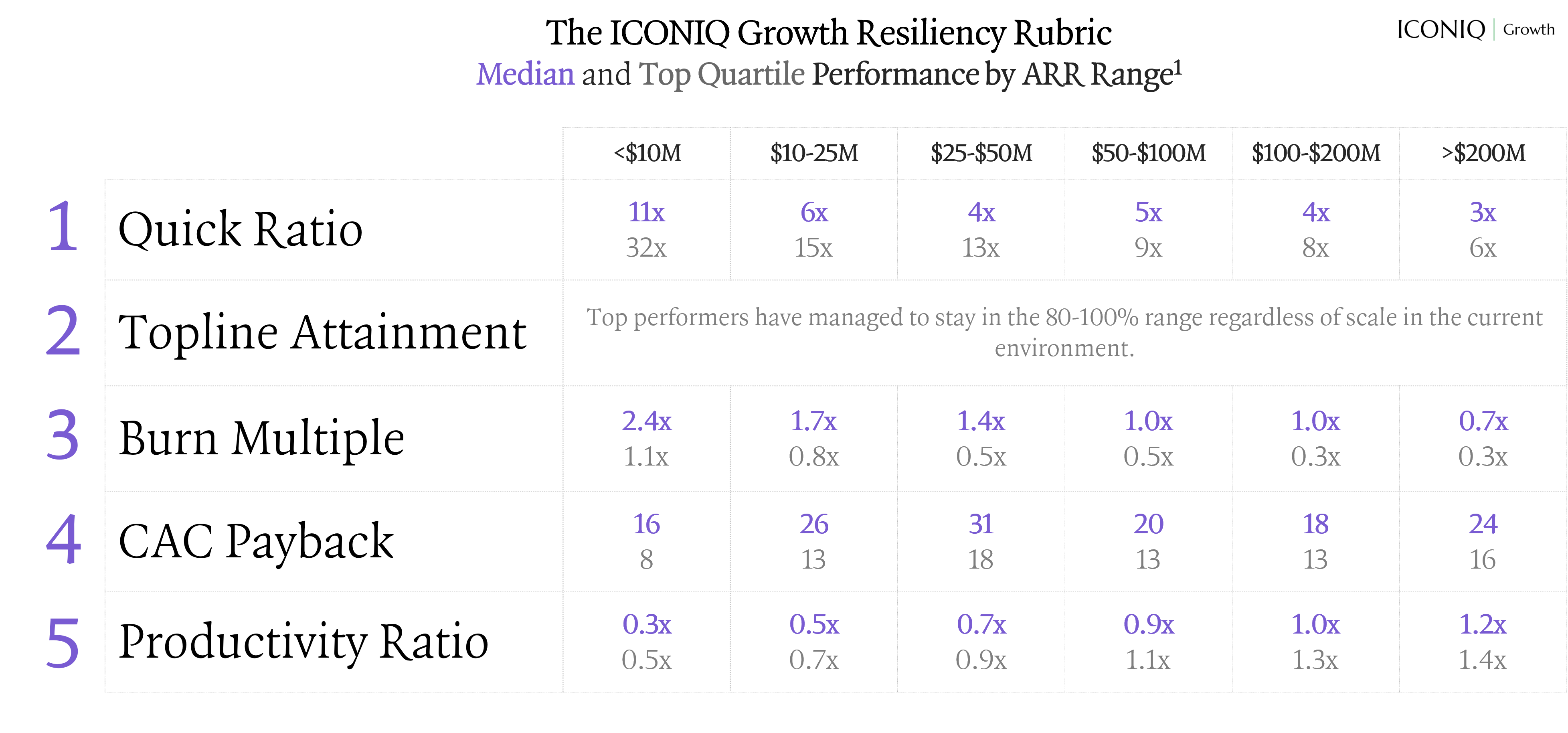
ICONIQ Growth, which has tracked financial and operating data from over 100 enterprise SaaS companies for more than a decade, notes that the Quick Ratio is a vital pulse-check on a company’s growth - but cautions that it should be paired with metrics like CAC payback and Burn Multiple for a truly holistic view of efficiency.
That pairing matters. A high Quick Ratio with an unsustainable burn rate is not a healthy business. A modest Quick Ratio with exceptional net revenue retention and controlled burn can be a compelling one. Context is everything.
What investors are really assessing when they look at your Quick Ratio is whether your growth engine has a structural advantage, or whether it’s simply an acquisition machine with a hole in the bottom.
The Benchmarks That Actually Matter
The widely cited benchmark is 4x. Mamoon Hamid popularised it, and it has become the shorthand most investors use. But like most rules of thumb, it needs context.
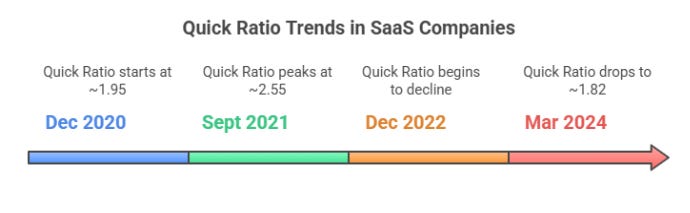
The SaaS industry’s overall Quick Ratio peaked at around 2.55 in September 2021 and declined to approximately 1.82 by March 2024, reflecting a significant cooling in growth momentum driven by rising interest rates, inflation, and a broader correction in tech valuations.
In practice, the benchmarks by stage look like this:
Below 1: Revenue is contracting. Churn is outpacing acquisition. This is a structural problem, not a marketing one.
1 to 2: Growing, but slowly losing the battle. Retention work is urgent.
2 to 4: Healthy. Most well-run growth-stage SaaS companies operate here.
Above 4: Exceptional. Strong product-market fit, minimal churn, real competitive moat.
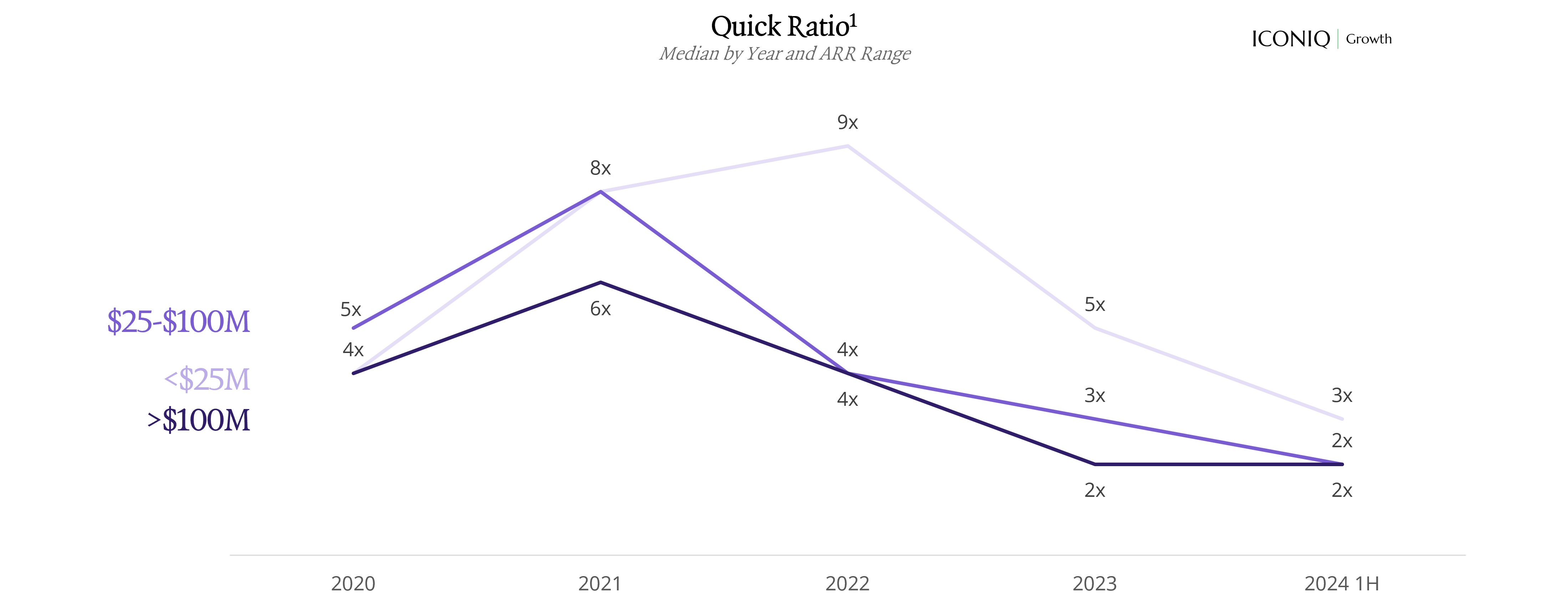
Early-stage companies often achieve higher ratios simply because their customer base is small and churn is limited. The challenge is maintaining a ratio above 3x as you scale past £10M ARR, when churn compounds and acquisition channels saturate.
ICONIQ’s data shows that top-quartile companies are able to maintain a Quick Ratio above approximately 3x even after reaching $100M ARR — for every $1 of churned ARR, these companies add around $3 in recurring revenue.
The Valuation Connection
Here is where it gets serious for founders thinking about their next round.
Your Quick Ratio doesn’t just tell investors whether your business is healthy. It directly influences the multiple they’re willing to pay.
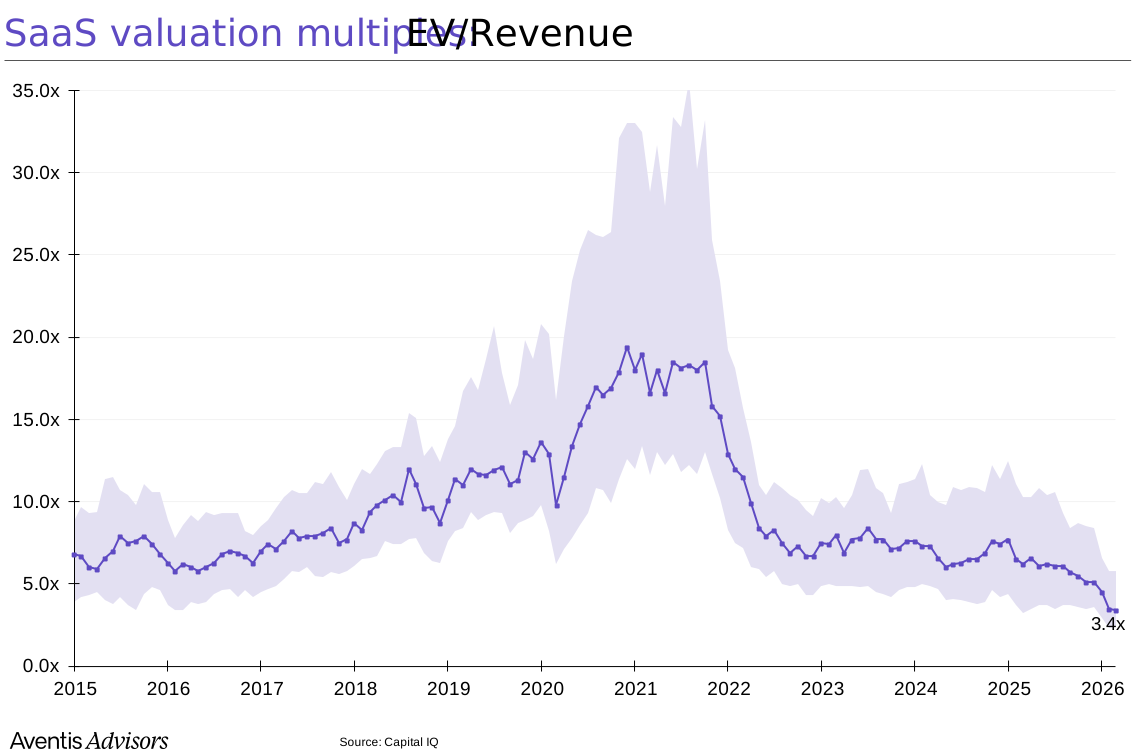
Public SaaS valuations have stabilised in the 6 to 7x ARR range as of year-end 2024, with the top 10 companies by multiple achieving a median of 14.2x - reflecting the premium investors place on businesses that demonstrate genuine growth efficiency rather than headline revenue alone.
Private SaaS companies sell at a meaningful discount to their public counterparts. According to SaasRise’s 2025 M&A Report, the median private SaaS revenue multiple in 2024 was 4.1x, compared to 5.6x for public SaaS companies - a 36% public premium.
What drives a company to the high end of that range? Efficient, defensible growth. A Quick Ratio of 4+ signals that your retention is strong, your product has real stickiness, and your growth isn’t dependent on throwing ever-increasing acquisition spend at a churning customer base.
Research from Predict Ventures shows that companies in the top quartile for Quick Ratio raise at 2 to 3x higher valuations than their peers, and that top-quartile Quick Ratio at Series A is strongly correlated with business outcomes 3 to 5 years later.
That’s not correlation. That’s causation. A strong Quick Ratio at early stage predicts whether a business has the structural quality to compound.
The Three Ways Founders Get This Wrong
Celebrating revenue growth without checking what’s underneath it. A rising MRR chart feels good. But if your Quick Ratio is declining quarter-on-quarter, you have a problem that topline numbers are hiding. Investors will find it. The time to find it is before they do.
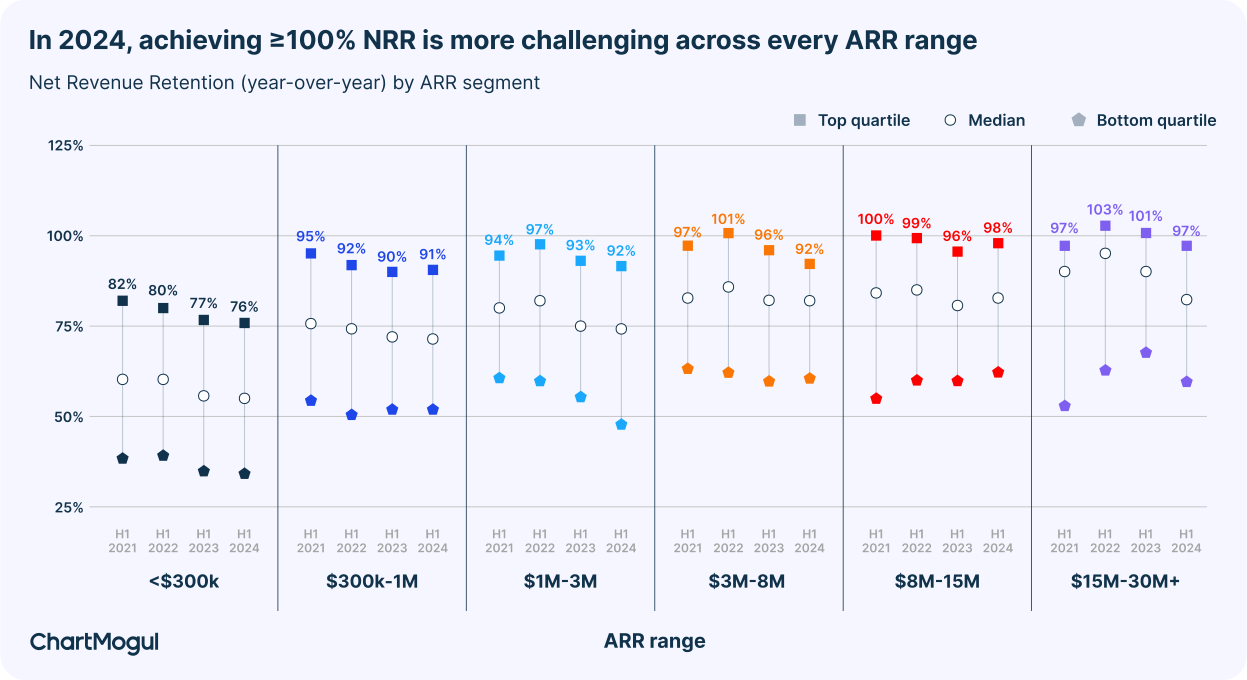
Confusing NRR with Quick Ratio. Net Revenue Retention measures how much revenue you keep from your existing customers, including expansion. The Quick Ratio measures total growth efficiency, including new logo acquisition. They’re related but they answer different questions. A company with 110% NRR and a poor Quick Ratio is retaining and expanding existing customers well, but struggling to acquire new ones at pace. Both numbers need to be strong.
Treating it as a static benchmark. The Quick Ratio is most powerful as a trend line, not a snapshot. A ratio of 3.5 today that was 4.2 six months ago tells a different story to one that was 2.8 six months ago. Investors will ask to see the trend. Have it ready.
What a Strong Quick Ratio Actually Signals
Beyond the number itself, a high Quick Ratio communicates something qualitative to investors that data alone can’t fully capture.
It says your product delivers enough value that customers stay and expand. It says your churn is not a structural problem requiring constant attention and spend. It says your growth is compounding - not just accumulating.
In the current fundraising environment, this matters more than it did in 2021. Burn multiples tightened significantly in 2024 and 2025, and companies demonstrating efficient top-line growth are now outperforming their peers in both fundraising outcomes and valuation.
The market has shifted from rewarding growth at any cost to rewarding growth that is defensible. A Quick Ratio above 3x, paired with a sub-18-month CAC payback and NRR above 110%, is the profile that commands Series A and Series B conversations at the highest valuations available in today’s market.
For Series A in 2025, top-tier investors expect NRR above 110% for premium valuations, CAC payback under 12 months, and a burn multiple under 2.5x. These metrics together tell the story the Quick Ratio introduces.
Three Ways to Move the Number
Fix the denominator before you scale the numerator. Most founders instinctively reach for more acquisition spend when they want to improve growth metrics. But reducing churn by 1% has a more powerful impact on your Quick Ratio than adding 10% more new customers, and it costs significantly less. Before scaling acquisition, audit why customers are leaving.
Build an expansion motion into the product. Expansion MRR sits in the numerator of your Quick Ratio. Every pound of expansion revenue makes your ratio better without requiring you to win a new customer. Seat expansion, usage-based pricing, and upsell pathways all contribute. Companies with a deliberate expansion motion consistently outperform those growing exclusively through new logo acquisition.
Segment the ratio and act on the signal. A blended Quick Ratio can hide wide variance across customer segments, geographies, or product lines. Calculate it by cohort and by segment. If your SMB Quick Ratio is 1.8 and your mid-market Quick Ratio is 4.6, that’s not a company problem - it’s a targeting problem. The data tells you exactly where to allocate resources.
The Number That Tells the Real Story
Revenue growth is the headline. The Quick Ratio is the story behind it.
Two companies at the same MRR, the same growth rate, and the same team size can be building fundamentally different businesses. One is compounding. The other is replacing. Investors know how to tell them apart, and the Quick Ratio is where they start looking.
Before your next investor conversation, run the numbers. Not as a snapshot. As a trend. By segment. By cohort. Know where it’s improving and where it’s under pressure, and have a view on why.
Because the founders who can speak to the quality of their growth, not just the quantity, are the ones who close the rounds that others don’t.
Is Your Growth Real?
Two companies can show identical revenue charts. Only one is actually building something.
The SaaS Quick Ratio Calculator is part of The Founders Corner resource library, built for founders who want to understand the quality of their growth before investors start asking.
Drop in your MRR numbers and get instant clarity on:
Your Quick Ratio, benchmarked against investor thresholds
Whether your growth is compounding or just replacing lost revenue
How your expansion and churn breakdown compares to stage benchmarks
A plain-English read on what your number signals to a VC in a room
And the calculator is just the start. Subscribers get access to 50+ founder tools, templates, and deep-dive resources inside The Founders Corner library, with new ones added every week.