

There’s a moment happening right now, inside the inbox of almost every fund you’re planning to pitch, that no founder is prepared for:
Your deck arrives. A partner doesn’t open it. A model does.
Not eventually. Right now. Sequoia, Accel, and Andreessen Horowitz are running private LLM instances and Claude API integrations that auto-tag inbound decks for sector, stage, and red flags before a human ever sees them. Notable Capital uses Claude with MCP integrations to manage over 500 inbound intros a year with a two-person team. The triage step that used to be an associate’s Monday morning is now a model’s first ninety seconds.

This isn’t a future-of-VC trend piece. It’s the current state of dealflow at the funds you most want to raise from, and it changes the actual question you should be asking before your next round.
You’ve spent your prep time on “will this land with a partner?” The question that now decides whether a partner ever sees it is different.
Will this survive the model that reads it first?
Why this is the moment founders are unprepared for 📊
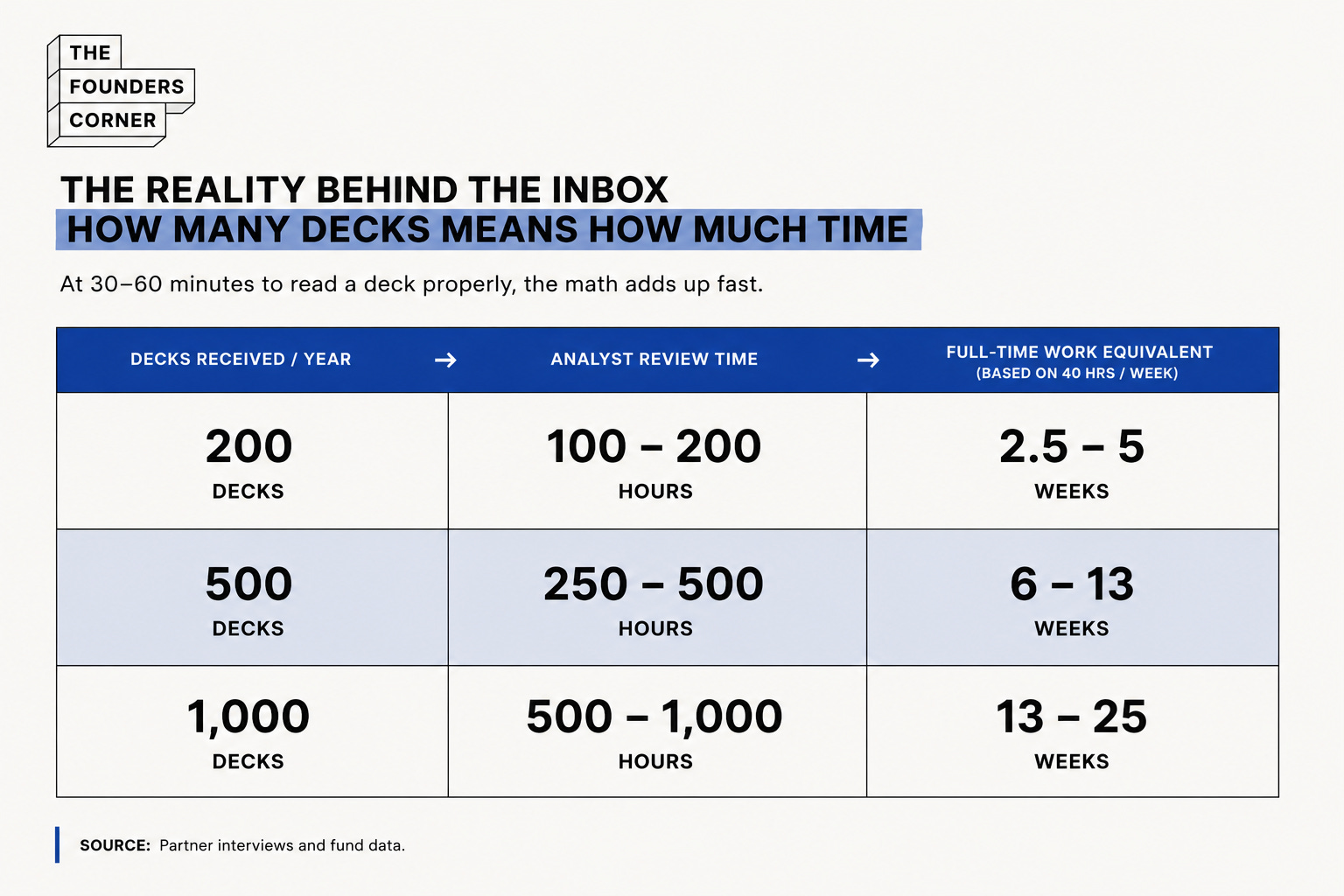
A mid-size VC firm with a generalist thesis receives somewhere between 200 and 500 pitch decks a year. A fund running a sector-specific strategy in a hot market cycle can see that number double. Each deck takes a skilled analyst 30 to 60 minutes to read properly: checking the team’s background, sanity-testing the market size claims, cross-referencing the financial projections.
That maths doesn’t work at scale, and the funds that figured this out first stopped trying to make it work. They built a screen instead.
The workflow now running inside the funds furthest ahead looks like this: inbound deck enters extraction, gets matched against the fund’s thesis, and comes out one of three doors. Fail, archived without a human ever opening it. Pass, claims get validated and a first memo gets drafted automatically. Needs Human Review, a ten-minute analyst check on the genuinely borderline cases, typically 15 to 25 percent of inbound.
A fund receiving 200 decks a month can have every single one extracted, scored, and sorted before an analyst opens their inbox on Monday.
Here’s the part that should change how you think about this. The funds doing this aren’t trying to move faster for its own sake. They’re trying to compress information asymmetry, the exact advantage VCs have profited from for forty years. Knowing more than the founder sitting across the table used to be the job itself. Now the model knows things about your category, your market, and your own public claims in real time, before you’ve finished your opening line.
That cuts both ways. AI-assisted screening doesn’t filter on narrative polish. It filters on founder background it can verify independently, market timing it can check itself, network density it can map from LinkedIn, and traction it can find without taking your word for it. All of it has nothing to do with how good your pitch sounds out loud.
What the screen is actually checking for 🔍
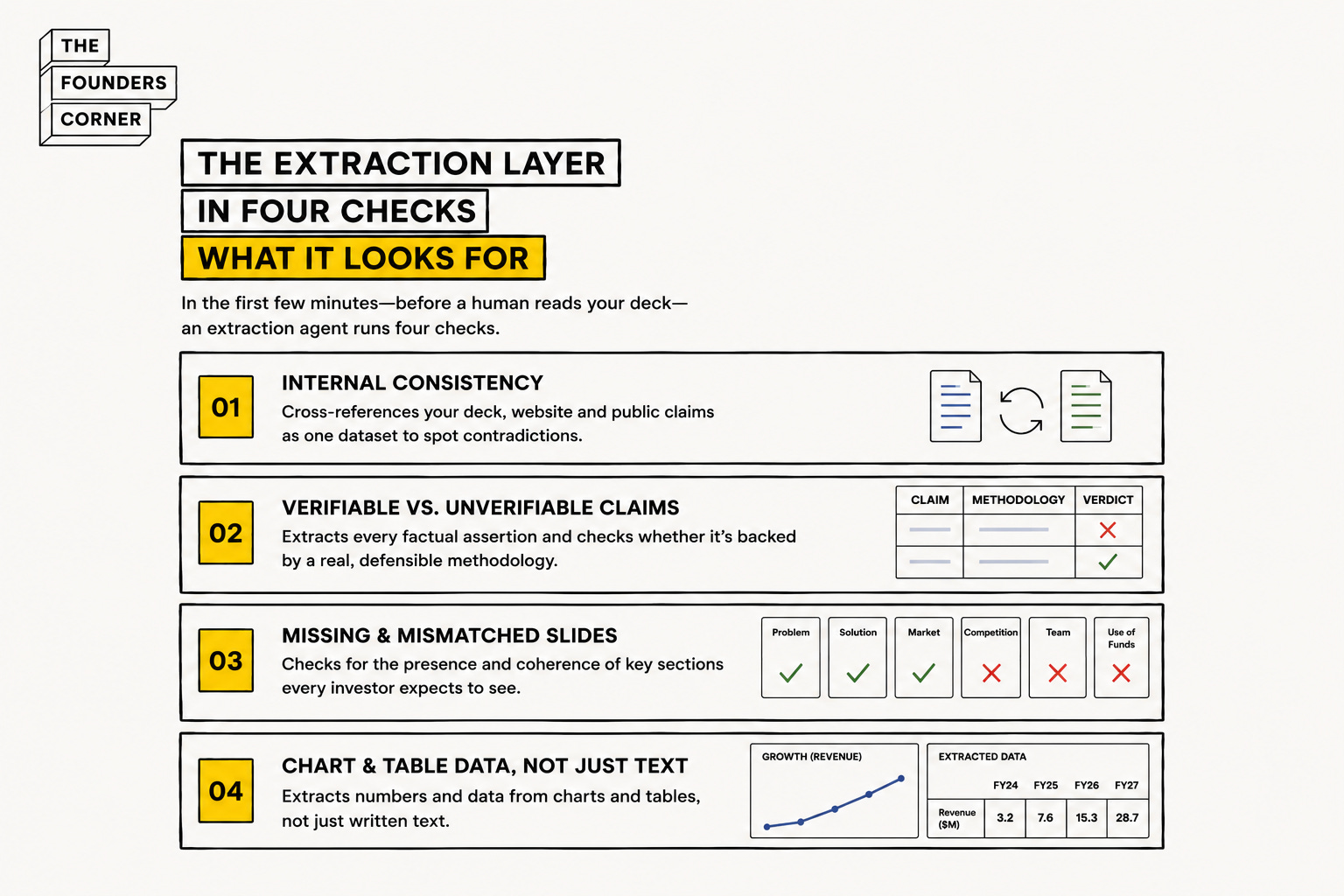
This isn’t a vague “be more concise” problem. The extraction layer is doing something specific, and almost no founder has seen it from the other side of the table.
Internal consistency. A well-configured extraction agent reads your deck, your website, and your public claims as a single dataset, then flags anywhere they disagree. One widely circulated case study showed a robotics startup’s claims flagged as inconsistent: one slide described early pilot stage, the company website described active commercial deployments. The model didn’t need a human to catch it. It cross-referenced both pages in the time it took to load them.
Verifiable versus unverifiable claims. Investor-side tools now extract every factual assertion in your deck and check it against the methodology behind it: is your TAM bottom-up from real buyer data, or a Gartner figure with a percentage claimed on top? A figure with no defensible methodology behind it gets flagged before an analyst ever forms an opinion of you.
Missing and mismatched slides. A configured agent flags a deck with no competitive landscape slide, no team slide, or no use-of-funds breakdown automatically, the kind of gap a rushed analyst reading their fortieth deck of the day would miss entirely.
Chart and table data, not just text. Financial projections in pitch decks are almost always embedded as chart graphics, not editable text. Tools built to read visual elements extract your real growth curve and unit economics from the slide itself. Tools that read only text return nothing, which means your actual numbers either get seen properly or get skipped over completely, and you have no control over which.
The uncomfortable truth underneath all four of these: the model isn’t biased against you. It’s indifferent. It will pass a plain deck with verifiable claims over a beautiful one with contradictions, every single time. That’s a different game to the one most fundraising advice prepares you for.
What’s inside this guide 🗂️
Nine prompts, run as a sequence against your actual deck before a single real investor sees it.
The Triage Simulation. Claude plays the extraction layer itself and tells you exactly which door you’d be sent through: Fail, Pass, or Needs Human Review.
The Claims Verification Audit. Every assertion in your deck tagged Supported, Inconsistent, or Unverifiable, the same audit a fund’s AI runs before you’ve spoken to anyone.
The Cross-Source Consistency Sweep. Checks your deck against your own website and team LinkedIns for the exact contradictions that get a deck flagged automatically.
The TAM Reality Check. Turns sourceless market sizing into the bottom-up version a screening layer, and the analyst behind it, won’t discount on sight.
The AI-Fingerprint Strip. Removes the smooth-curve, no-assumption, templated patterns that now read as “built with a tool,” not “built by someone who lived this.”
The Founder-Voice Injection. Inserts the specific, unfakeable detail at the exact slide where a pattern-matched deck currently goes hollow.
The Team Slide Verification. Rebuilds your team slide to survive an actual credential cross-check, not just look credible at a glance.
The Competitive Matrix Rebuild. Replaces the generic grid every AI deck tool generates with one that earns differentiation points instead of losing them.
The Full Screen Replica. Assembles everything into the actual investment memo paragraph a fund’s AI would hand its analyst on Monday morning.
🟦 Prompt 1 of 9: The Triage Simulation
Before you fix anything, you need to see your deck the way the model sees it, not the way you wrote it. That means giving Claude the actual job description of an institutional triage system, not asking it to “review my pitch deck,” which produces encouraging founder feedback instead of the cold extraction pass that’s actually waiting for you.
Paste your full deck content, text, not just a description, into a fresh conversation.
💬 Copy this prompt into Claude (new conversation, full deck pasted in)
You are the first-pass AI triage system used by an institutional VC fund
to screen inbound pitch decks before a human analyst ever sees them.
Your job is not to give founder feedback or be encouraging. Your job is
to extract structured data and make a routing decision exactly the way
an investor-side AI screening tool would.

Here is the deck content: [PASTE FULL DECK TEXT, SLIDE BY SLIDE]

My fund's mandate, for context: [STAGE], [SECTOR], [TYPICAL CHECK SIZE],
[GEOGRAPHY IF RELEVANT]

Do the following:

1. EXTRACT, slide by slide: team credentials, market size claim and
   methodology, product differentiation, traction metrics (MRR,
   customer count, growth rate), and the specific ask.

2. SCORE against the stated mandate. Does this fit on sector, stage,
   and check size? Be blunt if it doesn't.

3. ROUTE: classify this deck as FAIL (archived), PASS (fits mandate,
   claims appear internally consistent, moves to analyst validation),
   or NEEDS HUMAN REVIEW (borderline, explain exactly what's ambiguous).

4. Name anything that would get this deck processed in under 90
   seconds and never reach a human.

Be the indifferent extraction layer, not a friendly reviewer. I need
to see the version of this that doesn't care whether I raise.
⚡ Why this works: “Review my deck” produces a polished critique. This produces a routing decision. Only one of those tells you what’s actually waiting for your deck before a partner opens it.
🟦 Prompt 2 of 9: The Claims Verification Audit
Every claim in your deck currently sits in one of three states, whether you’ve thought about it that way or not: provably true, provably false, or simply unchecked. An investor’s AI doesn’t give you the benefit of the third category. Unchecked reads as unverifiable, and unverifiable gets a lower conviction score before anyone has formed an opinion of you.
💬 Copy this prompt into Claude
Act as the claims-verification layer of an investor's due diligence AI.

Here is my pitch deck: [PASTE DECK TEXT]
Here is my company website content: [PASTE OR SUMMARISE]
Here is my team's relevant LinkedIn history: [PASTE OR SUMMARISE]

Go through every factual claim in the deck: market size, traction
numbers, customer counts, team credentials, technical claims, and tag
each one:

- SUPPORTED: consistent with the website, LinkedIn, or public data
  I've given you
- INCONSISTENT: contradicts something else I've given you (quote both)
- UNVERIFIABLE: no external evidence either way

For every INCONSISTENT or UNVERIFIABLE claim, give me the specific
rewrite that either fixes the contradiction or adds the missing
evidence or source. Be exhaustive. Assume an investor's AI will check
literally everything, not just the headline numbers.
💡 Run this before every fundraise, not just the first one. Decks drift between versions. A number that was accurate in March is often stale by June, and stale is exactly what gets flagged.
🔒 You’ve seen how the model would route you, and where your claims stand. Now fix what’s left.
The triage simulation and the claims audit tell you where you’d land and what’s currently unverified. They don’t fix everything yet. Here’s what the next seven prompts do, all fully written out below for paid subscribers.
✅ Prompt 3: The Cross-Source Consistency Sweep. Pulls your deck, your website, and your founders’ LinkedIns into one conversation and surfaces every contradiction between them, the exact failure mode that gets a deck archived in seconds.
✅ Prompt 4: The TAM Reality Check. Replaces sourceless top-down market maths with the bottom-up version that doesn’t get discounted the moment a screening layer checks it.
✅ Prompt 5: The AI-Fingerprint Strip. A line-by-line rewrite that removes the smooth-curve, templated patterns now flagged automatically as thin thinking, and tells you exactly which of your slides currently has them.
✅ Prompt 6: The Founder-Voice Injection. Finds the slides where your deck reads as interchangeable with every other AI-assisted deck in the inbox, and inserts the specific, lived detail that breaks the pattern-match.
✅ Prompt 7: The Team Slide Verification. Rebuilds your team slide against the actual credential cross-check a screening tool runs, not just the version that reads well at a glance.
✅ Prompt 8: The Competitive Matrix Rebuild. Replaces the generic grid every AI deck-builder produces with one that earns real differentiation points instead of losing them.
✅ Prompt 9: The Full Screen Replica. The assembled simulation, the actual investment memo paragraph, conviction level included, that lands on a real analyst’s desk.
Paid subscribers also get:
✅ 50+ additional tools covering every other stage of the fundraising process: narrative building, outreach, investor research, meeting prep, term sheet analysis, and data room management
🟦 Prompt 3 of 9: The Cross-Source Consistency Sweep
This is the failure mode that kills decks in under two minutes, and it’s almost never a lie. It’s a slide that hasn’t been updated since the website was, or a founder bio that says ten years when LinkedIn says eight.