

👋 Hey, Chris here! Welcome to The Founders Corner. If you’ve been reading along, you’ll know I have very little patience for theory that fails the moment it meets a real buyer.
This series is a preview of a new book I’ve written with my partners Richard Blundell and Paul Watson — The Selling Software Algorithm: The Go-to-Market Navigation System for B2B Software Leaders.
It isn’t a strategy deck dressed up as a book. Between the three of us we’ve spent close to seven decades inside B2B software as founders, operators, investors and coaches — building companies, exiting some, and quietly breaking a few along the way, which is where most of the real learning lives. Through our work at Vencha we’ve now supported hundreds of founders trying to do the single hardest thing in software: turn a clever product into predictable commercial traction in a market that’s noisier and more crowded than it has ever been.
One pattern shows up again and again. Companies rarely struggle because the product is bad. They struggle because they have no navigation system for going to market. This book is that system.

Last time, we mapped where you actually lead and trail against named competitors today, dimension by dimension.
This time, we ask a harder question about that lead: how long would it survive if a well-funded competitor decided to copy it line for line.
Here’s the failure this piece exists to prevent. An investor asks a founder what stops a bigger company doing the same thing. The founder answers with confidence: a better team, faster shipping, closer to the customer. Nobody in the room has said anything false. But nobody has named a single thing a competitor with twenty times the money couldn’t buy, hire or build inside eighteen months. Every one of those answers describes a lead. None of them describes a moat.
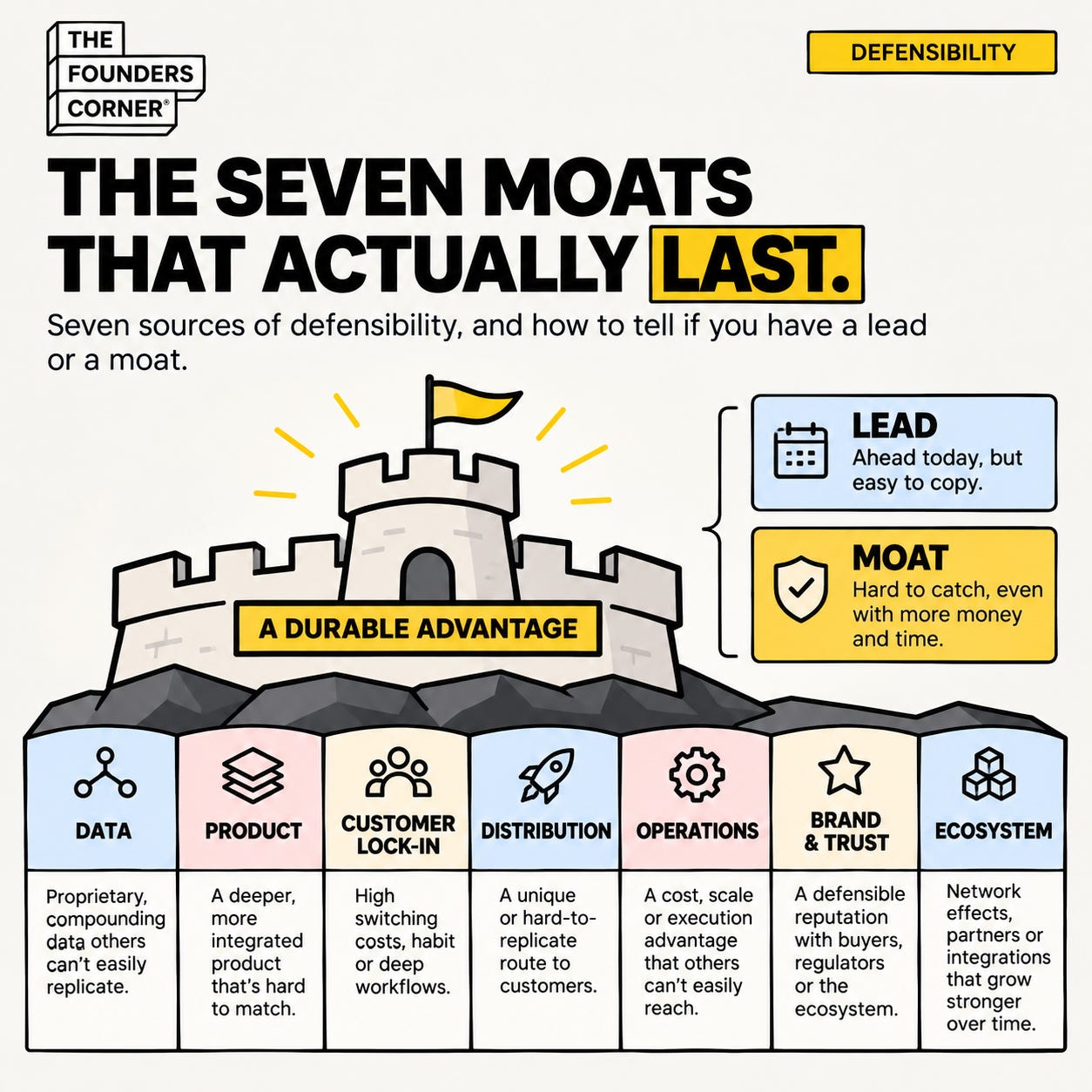
Table of Contents
A Simple Example: The Quarter a Bigger Company Noticed
Why “We Move Fast” Is Not a Moat
Ahead and Hard to Catch Are Different Claims
Seven Dimensions of Defensibility
Scoring Defensibility Honestly
Your Primary Moat, and Your Biggest Exposure
What the Research Says About Durable Advantage
Concentrated Strength Versus Spread Thin
Fortress, Strong, Developing, Vulnerable
The Honest Case Against Moat-Building This Early
Turning Your Weakest Dimension Into This Quarter’s Roadmap
Scoring Defensibility Properly
Brought to you by Omnisend
Your Black Friday emails are missing one thing. It’s ticking.
In 15 days, every inbox on the planet explodes.
“Limited time.” “Last chance.” “Ends soon.” Your customer has read those words a thousand times this year. They don’t believe them anymore. They scroll, they shrug, they tell themselves they’ll come back later.
They never come back later.
Now picture this instead. They open your email and there’s a clock. Live. Counting down. 03:14:22... 03:14:21... 03:14:20...
Their thumb stops. Their heart rate goes up. Suddenly “later” isn’t an option.
That’s the Omnisend email countdown timer, now built right into the email builder. And it changes everything about how your Black Friday campaign lands.
Tick. Tock. Sold.
⏳ They can feel the deadline. Words get ignored. A clock draining in front of them doesn’t. This is the moment “maybe” becomes “add to cart.”
🔁 Urgency on autopilot. Put it in your Black Friday email campaign, then drop it into your automation workflows. Every time-sensitive email goes out armed.
🎨 Unmistakably yours. Your fonts, your colours, your format. Days to seconds, or just minutes and seconds when you want real panic.
🚪 When it’s over, it’s over. At zero, the timer is replaced by your own image. The customer who hesitated sees exactly what they lost. Watch how fast they open your next email.
And here’s the best part.
No third-party timer app. No fiddly HTML. No extra subscription quietly eating your margin. Drag it in, set the end date, send yourself a test. You’re live in minutes.
Your competitors will spend Black Friday telling customers to hurry.
You’ll be the one making them.
The clock on this one is already running. The Omnisend email countdown timer is live now on Standard and Pro plans.
👉 Add a countdown timer to your Black Friday emails now

A Simple Example: The Quarter a Bigger Company Noticed
Remember the field-service scheduling company from last time. Not a real one, but you’ll recognise it.
It led its two closest competitors on Support and Service by two full points, and on User Experience by one. Its homepage said so. It was winning the shortlists where those two things mattered.
Then one of those competitors raised a large round and decided the mid-market was worth taking seriously.
Within two quarters, the rival had hired a weekend support team and rebuilt its mobile app. Nothing clever. Just money, pointed at the exact two dimensions our company had chosen to be remembered for.
Both leads shrank to almost nothing.
Almost none of the existing customers left.
Not out of sentiment. Because three years of schedules, engineer certifications and site access notes lived inside the product. Finance had built invoicing around it. Leaving meant a migration project, retraining forty people, and months of risk nobody wanted on their name.
The lead was a position. The switching costs were a moat. Only one was still standing two quarters later.
Why “We Move Fast” Is Not a Moat
Every founder can list reasons a competitor would struggle to catch them. Better team. Faster shipping. More customer insight.
Almost none of these are moats. Not because they’re untrue, but because they fail one test: surviving a well-resourced competitor deciding your category is worth entering seriously.
Speed can be bought. More money hires more engineers. It never scales perfectly, but it scales well enough to close a feature gap.
Talent can be hired away. Your best people are visible on LinkedIn to every recruiter in the category.
Insight leaks. Every demo, case study and customer you share is a free lesson for your competitor.
The useful question isn’t “are we better?” It’s this:
If a competitor with £30 million and eighteen months decided to copy us line for line, what specifically would stop them?
“They’d have to work quite hard” describes a lead. “They could build the product, but our customers still wouldn’t switch” describes a moat.
Ahead and Hard to Catch Are Different Claims
The positioning matrix answers a question about today: where you lead, where you trail, and what nobody owns. It’s the right place to start. But a snapshot can’t tell you whether a lead erodes in a quarter or compounds for a decade.
The matrix measures how far ahead you are. The moat assessment measures how fast that distance closes when someone starts running.
The two often disagree, and that’s where the useful decisions live.
A big lead with no moat behind it is worth exploiting now, loudly. It’s a sales message with a sell-by date.
A small lead backed by a real moat is worth investing in patiently, because it gets harder to beat every month you hold it.
A lead tells you where you are. A moat tells you how long you get to stay there.
Want to get in front of 250k+ founders and investors?
For sponsorship opportunities across The Founders Corner newsletter and LinkedIn (160k followers), email: founderscornermedia@gmail.com
Seven Dimensions of Defensibility
The assessment scores seven dimensions, three questions each.
Network Effects. Does customer fifty get a better product because customers one to forty-nine exist? More customers meaning more revenue is just growth.
Switching Costs. How embedded is the product in daily workflow, and how much data, configuration and habit would be lost by leaving? Most B2B software is quietly strongest here.
Brand and Trust. Can a cautious buyer put your name in front of their CFO without a long explanation?
Scale Economies. Do you get cheaper to serve, acquire or find as you grow, in ways a smaller rival can’t match?
IP and Technology. Patents, proprietary algorithms, and the honest question: how long would a funded team need to replicate your core product? Answer in months, not adjectives.
Regulatory and Compliance. Certifications and licences that take real time to obtain. Nobody can buy these quickly, however much they raise.
Data and Learning. A proprietary dataset, or an AI advantage that genuinely compounds with usage. The dimension founders most often overrate.
Notice what isn’t on the list. Speed, team quality, grit, culture. All valuable. None structural.
If a competitor could fix it with a hiring plan, it doesn’t belong on this chart.
Scoring Defensibility Honestly
This is the most flattering self-assessment a founder will ever fill in, because a high score feels like a valuation argument.
Score the barrier, not the benefit. “Customers love our onboarding” is a benefit. “Customers would lose two years of configured workflows if they left” is a barrier. Only the second counts.
Answer as the competitor. Score how hard it would be for a funded rival to neutralise each advantage, not how proud you are of it.
Ask a customer the leaving question. Not “would you leave?” Ask “what would moving off us next quarter actually involve?” The length of the answer is your switching cost score.
Do it with someone who’d rather you scored low. A non-exec or sceptical sales lead whose job is to say “prove it”.
A moat you have to argue for is usually a lead you’re hoping lasts.
Your Primary Moat, and Your Biggest Exposure
Every company scores unevenly, and the output names both ends. The highest dimension becomes your primary moat. The lowest becomes your named vulnerability.
Here’s the same fictional company:
Switching Costs. 73%. Schedules, certifications and invoicing integrations all live in the product.
Data and Learning. 53%. Four years of job-duration data used to predict visit length.
IP and Technology. 40%. A funded team could rebuild the core in about a year.
Regulatory and Compliance. 40%. ISO 27001, nothing sector-specific.
Brand and Trust. 33%. Well liked by customers, barely known outside them.
Scale Economies. 33%. Costs fall a little with volume, nothing a rival couldn’t match.
Network Effects. 20%. Nothing improves for one customer because another joined.
Neither end is a surprise once you see it. Both usually are before you measure them.
The founder would probably have put “our data” on the moat slide first. The scores say the real moat is less glamorous: it’s a pain to leave. That changes what you invest in, and what you tell investors.
What the Research Says About Durable Advantage
Four very different sources point the same way.
Warren Buffett, Fortune, 1999. At the height of the dot-com boom, Buffett argued the key to investing wasn’t how much an industry would grow, but a company’s competitive advantage and, above all, the durability of that advantage. Morningstar, which built its ratings on the idea, defines a narrow moat as roughly ten years of advantage and a wide moat as twenty or more. A moat is measured in time, not size.
Hamilton Helmer, 7 Powers, 2016. Helmer argues real power needs two things at once:
Moat = a benefit to you + a barrier to them
Benefits are common. Barriers are rare. “We ship fast” has a benefit and no barrier. Helmer also notes that network effects, scale and switching costs tend to arrive during takeoff, and brand much later.
NFX, 2019. The venture firm studied 336 digital companies founded between 1994 and 2017 that became worth over $1 billion. About 35% had network effects at their core, yet they accounted for roughly 70% of the total value. A 2022 re-run found the 70% still held.
NFX is a fund built around network effects and calls its method an estimate. The direction is still hard to ignore.
Martin Casado and Peter Lauten, Andreessen Horowitz, 2019. The counterweight, and the reason our example should be careful with that 53%. In “The Empty Promise of Data Moats”, they argue most data network effects are really weak scale effects: as a dataset grows, new data gets costlier to collect and less valuable to add. Defensibility, they conclude, isn’t inherent to data. It comes from proprietary sources, earned trust and domain depth, and surviving tough compliance scrutiny can itself be a moat.
The most valuable moats are the rarest, and the most claimed moat is the one that most often isn’t real.
If you’re building right now, these five are worth your time
The Positioning Shift That Doubled Revenue in Six Months: six dimensions, one radar chart, and why leading everywhere is a warning sign rather than a win.
Is Your Startup Too Early, Too Late, or Right on Time?: five timing signals and the window your market is actually sitting in right now.
Would Anyone Notice If Your Competitor Stole Your Homepage?: seven seconds, one armour-piercing message, and the swap test most hero lines fail.
The Test That Tells You If Anyone Will Actually Pay: five weighted dimensions, and the guard rail that caps an unfunded pain at 55 however urgent it sounds.
The 9-Step GTM System Every Founder Should Build Before They Scale: nine steps, one living document, so every new hire knows who to target and what to say.
Concentrated Strength Versus Spread Thin
A diversity index sits alongside the seven scores, measuring how evenly your strengths are spread rather than how high any one runs.
Picture two companies with a similar overall score.
Company A has Switching Costs at 90%, and everything else between 30% and 45%.
Company B has five dimensions between 50% and 60%, and nothing above 65%.
Company A is easier to build and easier to pitch. But it’s a single target. A rival offering free migration, or six months of running both systems in parallel, removes most of its defence in one move.
Company B has no single point of failure. Catching it means winning on five fronts at once, which is slow and rarely attempted. The cost is that it’s harder to explain in one sentence.
Concentrated? Defend the primary moat obsessively, then start building a second.
Spread thin? Push the one most likely to compound, so you have something sharp to explain.
Concentrated strength is a fast way to build a moat. It’s also a map telling a competitor exactly where to aim.
Fortress, Strong, Developing, Vulnerable
The overall percentage lands in one of four tiers:
Fortress (80% and above). Exceptionally difficult to replicate. Almost unheard of early.
Strong Moat (60–79%). Solid advantages worth deepening further.
Developing Moat (40–59%). Real, but concentrated in two or three dimensions, and still vulnerable to a well-resourced entrant.
Vulnerable (below 40%). Urgent moat-building needed before this becomes a pricing war, because when nothing structural separates you, price is all that’s left.
Our example scores 42%, averaged across the seven. Developing, just above the Vulnerable line.
Most early-stage companies, honestly assessed, sit here. That’s not a failure. It’s what Helmer’s stage point predicts. Developing is a starting point with a named list of what to build next.
What should worry you is a Fortress score on a company with twenty customers. That usually means the scoring rules weren’t followed.
The Honest Case Against Moat-Building This Early
Some of the objections are good ones.
“At seed, speed is the only moat that matters.” Find product-market fit first; worry about defence later.
“AI means anyone can copy anything.” So why score IP at all?
“A self-scored moat is theatre.” Founders score generously, and investors know it.
“Seven dimensions isn’t the full list.” Helmer’s seven include counter-positioning and process power, which aren’t scored here.
All fair. None is an argument for ignoring the question.
On speed: it gets you to where moats can form, but it’s the vehicle, not the destination. The assessment isn’t asking for a fortress at seed. It’s asking which moat you’re heading towards.
On AI: if code gets cheaper to copy, IP weakens for almost everyone, which makes switching costs, certifications, data rights and trust more valuable. If AI makes your product easy to copy, it makes everything that isn’t the product more important.
On theatre: agreed, which is why the scoring rules matter.
On the missing powers: counter-positioning is adopting a model an incumbent can’t copy without damaging itself, as Blockbuster couldn’t follow Netflix. If that’s your edge, write it down separately. It won’t show up in the seven scores.
“A competitor can copy your product in a year. Your customers’ last three years are much harder to copy.”
Turning Your Weakest Dimension Into This Quarter’s Roadmap
The output’s most useful section isn’t the score. It’s the action list attached to your three weakest dimensions, rather than a generic list every company gets.
For our example, that’s Network Effects, Brand and Trust, and Scale Economies.
Network Effects (20%). Find the feature where one customer’s usage makes the product better for the next. Anonymised benchmarks, say: how long a boiler service really takes across two hundred contractors. Each customer makes the benchmark sharper for everyone, and a rival can’t copy it without the same base.
Brand and Trust (33%). Turn happy customers into evidence buyers can see. Named case studies with numbers. A reference programme. That benchmark published as an annual report the category reads.
Scale Economies (33%). Lean into costs that fall with growth. Templates that make onboarding cheaper. Integrations built once, reused across a sector.
A company weak on Regulatory and Compliance would get a different prompt: pursue the certification proactively, because in a regulated market, compliance itself becomes the moat.
And one thing the tool can’t do for you: protect the primary moat while you build the others. Assume a rival will offer free migration, and make switching costs about more than data. Workflows, finance integrations, board reports. Data can be exported. Habits are much harder to move.
Three named dimensions, three specific actions, one quarter. That’s a roadmap. Seven aspirations is a poster.
Scoring Defensibility Properly
This is exactly what the Competitive Moat Assessment produces: twenty-one questions across seven dimensions, a tier, a named primary moat and a named vulnerability, a diversity index, and the specific top three actions that would actually move the needle, rather than a motivational list of moat types copied from a strategy textbook.
Run it straight after the positioning matrix. For each lead, ask whether there’s a moat behind it. Leads without one are your short-term sales message. Leads with one are your long-term strategy.
Then run it again in six months. Moats move slowly, which is exactly why it’s worth checking whether yours are moving at all.
Next in the series, we turn from defending what you’ve built to deciding what to build next, and the quiet cruelty of ranking a roadmap by arithmetic instead of opinion.
-Chris Tottman
Being ahead of competitors today and being hard to catch are different claims, and only a handful of structural advantages survive a well-funded competitor testing the difference.
The Competitive Moat Assessment scores seven dimensions of defensibility and names your primary moat and your biggest exposure specifically.