

The email arrives on a Wednesday afternoon.
“We’d love to have you come in and meet the full partnership.”
Every founder I have worked with describes the same feeling when they read that line. Relief. Then, almost immediately, a quieter panic.
Because getting the partner meeting means you passed the first filter. The associate liked you. The junior partner liked you. Someone in that firm believed enough to spend political capital putting your name on the agenda.
But the partner meeting is not a formality. It is not the first meeting with more people in the room.
It is a different event entirely. And most founders walk into it with the wrong preparation, the wrong expectations, and no understanding of what is actually happening on the other side of the table.
What the Partner Meeting Actually Is
Let me tell you what is happening in that room before you arrive.
The partner who championed you has already spent real energy convincing colleagues this is worth an hour of everyone’s time. That is not nothing. Partner meeting slots are limited. The agenda is fought over. Your champion has already made a bet on you.
Which means by the time you walk in, you are not starting from zero.
You are starting from a mild pre-existing belief among two or three partners who have read the summary your champion prepared. And from active skepticism from the others, whose job it is to find reasons not to proceed.
The partner meeting is a stress test. Not of your pitch. Of you.
Anyone can rehearse a deck. What partners are evaluating in that room is whether you think clearly under pressure, whether you know what you do not know, and whether they want to spend the next seven to ten years sitting on a board with you.
The deck is almost irrelevant. The questions are everything.
One useful data point before you walk in: First Round Capital, which has been running partner meetings twice a week for over fifteen years, funds roughly half the companies that make it to that stage. Half. Which means getting the meeting is not the hard part. The meeting is.
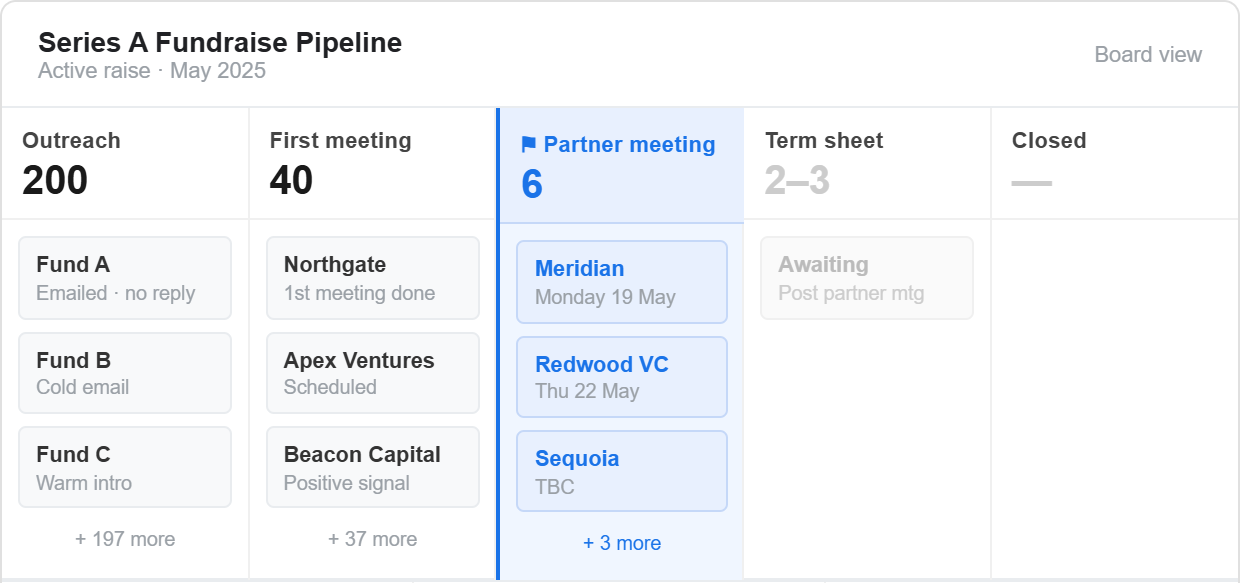
Why the First Meeting and the Partner Meeting Are Nothing Alike
The first meeting is an exploration. The partner meeting is a cross-examination.
In the first meeting, the investor is trying to understand your business. In the partner meeting, they already understand it. They have read your deck. They have looked at your LinkedIn. Some of them will have called a reference or two before you walk in.
They are not learning about you. They are testing you.
The questions will come faster. They will be more direct. They will be designed to find the edge of what you know. The moment you hit that edge is the most important moment of the whole meeting.
Most founders panic when they reach the boundary of their own knowledge. They bluff. They pivot. They talk around the gap.
The partners notice. Every time.
The founders who leave with term sheets do something different. They stop. They say what they know. Then they say what they are doing to find out.
That is not weakness. That is the answer partners are looking for.
The Room You Are Walking Into
A typical partner meeting has four to six people. Not all of them are there for the same reason.
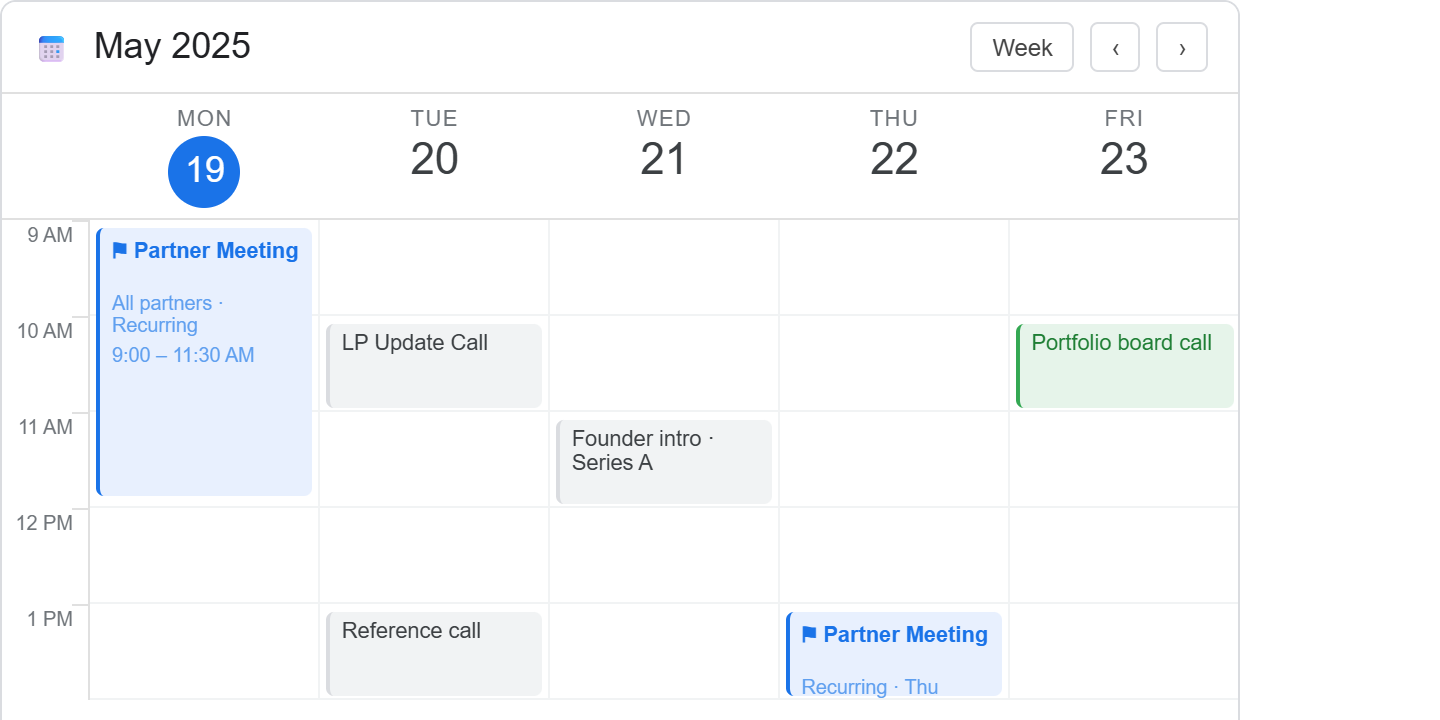
Understanding who is in the room and why they are asking each question changes how you answer every single one.
The quiet one in particular. Every room has a most senior partner who asks one or two questions, usually late. Those questions carry more weight than everything that came before. Identify that person in the first five minutes. Watch for their moment.
The Three Things Every Partner Meeting Is Testing
Strip away the specific questions and every partner meeting is evaluating the same three things.
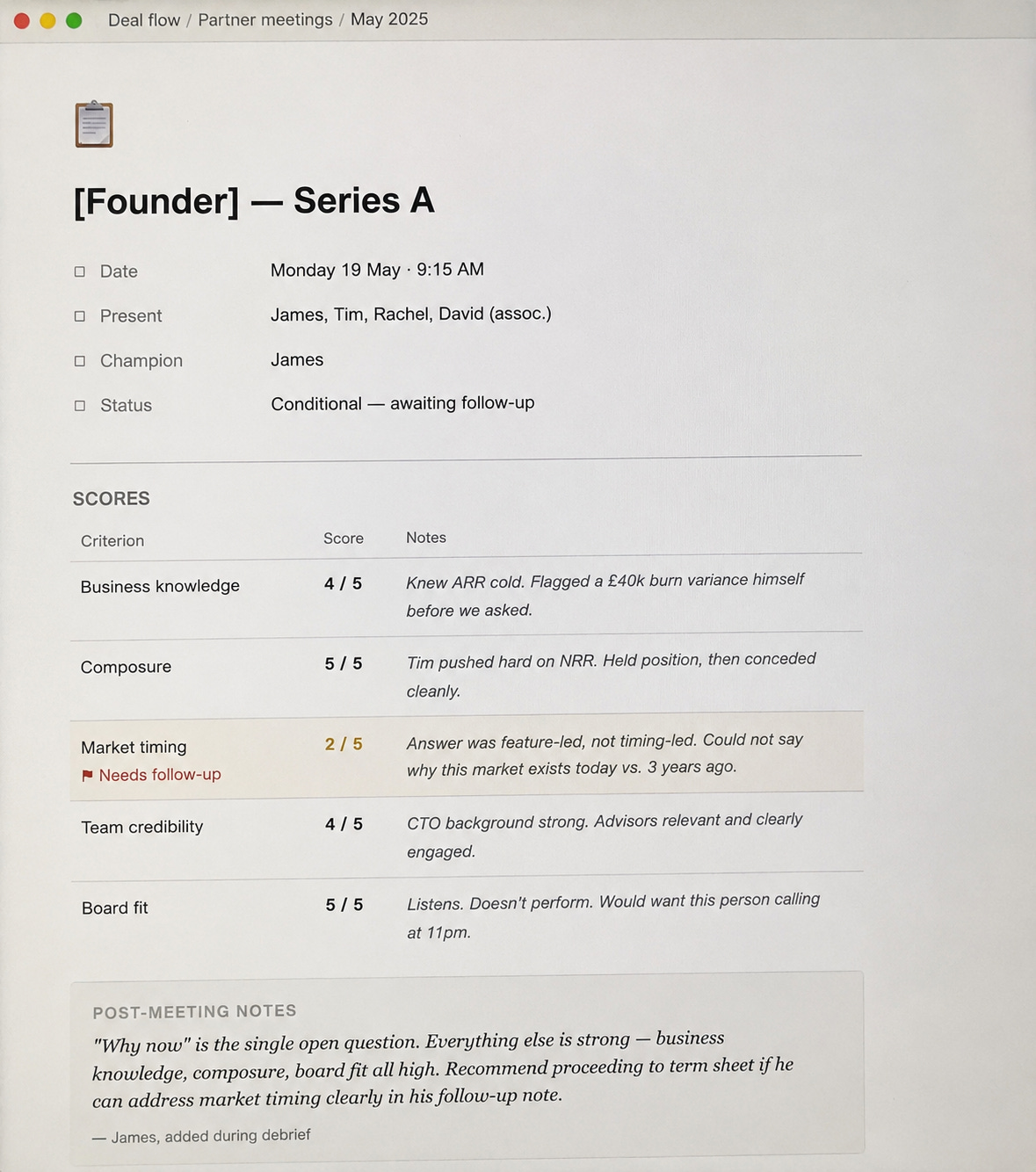
On the first test: most founders know their narrative better than they know their business. Know the actuals, not the slides. If a number has changed since your deck, say so unprompted. Self-disclosure builds more trust than polish.
On the second test: most founders either fold or fight. Both are wrong. When a partner challenges a core assumption, the room is not evaluating whether you are right - it is evaluating how you handle being pushed. Concede if they have a point. Push back if they do not. Either way, do it cleanly and move on. That composure under pressure is exactly what a board seat requires.
On the third test: investors are not just buying your business. They are buying a relationship. A board seat. Years of quarterly meetings, difficult conversations, and high-stakes decisions.
If the answer to that quiet internal question is yes, the other concerns become easier to resolve. If the answer is no, they rarely do. Build trust first. Everything else follows from it.
How to Prepare in the Week Before
Most founders prepare by rehearsing their deck. That is the wrong preparation.
Your deck is not the meeting. Your ability to answer questions you have not prepared for is the meeting.
Which means the best preparation is not rehearsal. It is stress testing.
Spend one hour with someone who will be genuinely tough with you. Not a co-founder. Not a friendly angel. Someone who knows institutional fundraising and will ask the questions you hope they do not ask.
Have them push on your numbers until you find the edge of what you know. Note exactly where that edge is. Then fill the gaps before you walk in.
Have them challenge your biggest assumption — not the secondary ones, the central one your entire model rests on. If you cannot defend it clearly and quickly, you are not ready.
Have them ask what you are most worried about. Because the partners will. Founders who answer this with honesty and clarity leave the room with trust. Founders who deflect leave with doubt.
The 48 Hours Before
One task. Update your numbers.
Not to refresh the deck. Partners have seen the deck.
Update your own mental model of the business. Know this week’s ARR. Know last month’s burn to the nearest five thousand. Know what in your pipeline is real versus aspirational.
Partners ask current numbers in partner meetings because they want to see whether you know your business in real time or only from the last time you updated a slide.
If a number has changed since your deck, say so unprompted. Do not wait for them to find it. Every time.
The Four Questions That End Partner Meetings
These come up in almost every room. They separate the founders who close from the ones who get the polite follow-up.
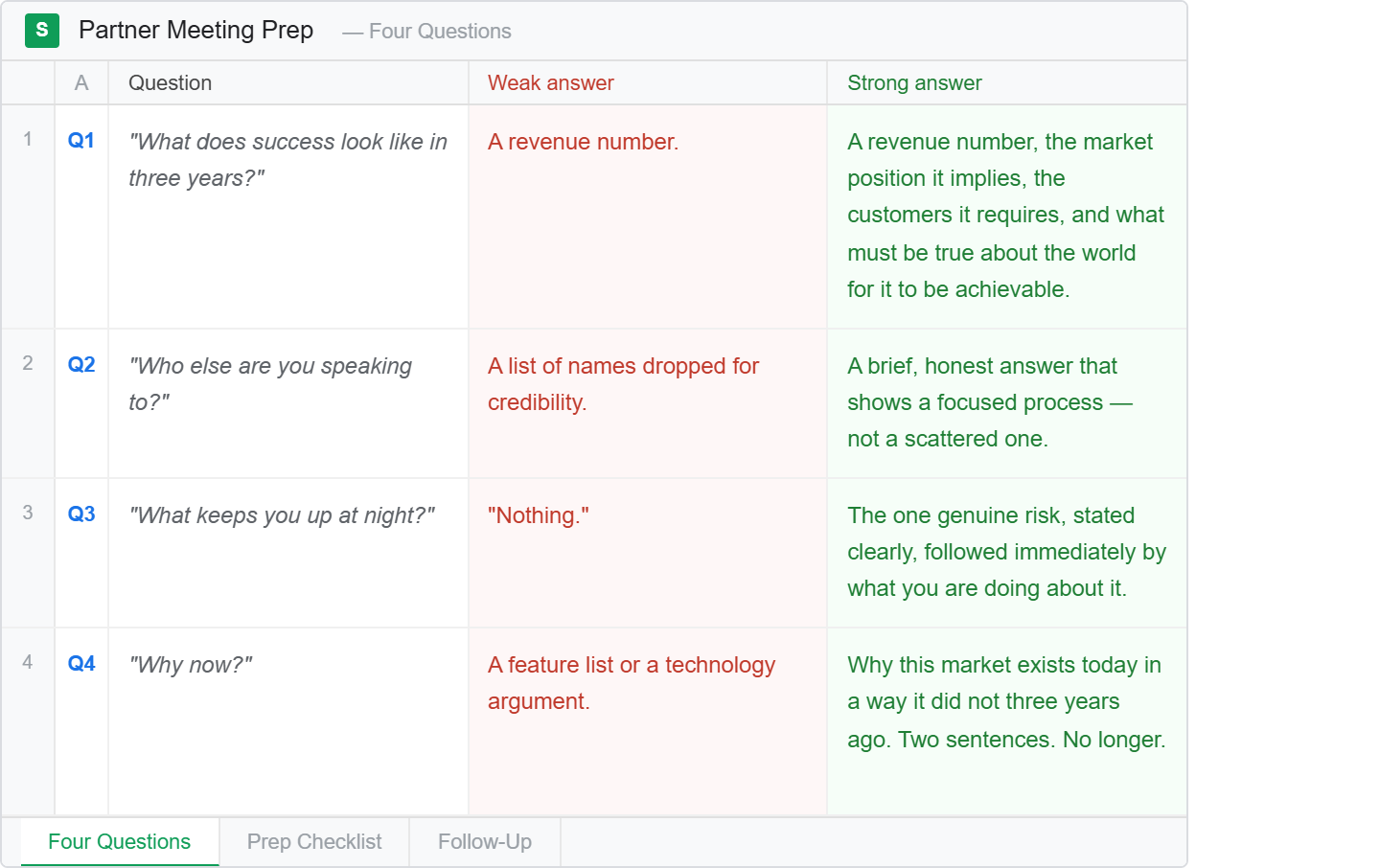
The “why now” question is the one most founders underestimate. It is not a question about your product. It is a question about timing — why does this market exist today in a way it did not three years ago? If you cannot answer this in two sentences, the meeting is harder to recover from than almost any other stumble.
What to Do When a Partner Is Wrong
This happens in every meeting.
A partner will make an assertion about your market, your customer base, or your competitive position that is incorrect. How you handle it reveals more about you than almost anything else in the room.
Do not fold. Do not argue. Disagree clearly, provide the evidence or reasoning, and move on.
“That is not what we are seeing. Here is what the data shows us.”
That is it. No defensiveness. No lengthy justification. Clean, direct, evidence-led disagreement.
The partners who challenged you will respect it. The ones who agree with you will trust you more. And your champion will quietly exhale.
The Follow-Up Most Founders Get Wrong
The meeting ends. Hands are shaken. Someone says they will be in touch.
Most founders send a thank you email that night. That email is usually a mistake. Not because gratitude is wrong. Because most thank you emails are long, restate the pitch, and arrive before the partners have even had their debrief conversation.
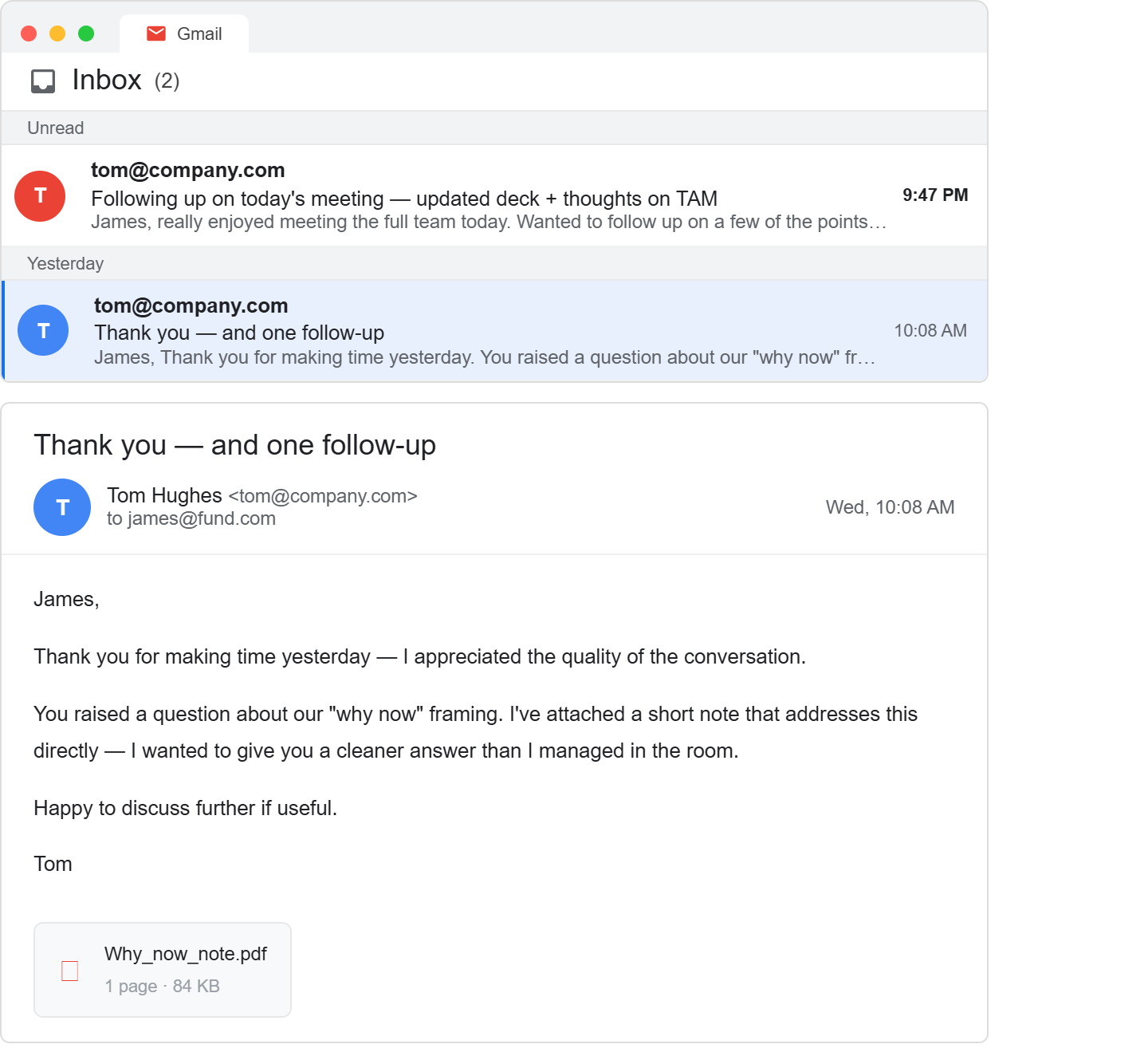
What works better: wait 24 hours. Then send one short email. Three sentences. Thank them for the time. Attach a single page that addresses the most specific question from the meeting that you could not answer fully in the room. Nothing else.
That follow-up does more work than any thank you email because it demonstrates something partners value above almost everything else in a founder: that you listen, that you act, and that you do not need to be reminded.
The partner meeting is the moment most founders have been building toward for months.
Most of them walk in thinking about their deck.
The ones who walk out with a term sheet walked in thinking about the room.
They knew who was in it. They knew what each person needed. They knew where the edge of their own knowledge was, and they had prepared for the moment they hit it.
The deck did not close those deals.
The founder did.
The Partner Meeting Preparation Framework
The Partner Meeting Preparation Framework is a five-tab working document built from the exact process I use when preparing my mentees for their first institutional partner meetings.
It is not a summary. It is not a checklist you will glance at once and close. It is the document you open the week before the meeting, work through section by section, and return to the morning of.
What’s inside:
✅ Who Is In The Room - The five roles every partner meeting contains: the Champion, the Skeptic, the Domain Expert, the Quiet One, the Associate. What each person is doing, and exactly what they need to see from you.
✅ What Is Being Evaluated - The three criteria every partnership uses, with specific observations on what separates founders who close from the ones who get the polite follow-up email.
✅ Questions That Decide The Room — The four questions that appear in almost every partner meeting, with side-by-side weak and strong answers — and the reason the stronger answer works where the weaker one doesn’t.
✅ The Preparation Checklist - Every action, from one week out through 24 hours after the meeting. Why it matters. When to do it.
✅ The Follow-Up Protocol - The three-sentence email template, the exact protocol notes, and the single rule most founders break without knowing it.
This is what a paid subscription to The Founders Corner gets you every week.
Not frameworks to screenshot and store. 50+ tools you open, use, and walk away from with something concrete - built for the decisions founders are actually making.
The Framework is available exclusively to premium subscribers of The Founders Corner.