

Every few months, Y Combinator does something almost no other investor in the world does.
They publish a list.
Not a vague thematic outlook. Not a “we’re excited about AI” blog post. A specific, partner-attributed, publicly available wishlist of exactly the kinds of companies they want to fund. They call it the Request for Startups.
Most founders glance at it. A few founders read it. Almost none of them dissect it the way they should.
That’s a mistake. Because the RFS is not just a list of ideas. It’s a window into how YC’s partners are reading the moment. It tells you which problems they believe are now solvable, which markets they think are newly vulnerable, and where they’re willing to write the first cheque. If you’re building anything in the neighbourhood of these categories, understanding the thesis behind each one gives you a meaningful edge, both in how you pitch and in how you position.
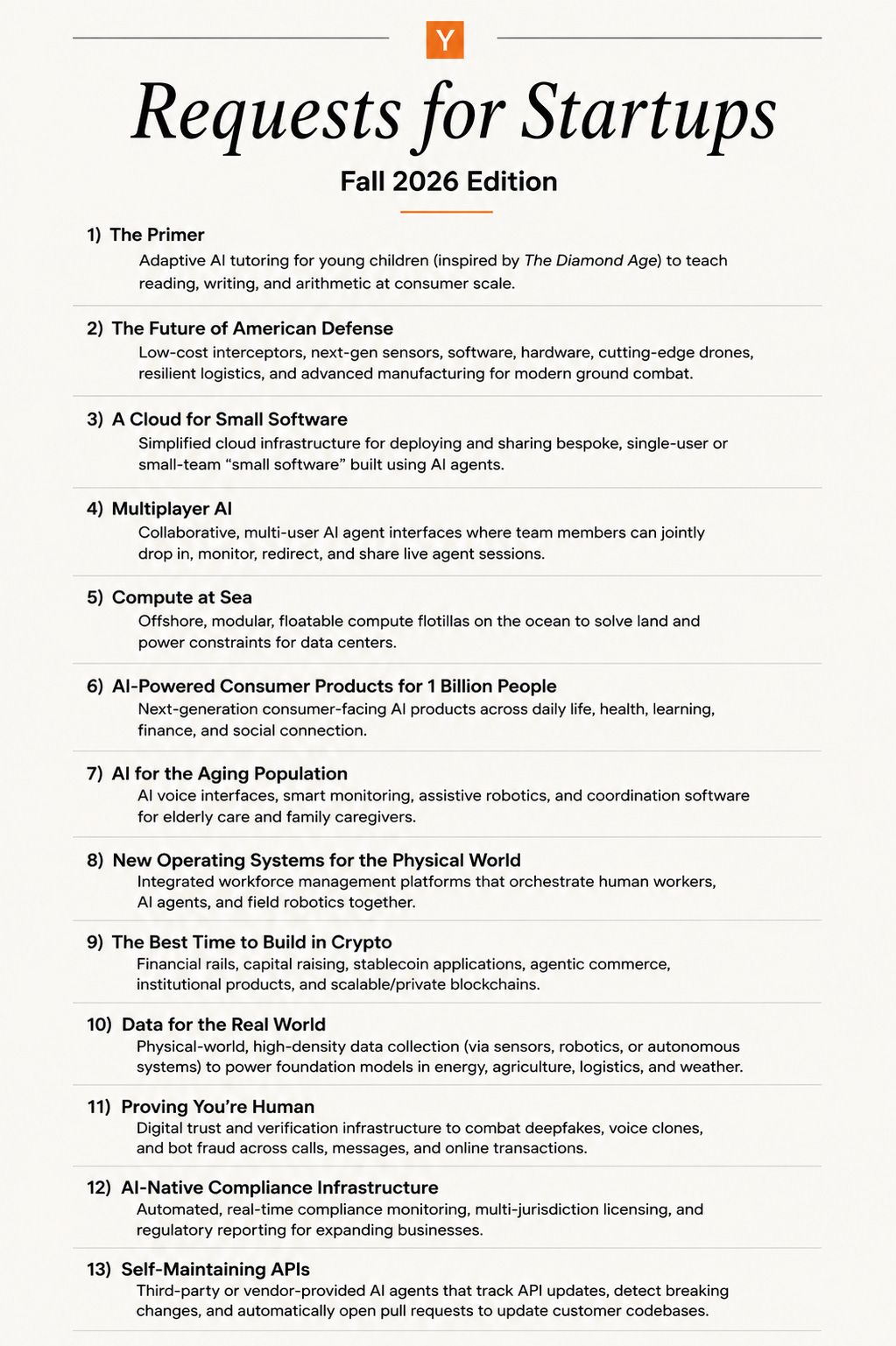
The Fall 2026 batch just dropped, and it’s a different kind of list than the one before it. Thirteen categories. A defense request written for the first time in the program’s history by a sitting cabinet official. And an opening line from YC that tells you almost everything about where this one is headed.
Let me break it down.
First: What the RFS Actually Is (And What It Isn’t)
Before we get into the categories, a calibration.
The RFS is not a requirement. YC still funds companies outside these categories. Always has, always will. The best YC companies of the last decade didn’t necessarily map neatly onto a wishlist. Airbnb didn’t. Stripe didn’t.
What the RFS is is a pre-approval signal. If your company falls into one of these categories and your execution is strong, you’re not asking a partner to build conviction from scratch. The category-level thesis already exists. You’re just demonstrating that you’re the right team to execute it.
That matters more than most founders realise. A YC interview is ten minutes. Every second a partner spends building context on your market is a second they’re not spending evaluating you. If they already believe in the space, you’ve bought yourself more time for the thing that actually wins rooms: founder credibility, specificity, and conviction.
So read the RFS. Not to narrow your options, but to understand where YC’s partners have already done the work.
Fall 2026 vs Summer 2026: The Shift in One Sentence
Before diving into Fall 2026 in full, it’s worth acknowledging where we’ve been, because the contrast is revealing.
Summer 2026 was a list about software finishing what software started: AI-native rebuilds of services, SaaS, and enterprise workflows, plus an unusually aggressive push into silicon and hardware, inference chips, semiconductor supply chains, electronics in space. It was YC saying, in effect: the AI layer is commoditising, so the interesting fights are moving to infrastructure and atoms.
Fall 2026 is a different list entirely. The “atoms” instinct is still there, but it’s pointed somewhere else. Instead of chips and orbital manufacturing, this batch’s physical-world bets are about labor, care, trust, and combat: construction crews, aging parents, ocean-based data centers, and the U.S. Army. YC’s own framing for the batch says it plainly: AI is moving into the physical world, and this new wave of startups is being asked to rebuild the systems that power it: education, healthcare, defense, finance, infrastructure, and work itself.
The other structural shift is who’s writing. Summer 2026 leaned on YC partners and a single YC-funded space-hardware founder. Fall 2026 includes, for the first time in the program’s history, a request from a sitting U.S. cabinet official, Army Secretary Daniel Driscoll, alongside operator-founders like Austin Tindle (Sorcerer) and Harsha Gaddipati (Slashy), writing from inside the problems they’re describing rather than observing them from a partner’s chair. That’s a meaningful signal about where YC thinks the best category intelligence now lives.
If you’re raising, here are 6 more worth your time:
The Claude Guide Every Founder Should Run Before Fundraising - your deck isn’t read by a partner first anymore. It’s read by a model. Here’s how to pass the screen before a human ever sees it.
The 6 Claude Prompts That Change What You Walk Into the Room With - the meeting system that gets you prepared for the investor, not just the pitch.
The Claude Prompt That Turns a Cold Email Into One a VC Actually Reads - cold emails convert at 3%. Here’s the five-prompt system that beats it.
The Two-Minute Investor Briefing Every Founder Should Be Running - the Claude agent that turns a fund and partner name into a full investor briefing before every meeting.
I Asked Claude to Reject My Pitch Until It Couldn’t. Then I Raised. - the adversarial system that finds every weak point in your pitch before an investor does.
How to Build Your Fundraising Narrative with Claude - the five-prompt sequence that turns your raw story into the argument that actually closes rounds.
The Three Threads Running Through Fall 2026
When you read all thirteen categories together, three distinct theses emerge, plus one clear outlier.
Theme 1: AI is leaving the chat window and entering the physical and institutional world.
The Primer, the Army request, Compute at Sea, New Operating Systems for the Physical World, and Data for the Real World all point the same direction: intelligence that used to live in a browser tab now has to run alongside soldiers, construction crews, ocean vessels, and sensors bolted onto real machinery. This is stated almost verbatim in the batch’s own preamble: AI is moving into the physical world; it shows up in more than a third of the categories.
Theme 2: Someone has to build the trust and plumbing layer underneath an AI-run economy.
Proving You’re Human, AI-Native Compliance Infrastructure, Self-Maintaining APIs, and A Cloud for Small Software are all, in different ways, about the unglamorous work of making an AI-saturated economy function without collapsing into fraud, regulatory chaos, or unmaintainable software sprawl. This is the least flashy thread on the list, and probably the most durable one.
Theme 3: AI becomes personal, social, and mass-market rather than an enterprise tool.
AI-Powered Consumer Products for 1 Billion People, Multiplayer AI, and AI for the Aging Population are about AI moving from something a knowledge worker uses alone at a desk to something woven into how ordinary people live, work together, and care for family. YC is explicitly betting the next iconic consumer brand hasn’t been built yet, three years into a cycle where the only new home-screen icon is still ChatGPT.
The outlier: crypto, argued from a contrarian angle.
The Best Time to Build in Crypto doesn’t sit neatly inside any of the three threads above. It’s a standalone bet that bear markets are when the real infrastructure gets built, precisely because the capital chasing “infinite yield” schemes has left the table.
A Category-by-Category Dissection
Here’s what each Fall 2026 category is actually saying, and what most founders will miss about it.
1. The Primer
Who wrote it: Andrew Miklas
The reference point is Neal Stephenson’s The Diamond Age, an adaptive book that doesn’t just teach a child to read, but grows with her over years, reshaping itself around who she’s becoming. The ask: a product that adaptively teaches young children to read, write, and do arithmetic at the quality of a devoted private tutor, at consumer scale, positioned as a supplement to teachers rather than a replacement.
What most founders miss: the entry point (a parent buying a reading and arithmetic tool) is deliberately modest. The actual thesis is a decade-long relationship with a single learner that compounds in depth over years, a retention and data moat most consumer edtech has never had access to.
2. The Future of American Defense
Who wrote it: Daniel P. Driscoll, US Secretary of the Army
The most unusual entry on the list by provenance. The Army’s pitch is blunt: modern combat has outpaced the old acquisition playbook, and the service wants low-cost interceptors, next-gen sensors, drones, and resilient logistics that plug into an open-system architecture built to survive extreme environments, from the Arctic to space to subterranean settings.
What most founders miss: this isn’t a defense-contractor RFP dressed up as a startup pitch. The explicit ask is for founders who move at startup speed and think in “cost per kill” rather than program-of-record cycles. The barrier isn’t capital or clearance; it’s cultural fit with a system that has, by its own admission, just torn up how it used to buy things.
3. A Cloud for Small Software
Who wrote it: Pete Koomen
AI coding agents have made it trivial to build “small software”: bespoke tools for one team, one workflow, one edge case, but deploying and sharing that software is still stuck in an era built for scale-first “Big Software.” Koomen’s framing: incumbent clouds optimised for complexity at scale; small software needs the opposite, something as easy to share as a Google Doc.
What most founders miss: the hard part isn’t hosting. It’s auth, permissions, and letting non-technical people share arbitrary code safely, the exact problems every “no-code” wave has stumbled on before. Solve that specifically for agent-generated software and you own a genuinely new category of cloud.
4. Multiplayer AI
Who wrote it: Aaron Epstein
The pattern Epstein points to is real: the tools that won the last two decades of work software went multiplayer first (Docs over Word, Figma over Photoshop). AI agents, by contrast, are still mostly single-player, one person, one chat window, one private transcript a teammate can view but not touch.
What most founders miss: as agent tasks stretch from minutes to days or weeks, the unit of work stops being an individual’s problem and starts being a team’s. The company that builds the shared, live session (where colleagues can watch, redirect, and hand off an agent mid-task the way they would a human teammate) is building the Figma moment for agentic work, not just a better chat UI.
5. Compute at Sea
Who wrote it: Francois Chaubard
The setup: AI is running out of compute, and data centers are running out of electricity, land, and increasingly local political tolerance. The ocean, by contrast, offers abundant sunlight, no permitting process, and a natural heat sink. The proposed unit is a “compute flotilla”: standardised, modular vessels operating together as one global cloud.
What most founders miss: this reads like a hardware moonshot, but the actual startup opportunity is closer to fleet logistics and marine engineering than chip design. The teams best positioned here have offshore, maritime, or industrial-vessel backgrounds, not just AI-infrastructure résumés.
6. AI-Powered Consumer Products for 1 Billion People
Who wrote it: Raphael Schaad
The provocation is sharp: every prior platform shift minted consumer giants; the web gave the world Google and Airbnb, mobile gave it Instagram and DoorDash; yet three years into the AI shift, the only new icon on most home screens is ChatGPT. Schaad’s argument is that intelligence has crossed the threshold where an agent can be treated like a person, and the cost of running that agent is falling roughly 10x a year, which means the consumer moment is close and whoever moves first owns it.
What most founders miss: the category isn’t “build an AI chatbot for X.” It’s a reopening of every basic human activity, getting around, learning, staying healthy, managing money, socialising, on the assumption that the previous generation of consumer apps solved these problems under compute and intelligence constraints that no longer exist.
7. AI for the Aging Population
Who wrote it: Max Kolysh
The demand curve here isn’t speculative: by 2030, one in five Americans will be over 65, with millions of caregiving jobs projected to go unfilled and 53 million family members already providing unpaid care. Meanwhile almost no consumer technology, including voice assistants, is actually designed for older users.
What most founders miss: the addressable buyer isn’t just the senior, it’s the adult child coordinating care from a distance. Products that solve for both the aging user’s dignity and independence and the family caregiver’s coordination burden have a much wider wedge than either alone.
8. New Operating Systems for the Physical World
Who wrote it: Charlie Warren
Eighty percent of the global workforce doesn’t sit at a desk, yet the software running construction, maintenance, and fleet operations has barely changed in two decades; it dispatches people, tracks them, manages assets, and bills the customer. Warren’s framing introduces a genuinely new wrinkle: there are now three categories of worker to manage simultaneously: AI agents that can quote and schedule work, robots physically deployed in the field, and humans wearing devices that record everything they do.
What most founders miss: the defensibility isn’t the software interface, it’s the data. A company operating at this layer captures end-to-end records of how physical work actually happens, data that no frontier lab, robotics startup, or legacy vendor currently has, because none of them sit at the point where the work occurs.
9. The Best Time to Build in Crypto
Who wrote it: Nemil Dalal
The contrarian case: prices are down, hyped narratives have fizzled, and builders are leaving; YC treats this as the buy signal, not the exit signal. The argument is that bear markets filter out founders chasing quick liquidity and let the founders solving real infrastructure problems build without competing against schemes promising impossible yield. YC notes it has already funded more than 100 crypto startups, expects that number to keep growing, and predicts most future YC companies will eventually run on crypto rails for capital raising or payments without most people even realising it.
What most founders miss: the specific bets named (stablecoin applications, agentic commerce, institutional products, and private or scalable blockchains) are all rails plays, not speculative-asset plays. This entry is about picks-and-shovels infrastructure, not token prices.
10. Data for the Real World
Who wrote it: Austin Tindle (Sorcerer) and Diana Hu
The observation is precise: models have gone superhuman on code, language, and images, but the physical world is still measured with sparse sensor data designed for humans, not for training AI. Falling sensor costs and improving foundation models have made dense physical-world data collection newly viable; the entry cites Gecko Robotics collecting structural data from hard-to-reach infrastructure and Sorcerer’s own autonomous weather balloons feeding government forecasting.
What most founders miss: the stated end-state is control, not just measurement. Once a physical system is densely modelled, it becomes steerable. The examples given (steering hurricanes, reversing desertification) sound outlandish, but the real near-term opportunity sits several steps earlier, in energy, agriculture, logistics, and construction, where “more real-world data” alone would already be transformative.
11. Proving You’re Human
Who wrote it: Max Kolysh
The framing example is genuinely alarming: a finance worker joined a video call with people he believed were his CFO and colleagues, and wired out $25 million. Every other person on that call turned out to be a deepfake. Kolysh’s argument is that every trust signal the internet currently relies on, a face on a call, a voice on a line, was built for a world where faking a human was expensive, and that world no longer exists.
What most founders miss: the ambition here isn’t a better deepfake detector. It’s becoming the verification layer that every bank, app, and video call checks before it trusts anyone: infrastructure-level ambition dressed as a security product, with an explicit design constraint that it shouldn’t require everyone to surrender their privacy to use it.
12. AI-Native Compliance Infrastructure
Who wrote it: Daivik Goel (Shor)
Financial compliance today is described as spreadsheets, siloed point solutions, and expensive headcount, with complexity compounding faster than revenue as companies expand into new jurisdictions. Goel’s argument is that most compliance work (monitoring regulatory change, flagging anomalies, generating reports, maintaining audit trails) is exactly the kind of task AI now handles faster and more cheaply than people, yet most existing tools are still built around manual review.
What most founders miss: the win condition isn’t automating the existing compliance workflow. It’s rethinking what compliance operations look like when AI is the default reviewer rather than the exception. State-by-state licensing and renewal cycles are named specifically as the acute pain point, suggesting a sharper wedge market than an enterprise-wide platform play from day one.
13. Self-Maintaining APIs
Who wrote it: Harsha Gaddipati (Slashy)
Gaddipati’s data point, drawn from working with more than 50 early-stage API vendors, is that API communication is structurally broken: breaking changes ship with little warning, useful features launch and go unnoticed, and changelogs simply don’t get read. He cites a striking internal statistic from his time at AWS: over 30% of service downtime traced back to unnoticed external API or package changes.
What most founders miss: the shift he’s pointing to is that agentic coding tools have already normalised giving external tools write access to a codebase, something that would have been unthinkable two years ago. The opportunity isn’t better changelogs; it’s API providers shipping the fix directly into customer codebases as a pull request, either as a per-provider agent or as a neutral third-party service: essentially Dependabot for the entire API layer, not just dependencies.
What This List Tells You If You’re Not Building Any of These
The RFS is useful even if your startup doesn’t fit a single category.
Read it as a map of YC’s macro bets right now. They’re saying AI’s frontier has moved from chat interfaces into physical institutions: schools, armies, oceans, construction sites, aging households. They’re saying the plumbing underneath an AI-run economy (trust, compliance, API maintenance, deployment) is as investable as anything built on top of it. And they’re saying consumer AI, after three years of enterprise-first attention, is about to have its platform moment.
If your startup sits in a different category but reflects those underlying beliefs (that you understand a domain from the inside, that your product is AI-native rather than AI-decorated, that you’re attacking a problem where the incumbent’s advantage has quietly evaporated) you’re in the right mental model even if you’re not on the list.
The RFS doesn’t define the universe of fundable companies. It defines the universe where YC has already done the thinking.
My Honest Take on Fall 2026
This is a more institutionally ambitious list than Summer 2026 was, even though it’s less flashy on paper. There’s no orbital manufacturing entry, no exotic chip-architecture ask. What’s here instead is arguably harder: convincing an eight-decade-old defense procurement bureaucracy to move at startup speed, building financial rails for an economy that mostly doesn’t know it’s about to run on them, and rebuilding the trust assumptions the entire internet has quietly relied on since before video calls existed.
The category I think is most underpriced by founders reading this list: Self-Maintaining APIs. It sounds like a narrow DevTools niche, but if agentic coding tools really have normalised write-access to customer codebases, this is a wedge into becoming permanent, trusted infrastructure inside thousands of companies at once: a distribution advantage almost no other category on this list offers as cheaply.
The category I expect to generate the most applications and the least differentiation: AI-Powered Consumer Products for 1 Billion People. The thesis is compelling, which is exactly why every founder with a consumer idea will reach for this framing regardless of fit. The founders who stand out won’t be the ones citing the falling-cost-of-tokens curve. They’ll be the ones who’ve already found a specific, ordinary human behaviour AI newly makes possible, and can show early evidence people are doing it.
And the category I think most founders will misjudge as a mismatch for a typical YC applicant: The Future of American Defense. The instinct is to assume this requires clearances, contracts, and a decade of relationships. The entry itself argues the opposite: that the old playbook has been deliberately dismantled specifically to let startups in faster. Founders who take that claim seriously, rather than assuming it doesn’t apply to them, have less competition than the framing suggests.
The RFS Is a Signal. Use It.
If you’re applying to YC for Fall 2026, the RFS should be part of your preparation. Not as a template to force-fit your startup into, but as a framework for understanding how the partners, and in this batch, a cabinet secretary and two operator-founders, are actually thinking.
The question to ask yourself: does my company reflect the beliefs behind the category I’m closest to? Do I understand the underlying thesis, not just the surface-level description? Can I articulate why now, why this market, and why my team, in the language of someone who has already committed to the space?
If you can answer those questions clearly, you’re not just pitching a product. You’re confirming a thesis they already hold.
That’s a very different kind of conversation.
🔒 The YC Application Bundle
Everything above is free. What follows turns that framework into action.
Paid subscribers get four tools built on the exact YC framework in this article. Most founders who run through them find one or two blind spots they didn’t know they had; better here than in a ten-minute interview room.
The YC Readiness Assessment scores your startup across the four dimensions YC actually uses to evaluate founders. You get a score for each one, specific gaps identified, and actionable guidance on what to fix before you apply.
The YC Category Fit Finder takes your startup description and tests it against every Fall 2026 RFS category. You see where you land strongest, which category is your best fit, and the precise framing that sharpens your pitch for that thesis.
The YC Video Script Builder generates a complete 60-second script in YC’s preferred format: who you are, what you build, your traction, why your team, confident close. The video is where most applications die. This fixes that.
The YC Founder DNA Matrix asks you the same seven questions YC partners ask in interviews, scores your answers the way they would, and shows you exactly what a higher-scoring answer looks like. Built on 20+ years of watching founders in these rooms.
Plus full access to the entire Founders Corner archive - every prompt, framework, and teardown we’ve published on getting a round closed.
Start your 7-day free trial → Cancel anytime.
The Four Things Standing Between You and a YC Interview
Download below