

Every few months, Y Combinator does something almost no other investor in the world does.
They publish a list.
Not a vague thematic outlook. Not a “we’re excited about AI” blog post. A specific, partner-attributed, publicly available wishlist of exactly the kinds of companies they want to fund. They call it the Request for Startups.
Most founders glance at it. A few founders read it. Almost none of them dissect it the way they should.
That’s a mistake. Because the RFS is not just a list of ideas. It’s a window into how YC’s partners are reading the moment. It tells you which problems they believe are now technically solvable, which markets they think are newly vulnerable, and where they’re willing to write the first cheque. If you’re building anything in the neighbourhood of these categories, understanding the thesis behind each one gives you a meaningful edge, both in how you pitch and in how you position.
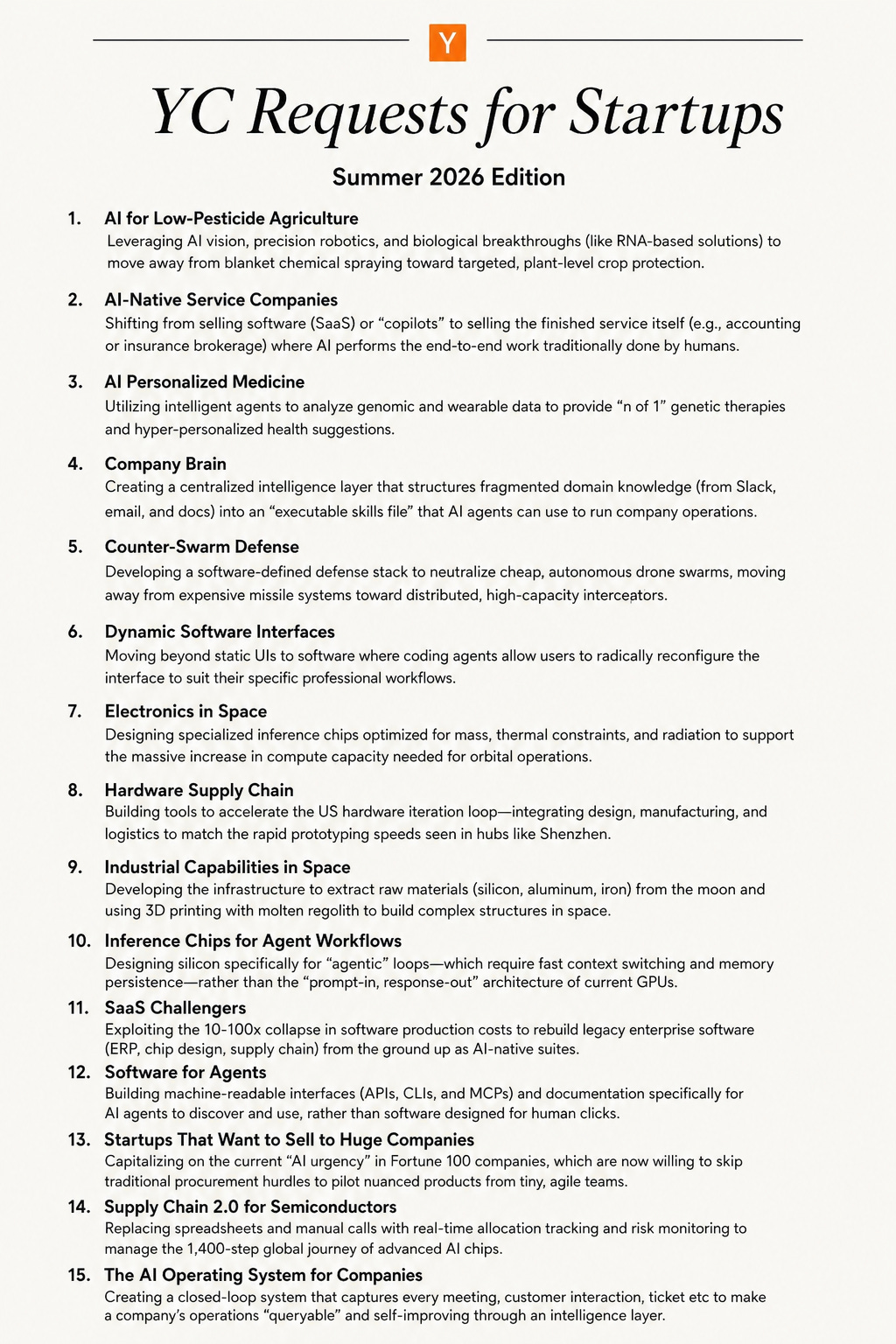
The Summer 2026 batch just dropped. It’s one of the most ambitious RFS lists YC has ever published. Fourteen categories. Three major themes. And a few entries that I think are genuinely underappreciated by most founders who will read it.
Let me break it down.
First: What the RFS Actually Is (And What It Isn’t)
Before we get into the categories, a calibration.
The RFS is not a requirement. YC still funds companies outside these categories. Always has, always will. The best YC companies of the last decade didn’t necessarily map neatly onto a wishlist. Airbnb didn’t. Stripe didn’t.
What the RFS is is a pre-approval signal. If your company falls into one of these categories and your execution is strong, you’re not asking a partner to build conviction from scratch. The category-level thesis already exists. You’re just demonstrating that you’re the right team to execute it.
That matters more than most founders realise. A YC interview is ten minutes. Every second a partner spends building context on your market is a second they’re not spending evaluating you. If they already believe in the space, you’ve bought yourself more time for the thing that actually wins rooms: founder credibility, specificity, and conviction.
So read the RFS. Not to narrow your options, but to understand where YC’s partners have already done the work.
Summer 2026 vs Spring 2026: The Shift in One Sentence
Before diving into Summer 2026 in full, it’s worth acknowledging where we’ve been, because the contrast is revealing.
The Spring 2026 RFS was a list that said: AI is the tool. Now aim it at industries that haven’t been disrupted yet. Eight categories, most of them variations on a single thesis: take an existing sector (hedge funds, government, metal mills, agencies, physical training) and rebuild the workflow with AI-native architecture. It was sharp, focused, and practical. The standout category was AI-Native Agencies, which was essentially YC saying out loud what every smart operator already suspected: the best AI play in services isn’t selling the tool, it’s doing the work at software margins. That’s a genuinely important insight, and the founders who picked it up early have a real head start.
Spring 2026 was also notably conservative on hardware and deep tech. It was a list for founders who wanted to win by knowing an industry from the inside and rewiring it. Good, but bounded.
Summer 2026 is a different list entirely. The scope is bigger. The ambition is higher. And the underlying message has shifted from “aim AI at unglamorous industries” to something more fundamental: we are at the beginning of a new hardware era, and AI is the foundation everything else is built on now.
Thirteen categories instead of eight. Three that didn’t exist in Spring: hardware supply chain, electronics in space, industrial space capabilities, and counter-swarm defence. The physical world is no longer a footnote. It’s structurally embedded in the thesis.
The other notable shift: Summer 2026 contains several categories where YC explicitly says they want founders coming directly from cutting-edge companies. The electronics-in-space entry literally calls out SpaceX and NVIDIA engineers by name. That’s unusual. It tells you something about how YC is thinking about the talent pipeline for hardware. They’re not expecting these companies to be built by generalists with a laptop. They want domain experts who have been inside the problem.
The Three Themes Running Through Summer 2026
When you read all fourteen categories together, three distinct theses emerge.
Theme 1: AI is no longer a feature. It’s the operating system.
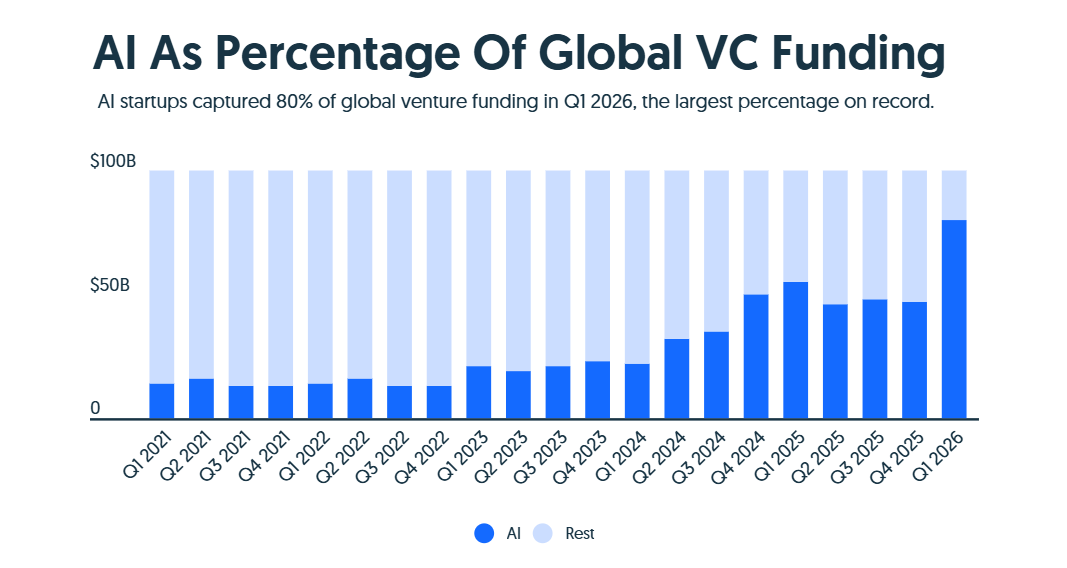
This is stated explicitly in the RFS preamble (“AI has stopped being a feature and started being the foundation”) and it shows up across at least half the categories. Company Brain, AI Operating System for Companies, Software for Agents, Dynamic Software Interfaces, AI-Native Service Companies, SaaS Challengers: these are all variations on the same belief. The entire software stack is being rebuilt, and the companies that win will be AI-native from the ground up, not retrofitted.
The key word in this theme is native. YC is not asking for AI features bolted onto existing products. They’re asking for products where AI changes the fundamental architecture of the value proposition. That distinction matters enormously in how you pitch.
Theme 2: Silicon is the new frontier.
Three categories (inference chips for agent workflows, electronics in space, and the semiconductor supply chain) form a cluster that would have seemed out of place in any YC RFS five years ago. This is a deliberate signal: the AI stack runs on hardware, hardware runs on chips, chips run on a supply chain that is dangerously fragile and under-tooled. YC sees opportunity across all three layers.
This is also the theme most founders will skip past. That’s worth noting. The founders who go deep here face less competition from other YC applicants, and the problems are structurally large. If you have the right background, the silicon cluster deserves serious attention.
Theme 3: The physical world is open for business.
Drones, agriculture, space manufacturing, hardware supply chains. Summer 2026 is the most “atoms” YC has ever been. The underlying logic is straightforward: sensors got cheap, robots got capable, and AI can now see, reason, and act in physical environments. The previous generation of “software eats the world” has run its course in digital markets. The next generation eats the physical ones.
This theme is early. The companies built on it will take longer. But the eventual scale is much, much larger.
A Category-by-Category Dissection
Here’s what each Summer 2026 category is actually saying, and what most founders will miss about it.
1. AI for Low-Pesticide Agriculture
Who wrote it: Garry Tan
This is Garry’s personal contribution to the list, and it has the most narrative energy of any entry. The setup is elegant: modern agriculture is stuck in a bad loop. More chemicals → diminishing results → higher costs → more risk. But now, for the first time, AI vision, cheap sensors, robotics precision, and biological alternatives have arrived simultaneously. For the first time, the loop can be broken.
The potential framing (the company that cuts pesticide use by 90% while helping farmers grow more food) isn’t just good business positioning. It’s a generational company thesis.
My read: This category will attract two types of founders: deep agritech specialists and AI-first generalists who’ve spotted the convergence. The former have the domain. The latter have the technical edge. The winning team probably has both.
2. AI-Native Service Companies
Who wrote it: Gustaf Alströmer
This is the natural evolution of the Spring 2026 AI-Native Agencies category, and it’s been upgraded. Spring 2026 was about agencies. Summer 2026 is about all services. The thesis is bigger: the total spend on services globally is many multiples of the spend on software. If AI can deliver a service at software margins, the addressable market is enormous.
The categories highlighted (insurance brokerage, accounting, tax, audit, compliance, healthcare administration) are notable for a specific reason: they’re already outsourced. That’s the tell. When a service is already outsourced, the customer has already accepted that they don’t need to own the delivery. They just need the outcome. An AI-native company that delivers the same outcome faster and cheaper doesn’t need to convince the customer to change their model. It just needs to undercut the existing supplier.
What most founders miss: The framing needs to be “we deliver the service” not “we automate the workflow.” The pitch is a services contract, not a SaaS subscription. This is a mental model shift that changes everything about go-to-market.
3. AI Personalized Medicine
Who wrote it: Ankit Gupta
Two cost curves are collapsing simultaneously: the cost of generating personalised diagnostics (genome sequencing, new biomarkers), and the cost of printing personalised therapies (mRNA, gene delivery vectors). Intelligent agents can now sit between those two curves, analysing your data, modelling your risk, and recommending or even designing interventions specific to you.
The FDA is also signalling more openness to n-of-1 therapies than at any point in recent history.
What most founders miss: The opportunity here isn’t just in direct-to-consumer health. It’s in building every layer of the supporting ecosystem: the diagnostics infrastructure, the data standards, the delivery logistics. This is a platform play, not just a single product.
4. Company Brain
Who wrote it: Tom Blomfield
Tom’s framing here is the most evocative in the entire RFS: every company runs on knowledge that lives in people’s heads, in old email threads, in Slack DMs that nobody can find. The company works because humans vaguely remember where the knowledge is. AI agents can’t work like that. If you want companies to run on AI automation, you need a new primitive: a structured, living, constantly updated map of how a company actually operates.
The reference to “Garry’s G-Brain” is a nod to Garry Tan’s personal knowledge management system. The implication being that what works for an individual CEO needs to be productised for every company in the world.
What most founders miss: This is not a search product. Tom is explicit about that. It’s not “a chatbot over documents.” It’s an executable skills file: structured knowledge that an AI agent can act on, not just retrieve. The distinction between retrieval and execution is the technical moat here.
5. Counter-Swarm Defense
Who wrote it: Tyler Bosmeny
The most unusual category on the list, and the one that signals most clearly how seriously YC is taking defence tech. Tyler’s opening is blunt: a swarm of cheap Iranian drones recently took out an AWS data centre. The existing defence stack (radars, cameras, jammers, interceptors that don’t talk to each other) was built for single threats. It cannot handle coordinated autonomous swarms.
The cost asymmetry is devastating: a Patriot missile costs $3 million. An FPV drone costs $500.
The insight that makes this a startup opportunity rather than a defence contractor problem: drone defence is starting to look less like operating a weapon and more like running a real-time distributed system. Tyler’s comparison (the winning companies will look more like Cloudflare than Raytheon) is the thesis in one sentence. If you’re a distributed systems engineer who wants to work on something consequential, this is worth paying attention to.
6. Dynamic Software Interfaces
Who wrote it: Ankit Gupta
This one is philosophically the most ambitious. The thesis: before AI, every user of a software product interacted with the same interface. After AI, users can become their own forward-deployed engineers. My email client looks like a task list. A student’s looks like a calendar. Both run on the same underlying primitives, but the surface layer is customised, not by a designer, but by the user themselves via a coding agent.
This requires rethinking the entire software delivery stack. Do companies ship source code instead of packaged binaries? Can middleware be modified on the fly?
My read: This is early. The category is asking founders to invent a new paradigm, not execute an existing one. The risk profile is higher. But if you’re a first-principles thinker who wants to define what software looks like in 2030, this is the invitation.
7. Electronics in Space
Who wrote it: Philip Johnston (StarCloud, YC-funded)
Reusable rockets are about to radically compress the cost of putting things in space. What will go up? Among other things, compute. Inference chips optimised for space (slightly adjusted for mass, thermal constraints, and radiation hardening) represent an entirely new product category that doesn’t yet exist in volume.
The fact that this RFS entry comes from a YC-funded founder rather than a YC partner is notable. It means the signal is coming from someone who is actively building adjacent to this problem and sees the gap in the market firsthand.
8. Hardware Supply Chain
Who wrote it: Nicolas Dessaigne
The problem is iteration speed, not just sourcing. In Shenzhen, a team can go from design to a physical part in a day. In the US, the same loop often takes weeks. That gap compounds, and for hardware startups, it’s often the difference between finding product-market fit and running out of runway.
YC is explicitly asking for startups that produce parts dramatically faster, enable rapid hardware iteration, and tightly integrate design, manufacturing, and logistics. The model they’re gesturing toward is something like the PCB and CNC machining automation that exists in pockets, but generalised across the hardware stack.
9. Industrial Capabilities in Space
Who wrote it: Adi Oltean (StarCloud)
The longest-horizon category on the list. Extracting raw materials on the moon (silicon, aluminium, iron, titanium) through electrolysis and 3D printing from molten regolith. The structural advantage: no gravity means no support structures in 3D printing, which changes the economics of manufacturing complex shapes.
This is speculative by the standards of most YC categories. But it’s on the list, which means YC is willing to fund early-stage companies building toward it. If you’re a deep-tech founder with relevant materials science or robotics background, this is the longest bet on the list, and potentially the largest.
10. Inference Chips for Agent Workflows
Who wrote it: Diana Hu
Most AI chips are designed for a world where inference means “prompt in, response out.” Agents don’t work like that. They loop: calling tools, branching, backtracking, holding context across dozens of steps. Current GPUs hit 30-40% utilisation on agentic workloads because the work is bursty and the chip wasn’t designed for it.
Diana’s observation about Groq is sharp: Groq’s real insight wasn’t the chip. It was the compiler. The hardware is only as good as the software layer that knows how to use it. The same will be true for whoever builds purpose-built silicon for agentic AI.
Barrier to entry: High. This is not a category for most founders. It’s explicitly for founders with chip architecture backgrounds who also understand how agents actually execute. If that’s you, the market is early and the eventual value is enormous.
11. SaaS Challengers
Who wrote it: Jared Friedman
This is arguably the most important category in the Summer 2026 RFS, and it’s the one I suspect will generate the most YC applications, which means it’s also the one where differentiation matters most.
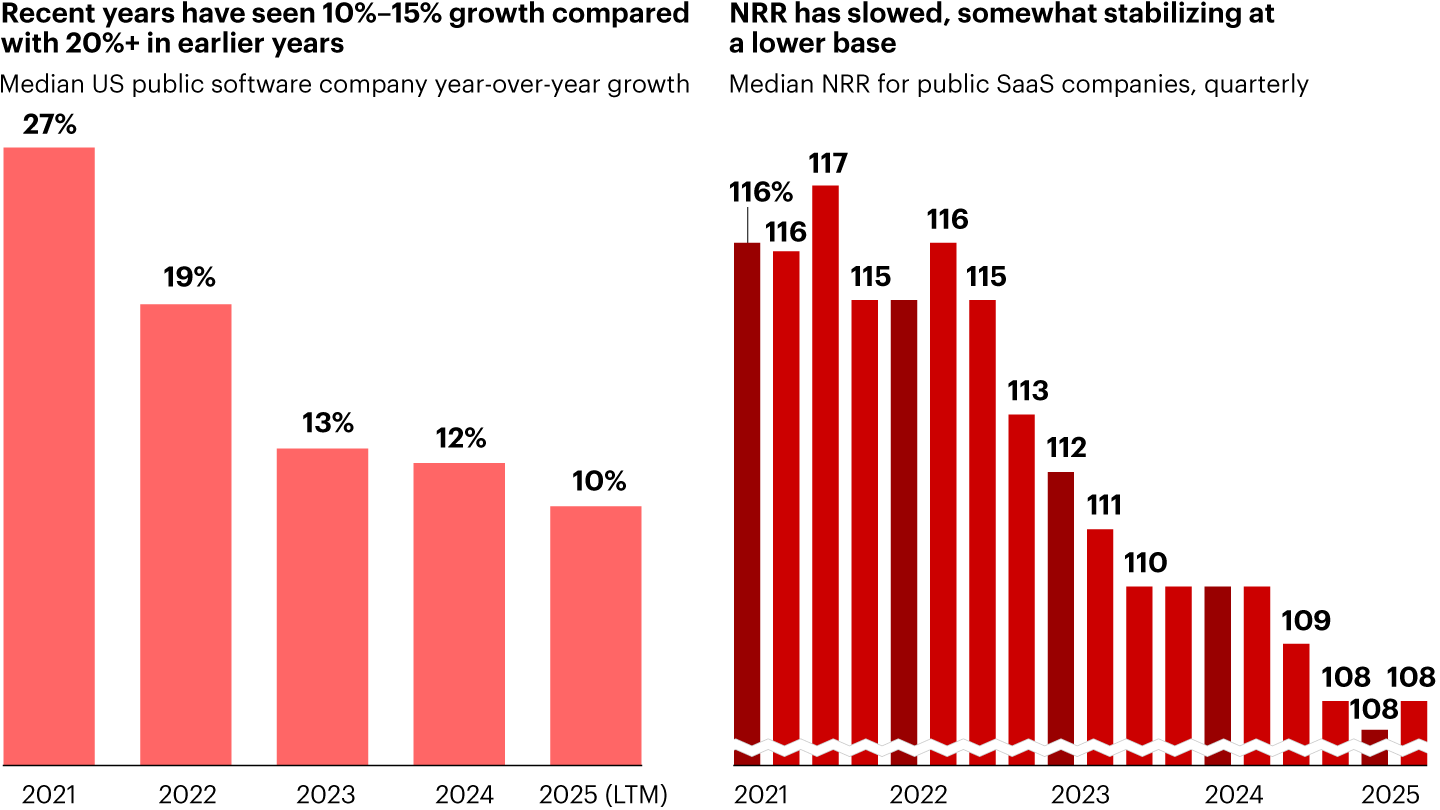
The thesis is elegant: AI has collapsed the cost of producing software by 10-100x. The moat that protected legacy SaaS (complexity, scale, years of accumulated code) is structurally weakened. A two-person team can now build a credible challenger to software that cost $50M and a decade to build.
Jared’s advice here is worth internalising verbatim: don’t start with project management tools. Go after the products that seem invulnerable. Chip design software. ERPs. Industrial control systems. Supply chain management. The giant, 10-million-line codebases that have been untouchable for decades. That’s where the real opportunity is. Not because it’s easy. It isn’t. But because nobody else has dared to try.
What most founders miss: The differentiator isn’t price. YC explicitly mentions that “clone it and sell it for one-tenth the price” is the floor, not the ceiling. The real play is AI-native architecture that makes the legacy product obsolete, not just cheaper. Think about what the product could be if you designed it for 2026, not 2010.
12. Software for Agents
Who wrote it: Aaron Epstein
This one has a phrase at its centre that I think will be quoted a lot in the next few years: “Make Something Agents Want.”
The insight is counterintuitive and genuinely interesting. Everyone is building AI agents. But agents are being deployed on top of software designed for humans: visual interfaces, click-through forms, dashboards built for eyes and fingers. Agents using this infrastructure are slow, brittle, and inconsistent. They’re navigating a world that wasn’t designed for them.
The category is asking for something different: software built explicitly for agents as first-class users. Machine-readable interfaces. APIs and MCPs instead of forms and buttons. Documentation that agents can parse to discover, sign up for, and immediately use new tools without human intervention.
What most founders miss: This is a layer-below play. You’re not building the agent. You’re building the infrastructure the agent runs on. The comparison Aaron makes implicitly is to AWS in 2006. The world was building internet companies, and the smart bet was the infrastructure underneath them. The agent economy is being built right now. The infrastructure beneath it is underserved.
13. Startups That Want to Sell to Huge Companies
Who wrote it: Harshita Arora and Brad Flora
For years, the conventional wisdom was that startups should sell to other startups. Fast-moving buyers, short sales cycles, genuine appetite for new tools. PG’s advice and it was good advice.
What’s changed is that the biggest companies in the world — F100 size, not just “big” — are now actively looking for founders who can bend AI to solve key problems for them. The people running these organisations are smart, forward-thinking, and no longer hiding behind procurement departments. They’re out searching.
Three things have shifted simultaneously. Enterprise buyers are awake and accessible in a way they never were before. Small teams can now ship products with the depth and nuance a Fortune 10 actually needs — in months, not years. And the ROI on solving problems at that scale is so large that leaders at these companies understand exactly what’s at stake if they don’t move.
What most founders miss: The pitch to a massive enterprise isn’t the same as the pitch to a Series B startup. The language is different. The proof points are different. The decision-making structure is different. But the opportunity — a multi-million dollar pilot in year one — is real in a way it simply wasn’t five years ago.
14. Supply Chain 2.0 for Semiconductors
Who wrote it: Diana Hu
A single advanced AI chip goes through roughly 1,400 process steps, crosses a dozen countries, and takes five months to build. It’s managed with spreadsheets, SAP, and phone calls. That’s not hyperbole. It’s literally how the most strategically critical supply chain in the world operates.
The gap Diana is pointing at: almost none of the tooling you’d expect exists. Real-time allocation tracking. Multi-tier risk monitoring. Export compliance automation. The companies that build this need to understand wafer allocation and packaging constraints at a deep level, which is exactly why it’s a startup opportunity rather than a feature inside an existing ERP.
15. The AI Operating System for Companies
Who wrote it: Diana Hu
Related to Company Brain but approaching the same problem from a different angle. Diana’s framing is about closed-loop intelligence: the best AI-native companies have made their entire operation queryable. Every meeting, every ticket, every customer interaction, legible to an intelligence layer that can reason across all of it.
The gap she’s identified is the integration problem. Building this today requires brutal custom work: stitching together Slack, Linear, GitHub, Notion, call recordings, and a dozen other tools. There’s no product that connects all this context into a single reasoning layer.
My read: These two categories (Company Brain and AI Operating System) will converge. The company that builds both primitives: structured knowledge plus real-time operational intelligence, will own the enterprise AI layer the way Salesforce owned CRM. It’s a genuinely large opportunity.
What This List Tells You If You’re Not Building Any of These
The RFS is useful even if your startup doesn’t fit a single category.
Read it as a map of YC’s macro bets. They’re saying the AI layer is commoditising: the model itself is less interesting than what’s built on top of it. They’re saying hardware is coming back as a frontier. They’re saying the physical world is finally vulnerable to software-led disruption. And they’re saying that the founders who win will be people who know a domain from the inside, not people who picked an industry from a spreadsheet.
If your startup sits in a different category but reflects those underlying beliefs (that you understand your market from the inside, that your product is AI-native rather than AI-enhanced, that you’re attacking a problem where the existing solution is genuinely broken) you’re in the right mental model even if you’re not on the list.
The RFS doesn’t define the universe of fundable companies. It defines the universe where YC has already done the thinking.
My Honest Take on Summer 2026
This is the most interesting RFS YC has published in several years. Here’s why.
Previous lists were largely about applying AI to existing workflows. The 2024 and early 2025 RFS iterations were heavily weighted toward enterprise software, government, and financial services: important categories, but fundamentally about layer-two applications sitting on top of existing infrastructure.
Summer 2026 goes deeper. The semiconductor supply chain entries, the chip design entries, the space manufacturing entries: these are layer-zero bets. They’re about building the infrastructure that the next decade of AI runs on. That’s a different level of ambition, and it reflects something real: the AI stack has advanced to the point where the bottleneck has shifted from software to hardware, and YC is placing bets accordingly.
The category I think is most undervalued by founders reading this list: Software for Agents. Everyone wants to build the agent. Very few people are thinking about what the agent needs. The companies that build the infrastructure layer underneath the agent economy (the APIs, the machine-readable interfaces, the documentation systems) will compound quietly for years while everyone else fights for attention in the agent application layer. That’s where I’d be looking hardest.
The category I think will generate the most noise but the least differentiated applications: SaaS Challengers. Jared’s framing is genuinely sharp, but the entry-level version of this thesis (”I’m building an AI-native version of [existing product]”) will flood YC’s inbox. The founders who stand out won’t be the ones rebuilding Notion or Asana. They’ll be the ones who’ve identified a $200M ARR software product that serves a deeply unglamorous vertical and made a credible case for why the moat is now gone.
And the category I think most founders will underestimate: AI-Native Service Companies. Not because the thesis is hard to understand. It isn’t. But because executing it requires a mental model shift that’s genuinely difficult. You’re not building software. You’re building a services company that happens to run on software. The unit economics, the go-to-market, the hiring, the positioning: all of it is different. The founders who crack it will build companies with revenue that looks nothing like traditional SaaS. And that’s the point.
The RFS Is a Signal. Use It.
If you’re applying to YC for Summer 2026, the RFS should be part of your preparation. Not as a template to force-fit your startup into, but as a framework for understanding how the partners are thinking.
The question to ask yourself: does my company reflect the beliefs behind the category I’m closest to? Do I understand the underlying thesis, not just the surface-level description? Can I articulate why now, why this market, and why my team, in the language of a partner who has already committed to the space?
If you can answer those questions clearly, you’re not just pitching a product. You’re confirming a thesis they already hold.
That’s a very different kind of conversation.
🔒 The YC Application Bundle
Everything above is free. What follows turns that framework into action.
Paid subscribers get four tools built on the exact YC framework in this article. Most founders who run through them find one or two blind spots they didn’t know they had - better here than in a ten-minute interview room.
The YC Readiness Assessment scores your startup across the four dimensions YC actually uses to evaluate founders. You get a score for each one, specific gaps identified, and actionable guidance on what to fix before you apply.
The YC Category Fit Finder takes your startup description and tests it against every Summer 2026 RFS category. You see where you land strongest, which category is your best fit, and the precise framing that sharpens your pitch for that thesis.
The YC Video Script Builder generates a complete 60-second script in YC’s preferred format - who you are, what you build, your traction, why your team, confident close. The video is where most applications die. This fixes that.
The YC Founder DNA Matrix asks you the same seven questions YC partners ask in interviews, scores your answers the way they would, and shows you exactly what a higher-scoring answer looks like. Built on 20+ years of watching founders in these rooms.
The deadline is May 4. These are the most useful thirty minutes you’ll spend before submitting.