

Every few months, Y Combinator does something almost no other investor in the world does.
They publish a list.
Not a vague thematic outlook. Not a “we’re excited about AI” blog post. A specific, partner-attributed, publicly available wishlist of exactly the kinds of companies they want to fund. They call it the Request for Startups.
Most founders glance at it. A few founders read it. Almost none of them dissect it the way they should.
That’s a mistake. Because the RFS is not just a list of ideas. It’s a window into how YC’s partners are reading the moment. It tells you which problems they believe are now solvable, which markets they think are newly vulnerable, and where they’re willing to write the first cheque.
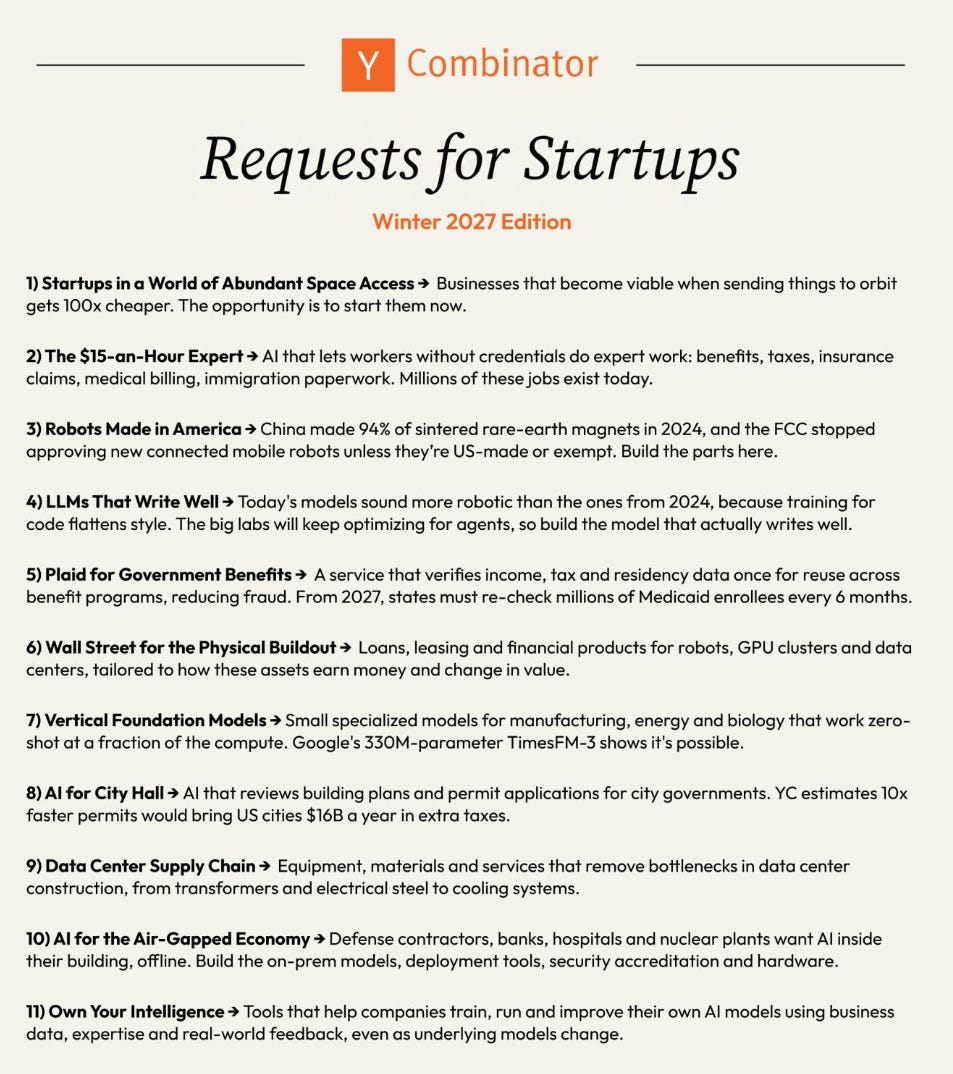
The Winter 2027 list is out, and it reads very differently from the one we dissected in July. Eleven categories. Not a single consumer app among them. And an opening line from YC that tells you almost everything about where this one is headed:
AI’s biggest bottlenecks are moving beyond the models.
Let me break it down.
First: What the RFS Actually Is (And What It Isn’t)
Before we get into the categories, a calibration.
The RFS is not a requirement. YC says so on the page itself: these ideas are only a fraction of what they fund, and you don’t need to work on any of them to apply. The best YC companies of the last decade didn’t map neatly onto a wishlist. Airbnb didn’t. Stripe didn’t.
What the RFS is is a pre-approval signal. If your company falls into one of these categories and your execution is strong, you’re not asking a partner to build conviction from scratch. The category-level thesis already exists. You’re just demonstrating that you’re the right team to execute it.
That matters more than most founders realise. A YC interview is ten minutes. Every second a partner spends building context on your market is a second they’re not spending evaluating you. If they already believe in the space, you’ve bought yourself more time for the thing that actually wins rooms: founder credibility, specificity, and conviction.
So read the RFS. Not to narrow your options, but to understand where YC’s partners have already done the work.
Fall 2026 vs Winter 2027: The Shift in One Sentence
Before diving into Winter 2027 in full, it’s worth looking back at Fall 2026, because the contrast is revealing.
Fall 2026 was a list about where AI goes next. Into classrooms, into the Army, onto ships, into the homes of aging parents, onto a billion phones. YC’s framing was that AI was moving into the physical world and founders should rebuild the systems around it.
Winter 2027 is a list about what’s standing in AI’s way. Not where intelligence should go, but why it isn’t there yet. Transformers with three-year lead times. Rare-earth magnets made almost entirely in China. Banks that underwrite a robot like a forklift. City permit offices still doing everything by hand. Hospitals and defence contractors that can’t send their data to an API.
Three other shifts are worth noting.
Consumer has disappeared. Fall 2026 had three consumer-facing categories, including a direct challenge to build AI products for a billion people. Winter 2027 has none.
Crypto has gone too. Last batch’s contrarian bear-market bet doesn’t reappear.
And the authorship has come back inside. Fall 2026 featured, for the first time, a sitting cabinet official (Army Secretary Daniel Driscoll) and operator-founders writing from inside their own companies. Every Winter 2027 entry is written by someone at YC. Six authors, eleven categories. Brad Flora wrote three of them, and all three lean on what YC is already seeing inside its own portfolio. That’s a different kind of signal: less “here’s a thesis we find interesting,” more “here’s a pattern we keep watching our founders hit.”
If you’re raising, here are 6 more worth your time:
The Claude Guide Every Founder Should Run Before Fundraising - your deck isn’t read by a partner first anymore. It’s read by a model. Here’s how to pass the screen before a human ever sees it.
The 6 Claude Prompts That Change What You Walk Into the Room With - the meeting system that gets you prepared for the investor, not just the pitch.
The Claude Prompt That Turns a Cold Email Into One a VC Actually Reads - cold emails convert at 3%. Here’s the five-prompt system that beats it.
The Two-Minute Investor Briefing Every Founder Should Be Running - the Claude agent that turns a fund and partner name into a full investor briefing before every meeting.
I Asked Claude to Reject My Pitch Until It Couldn’t. Then I Raised. - the adversarial system that finds every weak point in your pitch before an investor does.
How to Build Your Fundraising Narrative with Claude - the five-prompt sequence that turns your raw story into the argument that actually closes rounds.
The Three Threads Running Through Winter 2027
When you read all eleven categories together, three distinct theses emerge, plus one clear outlier.
Theme 1: The buildout needs atoms, and the capital to pay for them.
Robots Made in America, Data Center Supply Chain, Startups in a World of Abundant Space Access, and Wall Street for the Physical Buildout all describe the same problem from different ends. AI’s next phase runs on physical things: robots, transformers, switchgear, launch capacity, GPU clusters. Those things are scarce, often imported, and expensive to finance. A clear sub-theme runs through two of them: building it in America, rather than depending on Chinese magnets or a single domestic steel plant.
Theme 2: AI has to get past the walls.
AI for City Hall, Plaid for Government Benefits, and AI for the Air-Gapped Economy are about the parts of the economy where the data and the work are locked behind regulation, procurement, or a literal absence of internet connection. These are the slowest customers to sell to. YC’s argument, made explicitly in two of the three entries, is that this is exactly why the companies that get in will be so hard to dislodge.
Theme 3: The era of renting all your intelligence is ending.
Own Your Intelligence, Vertical Foundation Models, and LLMs That Write Well all make some version of the same argument: the frontier labs are optimising for things that leave real gaps. Open-weight models have caught up. Specialised models can be cheaper and better in narrow domains. And the labs’ focus on coding has, in one partner’s view, made their models worse at sounding human. This is the most quietly provocative thread on the list.
The outlier: The $15-an-Hour Expert.
It doesn’t sit inside any of the three threads. It isn’t a technology thesis at all. It’s a labour-market thesis: that AI’s biggest economic effect may be turning ordinary workers into specialists, rather than replacing them.
A Category-by-Category Dissection
Here’s what each Winter 2027 category is actually saying, and what most founders will miss about it.
1. Startups in a World of Abundant Space Access
Who wrote it: Ankit Gupta
The setup: SpaceX is projecting a future of 10,000 Starship launches a year. An expendable Starship is already close in cost to a reusable Falcon 9, and far cheaper per kilogram. As Starship becomes reusable, Gupta expects launch costs per kilogram to fall by several orders of magnitude. The ask is for business models that don’t quite work today, but would work if launch got 100x cheaper.
What most founders miss: this is a timing bet, not a hardware bet. YC is explicitly asking for companies that are early on purpose. The pitch that wins here isn’t “we’ve built a satellite.” It’s a precise argument about which cost threshold unlocks your business, roughly when that threshold arrives, and what you can sell before it does.
2. The $15-an-Hour Expert
Who wrote it: Brad Flora
The contrarian framing: everyone talks about AI replacing workers. Flora wants the opposite, AI that turns a capable person without credentials into someone doing specialist work. He names the target zones: benefits, taxes, insurance claims, medical billing, immigration paperwork. Anywhere a credential is the bottleneck. His closing line is the most ambitious on the list: the last industrial revolution built a middle class from factory jobs, and this one could build it from expert jobs.
What most founders miss: this isn’t a software category. The company is the workforce. The product is a trained, AI-backed team doing work customers used to pay specialists for. Which means the hard problems are hiring, training, quality control, and margin, not model choice.
3. Robots Made in America
Who wrote it: Diana Hu
Hu’s argument is that robot foundation models are starting to transfer skills between robots, which moves the bottleneck to hardware. The numbers are pointed. The US installed 38,400 industrial robots in 2025, up 12%, but most are imported from Japan and Europe. China made 94% of the world’s sintered rare-earth magnets in 2024, and when it restricted exports in April 2025, some automakers had to cut production. In July, the FCC stopped authorising new connected mobile robot models unless they’re made in the US or get an exemption.
What most founders miss: the rule has a number attached. More than 65% of a robot’s component cost must be domestic, rising to 75% in 2029. Assembly doesn’t clear that bar. The opportunity is in the parts list Hu spells out: magnets, motors, strain-wave gears, encoders, force sensors, grippers, chips, battery packs, and the machines that make them. Unglamorous components with a regulatory tailwind are a very different business from building the next humanoid.
4. LLMs That Write Well
Who wrote it: Jared Friedman
The most surprising entry on the list. Friedman argues that as LLMs got better at code and maths, they got worse at writing: current models sound more robotic than the ones from 2024 and 2025. His diagnosis is structural. The reward signals that make models good at coding flatten voice and style, and the major labs will always prioritise coding and agents when forced to choose.
What most founders miss: this is a model-training company, not a writing app. Wrapping a frontier model in a “make it sound human” prompt is precisely what this entry argues doesn’t fix the problem.
To be fair to the labs, this is a claim, not a settled fact. A single training-priority shift at any frontier lab could close the gap. Founders building here need a reason their advantage survives that.
5. Plaid for Government Benefits
Who wrote it: Gustaf Alströmer
Anyone who has applied for benefits knows the loop: prove your income, your household, your address, then do it again for the next programme and again at renewal. No agency shares data. Honest people get rejected over a missing document while fraud gets through. Alströmer cites the Government Accountability Office estimate that fraud costs the federal government up to half a trillion dollars a year, and notes AI can now forge a pay stub in seconds. The ask: a consent-based layer that pulls verified income, tax and residency data from source into every programme at once. Verify once, apply everywhere.
What most founders miss: there’s a dated forcing function. From 2027, states must re-check millions of Medicaid enrollees every six months. That’s a specific, recurring, legally mandated workload landing on state agencies, and it’s a far sharper wedge than “modernise government benefits.”
6. Wall Street for the Physical Buildout
Who wrote it: Brad Flora
Software is cheap to start. Robots, GPU clusters and data centres aren’t, and somebody has to fund all that steel and silicon upfront. Flora’s observation is that the financing mostly doesn’t exist yet. Banks underwrite a robot like a forklift. YC founders are inventing the instruments themselves: a lender for robots that each earn $500k a year, put options on GPU capacity. Every great buildout, from railways to electricity to telecoms, created giant financial companies alongside it.
What most founders miss: the founder profile is unusual. Flora wants people who understand both the machines and the money. A fintech founder without hardware literacy can’t price the asset. A hardware founder without capital-markets experience can’t structure the instrument. The rare team that has both is competing against almost nobody.
7. Vertical Foundation Models
Who wrote it: Diana Hu
Hu wants research labs building specialised foundation models for manufacturing, energy and biology that work zero-shot or from a handful of examples. Her reference point is Google’s TimesFM-3: a 330M-parameter forecasting model that works across related time series with no task-specific fine-tuning. Trained once, each user brings their own history as context. The bar is explicit: match or beat general-purpose models at orders of magnitude less inference compute.
What most founders miss: Hu names the hard part herself, and it isn’t the architecture. It’s high-quality, verifiable, vertical-specific rewards, and the rights to the data. A team that has deep domain access and data rights already in hand is starting the race several laps ahead of a team with a better model idea.
8. AI for City Hall
Who wrote it: Gustaf Alströmer
If you want to build a house or start a business in America, you need your city’s permission first. Forms, plan reviews, inspections, months of waiting. In some cities the permit takes longer than the build. Alströmer’s maths: if every US building permit were approved in 10% of the current time, US cities would gain $16 billion a year in additional tax revenue. There are 19,000 cities, and almost all still do this by hand.
What most founders miss: the line that matters most is the one dismantling the objection. The conventional wisdom says you can’t sell software to government. Alströmer says that used to be true and no longer is, and that some of YC’s government-AI companies are growing faster than almost anything else they’ve seen. The permit is the wedge. 311, public records, licensing and inspections are the expansion path he names.
9. Data Center Supply Chain
Who wrote it: Jared Friedman
Friedman calls the AI data centre buildout the largest capital investment project in American history: bigger than the railways, the highways and the Manhattan Project combined. Everyone knows about the demand for GPUs, power and electricians. He points at the non-obvious bottlenecks instead. Large power transformers have a three-year lead time. Switchgear, circuit breakers and liquid cooling equipment are sold out. The grain-oriented electrical steel used in transformer cores is made at a single US plant, which can’t keep up.
What most founders miss: this is the broadest entry on the list, which makes it the easiest to pitch badly. “We serve the data centre buildout” is not a thesis. The founders who stand out will name one specific sold-out component and show how they shorten its lead time.
10. AI for the Air-Gapped Economy
Who wrote it: Brad Flora
The most valuable data in the world isn’t in the cloud. Defence contractors, banks, hospitals and nuclear plants keep it behind walls and can’t send it to an AI API. Flora says YC founders keep hitting the same wall: the customer loves the product and wants it running entirely inside their own building with no internet connection. The ask covers on-prem models, deployment tooling, security accreditation and hardware.
What most founders miss: Flora is unusually candid about the trade. It’s slower and harder to sell. It’s also where the largest budgets and most defensible companies are. Security accreditation is listed as a category in its own right, which suggests that helping other AI companies get through the walls may be a business before building your own product inside them.
11. Own Your Intelligence
Who wrote it: Jon Xu
Today nearly every company building with AI rents its intelligence: send tokens to a frontier lab, get answers back, pay the bill. That made sense when the best models were years ahead. Xu argues it no longer does, because open-weight models are now competitive on meaningful benchmarks and companies are increasingly aware of their dependency. He expects more of them to own models they improve on their own data and run where they choose, particularly in regulated industries.
What most founders miss: the gap Xu describes isn’t model hosting. It’s everything between downloading an open model and owning one that improves the business: turning workflows into evals, expertise into training data, production failures into improvements, and carrying all of it forward to each new base model. That last part, surviving the base-model upgrade cycle, is where most fine-tuning efforts quietly die. He’s also careful to say companies will keep renting frontier intelligence for their hardest problems. This is “and,” not “instead.”
What This List Tells You If You’re Not Building Any of These
The RFS is useful even if your startup doesn’t fit a single category.
Read it as a map of YC’s macro bets right now. They’re saying the model is no longer the constraint; the constraints are physical supply, financing, regulation and data access. They’re saying the slowest, most walled-off customers (governments, hospitals, defence, banks) are now worth the sales cycle. And they’re saying the dependency on a handful of frontier labs is a strategic risk companies will pay to reduce.
If your startup sits in a different category but reflects those beliefs (that you’re removing a real bottleneck rather than adding another AI layer, that you can sell into a hard customer others avoid, that your advantage survives the next model release) you’re in the right mental model even if you’re not on the list.
The RFS doesn’t define the universe of fundable companies. It defines the universe where YC has already done the thinking.
My Honest Take on Winter 2027
This is the least science-fiction list YC has published in a while, and probably the most commercially grounded. Even the space entry is framed as an economics question rather than a moonshot. What’s here instead is a series of very specific shortages: of transformers, of magnets, of financing instruments, of permit reviewers, of models that can run without the internet.
The category I think is most underpriced by founders reading this list: Wall Street for the Physical Buildout. Fintech founders don’t read hardware RFS entries, and hardware founders don’t think of themselves as lenders. If Flora is right that every great buildout created giant financial companies alongside it, this one is still waiting for its first.
The category I expect to generate the most applications and the least differentiation: Own Your Intelligence. Every fine-tuning, eval and model-hosting startup will reach for this framing. The founders who stand out won’t be the ones arguing open-weight models have caught up. Everyone will say that. They’ll be the ones who can show a customer’s model getting better after a base-model upgrade, not just before it.
And the category I think most founders will misjudge: The $15-an-Hour Expert. The instinct will be to read it as an AI-tools category and pitch a copilot for claims adjusters. The entry describes something closer to a services company with AI leverage, where the workforce is the product. The founders who win here will know exactly which tasks legally require a credential and which only traditionally did, because that line is the entire business.
The RFS Is a Signal. Use It.
If you’re applying to YC for Winter 2027, the RFS should be part of your preparation. Not as a template to force-fit your startup into, but as a framework for understanding how the partners are actually thinking.
On-time applications for the Winter 2027 batch close on 2 November at 8pm PT (4am UK time on 3 November). On-time applicants get a decision by 11 December, and the batch runs January to March in San Francisco. YC still considers late applications but won’t promise a timeline, and Early Decision is open for the Spring, Summer and Fall batches if this one is too soon.
The question to ask yourself: does my company reflect the beliefs behind the category I’m closest to? Do I understand the underlying thesis, not just the surface-level description? Can I articulate why now, why this market, and why my team, in the language of someone who has already committed to the space?
If you can answer those questions clearly, you’re not just pitching a product. You’re confirming a thesis they already hold.
That’s a very different kind of conversation.
🔒 The YC Application Bundle
Everything above is free. What follows turns that framework into action.
Paid subscribers get four tools built on the exact YC framework in this article. Most founders who run through them find one or two blind spots they didn’t know they had; better here than in a ten-minute interview room.
The YC Readiness Assessment scores your startup across the four dimensions YC actually uses to evaluate founders. You get a score for each one, specific gaps identified, and actionable guidance on what to fix before you apply.
The YC Category Fit Finder takes your startup description and tests it against every Winter 2027 RFS category. You see where you land strongest, which category is your best fit, and the precise framing that sharpens your pitch for that thesis.
The YC Video Script Builder generates a complete 60-second script in YC’s preferred format: who you are, what you build, your traction, why your team, confident close. The video is where most applications die. This fixes that.
The YC Founder DNA Matrix asks you the same seven questions YC partners ask in interviews, scores your answers the way they would, and shows you exactly what a higher-scoring answer looks like. Built on 20+ years of watching founders in these rooms.
Plus full access to the entire Founders Corner archive - every prompt, framework, and teardown we’ve published on getting a round closed.
Start your 7-day free trial → Cancel anytime.
The Four Things Standing Between You and a YC Interview
Download below