

👋 Hey, Chris here! Welcome to The Founders Corner. If you’ve been reading along, you’ll know I have very little patience for theory that doesn’t survive contact with a real buyer.
This series is a preview of a new book I’ve written with my partners Richard Blundell and Paul Watson — The Selling Software Algorithm: The Go-to-Market Navigation System for B2B Software Leaders.
It isn’t a strategy deck dressed up as a book. Between the three of us we’ve spent close to seven decades inside B2B software as founders, operators, investors and coaches — building companies, exiting some, and quietly breaking a few along the way, which is where most of the real learning lives. Through our work at Vencha we’ve now supported hundreds of founders trying to do the single hardest thing in software: turn a clever product into predictable commercial traction in a market that’s noisy, cautious, and more crowded than it has ever been.
One pattern shows up again and again. Companies rarely struggle because the product is bad. They struggle because they have no navigation system for going to market. This book is that system.
Most founders know their product is different. The problem is that their homepage often doesn’t make that difference obvious.
That matters more than it used to. Buyers are moving quickly, they have seen hundreds of versions of the same claims, and they are not going to spend five minutes working out what makes you different.
There is a very simple way to find out whether your message is doing its job. Take the hero message off your homepage and put it on your closest competitor’s. Then ask yourself a slightly uncomfortable question: would anyone notice?
That is where we’ll start.
Table of Contents
A Simple Test: Swap Your Homepage With a Competitor’s
Seven Seconds, and Not a Second More
Why “Why” Beats “What” and “How”
One Armour-Piercing Message, Not Five Soft Ones
Strip Away the Algorithms and the Platforms
The Modern Messaging Stack
Matching Your Message to the Curve You Just Mapped
A Simple Test: Swap Your Homepage With a Competitor’s
Take the hero message off your website. Paste it onto your closest competitor’s homepage. Now ask your team whether anyone would notice.
If nobody would, the message isn’t yours. It’s category wallpaper, and it’s costing you every visitor who arrives without already knowing who you are.
The test works because it strips out everything you know about your own product and leaves only what the buyer can see. You know your architecture is different. They don’t, and they aren’t going to burn the mental calories finding out.
Seven Seconds, and Not a Second More
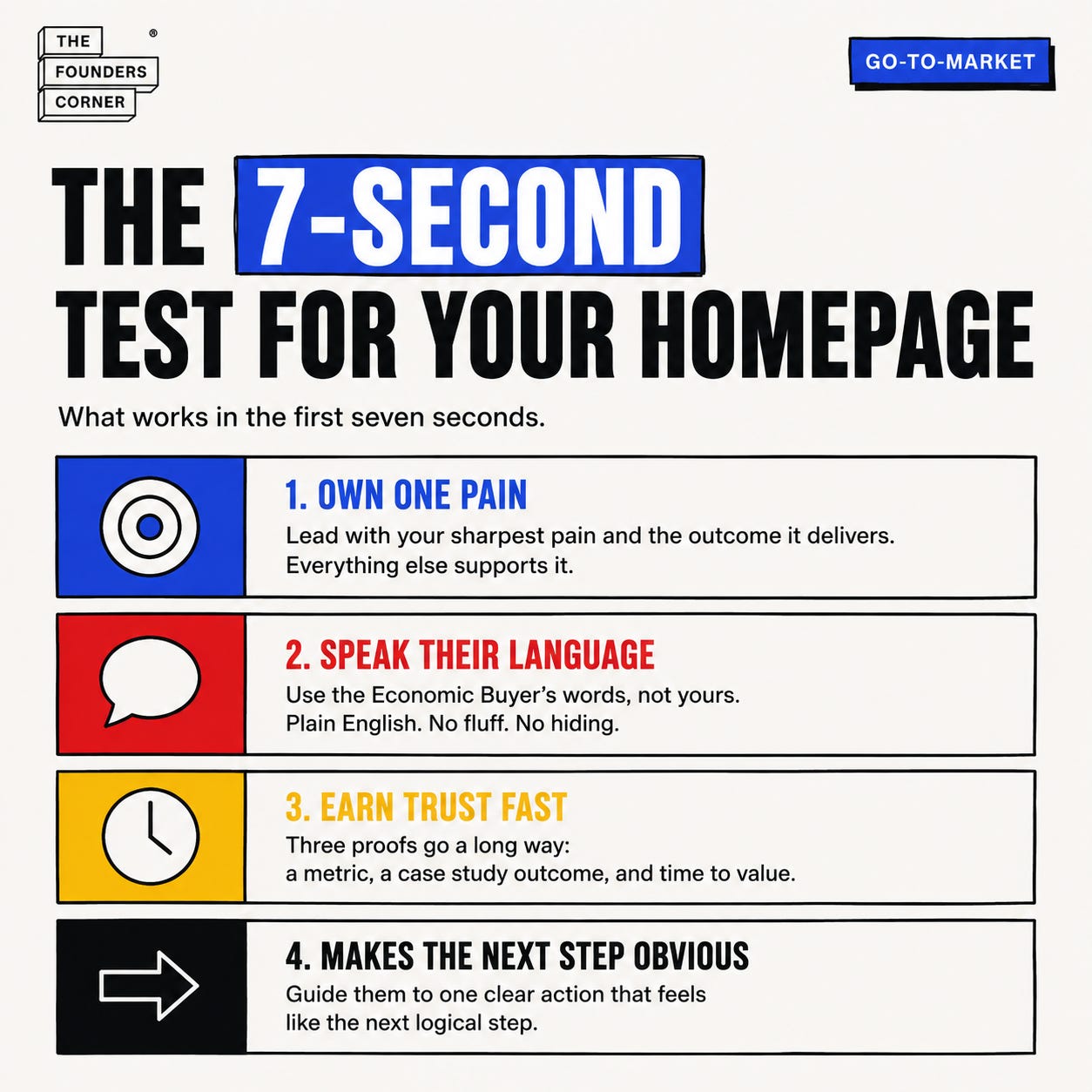
Buyers scroll the way everyone now scrolls. You have roughly seven seconds, often less, to produce the small internal jolt of recognition that says “that’s me.”
They don’t owe you patience. They don’t owe you curiosity. They certainly don’t owe you a meeting. Your messaging has to earn its place before it earns their attention, and most of it never does, because it was written to satisfy the founder’s pride rather than the buyer’s need.
There’s a deeper version of this too. Most software companies write messaging about operational pain: time saved, cost reduced, workflow streamlined. All true, all useful later as a convincer. But the great ones go one layer down, to the reputational risk, the internal politics, the recurring problem that keeps surfacing in leadership conversations. You’re not only selling operational improvement. You’re selling relief, credibility, and a better leadership story.
Why “Why” Beats “What” and “How”
“We are an AI-powered platform that uses machine learning to optimise X” isn’t a message. It’s a product description, and it forces the buyer to do the interpretation. Buyers no longer interpret. They discard.
Lead with “how” and you’ll lose even faster. “We unify data across systems using our proprietary engine” may be entirely true, and it’s still not the reason anyone will care.
Lead with why it matters, which usually means pain, consequence and outcome, in plain English, in the Economic Buyer’s own voice. If a twelve-year-old can’t read your homepage and explain what you do, the language is too complicated. Complexity isn’t sophistication. It’s usually fear, because vague language lets you hide and clear language forces you to commit.
From the book: what great hero messages sound like
One Armour-Piercing Message, Not Five Soft Ones
The most common failure here is the multi-message compromise. A company tries to speak to everyone, writes five value statements, dilutes each one slightly, and hopes the buyer will pick the one that fits.
Buyers don’t do that. They glance, they judge, and they leave.
You need one armour-piercing message, anchored in your number one pain. The second and third pains can sit underneath it, but the hero line leads with the sharpest blade you have: the knife in your product, the thing that changes their world most urgently.
If you’re unsure what that knife is, go back to your pain wheel rankings and ask a brutally simple question. Which pain, if removed, would make the Economic Buyer feel the greatest relief? That’s usually the knife.
Strip Away the Algorithms and the Platforms
There is a time to explain how you do it. It isn’t in the first seven seconds of someone reading your website.
Words like “platform”, “algorithm”, “proprietary engine”, “next generation” and “AI-powered” are, in early messaging, a form of hiding. They signal sophistication without stating meaning. Economic Buyers don’t buy sophistication. They buy business outcomes they can defend in a room full of people who weren’t on your demo.
Removing that decorative language isn’t dumbing down. It’s respecting their time.
The Modern Messaging Stack
Once your algorithm is clear, the structure that follows is straightforward, and it forces your language to stay buyer-first.
The hero message carries the top pain and the outcome. One line names who it’s for, narrow and specific, ideally naming the Economic Buyer outright. Three supporting proofs follow: a metric, a case study outcome, a time-to-value claim. Then a calm call to action, not “book a demo” but something that feels like the next logical step, such as “see how it works in your world”.
That sequence mirrors how buyers actually process information. Fast emotional recognition first, then credibility, then action.
From the book: the Modern Messaging Stack
Matching Your Message to the Curve You Just Mapped
Last time we mapped readiness, and the same discipline applies here. Not everyone inside your perfect customer profile is ready to hear the same thing.
Late adopters, particularly around AI, arrive nervous and unsure what to ask. They fear hallucinations, compliance exposure and reputational fallout, and they want proof, references and reassurance. Innovators and early adopters respond to clarity, urgency and an ambitious outcome, but they respond to honesty just as strongly. They want to know what’s possible, what’s proven, and what’s safe.
Your messaging should be built for the part of the curve you’re targeting first, which early on should almost always be that front section of your perfect customer profile.
This is exactly what Builder Step 5 exists to check: whether your hero message, your named buyer and your three proofs actually hold together, or whether you’ve written five soft messages and hoped one of them lands.
Selling Software Algorithm Builder, Step 5: Messaging (recreated illustrative mockup based on the tool’s documented output; a fictional example company is shown)
Next in the series, we look at what happens when the algorithm stops being a document and becomes behaviour, and why this is the one piece of work a founder cannot delegate.
-Chris Tottman
Most hero messages could sit on a competitor’s website without anyone noticing, because they were written to describe the product rather than change the buyer’s world.
The Selling Software Algorithm Builder Step 5 tests your messaging against your Economic Buyer and your three pains, and shows you exactly where it goes soft.
Start your 7-day free trial → Cancel anytime.