

👋 Hey, Chris here! Welcome to The Founders Corner. If you’ve been reading along, you’ll know I have very little patience for theory that doesn’t survive contact with a real buyer.
This series is a preview of a new book I’ve written with my partners Richard Blundell and Paul Watson — The Selling Software Algorithm: The Go-to-Market Navigation System for B2B Software Leaders.
It isn’t a strategy deck dressed up as a book. Between the three of us we’ve spent close to seven decades inside B2B software as founders, operators, investors and coaches — building companies, exiting some, and quietly breaking a few along the way, which is where most of the real learning lives. Through our work at Vencha we’ve now supported hundreds of founders trying to do the single hardest thing in software: turn a clever product into predictable commercial traction in a market that’s noisy, cautious, and more crowded than it has ever been.
One pattern shows up again and again. Companies rarely struggle because the product is bad. They struggle because they have no navigation system for going to market. This book is that system.
Most of this series has walked through the algorithm one clause at a time: the Economic Buyer, the Perfect Customer Profile, the three pains. This time, we go back and sharpen a piece we skipped past too quickly.
Because there’s a moment that repeats in almost every one of these sessions. A team spends two hours on the four strands of DNA, writes a profile paragraph they’re genuinely proud of, and then goes looking for accounts. Three months later the pipeline is full of companies that match the paragraph perfectly and behave nothing like the customers who made them believe they had a business in the first place. The profile wasn’t wrong. It just wasn’t doing the job they thought it was doing.
Table of Contents
A Simple Example: Two Companies, One Paragraph
A Profile That Describes, and a Profile That Filters
The Question That Does the Real Work
Real Non-Negotiables From Real Companies
Why Vague Answers Are a Warning Sign
What It Means If You Genuinely Don’t Have One
The One-Sentence Test
Where This Lives in Your Algorithm
A Simple Example: Two Companies, One Paragraph
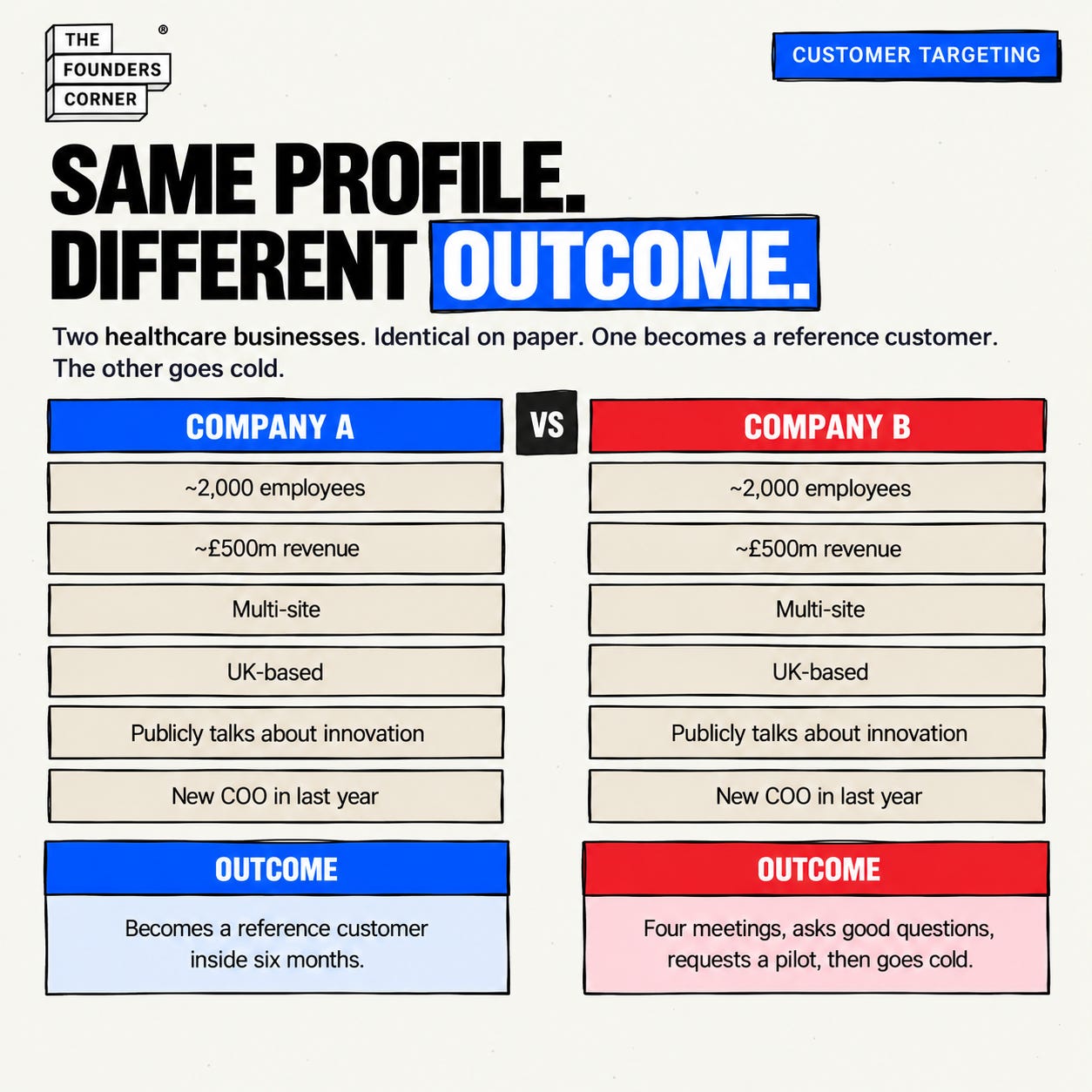
Picture two mid-market healthcare services businesses. Both have around 2,000 employees. Both turn over roughly half a billion. Both are multi-site, both are UK-based, both have a leadership team that talks publicly about innovation, and both appointed a new COO in the last year.
On paper, they are the same account. Any sensible reading of your DNA profile puts them side by side on the focus list, and any sensible rep works them the same way.
One of them becomes your best reference customer inside six months. The other takes four meetings, asks good questions, requests a pilot, and quietly goes cold in a way nobody can quite explain afterwards.
The difference usually isn’t the product, the rep, or the timing. It’s that the first company was already running a mission-critical process in a spreadsheet that broke every month, and the second one wasn’t. Nothing in the profile paragraph captured that, because the paragraph was built to describe a type of company, not to test a specific one.
Want to get in front of 250k+ founders and investors?
For sponsorship opportunities across The Founders Corner newsletter and LinkedIn (160k followers), email: founderscornermedia@gmail.com
A Profile That Describes, and a Profile That Filters
The four strands of DNA, demographic, geographic, psychographic and behavioural, give you a Perfect Customer Profile with real texture. It’s a genuine step up from “mid-market SaaS companies” and it’s the work most founders never do properly. So when a team finishes it, the instinct is to stop. The paragraph sounds concrete. It survives being read out loud. It feels finished.
A paragraph is not a filter, though. It describes a company that would fit. It doesn’t tell you which companies must fit, and that distinction is worth an entire chapter on its own.
Here’s the practical test. Take your profile paragraph and try to use it to say no to an account someone on your team is excited about. Most profiles fold instantly. There’s always a strand you can argue is close enough, always a reason this one is a bit different, always a “well, they’re not quite that size, but the pain is the same.” A description invites interpretation. That’s what descriptions are for.
A filter doesn’t. A filter is a condition that either holds or doesn’t, and everybody in the room can see which.
The Question That Does the Real Work
What MUST be true about a Perfect Customer to deliver maximum value?
Ask it slowly, and insist on specifics. Not “it would help if”. Not “ideally they”. Must.
The word is doing all the work, and your team will try to soften it. That’s not a lack of rigour, it’s an entirely rational instinct: a “must” closes doors, and closing doors on a Tuesday when the quarter looks thin is uncomfortable. Say the word out loud, more than once, and make people finish the sentence with something you could actually verify from the outside.
In every successful software business we’ve worked with, there’s at least one non-negotiable condition that makes the product click. Take that condition away, and even a company that matches every other strand of the DNA profile will underperform, churn early, or never quite get to delight.
That last word matters more than it looks. The bar isn’t whether they’ll buy. Plenty of companies will buy. The bar is whether they’ll become the kind of customer who renews without a fight and puts your name in front of the next three accounts unprompted.
Real Non-Negotiables From Real Companies
The condition takes different shapes in different businesses.
Sometimes it’s structural: the company must already run a mission-critical process in a spreadsheet and feel that pain daily. That’s not a proxy for the pain, it is the pain, and it’s visible in a discovery call within ten minutes.
Sometimes it’s regulatory: they must operate somewhere audit friction or reporting accuracy is genuinely non-negotiable, not a slogan on a values page. Regulated is a useful word only if it changes what happens when something goes wrong.
Sometimes it’s technical: they must already run a specific CRM or data platform you integrate with cleanly, because the integration is what turns a three-month implementation into a three-week one, and the whole value case depends on that gap.
And sometimes it’s about mandate rather than environment: the buyer must be under explicit pressure to fix something this year, not “at some point”. A company can match your PCP perfectly and still be the wrong account this quarter if that mandate isn’t there yet. This is the one teams miss most often, because it’s the only condition that changes with time. The same logo can be a hard no in March and your best deal of the year in September.
Why Vague Answers Are a Warning Sign
If your team can’t get past “it would help if they had budget” or “ideally they’re already using AI”, that vagueness is telling you something.
Budget isn’t a condition, it’s a consequence. Every company has budget for the thing they’ve decided they have to fix. “Already using AI” isn’t a condition either, it’s a mood. Neither one lets you look at two accounts and say, with a straight face, that one of them is out.
The useful signal in a vague answer is that it usually means one of two things. Either the non-negotiable hasn’t been found yet, and it’s sitting inside your existing customer base waiting for someone to go and look for it. Or your product doesn’t actually have one, which is a much bigger problem, and much better surfaced now than a year into a confused pipeline.
What It Means If You Genuinely Don’t Have One
Sit with that second possibility for a moment rather than arguing with it.
A product with no non-negotiable condition is a product that works roughly equally well everywhere, which sounds like a strength and behaves like a weakness. It means nothing about a customer’s situation makes you obviously the right answer. It means your value is real but marginal, the kind that shows up in a business case as a nice-to-have and gets deferred the moment something urgent lands.
Founders in this position usually don’t have a targeting problem. They have a product or positioning problem wearing a targeting problem’s clothes, and no amount of better filtering will fix it. The honest move is to go back to your ten best customers, find the one thing that was true for all of them and untrue for the ones who churned, and build toward it deliberately.
That’s a harder quarter. It’s a much better year.
The One-Sentence Test
Refine the answer until it fits in one clean sentence. For example:
“We deliver maximum value when a company is heavily regulated, is managing risk in silos, and is under constant board-level scrutiny to prove compliance.”
Notice what that sentence does. Three conditions, all of them observable from outside the account, none of them requiring the buyer to agree with you first. A rep can hold it in their head on a call. A marketer can build a list against it. A product lead can use it to decline a roadmap request without it turning into a debate about strategy.
If your version needs a paragraph of context to make sense, it isn’t finished. If it uses words like “innovative” or “forward-thinking”, it isn’t finished either, because those describe how a company would like to be seen rather than what is actually true about it.
When you can say it that clearly, you’ve found the condition that makes value inevitable rather than merely possible. The book calls it the cherry on the cake. In practice it’s closer to the thing holding the cake together.
Where This Lives in Your Algorithm
This sits as an optional field inside Step 1 of the Builder, right alongside the four strands of DNA.
Being optional makes this field easy to skip on a first pass, and most teams do skip it, because it’s the one question in the whole exercise that can’t be answered by consensus. It’s also the one that sharpens everything downstream once a team goes back and fills it in properly: the market map gets shorter, the focus list gets more honest, and the accounts your reps walk away from stop being a source of argument.
Selling Software Algorithm Builder, Step 1: Perfect Customer (recreated illustrative mockup based on the tool’s documented output; a fictional example company is shown)
Next in the series, we turn a spreadsheet of accounts into something your team actually recognises: the Market Map Face Book, and why a market map without faces is just a list.
-Chris Tottman
Most PCPs describe a company that would fit. Few name the one condition that must be true for it to actually work.
The Selling Software Algorithm Builder Step 1 has a dedicated field for exactly this, so the question doesn’t get skipped on a busy afternoon.
Start your 7-day free trial → Cancel anytime.