

👋 Hey, Chris here! Welcome to The Founders Corner. If you’ve been reading along, you’ll know I have very little patience for theory that doesn’t survive contact with a real buyer.
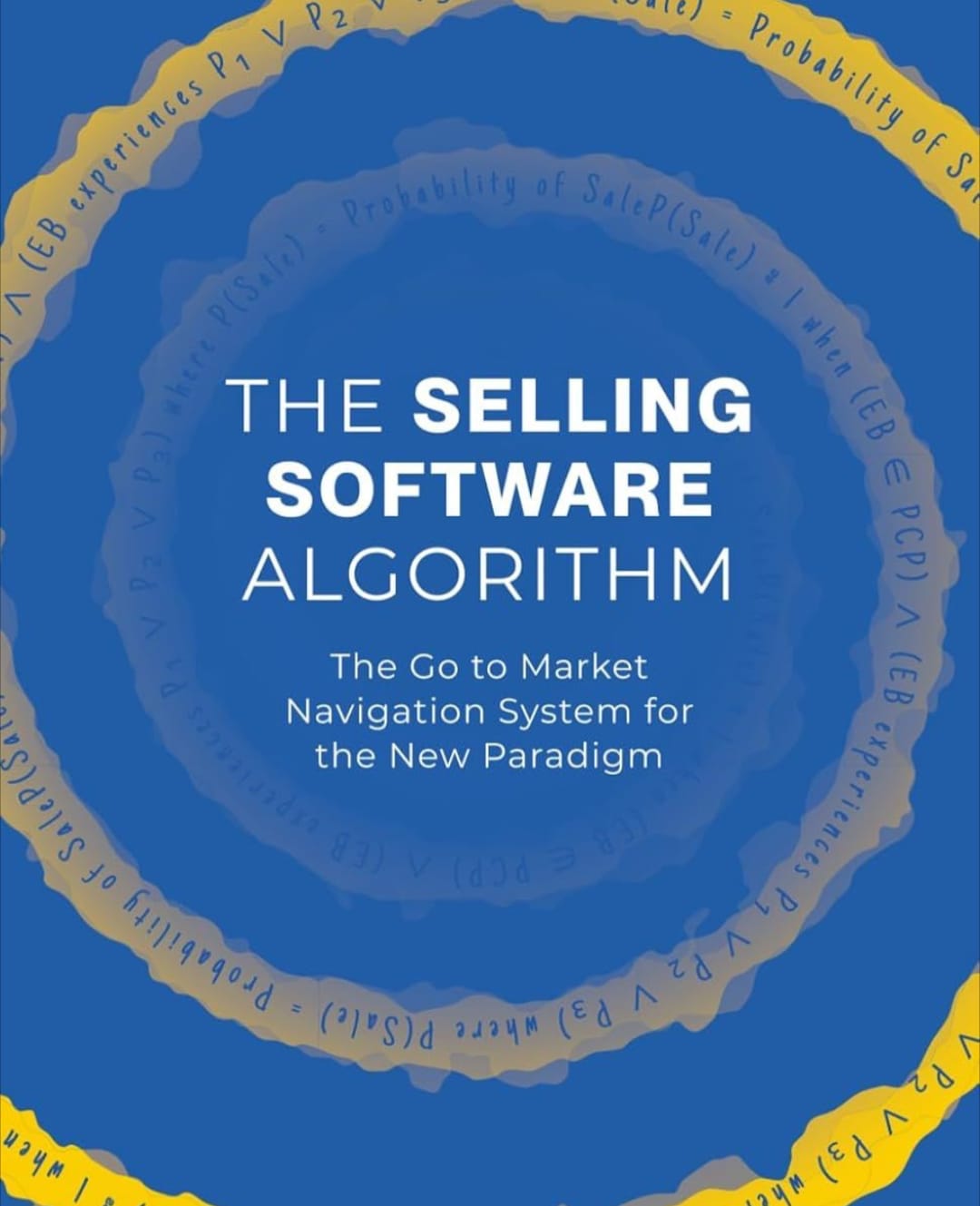
This series is a preview of a new book I’ve written with my partners Richard Blundell and Paul Watson — The Selling Software Algorithm: The Go-to-Market Navigation System for B2B Software Leaders.
It isn’t a strategy deck dressed up as a book. Between the three of us we’ve spent close to seven decades inside B2B software as founders, operators, investors and coaches — building companies, exiting some, and quietly breaking a few along the way, which is where most of the real learning lives. Through our work at Vencha we’ve now supported hundreds of founders trying to do the single hardest thing in software: turn a clever product into predictable commercial traction in a market that’s noisy, cautious, and more crowded than it has ever been.
One pattern shows up again and again. Companies rarely struggle because the product is bad. They struggle because they have no navigation system for going to market. This book is that system.
Almost every software founder starts out believing the same comforting thing.
That the size of the opportunity is the point. That a bigger market means a bigger business. That if the product can help almost anyone, then surely the growth will take care of itself.
It feels like ambition. It looks like confidence on a pitch deck.
It’s actually the fastest route to a company that works incredibly hard and goes almost nowhere.
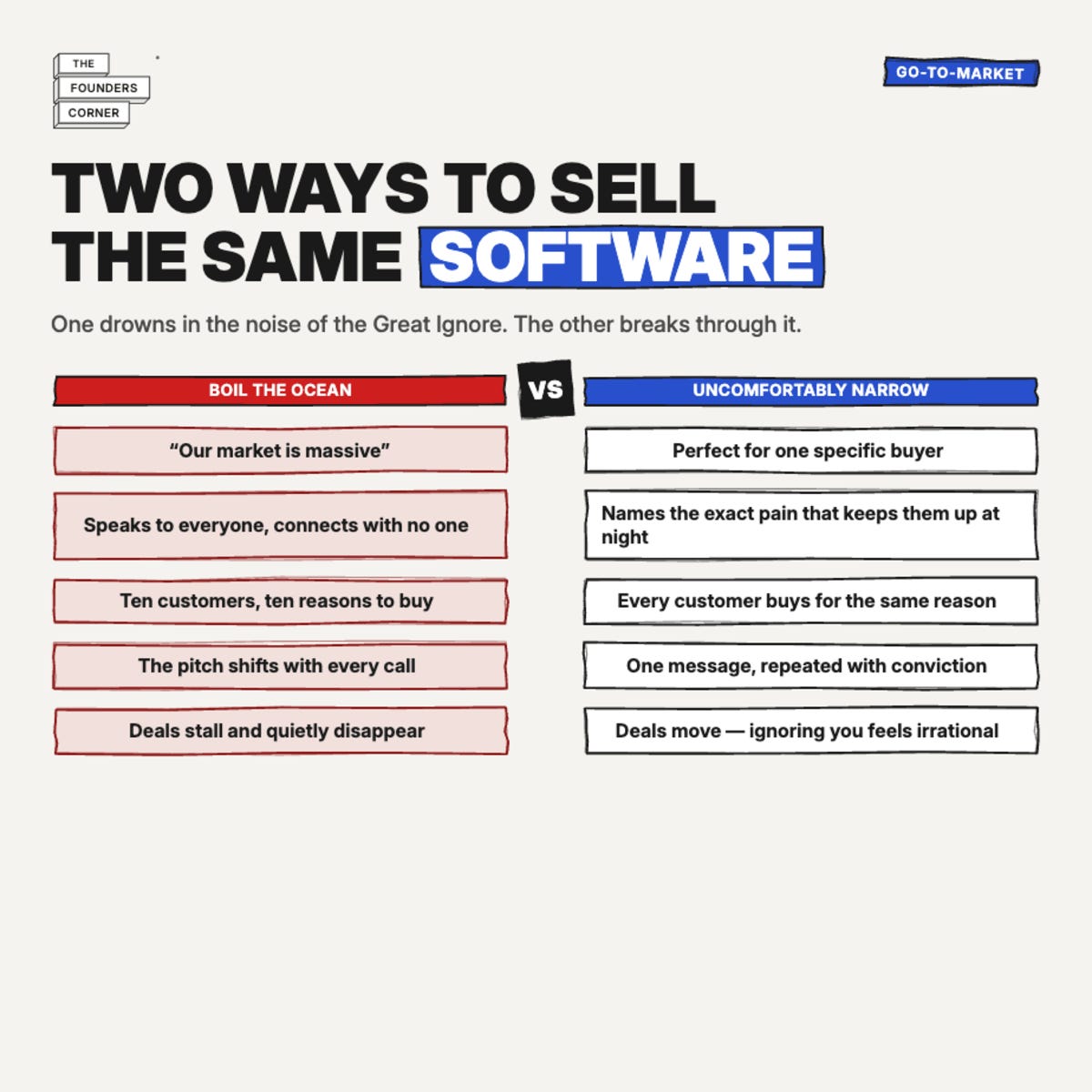
Because here’s the uncomfortable truth we’ve watched play out hundreds of times: the broader you go, the quieter you get. When you try to be relevant to everyone, you become urgent to no one. And in today’s market, being ignored isn’t a soft failure. It’s the default outcome.
Let me show you exactly how this happens — and what the founders who break through do instead.
Table of Contents
The Founder Who Tried to Boil the Ocean
The Age of the Great Ignore
Why “Our Market Is Massive” Is a Warning, Not a Boast
Customers Don’t Buy Software — They Buy Relief
The Discipline of Getting Uncomfortably Narrow
What Focus Actually Unlocks
The One Sentence That Changes Everything
The Founder Who Tried to Boil the Ocean
A few years ago we were mentoring a founder — let’s call him Jack.
Jack was bright, articulate, and deeply ambitious. He was also visibly exhausted. He’d built a genuinely clever data analytics platform, raised a solid seed round, hired a small but capable team, and spent the better part of a year running outbound campaigns that looked busy on paper but produced almost nothing of substance.
His decks were polished. Full of phrases that sounded impressive and meant nothing.
“Empowering smarter decisions.” “Unlocking insights from your data.” “Driving operational excellence through AI.”
Meetings were being booked. Deals lingered, stalled, and quietly disappeared. Jack knew something was wrong but couldn’t put his finger on it.
Then he said the sentence we’ve come to recognise as a flashing red warning light.
“The thing is,” he said, leaning forward, “our market is massive. We’re truly global. You should see the size of our TAM.”
And there it was.
Jack’s product could help finance teams, sales operations, supply chain managers, marketing analysts — almost everyone. That was precisely the problem. When everyone can use your product, it becomes impossible to define who actually needs it.
His homepage was a graveyard of corporate clichés. Acronyms only insiders understood. Endless talk about how clever the technology was, and almost nothing about the pain it relieved.
So we cleared a whiteboard and started again with a single question.
Not who could use this? But who must have this?
The Age of the Great Ignore
Before we get to what Jack did next, you need to understand the environment every founder is now selling into. Because it’s changed, and most go-to-market strategies haven’t caught up.
We call it the Age of the Great Ignore.
The vast majority of outreach today is deliberately tuned out. Not opened. Not absorbed. Not responded to. In many cases, not even seen. Buyers have become expert at filtering noise because they have no choice — they’re time-poor, decision-heavy, and interrupted every few minutes.
Generic outbound emails vanish into the void. Cold LinkedIn messages are ignored. Automated sequences are treated as background clutter. In plenty of organisations, the senior buyer doesn’t even manage their own inbox any more — an executive assistant quietly deletes anything that looks untargeted or self-serving.
If you doubt any of this, ask yourself honestly how many unsolicited emails you opened and read this week.
This is the game now. And it’s made worse by AI, not better.
The market is being flooded with copilots, platforms, and automation tools at a pace none of us have seen before. That abundance hasn’t created clarity for buyers — it’s created a fog of sameness and deep scepticism. Everyone sounds the same. Everyone promises transformation. Budgets are tighter, procurement is slower, and the bar for adoption has risen sharply.
In an environment like this, volume is not your friend. Shouting louder just adds to the noise you’re trying to cut through.
The only reliable way to be heard is to be so obviously relevant that ignoring you would feel irrational.
Why “Our Market Is Massive” Is a Warning, Not a Boast
Here’s the principle Jack was about to learn the hard way, and it runs directly counter to instinct:
The bigger the market you claim to serve, the sharper and narrower your messaging needs to be.
Most founders believe the opposite. They think a huge addressable market justifies broad, sweeping language — because narrowing feels like leaving money on the table. Why speak to one buyer when you could speak to ten?
But breadth in your messaging doesn’t capture the big market. It forfeits it.
When your message tries to hold ten different buyers in mind at once, it collapses into abstraction. “Empowering smarter decisions” is technically true for everyone, which is exactly why it lands with no one. There’s no person on the other side of that sentence leaning forward and thinking that’s me, that’s my problem, that’s the thing I’ve been trying to fix for two years.
A massive TAM isn’t a strategy. It’s a temptation. And it’s usually the thing standing between a founder and their first repeatable sales motion.
Customers Don’t Buy Software — They Buy Relief
This is the part that took Jack the longest to accept, and it’s the part most technical founders resist hardest.
Nobody wakes up in the morning desperate to buy software that “empowers their team.” Nobody has ever felt a burning need for “smarter insights” in the abstract.
What people buy is relief.
Relief from stress. From operational chaos. From the quiet dread of walking into a leadership meeting with another forecast missed. They’re buying an escape from the 3am, stare-at-the-ceiling problem — the broken internal process that refuses to go away and keeps resurfacing in every meeting.
So we asked Jack’s team a different set of questions. Whose career gets easier when this problem is solved? Whose reputation gets stronger? Whose bonus is protected? Who’s the person banging the boardroom table demanding this gets fixed?
The breakthrough didn’t come from Jack. It came from his Customer Success Manager, who remembered something a customer had said on a feedback call — the Head of Operations at a mid-sized retail chain:
“Your platform finally lets us see what’s happening in our stores in real time. Before this, honestly, we were flying completely blind.”
That was the moment everything changed.
This was never about analytics, or AI, or insight in the abstract. It was about real-time visibility for multi-site operators who couldn’t afford to be a day late spotting a problem.
So we rebuilt the message from scratch:
“We deliver real-time visibility for mid-enterprise retail operations. Know what’s happening in every store, every minute, without waiting for a report.”
It felt almost too narrow.
That was precisely why it worked.
The Discipline of Getting Uncomfortably Narrow
This is the discipline at the heart of everything we teach, and the phrase we use every single day: you have to get uncomfortably narrow.
Not comfortably focused. Not “we’ve picked a couple of verticals.” Uncomfortably narrow — narrow enough that it makes you slightly nervous, because you can feel all the customers you’re choosing not to chase.
Once Jack committed to it, the data got even sharper. His happiest customers turned out to be retail brands with between twenty and one hundred stores, led by operational leaders who reported into the CFO and needed marginal gains to outsmart their competitors.
So we wrote it down plainly:
“Our software is perfect for Heads of Retail Operations in multi-site retail chains with between twenty and one hundred stores, who are struggling to track performance in real time and are spending hours every week reconciling spreadsheets while losing competitive advantage.”
Read that back. It’s specific to the point of discomfort. It excludes almost everyone.
And it unlocked everything.
Most founders resist this instinctively, because narrowing feels like shrinking. It feels like the opposite of ambition. But focus is not the enemy of scale — it’s the precondition for it. Before you can be something to everyone, you have to become indispensable to someone.
You have to find the single sharpest instrument in a product that, over the years, has quietly become a Swiss Army knife of features. And then you have to find the exact buyer who feels the sharpness of that one blade most acutely.
What Focus Actually Unlocks
Here’s what happened to Jack within six months of getting uncomfortably narrow.
His revenue doubled.
His product roadmap simplified, because he finally knew which requests mattered.
His sales motion became repeatable — the same message, the same buyer, the same pain, again and again.
Investors stopped asking whether the business could scale and started asking how fast.
And then the counterintuitive part.
Once he’d dominated that narrow niche, companies from outside his original focus began to inbound — drawn in by the sheer clarity of his positioning and the strength of his results. The reputation he built by being precise for a few became the magnet that attracted the many.
That’s how focus actually works.
It doesn’t shrink your opportunity. It expands it.
The confusion in the market fades. The team stops pulling in different directions. The messaging lands because it reflects the buyer’s reality rather than the founder’s feature list. Demos start to feel like genuine pain relief instead of product explanation. And outreach earns attention because it’s unmistakably relevant, spoken in the buyer’s own language.
In the Age of the Great Ignore, that relevance is the whole game.
The One Sentence That Changes Everything
Everything we’ve walked through here compresses into a single sentence — the spine of the entire Selling Software Algorithm:
Our software is perfect for [a clearly defined Economic Buyer] in [a tightly defined Perfect Customer Profile] who’s struggling with [the three most visceral business pains our software solves].
It looks disarmingly simple. You could be forgiven for reading it, filling in the blanks, and moving on.
Please don’t.
The power isn’t in the sentence. It’s in the work required to earn the right to write it — the discomfort of choosing one buyer, the honesty of confronting which pains are real versus which ones you assumed, the discipline of validating all of it with evidence instead of optimism.
That work is what the rest of this series is about. In the pieces to come, I’ll break down each part of that sentence in turn: how to define your Economic Buyer as a human being with ambition, pressure and personal risk — not just a job title. How to build a Perfect Customer Profile precise enough to be a forcing function. And how to uncover the three business pains buyers feel so deeply that doing nothing is no longer an option.
But it all begins here, with the hardest decision most founders keep avoiding.
Stop trying to be relevant to everyone.
Choose the theatre you want to fill. Fill it with the right buyers. And speak — calmly, precisely — to the three things that already keep them up at night.
That’s not a smaller ambition.
It’s the only version of ambition that actually scales.
—Chris Tottman
One more thing.
Most founders read something like this, agree with all of it, and change nothing by Monday.
So we built the GTM Builder. It’s new. It’s the guided journey I take my founders on, finally in one tool. It works out where you actually are and hands you the next thing from The Founders Corner arsenal — not all sixty-odd tools, the right one, at the right moment.
You come out with a buyer you can name, three pains you’ve validated rather than assumed, and a message that survives contact with a real prospect.
If you’re raising, do it now, not after.
The gaps in your go-to-market get found either way. Better here, in private, than in a partner meeting by someone who’s already decided.