

Most founders choose an accelerator the same way.
They Google “best startup accelerators 2026.”

They find a listicle ranking twenty programmes by brand.
They skim the cheque sizes and shortlist the three biggest.
Then they apply to whichever window is open and sign whatever arrives, because the name was familiar. Nobody ever tells them what the deal costs.
The problem isn’t the programme. The problem is that nobody prices the offer.
An accelerator taking a fixed percentage for a fixed amount of cash has already told you its valuation. It just never writes it down, and no listicle does the division for you.
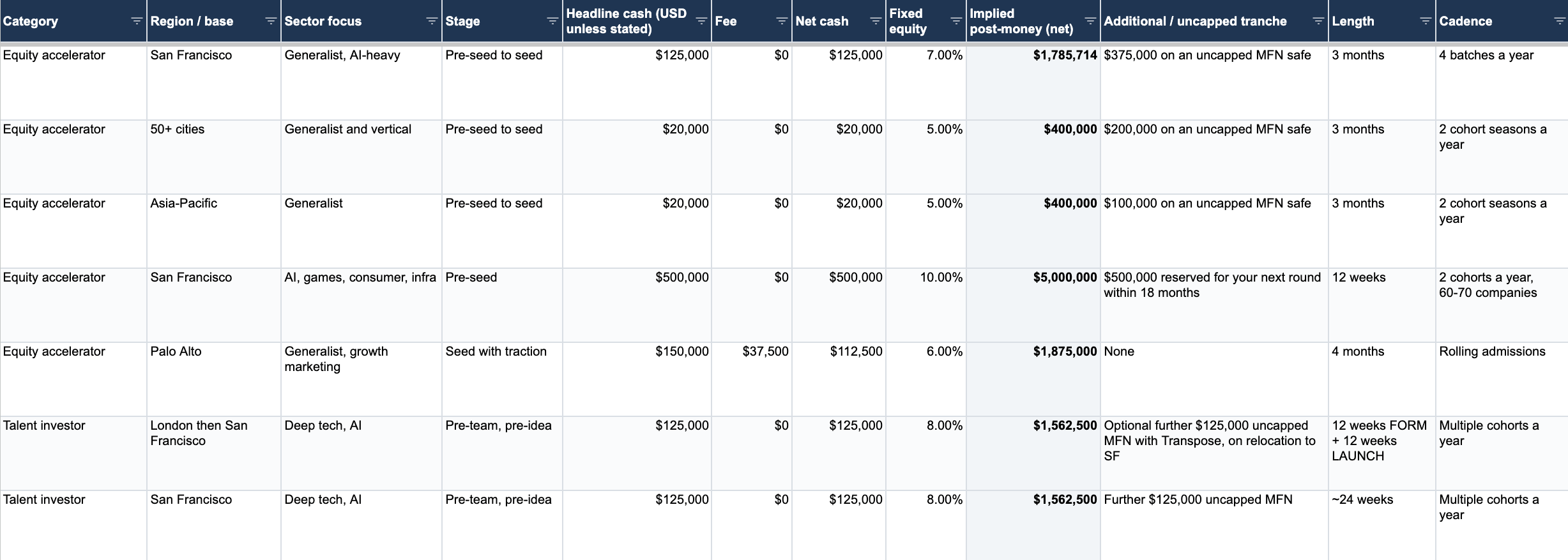
So we did it. 255 times.
Want to get in front of 250k+ founders and investors?
For sponsorship opportunities across The Founders Corner newsletter and LinkedIn (160k followers), email: founderscornermedia@gmail.com
Why the “Best Accelerators” List Doesn’t Work
Implied post-money = net cash ÷ fixed equity percentage
That’s the whole technique. Run it and the market becomes legible in ninety seconds.
a16z speedrun. $500,000 for 10%. Implied $5.0M.
Y Combinator. $125,000 for 7%. Implied $1.8M.
Entrepreneur First. $125,000 for 8%. Implied $1.6M.
Antler, Singapore. $150,000 for 10%. Implied $1.5M.
Techstars. $20,000 for 5%. Implied $400,000.
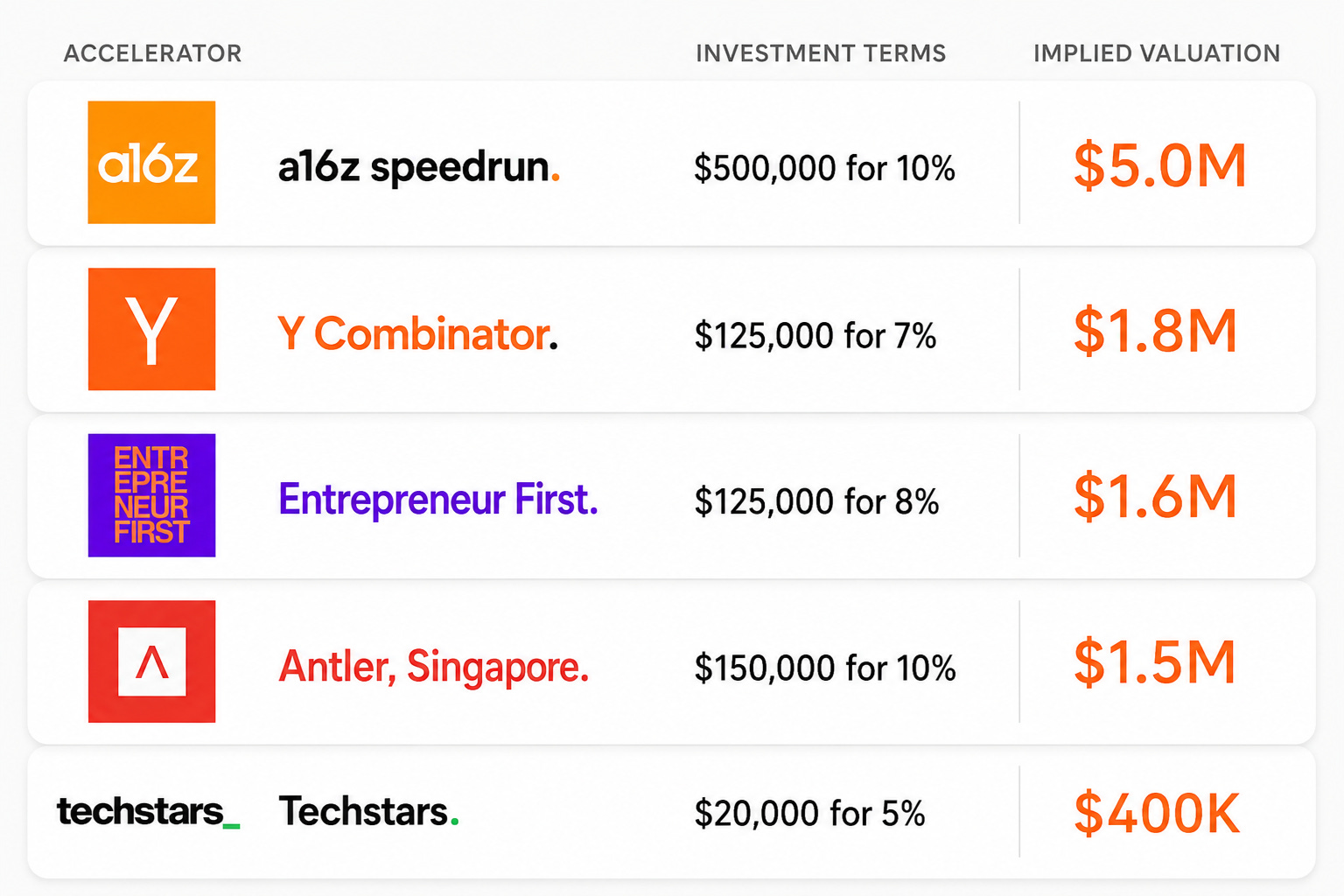
Same three months. Same demo day. A twelve-fold spread, and all of them publish the inputs while none publishes the number.
Read Techstars fairly, though. The 5% is common stock rather than preferred, putting them behind you in a downside exit. No fee. And most of their money sits in a $200,000 uncapped tranche that sets no valuation at all. A genuine defence, but not a reason to skip the calculation.
There’s a bigger problem with that league table, and it isn’t the one anyone expects.
The Second Number, and Why It Reverses the First
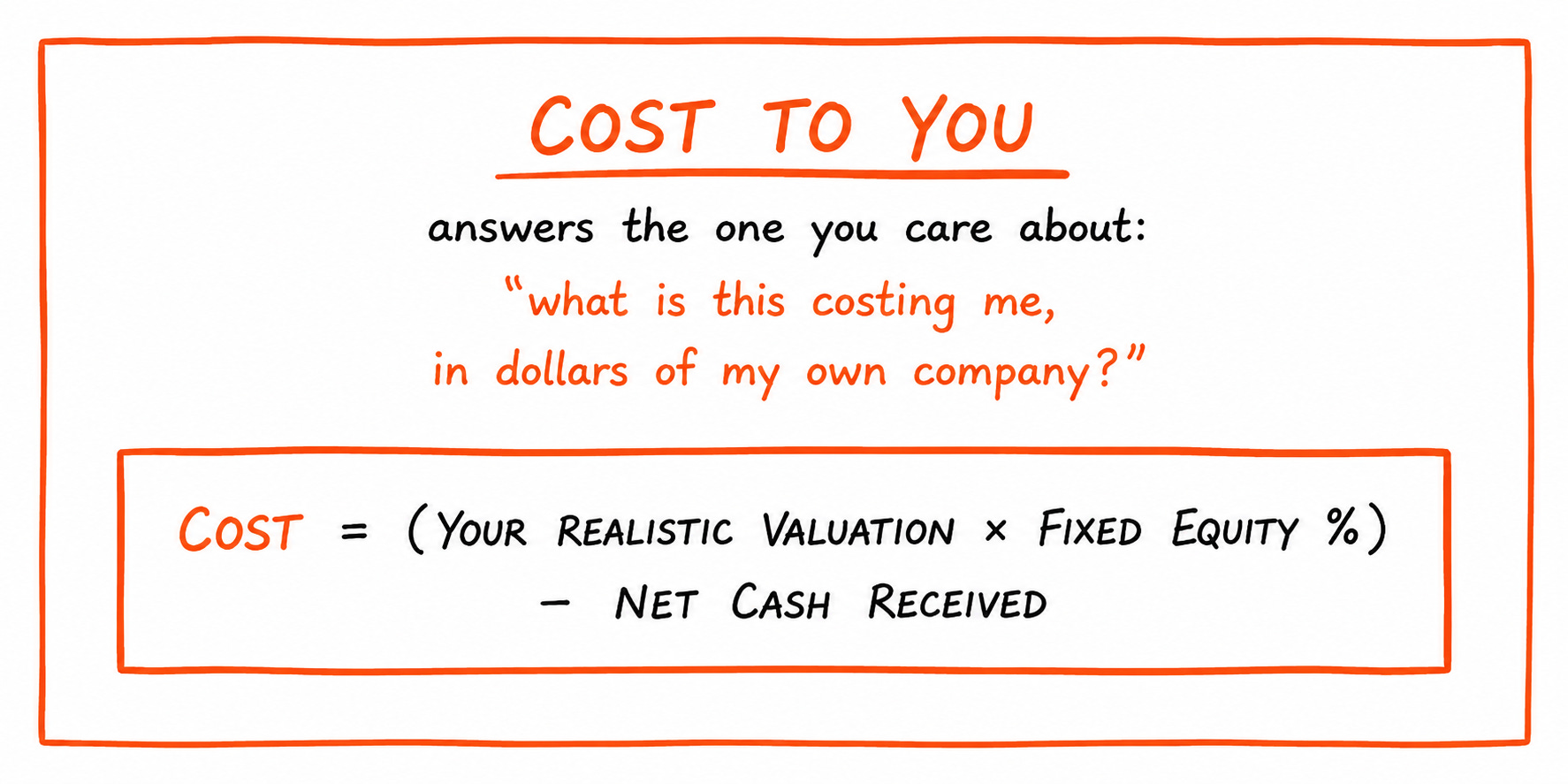
Implied post-money answers one question: at what valuation is this trade fair? Not the one you care about: what is this costing me, in dollars of my own company?
Cost = (your realistic valuation × fixed equity %) − net cash received
Say you could credibly raise at a $12M post-money cap.
Techstars takes 5%, worth $600,000, and gives you $20,000. Cost: $580,000.
a16z speedrun takes 10%, worth $1,200,000, and gives you $500,000. Cost: $700,000.
Y Combinator takes 7%, worth $840,000, and gives you $125,000. Cost: $715,000.
Antler Singapore takes 10%, worth $1,200,000, and gives you $150,000. Cost: $1,050,000.
On implied post-money, Techstars looked twelve times dearer than speedrun. On cost, Techstars is the cheapest of the four and speedrun is $120,000 more expensive.
The table doesn’t shift. It inverts.
The two numbers are linked exactly:
Cost = your fixed equity % × (your valuation − the programme’s implied valuation)
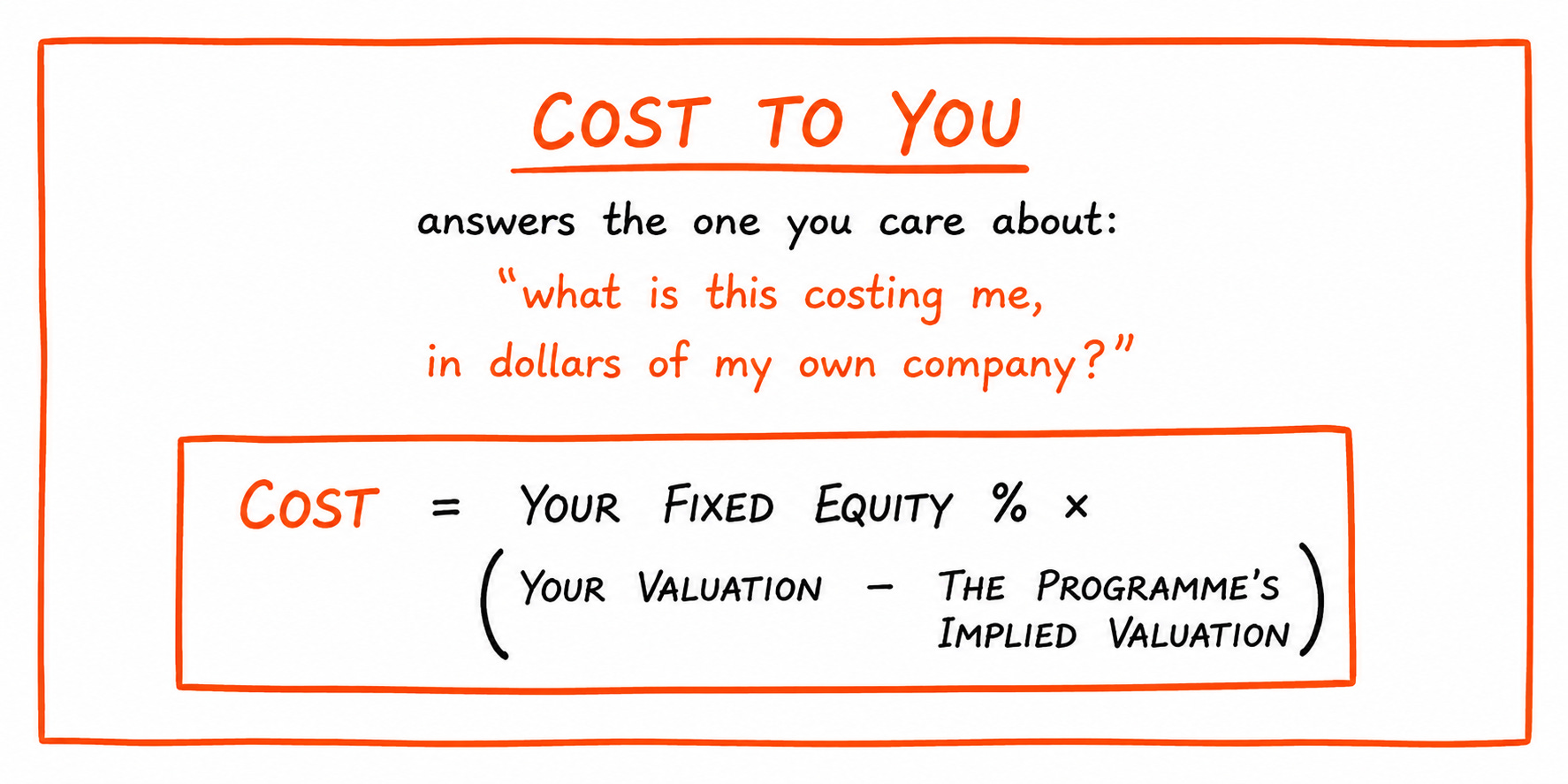
So implied post-money is your break-even. Below it, the programme pays you to attend. Above it, you pay them, and the bill rises in a straight line with how good you already are.
At a $4M valuation, speedrun’s $500,000 for 10% is worth more than the equity you give up. It effectively pays you $100,000 to be there. At $25M, the identical deal costs you $2,000,000. Same paperwork, same twelve weeks, a $2.1M swing.
Which is why the “is YC worth it?” argument never resolves. Both sides are right about different companies.
Caveat: the fixed slice converts inside your priced round and is then diluted by new money and any option pool increase, so true cost sits slightly below these figures. The ranking is unaffected.
The Evidence Nobody Puts in the Listicles
Gonzalez-Uribe and Leatherbee studied Start-Up Chile with a regression discontinuity design, in the Review of Financial Studies. Some founders got cash and coworking. Others got the same plus structured schooling.
The schooling significantly increased venture performance.
Cash and coworking alone showed no measurable effect whatsoever.
Sandy Yu, in Management Science, matched roughly 900 accelerator companies against 900 comparable ones and found they closed earlier and more often, consistent with accelerators resolving uncertainty about quality sooner. A 2025 meta-analysis of 21 studies found a positive effect overall, concentrated in top-ranked programmes.
Ranking by cheque size ranks by the weakest ingredient. The money buys runway, not performance, and per the formula above it’s the smaller half of the trade.
Brand tier isn’t snobbery, it’s the finding. A weak-network programme selling the same three months is selling the ingredient that didn’t work, at a price that still scales with your quality.
Our Most-Read Articles Right Now
🔥 What a Cap Table Actually Is - And Why It Matters What 7% actually becomes after three more rounds.
🔥 The Way VCs Actually Calculate Your Valuation The quiet maths that sets your valuation before the meeting starts.
📈 How Investors Decide If You Are Ready Stage by stage expectations, so you know what’s wanted next.
📋 The Most Dangerous Document a Founder Will Ever Sign The clauses that matter more than valuation.
The Fee That Removes a Quarter of Your Valuation
Several programmes charge a fee and deduct it from the investment, so you never write a cheque and never feel it leave.
500 Global’s published deal is $150,000 for 6%. Its own page states it charges $37,500, deducted from the investment. You receive $112,500.
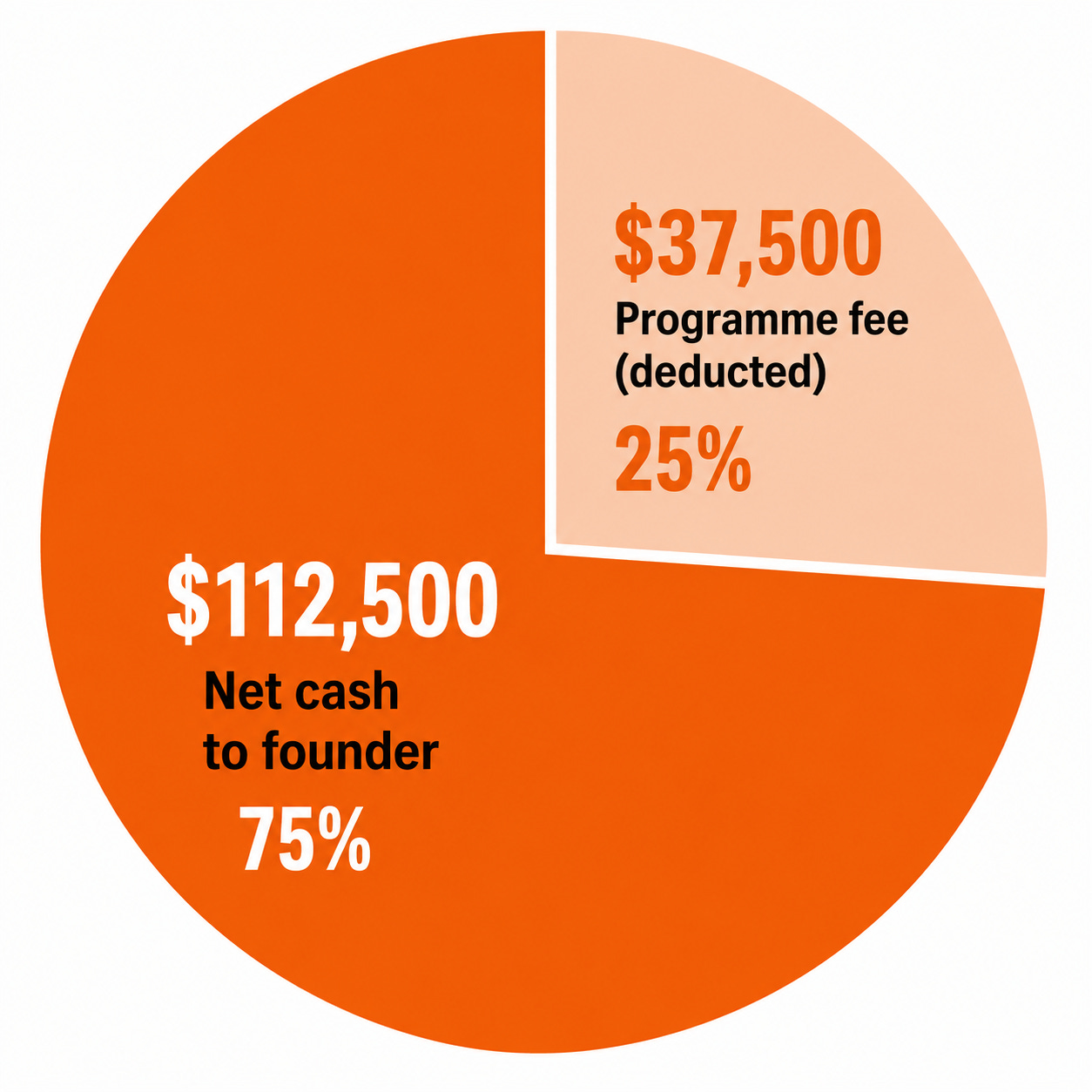
On the headline: $150,000 ÷ 6% = $2.5M implied.
On what arrives: $112,500 ÷ 6% = $1.875M implied.
The fee removes $625,000 of implied valuation without appearing in the announcement.
Founder Institute sits at the far end: a fee reported between $499 and $999, plus 2.5% in warrants, and no cash at all. That’s tuition, and should be priced as tuition.
Y Combinator says the same on its own deal page: deduct fees from the investment when comparing offers. Always divide by net cash, never headline cash.
The Part of the Deal With No Price
Most deals arrive in two pieces, and only one is priced. The fixed slice is a set percentage for a set amount. That’s the price.
The uncapped MFN tranche converts on the terms of the lowest-cap instrument you issue before your next priced round. That isn’t a price. It’s a promise to accept whatever price you negotiate later, and an MFN adopts the most favourable terms in the window, so one small bridge safe taken in a difficult month drags the whole tranche down with it.
Note what this does to the cost formula. Cash in roughly equals value out at whatever cap you set, so the tranche’s net cost is near zero. The entire cost of an accelerator sits in the fixed slice. Which is why Techstars, with a small fixed percentage and a large uncapped tranche, is cheap for a strong company despite that alarming implied number.
What Each Entry Includes
1. Category. Seven products get sold under one word. Comparing across them is the commonest error.
2. Region and sector focus. Filter before reading anything else.
3. Headline cash, fee and net cash. The gap between the first and third is where the price hides.
4. Fixed equity percentage. The priced slice only, where your entire cost sits.
5. Implied post-money. Calculated live. Correct an input and it recalculates.
6. The uncapped tranche. Named, so you know which part has no price.
7. Length, cadence and acceptance rate.
8. Terms status. Verified at source, Published, or Not published, meaning they negotiate per company and you can’t compare in advance.
9. Direct link and checked date. Techstars changed its deal in 2025. Neo swapped its accelerator for a residency in 2026. Half the comparison content on Google describes deals that no longer exist.
A Taste of What’s Inside
a16z speedrun, San Francisco
$500,000 for 10% · Implied $5,000,000 · 12 weeks · Under 0.4% acceptance
The highest break-even of any major programme: close to free if you’re early, expensive if you’re not. A further $500,000 reserved for your next round. No board seat.
Techstars, 50+ cities
$20,000 for 5% common stock · Implied $400,000 · 3 months · No fee
The lowest implied price and the most misread. The fixed slice is small, so it’s the cheapest of the big programmes once you’re worth $10M or more. Spring 2027 closes 18 November.
Hub71, Abu Dhabi
No equity · Subsidy reported up to $100,000 · Up to 2 years
Housing, office space, insurance and credits, no ownership taken. Founders reject packages like this for “not coming with a cheque,” then sign an equity deal with less net cash in it.
The Geography Breakdown
274 entries, six continents.
US: SF, New York, Boston, Berkeley, Austin, across deep tech, health, space, defence and quantum.
UK and Europe: Seedcamp, EF, Zinc, Carbon13, Rockstart, Lanzadera, Venture Kick, the EIC Accelerator.
Gulf: Hub71, Flat6Labs across five countries, Sheraa, DIFC.
Africa: Baobab, Startupbootcamp AfriTech, Norrsken, CcHUB, MEST.
India and Asia: Antler India, EF Bangalore, 100X.VC, Surge, Iterative, SparkLabs.
Oceania and Canada: Startmate, Icehouse, CDL, DMZ, Velocity.
Latin America: Platanus, Parallel18, Start-Up Chile.
Geography moves the price more than category does, and the same brand prices differently by city. Antler, Flat6Labs, 500 Global and Startupbootcamp all run different deals per market.
The Windows Open Right Now
Techstars Spring 2027 opened 24 August and closes 18 November 2026. All Spring programmes share the deadline, so choose city and vertical first, then write once.
a16z speedrun SR008 has a priority window of 12 October to 1 November 2026.
Entrepreneur First’s first selection round closes 5 October 2026. Three run per cycle, and the first is strictly better than the third.
Y Combinator Winter 2027 isn’t published yet, but the pattern suggests late October. Early Decision is open now if you need an answer ahead of a raise or a visa.
“You are not buying capital. You are buying a deadline and a distribution list. Price them separately, because only one of those appears on the term sheet.”
The Bottom Line
Founders choose badly because they compare badly.
They rank by cheque size, the ingredient doing the least.
They ignore fees that remove a quarter of the implied valuation.
They treat an uncapped tranche as free money rather than a price their worst round sets later.
And they never ask the only question that matters: at my valuation, what does this cost me in dollars?
Two calculations fix all of it.
Implied post-money = net cash ÷ fixed equity. That’s your break-even.
Cost = fixed equity × (your valuation − that break-even). That’s your bill.
Run both before you write the application, not after the term sheet lands. If the bill is a number you wouldn’t spend in cash for the same outcome, you have your answer.
Techstars closes 18 November. Speedrun opens 12 October. Those applications are being decided right now, by whoever is doing the maths.
The file is waiting below.
The Full 255-Programme Directory
Exactly what you’re downloading:
Directory. 187 equity programmes across six continents, with a live Implied Post-Money column, fee-adjusted net cash, uncapped tranches named, acceptance rates, source links and checked dates. Filterable by category, region, sector and stage
Price Calculator. Enter the offer and your realistic cap. Returns the implied post-money, the fee-adjusted price, the MFN exposure, and the dollar cost at your own valuation
Equity-Free & Credits. 39 programmes taking no ownership, from NVIDIA Inception and MassChallenge to Hub71 and the EIC Accelerator
Peer Groups & Coaching. 22 options with entry bars and reported costs. The founder who can’t get into YC can usually get into one of these next month
Events & Summits, Deadline Calendar, Summary and Sources. 26 events with typical timing, what’s open and closing next, live counts by region, and every figure cited and linked
Filter to your stage, rank by cost rather than cheque, then price your live offer before you sign anything.
Paid subscribers also get:
60+ additional tools across every stage of fundraising and company building: investor research, pitch deck screening, meeting prep, term sheet analysis, financial models, and the full investor database library.
Download Below
Start your 7-day free trial → Cancel anytime.