

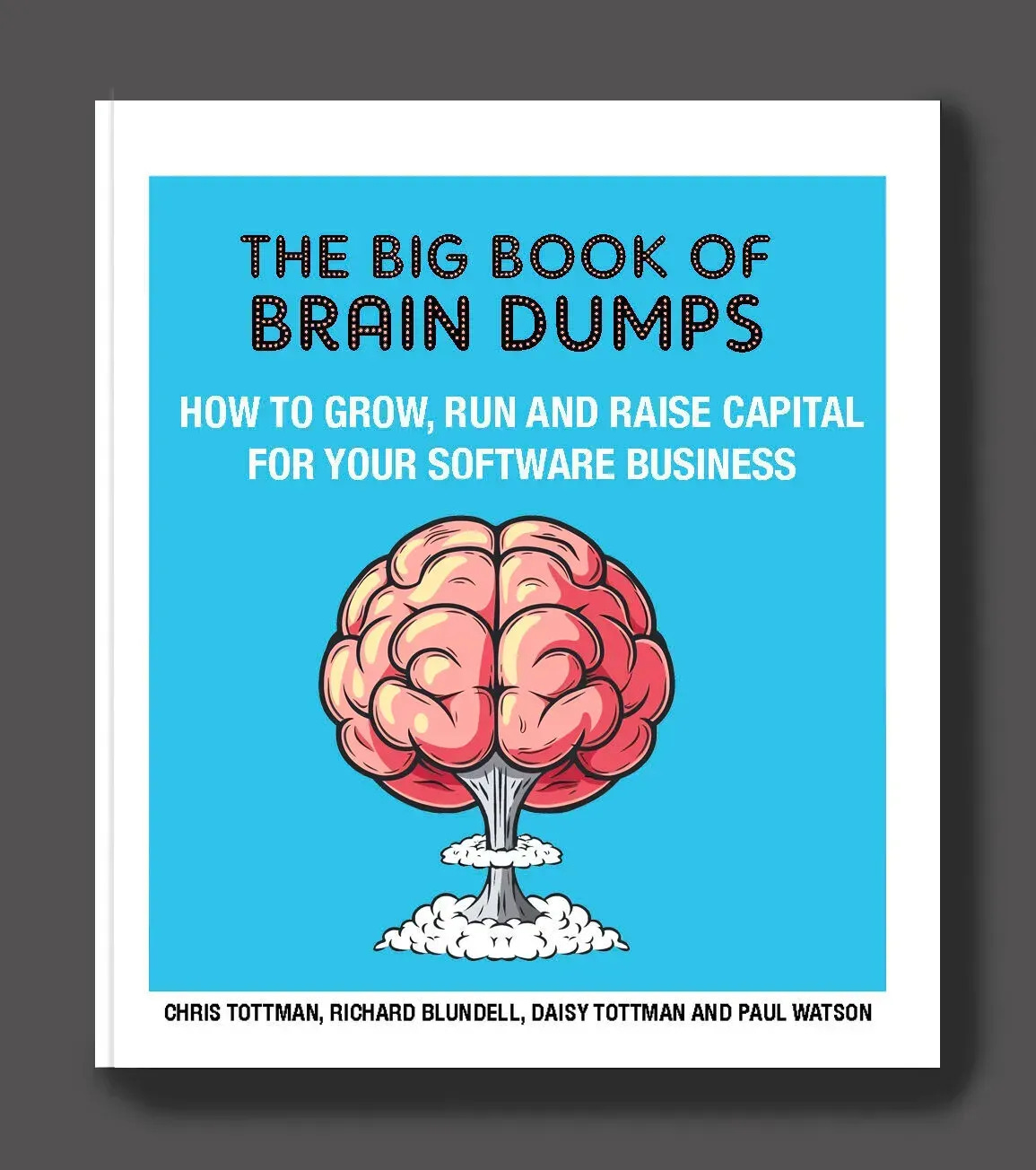
👋 Hey, Chris here! Welcome to BrainDumps—a weekly series from The Founders Corner. If you’ve been reading along, you know this series is a preview of a bigger project. Well, it’s finally here: The Big Book of BrainDumps is out now!
It isn’t a theory book—it’s the founder’s field manual. Inside, you’ll find 70 powerful frameworks distilled from 30+ years scaling software companies to hundreds of millions in ARR, 20+ years investing in 500+ B2B tech startups, and over $1B of shareholder value created. From raising capital to hiring your first VP of Sales, this book turns scars and successes into practical playbooks you’ll return to again and again. I expect most copies will become well-worn, scribbled on, and dog-eared—because it works.
High-performing teams are the backbone of every successful business. Capital helps. Strategy matters. Talent is essential. But even the most capable, well-funded, and strategically aligned organisations can falter if the dynamics within the senior team begin to fracture.
Patrick Lencioni’s The Five Dysfunctions of a Team provides one of the clearest lenses through which to diagnose these fractures. It shifts the conversation away from capability and towards behaviour. In doing so, it highlights a powerful truth: most teams do not fail because they lack intelligence; they fail because they lack cohesion.
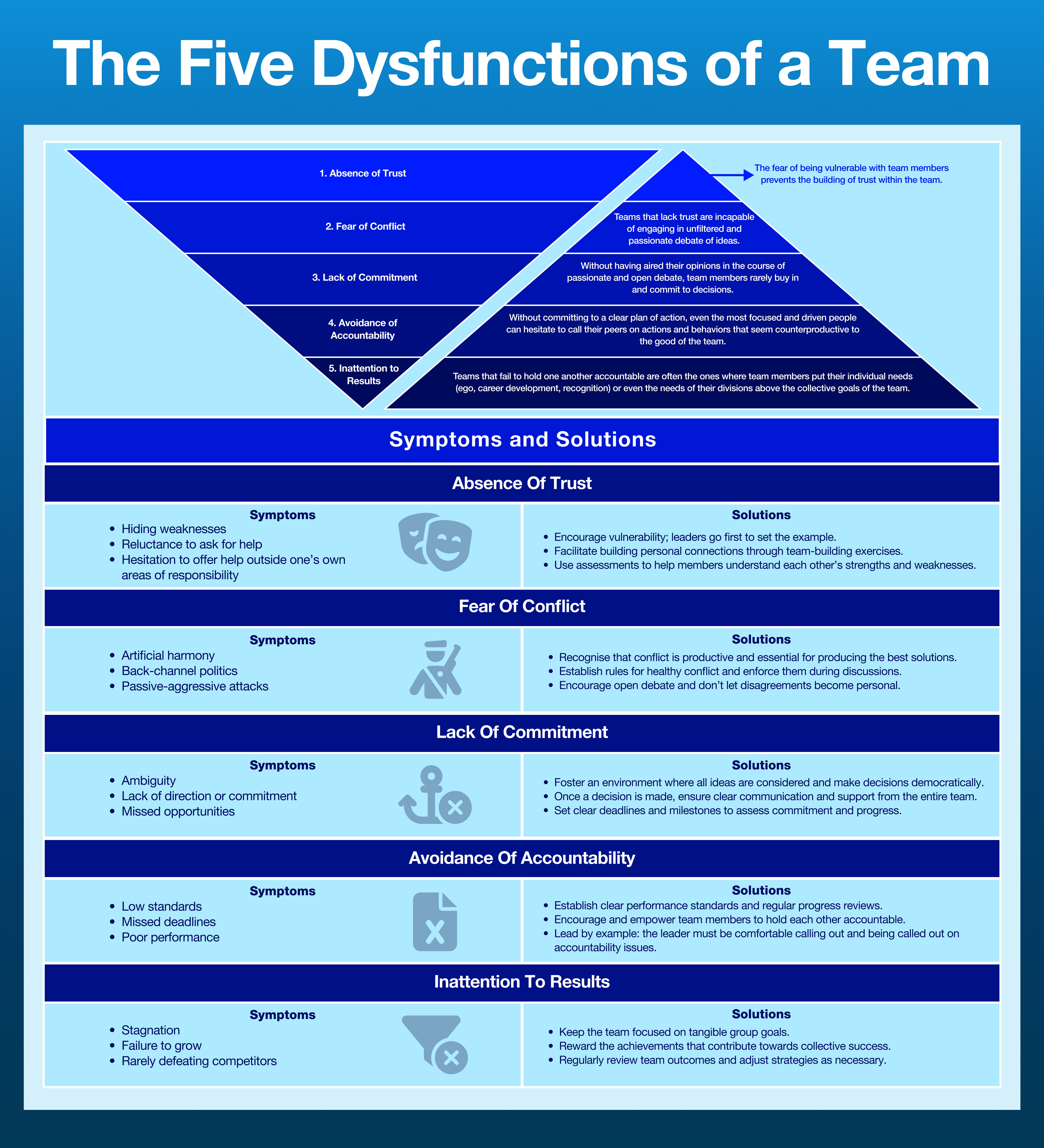
At the heart of Lencioni’s framework are five interconnected dysfunctions — absence of trust, fear of conflict, lack of commitment, avoidance of accountability, and inattention to results. These are not isolated problems. They form a hierarchy, each building upon the previous one. When the foundation is weak, the entire structure becomes unstable.
Table of Contents
Trust: The Bedrock of Performance
Conflict: The Engine of Better Decisions
Commitment: Clarity Over Consensus
Accountability: Shared Standards, Not Centralised Control
Results: The Ultimate Measure
An Integrated System, Not Isolated Issues
The Ongoing Discipline of Team Health
Closing Thoughts
Trust: The Bedrock of Performance
The first and most fundamental dysfunction is the absence of trust. Importantly, this is not about believing that colleagues are competent. It is about vulnerability-based trust — the willingness to admit mistakes, ask for help, expose weaknesses, and speak candidly without fear of embarrassment or political fallout.
In teams where this form of trust is lacking, people operate defensively. Feedback is filtered. Mistakes are concealed. Assistance is withheld. Conversations become guarded and political. Over time, this erodes collaboration and slows decision-making because energy is spent on self-protection rather than collective progress.
Building trust requires deliberate leadership. It demands that leaders model vulnerability themselves. When a CEO openly acknowledges uncertainty, shares lessons from failure, or invites challenge without defensiveness, it creates psychological safety for others to do the same. Regular one-to-one conversations, transparent communication, and structured trust-building exercises can accelerate this process, but nothing substitutes for leadership behaviour. Trust is not mandated; it is earned through consistent example.
Conflict: The Engine of Better Decisions
Once trust is established, teams must confront the next dysfunction: fear of conflict. Many teams confuse harmony with health. Meetings appear calm. Decisions seem unanimous. Yet beneath the surface, unresolved disagreements simmer.
Artificial harmony may feel comfortable, but it suppresses innovation and leads to mediocre decisions. Healthy teams understand that conflict, when focused on ideas rather than personalities, is essential. Robust debate sharpens thinking. It stress-tests assumptions. It reveals blind spots before they become costly mistakes.
Leaders play a crucial role in normalising constructive disagreement. They must frame debate as a sign of engagement rather than insubordination. Establishing clear rules for respectful dialogue, actively drawing out quieter voices, and intervening when discussions become personal helps maintain productive tension. The goal is not conflict for its own sake, but clarity through challenge.
Commitment: Clarity Over Consensus
When teams avoid conflict, they struggle to achieve genuine commitment. Without open debate, decisions lack depth, and individuals leave meetings unconvinced or unclear about the chosen path forward.
Commitment does not require consensus. It requires clarity and alignment. Team members may not agree with every decision, but they must understand the rationale and feel heard during the discussion process. When leaders summarise decisions clearly, define ownership explicitly, and communicate timelines transparently, ambiguity diminishes.
A lack of commitment often manifests as hesitation, revisiting settled decisions, or passive resistance disguised as refinement. Clarity prevents drift. It enables teams to move forward decisively, even in uncertain environments.
Accountability: Shared Standards, Not Centralised Control
Without commitment, accountability weakens. When expectations are unclear or buy-in is partial, peers hesitate to challenge one another. Accountability becomes the sole burden of the leader, creating bottlenecks and fostering resentment.
In high-performing teams, accountability is collective. Team members hold one another to agreed standards. Missed deadlines and underperformance are addressed constructively and directly. This is only possible when trust and healthy conflict are already embedded in the culture.
Leaders must set explicit performance standards and make goals visible. Encouraging peer-to-peer feedback and recognising accountability in action reinforces this norm. Accountability is not about punishment; it is about protecting the integrity of the team’s commitments and maintaining performance momentum.
Results: The Ultimate Measure
At the top of the pyramid lies the final dysfunction: inattention to results. When trust is fragile, conflict is avoided, commitment is weak, and accountability is inconsistent, individuals begin prioritising personal success, departmental metrics, or political positioning over collective outcomes.
This misalignment is subtle but damaging. Silos form. Urgency dissipates. Execution slows. Over time, organisational performance stagnates.
To counteract this, leaders must relentlessly focus the team on shared, measurable results. Collective goals should be clear, visible, and tied to company success. Celebrating team achievements rather than individual heroics reinforces unity. Aligning incentives with organisational outcomes ensures that everyone is rowing in the same direction.
When collective results matter more than personal credit, alignment strengthens and performance accelerates.
An Integrated System, Not Isolated Issues
One of the most powerful aspects of Lencioni’s model is the recognition that these dysfunctions are sequential and interdependent. Attempting to fix accountability without first addressing trust is futile. Trying to improve results without strengthening commitment will yield only temporary gains.
The real work begins at the foundation. Trust enables conflict. Conflict enables commitment. Commitment enables accountability. Accountability drives results.
For leaders, this framework serves as both a diagnostic tool and a behavioural mirror. Teams reflect leadership. If leaders avoid vulnerability, teams will do the same. If leaders shut down dissent, debate will disappear. If leaders tolerate ambiguity, commitment will weaken. Culture is not accidental; it is modelled daily.
The Ongoing Discipline of Team Health
Importantly, even strong teams can regress. External pressure, rapid growth, or strategic pivots can strain relationships and expose cracks. The difference between average and exceptional teams lies not in the absence of dysfunction, but in their ability to recognise and address it quickly.
Building a cohesive team is not a one-off initiative. It is an ongoing discipline. It requires vigilance, self-awareness, and the courage to confront uncomfortable truths.
Ultimately, the strength of a team is not determined by the brilliance of its members, but by the quality of their interactions. When trust runs deep, conflict is constructive, commitment is clear, accountability is shared, and results are collective, execution becomes confident and decisive.
Talent opens the door. Cohesion sustains success.
Closing Thoughts
The uncomfortable truth most leadership teams won’t say out loud: the dysfunction isn’t the team. It’s the room. It’s the silence that gets mistaken for alignment, the politeness that gets mistaken for trust, and the lack of challenge that gets mistaken for confidence. Lencioni’s framework doesn’t give you a fix. It gives you a mirror. What you do with what you see in it — that’s the real test of leadership. The best teams aren’t the ones without friction. They’re the ones who stopped pretending they were.
-Chris Tottman
Essential reminder that team cohesion starts with trust and open dialogue
I don’t know how many more ways I can say that I need help with several things