

There’s a moment in every VC meeting that separates the founders who raise from the founders who don’t.
Not the pitch. Not the numbers. Not even the story - though all of that matters.
It’s when a founder says something that shows they know this investor. Not the fund. Not the sector. This person. The way they think. What they’ve backed before and why. What they publicly hate about how founders pitch their category. What made their last deal in your space fail.
That moment of recognition, the investor’s slight lean forward, the shift from evaluating to actually engaged, is almost impossible to manufacture in the room. You either walk in having done the work, or you don’t.
The problem is that doing that work thoroughly, across twelve or fifteen or twenty meetings, takes time most founders don’t have.
This article builds the solution. A Claude powered research agent that takes a fund name and a partner name, searches everything publicly available about how they think and what they back, and returns a structured investor briefing in two to three minutes. Run it the night before every meeting. Run it across your entire target list. Walk into every room knowing more about the person across the table than they’d expect you to.
What’s inside this guide
A six prompt agent pipeline covering:
Prompt 1: Fund profile - thesis, stage, check size, and where their current conviction is actually concentrated (not what their website says)
Prompt 2: Partner background - career arc, domain expertise, communication style, and what they’ve said on record about your category
Prompt 3: The objection map - personalised to this investor’s stated positions, not generic VC pushback
Prompt 4: Portfolio overlap analysis - every company in their portfolio that could be seen as competitive or adjacent, and how to frame your differentiation before they ask
Prompt 5: The framing brief - exactly how to tell your story to this investor specifically, what to lead with, what to address unprompted, and what not to say
Prompt 6: The one page briefing document - the assembled output you read the night before. Structured, scannable, meeting ready
Why surface research fails
Most founders research the fund. Website, portfolio page, “we invest in B2B SaaS” - done.
That’s not research. That’s the same information every founder sitting in that chair already has.
By the numbers:
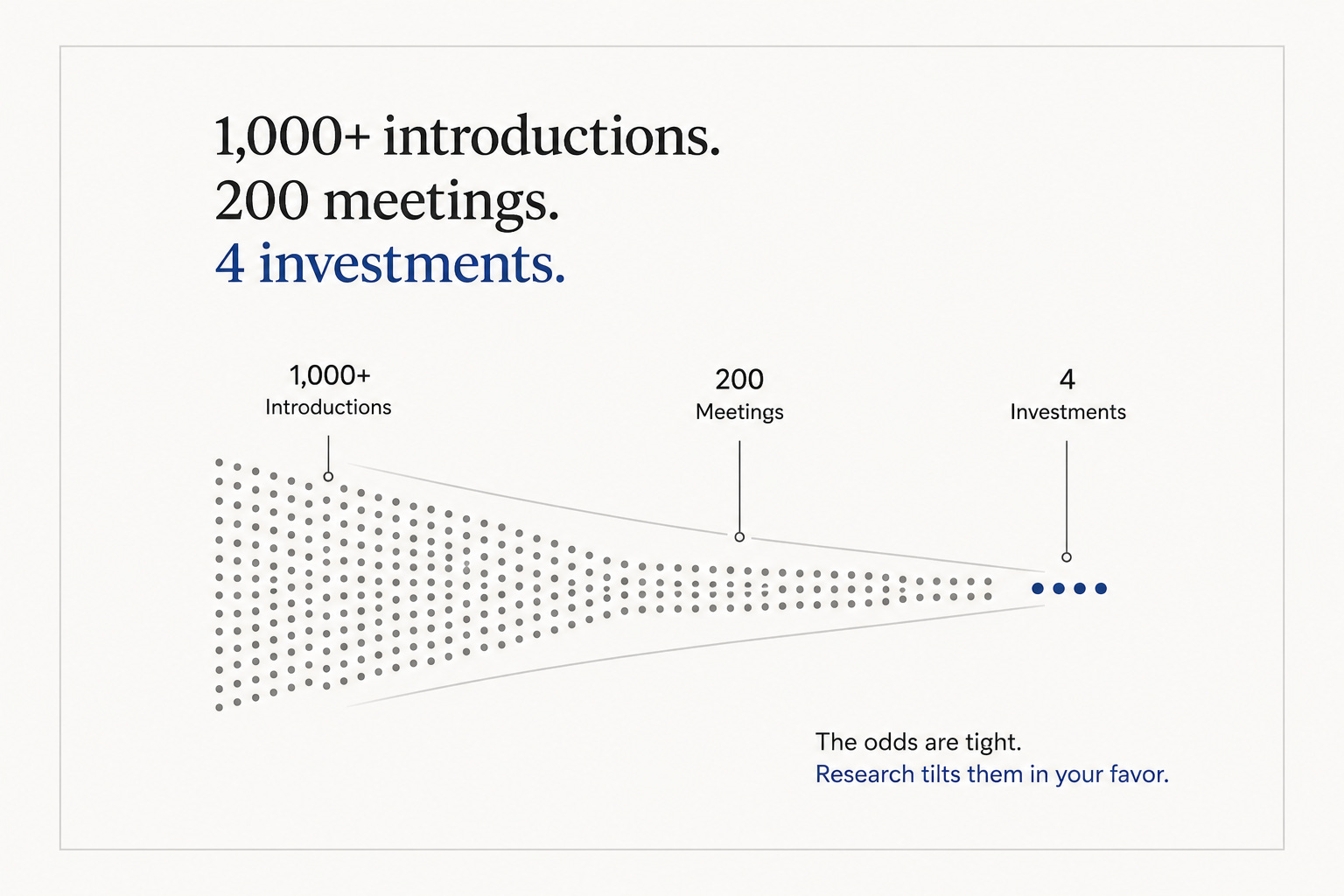
1,000+ introductions - a typical VC sees per year. They take meetings with 200. They invest in 4.
80% of the time, a VC decides not to meet with a company after introduction (NFX data)
3 minutes 44 seconds - average time a VC partner spends on a pitch deck (DocSend)
The research that changes your outcome covers six things and most of them aren’t on the fund website.
What thorough investor research actually covers:
Thesis and conviction zones - Where does this investor actually lean in right now? What sector dynamics are they publicly excited about and which have gone quiet?
Portfolio pattern analysis - What does the portfolio tell you that the website doesn’t? Check sizes, co-investors, how long between rounds.
Public positions and on record views - Podcasts, essays, Twitter threads, interview quotes. What has this partner said on record about your market?
Potential objections - Based on their thesis and prior statements, where does your company most likely face scepticism from this specific person?
Background and origin story - Operator background vs. analyst track? This shapes how they hear your story and what they actually weight.
The right framing for this room - How should you tell your company’s story to this investor specifically?
Doing all of this manually, for every meeting, is two hours per investor. For a twelve meeting raise, that’s a full working week - before you’ve run a single pitch session.
The agent below compresses that into two minutes.
The architecture: how the agent works
This isn’t a single prompt. It’s a six step research pipeline that Claude runs in sequence, each step feeding the next, ending with a structured briefing document you can read in five minutes before every meeting.
The pipeline:
Fund Profile → Partner Background → Public Views → Portfolio Signals → Objection Map → Briefing Doc
Each step builds on the last. By the time you reach Prompt 6, Claude has a detailed picture of who this investor is, what they believe, what their portfolio looks like, and how your company fits. The final output assembles all of it into one document.
What the output looks like
Before the prompts, here’s what the agent actually produces. This is what you want to be reading the night before a meeting.
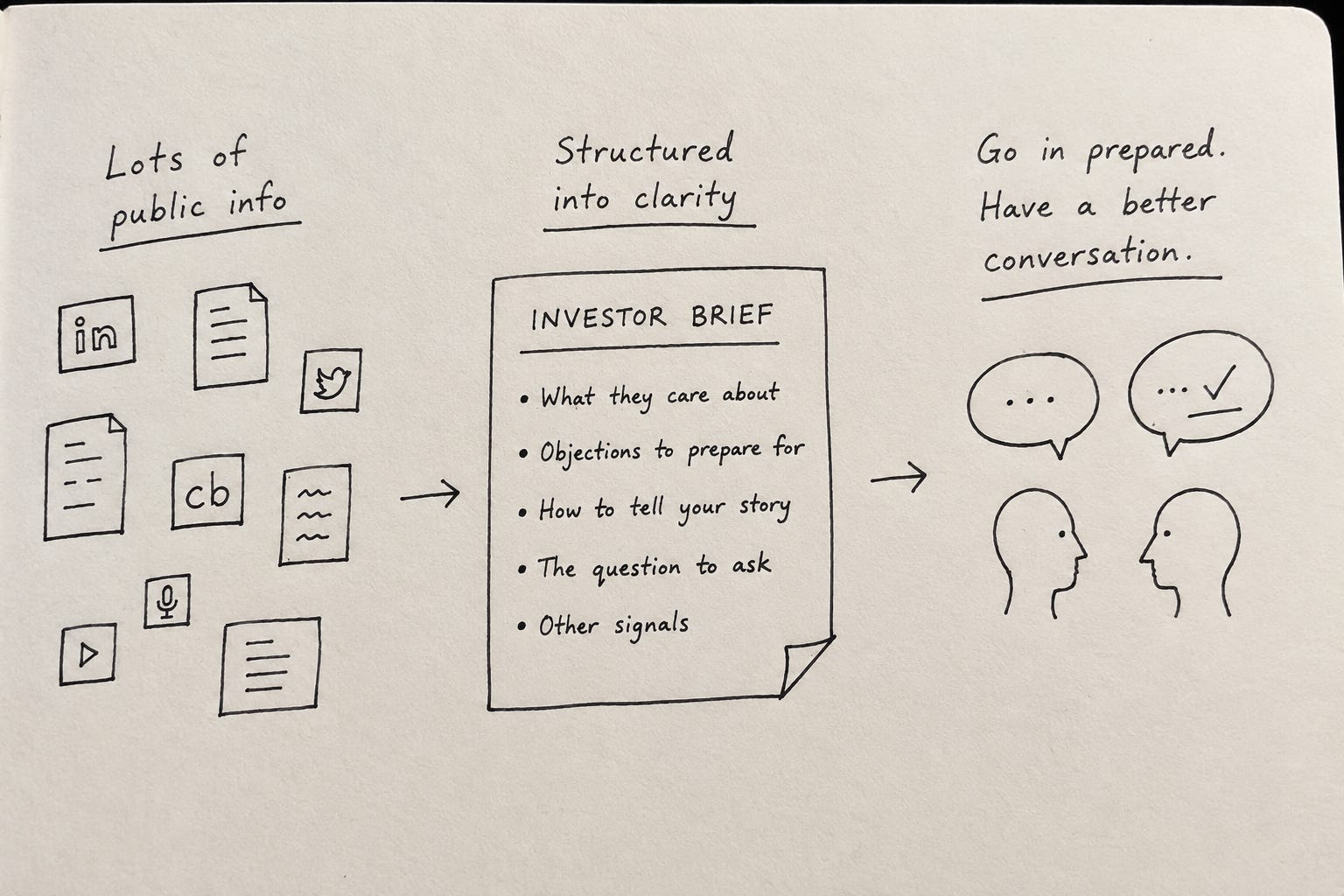
INVESTOR BRIEF: [Partner Name] · [Fund Name] Meeting: [Date + Time]
Fund snapshot
Early stage B2B infrastructure, £1–3M lead checks at Seed
Thesis: workflow automation with a PLG wedge into SMB, expanding to Enterprise
Current conviction: AI native ops tooling, vertical SaaS with negative churn signals
Co-investors: Balderton, Notion Capital, Crane (repeated pattern)
Partner profile Former operator - scaled engineering at two Series B companies before investing in 2019. No analyst background. Thinks in product and GTM. Has publicly stated he doesn’t read decks before first meetings.
What they’ve said about your category “The problem with [category] companies is they all describe the same workflow problem and none of them can explain why they survive the first enterprise procurement cycle.” — B2B SaaS podcast, 2024.
Objections to prepare for
API concentration risk - they’ve publicly raised this for similar businesses
Land and expand proof at SMB layer - no cohort data shared yet
Enterprise procurement cycle - their failed portfolio company hit exactly this wall
Why this team over others - stated priority on unfair access or insight
Valuation vs. traction - round size relative to current ARR is above their typical entry
Portfolio watch One write-off in 2022 in adjacent space - product had similar API dependency. Worth acknowledging early.
How to tell your story today
Lead with negative churn number, not growth rate - he cares about retention signals
Acknowledge API dependency first, show you’ve stress tested the mitigation
Do not open with TAM - he’s stated publicly this is a signal of weak thinking
The question to ask them “You backed [Portfolio Company] in this space in 2021 - what did you learn from that, and how does it shape what you’d need to see from a company like ours?”
That output is generated from public information. No insider access. No warm introduction required. Just the right prompts, run in the right order.
Here’s how to build it.
Prompt 1: Build the fund profile
The first step establishes the base layer - who the fund is, what they actually back, and where their current conviction is concentrated.
🟫 PROMPT 1 OF 6 - Fund profile
You are a research analyst preparing an investor briefing for a founder meeting.

Research the VC fund: [FUND NAME]

Using all publicly available sources — their website, portfolio pages, partner blogs, media interviews, and recent news — produce a structured fund profile covering:

1. INVESTMENT THESIS
- What sectors and business models do they focus on?
- What stage do they typically lead (seed, Series A, B)?
- Typical check size and portfolio company count
- Any stated or demonstrated thesis evolution in the last 12–24 months

2. CONVICTION ZONES (RIGHT NOW)
- Based on recent investments and public statements, where is this fund leaning in currently?
- Any sectors or models they appear to be pulling back from?

3. PORTFOLIO PATTERNS
- What do their portfolio companies have in common beyond sector?
- GTM motion patterns, team backgrounds, business model preferences
- Notable exits or write-offs and what they suggest about thesis fit

4. CO-INVESTOR PREFERENCES
- Which other funds do they typically co-invest with?
- Do they lead, follow, or both?

Output as a structured briefing section titled "Fund Profile: [FUND NAME]"
Keep it factual and sourced where possible. Flag any gaps in available information.
Run this first. The output becomes the foundation everything else is built on. The key is asking Claude to go beyond the fund website - the portfolio pattern analysis and the thesis evolution question often surface things that aren’t written anywhere.
Prompt 2: Research the specific partner
The fund profile tells you the institution. This prompt tells you the person.
Most deals live and die based on the specific partner’s conviction - not the fund’s general thesis. You need to know how this person thinks, where their pattern recognition comes from, and what they publicly believe about your market.
🟫 PROMPT 2 OF 6 - Partner profile
Now research the specific partner you'll be meeting: [PARTNER NAME] at [FUND NAME]

Build a partner profile covering:

1. BACKGROUND
- Career history before this fund (operator? investor? analyst track?)
- Domain expertise and where it's deepest
- Any companies they founded or led

2. INVESTMENT TRACK RECORD (at this fund)
- Their named portfolio companies or led deals
- How long have they been at this fund?
- Any pattern in the types of companies they personally champion?

3. PUBLIC POSITIONS
- Podcasts, interviews, published essays, Twitter/LinkedIn threads
- What have they said on record about: founder qualities they back, sectors they're excited or sceptical about, how they think about early stage valuation, what makes a pitch land vs. not?
- Any direct statements about [YOUR CATEGORY OR SECTOR]?

4. COMMUNICATION STYLE
- Based on interviews and writing: are they direct or exploratory? Do they probe or listen first? Operator intuitive or data first?

Output as "Partner Profile: [PARTNER NAME]"
Be specific about sources and dates where possible. Note anything that seems to have shifted over time.
This is where the prep work most founders skip gets done. A founder who walks in knowing what this specific partner said on a podcast eight months ago about API dependency risk is not the same as a founder who looked at the fund website.
Keep reading with a 7 day free trial
Subscribe to The Founders Corner to keep reading this post and get 7 days of free access to the full post archives.
What’s behind the paywall:
✅ Prompt 3: The objection map - takes everything gathered so far and generates the five most likely objections this specific investor will raise based on their stated positions. Not generic VC objections. Personalised to this room.
✅ Prompt 4: Portfolio overlap analysis - examines the fund’s portfolio for companies that may be seen as competitive or adjacent to yours. Tells you what to prepare for and how to frame your differentiation before anyone asks.
✅ Prompt 5: The framing brief - synthesises all prior research into a single recommendation: how to tell your story to this investor specifically. What angle to lead with, what to hold back, and what to address unprompted.
✅ Prompt 6: The one page briefing document - the final assembly prompt. Structured output you read the night before every meeting. Five minutes. Replaces two hours of manual research.
✅ The complete target list workflow - how to adapt this agent to run across your full investor list and produce a comparable briefing for every meeting in your pipeline, not just the ones you already know are important.
✅ Instant access to 50+ other tools and walkthroughs we’ve already built: outreach sequences, term sheet explainers, data room checklists, follow-up frameworks, covering the entire fundraising process from first contact to close.
Prompt 3: The objection map
This is the highest value step in the sequence.