

I have backed founders who pivoted too early and lost the thing that was actually working.
I have backed founders who pivoted too late and burned the last of their runway trying to save something that could not be saved.
Both mistakes cost the same amount of money. Both come from the same missing piece. Neither founder had a system for reading the signal underneath the noise.
Persistence and stubbornness look identical from the outside. So do agility and panic. The only thing that separates them is information. Most founders are making the biggest strategic call of their company’s life with almost none of it.
![I restored in HD 4k the original "Spider-Man Pointing at Spider-Man" Template - (aka spiderman confusion meme) - [4096*3072] : r/MemeRestoration](https://substackcdn.com/image/fetch/$s_!XMKp!,f_auto,q_auto:good,fl_progressive:steep/https%3A%2F%2Fsubstack-post-media.s3.amazonaws.com%2Fpublic%2Fimages%2F5a1f95a8-fda4-4736-b82f-c62766e9b379_4096x3072.jpeg "I restored in HD 4k the original \"Spider-Man Pointing at Spider-Man\" Template - (aka spiderman confusion meme) - [4096*3072] : r/MemeRestoration")
How founders decide whether to pivot or persist in 2026. The framework I use with portfolio companies to separate a direction that needs more time from one that needs to change. Built so you make the call before your runway makes it for you.
What a Pivot Actually Is
Founders use the word “pivot” to mean “we changed direction.” That definition is too broad to be useful. It’s also why most pivots fail. Founders don’t actually know what they’re doing when they do it.
Here’s the precise version. A pivot is a structured course correction that keeps your core insight intact while changing something material about how you’re pursuing it. The core insight is the thing you learned about your market that you believe is true and defensible. The change is the customer segment, the channel, the business model, or occasionally the product itself.
A pivot is not a restart. A founder who throws out everything they’ve learned and begins again hasn’t pivoted. They’ve started a new company with less money than they had the first time. That’s sometimes the right call. It is never a pivot.
This distinction is not academic. It’s the difference between a company that compounds its learning and one that resets to zero every time things get hard.
Slack was built on the insight that persistent, searchable team communication unlocks something fundamental about how knowledge workers collaborate. The original product was a game. Every visible piece of it changed. The insight never moved.
Instagram began as Burbn, a check-in app with photo sharing bolted on as an afterthought. The founders kept one thing: mobile photo sharing had something real inside it. They stripped away everything else the app was trying to be.
YouTube started as a video dating site. The insight, that people wanted an easy way to share video, survived. The dating site did not.
In every one of these, the founders could tell you exactly what they were keeping before they touched anything else. That is the discipline almost every founder skips. They start rearranging the furniture before they’ve decided which walls are load-bearing.
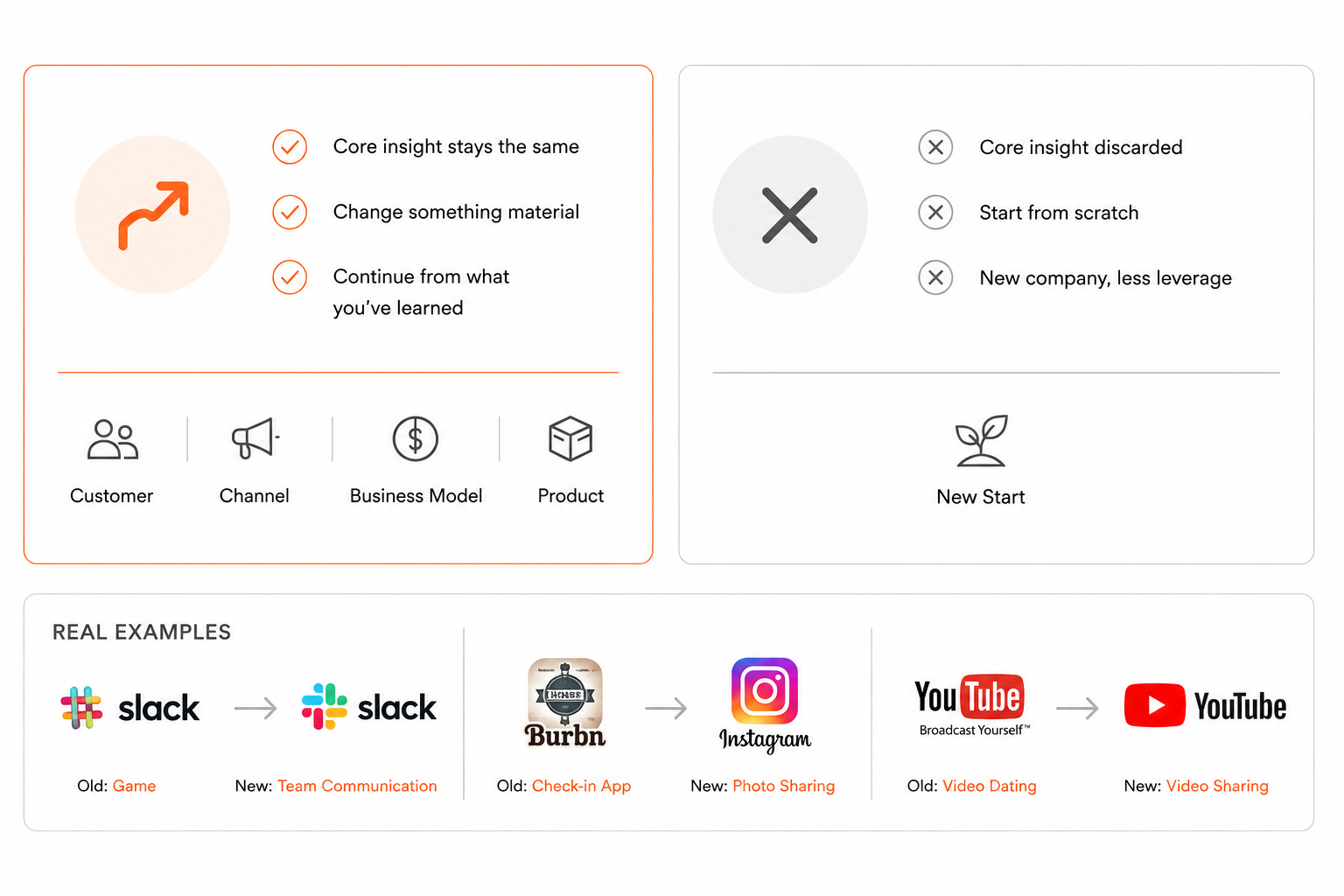
The one-line test: a pivot keeps the core insight and changes the customer, channel, business model, or product. A restart discards everything. Slack, Instagram, and YouTube all pivoted. Not one of them started over.
What the Data Actually Says
Founders treat “we might have to pivot” like an admission of failure. The data says the opposite.
CB Insights’ failure data shows 35% of startups die because there was no real market need. Translation: they built something the market didn’t want, and kept building it until the money ran out. Another 19% fail from running out of cash outright. A meaningful chunk of those are the same failure, measured at a later stage. A wrong direction that was never corrected.
Startup Genome tracked this across more than 3,000 companies. Startups that pivot once or twice raise 2.5x more money. They grow their user base 3.6x faster. They’re 52% less likely to scale prematurely than companies that never pivot, or that pivot more than twice.
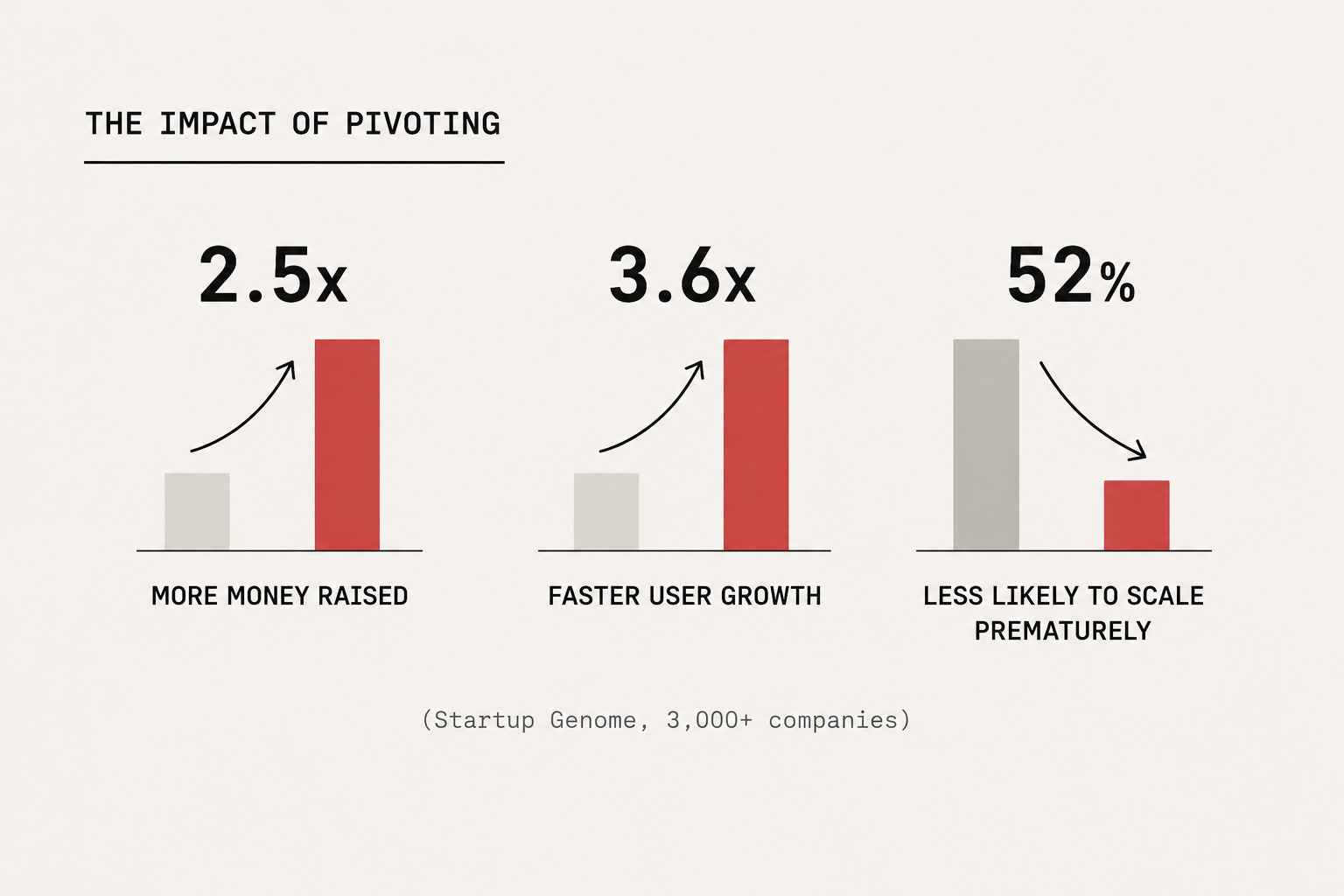
The sweet spot isn’t zero pivots. It’s exactly one, made deliberately, made on time.
First Round Capital’s internal portfolio analysis found that their highest-return companies almost always went through a real, meaningful direction change in their first 24 months. The exceptions were the rare handful that nailed product-market fit on the first attempt. Everyone else either pivoted well, or never found fit at all and quietly disappeared from the portfolio.
Read that again. The pivot is not the risk. Not having a system to know when you’re in one is the risk.
The Four Signals That Actually Mean Something

Not every piece of bad news is a pivot signal. A channel that isn’t converting. A customer segment that’s harder to reach than expected. A quarter where the team underperformed. These have tactical fixes. They do not require you to blow up your strategy.
The signals that actually matter are different in kind, not just in degree. I look for four of them. I’ve never seen a company that needed to pivot that wasn’t showing at least two.
Signal one: your best customers are not the customers you built for. This happens constantly. Founders miss it because they’re staring at the ICP slide instead of the renewal data. The customers who renew without being chased, expand without being upsold, and refer without being asked, look nothing like the persona in your deck. When this happens, the market has already told you where the value is. The only question left is whether you keep fighting to convince the wrong customer, or go build for the one who already gets it.
Signal two: the problem is real, but the solution is wrong. This is not the same as a bad product. A bad product can be iterated into a good one. A wrong solution approaches a real problem from a direction the customer structurally cannot adopt, because of how their team works, where their budget sits, or how the decision actually gets made inside their org. No amount of product polish fixes a wrong solution. Only a structural rethink does. Most teams spend six months polishing before they realize this.
Signal three: you’re winning deals you can’t explain, and losing deals you can’t explain either. This is the most dangerous signal on this list. It disguises itself as momentum. Revenue is coming in. The pipeline looks fine on a dashboard. But underneath it, there’s no pattern. Your wins share no common thread. Your losses share no common thread. That means you don’t have a repeatable motion. Which means you can’t scale what you have. Which means the “growth” is founder hustle wearing a machine’s clothing.
Signal four, and the one I watch teams miss most often: your NPS is high, but referrals are zero. A customer who gives you a nine and never mentions you to a single peer isn’t advocating for you. They’re satisfied enough not to complain. That’s a completely different emotional state from being transformed enough to evangelize. When satisfaction is high and word-of-mouth is flat, it almost always means you’re solving a real problem, just not the most painful version of it. Somewhere adjacent to what you built is the version that turns customers into your sales team. Finding it is a design question. It is not a sales problem, and no amount of SDR headcount will fix it.
What Most Founders Do Instead
When these four signals show up, the instinctive founder move is to add. More features. More channels. More reps. More spend.
The logic underneath it always sounds reasonable. Not enough people are seeing this yet. Or the product just needs one more capability to tip the reluctant buyer.
This logic kills companies more reliably than almost any other single decision I’ve watched founders make.
I had a portfolio company that was flat for three straight quarters. MRR wasn’t falling. It also wasn’t moving. The team’s answer was to hire two more salespeople. Six months and two hiring cycles later, MRR was still flat and burn was materially worse.
When we finally sat down and ran the diagnostic, it took about an hour to find the pattern. Every customer who was staying and expanding sat in one specific vertical the team had never consciously targeted. Nobody had noticed, because nobody had looked. The two new reps were pointed at the wrong market entirely. The sales motion was never the problem. The direction was.
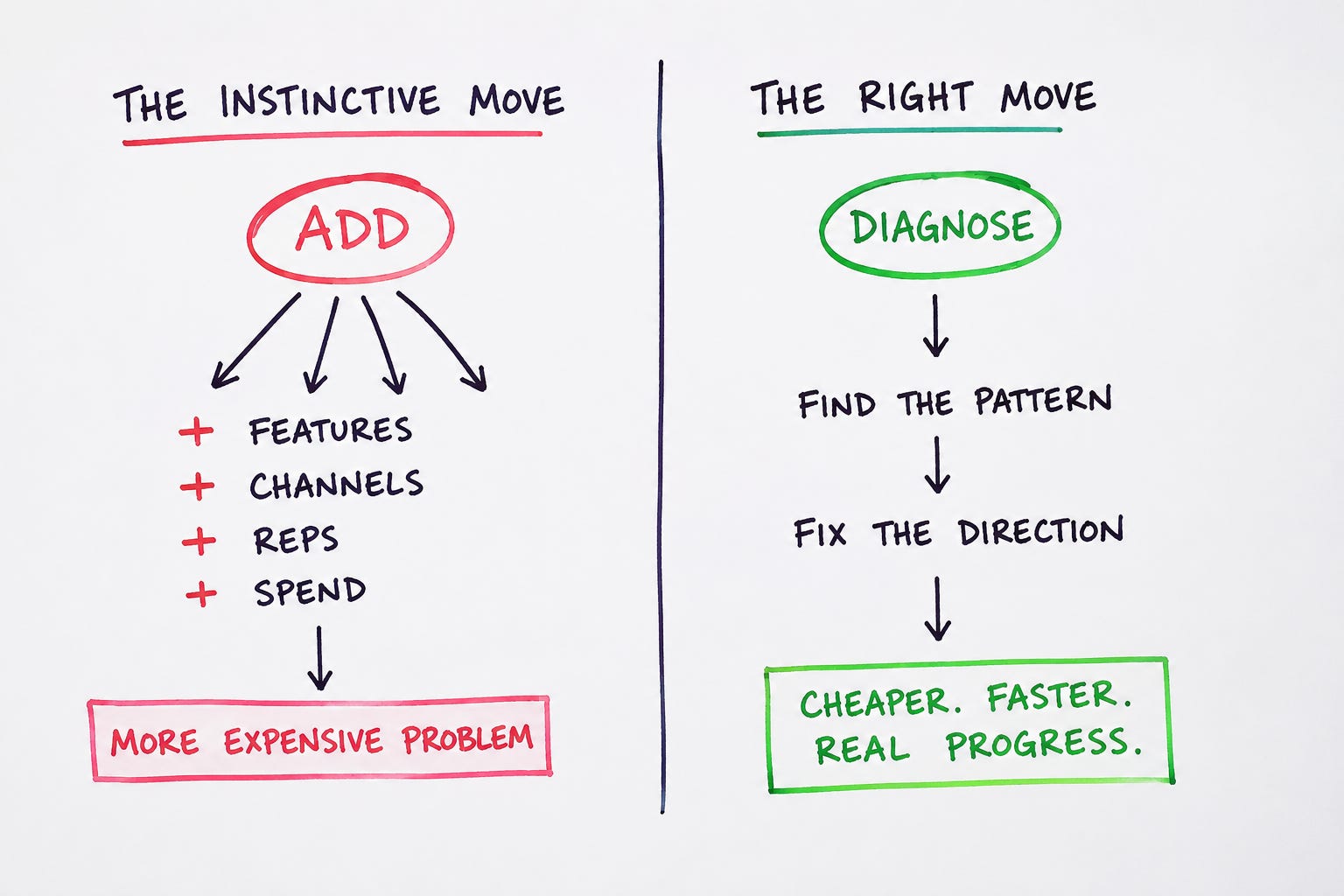
Adding effort to a broken direction doesn’t fix the direction. It makes the direction more expensive to keep running and harder to walk away from later. By the time cash forces the decision instead of judgment, the founder has less time, less money, and a smaller team than they’d have had if they’d moved six months earlier.
I can usually see this coming before the founder can. The tell is always the same. It’s when a founder spends more energy explaining why the signals are wrong than actually examining what the signals mean. That inversion, defending the direction instead of interrogating it, almost always means the decision has already been made somewhere below the surface. It just hasn’t been said out loud yet.
The Cost of Getting the Timing Wrong in Either Direction
Pivoting too late is the more common failure. Pivoting too early is just as expensive, and it gets talked about far less because it doesn’t look like a clean failure from the outside.
It looks like a company permanently in transition. Always testing the next thing. Never building enough momentum in any one direction to actually know if it’s working.
The tell that you’re pivoting too early: you haven’t talked to enough customers to actually know why the current direction is underperforming. A founder who’s had twenty serious customer conversations and heard the same objection fourteen times has data. A founder who’s had five conversations and heard a mixed bag of feedback has noise, and is about to make an expensive decision based on it.
The threshold I use before a pivot is even on the table: ten to fifteen substantive customer conversations, with people in your actual target segment, conducted by the founder directly, in the last sixty days. Not surveys. Not an NPS number. Real conversations where you asked specifically about the problem, their current workaround, and what would have to be true for them to switch. If that work hasn’t been done, the issue isn’t your direction. The issue is you don’t yet have enough information to evaluate it.
The founders who nail the timing separate two decisions that most people collapse into one. The first is strategic: is the current direction actually not working, and does something material need to change. The second is design: what specifically changes, and what specifically stays.
Most founders skip straight to the second question before they’ve honestly answered the first. That’s exactly how you end up either delaying a decision you already know you need to make, or rushing a redesign because the runway has become the thing forcing your hand.
A few more worth reading:
→ The Claude Guide Every Founder Should Run Before Fundraising - the 9 prompts that replicate how modern VC firms screen your deck before a partner ever opens it
→ How to Build Your Fundraising Narrative with Claude - the prompt playbook for crafting, sharpening, and stress-testing your story before you walk into a room with a VC
→ The Number That Kills More Fundraises Than Any Bad Idea - why your market size slide is either your strongest asset or the quiet reason you’re not getting a second meeting
→ The Investors Who Actually Write Cheques In 2026 - inside the layer of capital that doesn’t call itself venture, and how to find the ones who’ll actually fund your new direction
🔒 The Pivot Playbook
Part 1: The Verdict Test. Four questions. One table at the end. It tells you, in black and white, whether you’re looking at an execution problem, a direction problem, or a genuinely ambiguous signal that needs the six-week test in Part 4. No more guessing which one you’re actually in.
Part 2: The Redesign Map. The three real pivot types, mapped directly against your Part 1 answers. Fill-in sections for exactly what you keep, exactly what you change, and the success criteria you set before you start. So you’re not quietly moving the goalposts three weeks in to make the new direction look like it’s working.
Part 3: The Trust Playbook. The exact framing for the three conversations that make or break a pivot. Your team. Your investors. Your existing customers. Each one built to create confidence in the decision, not panic about it.
Part 4: The Six-Week Verdict. A week-by-week tracker that tells you whether the new direction is actually working, before you’ve bet the whole company on it. Built so you find out in six weeks. Not six months.
This is what a premium subscription to The Founders Corner gets you every week. Fifty-plus tools you open, run once for real, and walk away from with a decision made, not a framework you screenshot and forget about.
Start your free 7-day trial → Cancel anytime. All four parts unlocked immediately.